Ripple Calls XRPL Permissioned Domains A ‘Gamechanger’ As Go-Live Nears

bitcoinistPublicado em 2026-01-14Última atualização em 2026-01-14

Resumo

RippleX announces that the XRP Ledger's "Permissioned Domains" amendment is nearing activation, requiring an 80% validator consensus. Currently at 76.47%, this feature introduces institutional-grade access controls on the public blockchain, enabling regulated entities to use permissioned trading and lending protocols without private infrastructure. It paves the way for a Permissioned DEX, limiting market interactions to approved participants, and supports future applications like on-chain foreign exchange and lending. The community highlights the need for more stablecoins and real-world assets to boost liquidity. XRP price is noted at $2.15.

Ripple’s developer arm RippleX says the XRP Ledger’s “Permissioned Domains” amendment is nearing its activation threshold, positioning the network to roll out institution-friendly access controls that could underpin a permissioned version of XRPL’s native decentralized exchange.

In a series of posts on X late Tuesday, RippleX framed Permissioned Domains as a “gamechanger” enabling layer for “permissioned flows” on a public blockchain, an approach aimed squarely at regulated firms that want on-chain settlement and trading without adopting fully private infrastructure.

Ripple’s Next ‘Gamechanger’ For The XPR Ledger

Via X, RippleX said: “The amendment for Permissioned Domains is nearing the threshold for activation.Ripple supports this feature, as well as the Permissioned DEX which this will ultimately enable. “

Under XRPL’s governance process, amendments become active after maintaining a 80% validator supermajority for a sustained period. According to xrpl.org, the PermissionedDEX is currently open for voting and has reached 50.00% thus far, while the PermissionedDomains amendment stands at 76.47%.

RippleX describes the feature as a “game-changer for XRPL because they bring institutional-grade controls to a public network, without sacrificing the trade-offs of a private chain.”

The company further writes: “While the Permissioned Domains amendment is an enabling feature, it sets the stage for financial institutions to engage in permissioned flows on a fast, scalable, and resilient blockchain network, the XRPL. The Permissioned DEX will enable permissioned trading flows, and the upcoming lending protocol may apply Permissioned Domains for controlled lending and borrowing flows.”

On XRPL’s documentation, permissioned domains are described as controlled environments that “do nothing on their own,” but can be used by higher-level features, such as permissioned DEX functionality and lending protocols,to restrict and manage access for compliance-driven deployments. Permissioned DEXes are the practical endpoint: regulated entities participating in XRPL’s native order books while enforcing who can interact with specific markets.

“Traditionally, any XRPL DEX offer can be matched by anyone. A permissioned DEX changes that,” Ripple wrote, describing permissioned trading as rules-based matching limited to approved participants.

RippleX also points to adjacent roadmap items, including an upcoming lending protocol that could apply the same domain-based controls to borrowing and lending flows, suggesting the design pattern is intended to extend beyond trading into broader onchain finance primitives.

The announcement drew immediate interest from XRP community voices. Popular community member Krippenreiter highlighted “on-chain FX” as a headline application, while Anodos Finance CEO Panos Mekras responded that “the only thing left is to bring the actual assets and liquidity to flow.” Krippenreiter agreed, calling for “more stablecoins, RWAs, and more market making.”

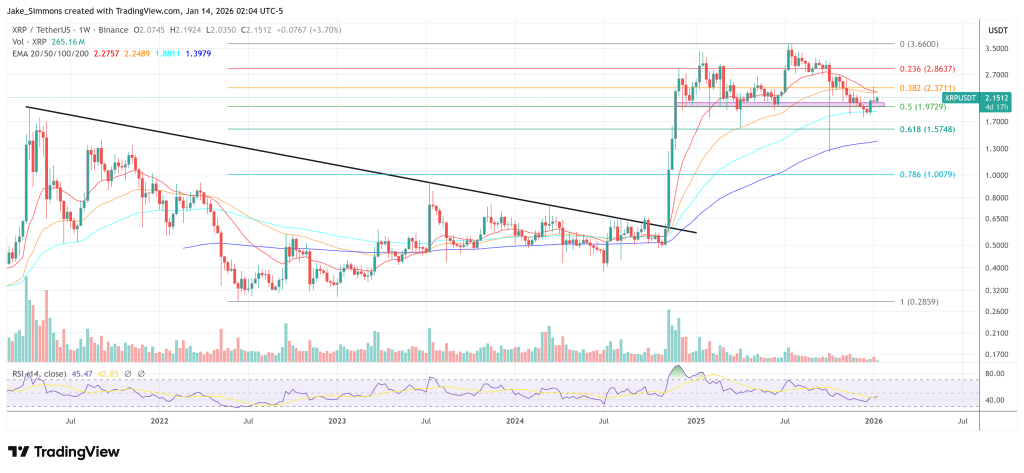
At press time, XRP traded at $2.15.

XRP needs to reclaim the 0.382 Fib, 1-week chart | Source: XRPUSDT on TradingView.com

Perguntas relacionadas

QWhat is the 'Permissioned Domains' amendment on the XRP Ledger and why is it significant?

AThe 'Permissioned Domains' amendment is an enabling feature that introduces institution-grade access controls to the public XRP Ledger network. It is significant because it allows for 'permissioned flows' on a public blockchain, enabling regulated firms to use on-chain settlement and trading without having to adopt fully private infrastructure, thus combining the benefits of a public network with the controls of a private chain.

QWhat is the governance process for activating an amendment on the XRPL, and what is the current status of the PermissionedDomains vote?

AUnder XRPL's governance process, an amendment becomes active after it maintains an 80% validator supermajority for a sustained period. At the time of the article, the PermissionedDomains amendment had reached 76.47% of the vote.

QHow does a Permissioned DEX differ from the traditional XRPL DEX?

ATraditionally, any offer on the XRPL DEX can be matched by any participant. A Permissioned DEX changes this by enabling rules-based matching that is limited to only approved, vetted participants, which is crucial for compliance-driven deployments by regulated entities.

QBeyond trading, what other potential use cases for Permissioned Domains does RippleX mention?

ARippleX mentions that the upcoming lending protocol could apply the same Permissioned Domains feature to control borrowing and lending flows, suggesting the design pattern is intended to extend into broader on-chain finance primitives beyond just trading.

QWhat was the price of XRP at the time the article was published?

AAt press time, the price of XRP was $2.15.

Leituras Relacionadas

Agent Race Ends, Super Workbench Takes Over

The era of fragmented AI agents is ending. Over the past month, China's tech giants—Tencent, Alibaba, and ByteDance—have simultaneously shifted strategy: instead of launching new, standalone AI agents, they are consolidating their various agent projects into unified "super workbenches." Tencent integrated its QClaw teams into WorkBuddy, a strategic product hailed as a potential third flagship after QQ and WeChat. Alibaba is merging its QoderWork, Wukong, and MuleRun agents into a new "Qianwen Office" platform under DingTalk's leadership. ByteDance rebranded its TRAE SOLO coding agent to TRAE Work, signaling a broader focus on workflow collaboration. This convergence marks a pivotal industry consensus. The initial exploration phase, where companies rapidly built numerous overlapping agents for different scenarios, proved costly and inefficient. With open-source tools eroding technical barriers, competition has shifted from agent creation to resource consolidation and cost control. Historically, platform wars are won not by creating more products, but by simplifying them—as seen with browsers unifying web access and super-apps consolidating services. Now, the "super workbench" aims to become the unified AI entry point for work. This reflects a deeper market realization: the primary audience for AI is no longer just programmers (a market in the tens of millions) but all knowledge workers (a market of billions). The real opportunity lies in augmenting everyday tasks—managing emails, documents, data, and meetings—across the entire workday. The core battleground is becoming control over the primary AI entry point that employees use daily. Tencent's WorkBuddy leverages WeChat and Tencent Docs; Alibaba's Qianwen Office taps into DingTalk's organizational data; ByteDance's TRAE Work integrates with Feishu's workflows. Whoever owns this "super workbench" gains strategic control over orchestrating enterprise data and APIs. This shift is redefining enterprise software. Traditional SaaS applications, valued for their user interfaces, will recede into the background. Their core functionalities will be exposed as standardized "Skills" or APIs for the super workbench's agents to invoke. Software value will shift from selling user seats to charging based on API calls and outcomes delivered. The evolution of agents is moving through clear stages: first as novel standalone products, then as consolidated primary work entry points, and finally as pervasive, invisible capabilities embedded into the digital fabric. The recent moves by major tech firms signal the transition from the first stage into the second, accelerating toward the third. In the end, the most successful agent technology may become invisible—like electricity or the HTTP protocol—a fundamental, unnamed infrastructure powering work itself.

marsbitHá 5m

Agent Race Ends, Super Workbench Takes Over

marsbitHá 5m

Michael Saylor: 110 Reasons to Oppose BIP-110

Michael Saylor presents 110 arguments against Bitcoin Improvement Proposal (BIP) 110, a soft fork aimed at restricting certain non-monetary data storage uses (like inscriptions) on the Bitcoin blockchain. He acknowledges the proponents' valid concerns—such as node costs, fee pressure, and preserving Bitcoin's monetary focus—but fundamentally disagrees with the proposed solution. Saylor argues that BIP 110 represents a dangerous precedent of using consensus rules to enforce value judgments on transaction validity, moving away from Bitcoin's core principles of neutrality and permissionless innovation. His key objections are organized into eleven categories: 1) It violates neutrality and hard consensus by banning currently valid transactions. 2) It fails to meet the high burden of proof required for a consensus change, lacking concrete data on the alleged crisis. 3) Its seven bundled technical restrictions are overly broad, targeting generic script functionalities and blocking future upgrade paths. 4) It sacrifices compatibility and future optionality by closing off designed upgrade hooks. 5) Its temporary rules add significant complexity (grandfathering, expiry states) without sufficient justification. 6) The economic and security impacts, particularly on miner revenue and fee markets, are uncertain and unmodeled. 7) Superior, market-based tools (fee markets, relay/mining policies) already exist to manage blockchain load. 8) It stifles innovation by creating a chilling effect for developers. 9) Its modified activation mechanism (55% threshold, forced signaling) is aggressive and risks network splits. 10) The precedent it sets—using consensus to suppress disliked but legal uses—is more dangerous than the problem it aims to solve. 11) A better path exists: improving measurements, refining resource-based policies, and allowing market forces to work. Saylor concludes that Bitcoin's strength lies in its neutral rules, open markets, and hard consensus. Changing these foundational elements to target specific use cases is an unnecessary and risky "iatrogenic" intervention. He advocates for guarding Bitcoin's neutrality rather than acting as its redeemer.

marsbitHá 20m

Michael Saylor: 110 Reasons to Oppose BIP-110

marsbitHá 20m

Trading

Spot
活动图片