Revealed: The "Super Small Shop" with Daily Revenue Over Ten Thousand? How NewOne Robot is Reconstructing the Coffee and Tea Beverage Business

marsbitPublicado em 2026-05-16Última atualização em 2026-05-16

Resumo

"New One Coffee," China's first robot-operated coffee and tea beverage shop, opened in Beijing, showcasing a highly automated "one person, one robot, one shop" model. This concept, powered by the fully integrated 'Robot in store' system, aims for ultimate staff efficiency, requiring only one employee per location. The store combines coffee, tea, and bakery items to drive all-day sales, overcoming the typical morning-only or afternoon-only traffic peaks of traditional cafes or tea shops. The business model focuses on super-compact stores (around 10 square meters) to minimize rental costs. Its robotic system, capable of handling numerous SKUs, uses big data for rapid, data-driven product development and selection. Furthermore, the automation frees up staff to focus on customer relationship and private community building. Targeting rapid national expansion, New One is offering a special rapid ROI partnership policy for its first 20 partners. This policy significantly lowers the initial investment barrier by waiving various traditional franchise fees, promising a lighter asset model and faster break-even period, supported by claimed high daily revenue potential.

One person and one set of robot integrated equipment can support a combined coffee and milk tea shop with daily revenue over ten thousand. This signifies that with collaborative robots and even humanoid robots entering the consumer sector, highly automated commercial terminals have become an industry norm within reach.
Are you still troubled by the high labor costs and difficult-to-standardize quality control in coffee shops?

Are you worried that your milk tea shop only has business in the afternoon, leaving the morning rent wasted?

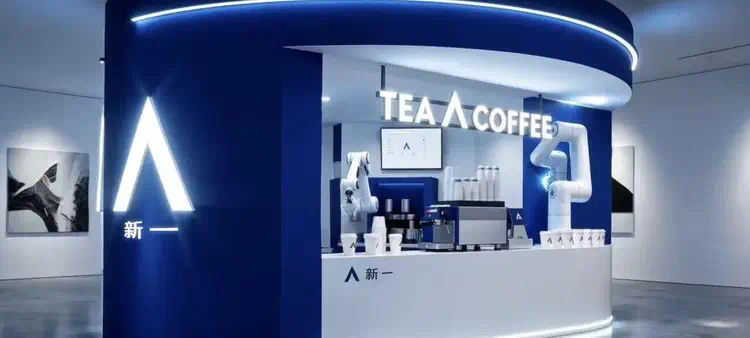
Recently, the first robot coffee and milk tea combined store – NewOne Coffee – officially opened in Beijing's China World Center. With an impressive performance record, this shop offers a brand new solution for all small and micro entrepreneurs wanting to enter the tea and coffee market.

1

Aiming for Ultimate Human Efficiency:

Validating the "One Person, One Machine, One Store" Business Model

In today's climate of rising labor costs, traditional coffee shops often require at least 3-4 staff members on rotating shifts. NewOne Coffee boldly introduced the market's extremely rare "one person, one machine, one store" model.

What does this mean?

Each store only needs 1 staff member equipped with 1 self-developed robot application system.

This system is not a simple automatic tea maker, but a full-process smart integrated system called Robot in store, developed by the "Machine Stroll" team with over 85% experience from the internet industry. This system integrates robotic arms, coffee machines, milk tea machines, ice makers, cup dispensers, labeling machines, and other equipment. From ordering and payment processing to production, and even data analysis and marketing promotion, everything operates automatically.

What's the result? Data shows that on the opening day, some NewOne Coffee stores achieved a turnover close to 20,000 yuan, directly covering the entire month's rent, and this was accomplished without even launching delivery services.

2

The Super Smart Small Shop That Only Needs 10+ Square Meters

For investors struggling to find large storefronts, NewOne Coffee's site selection logic is highly attractive. Their site selection team primarily focuses on ultra-small shops around 10+ square meters, preferring areas like office buildings, street-side communities, and comprehensive commercial complexes. Besides Robot in store (Smart Store), NewOne Coffee also offers Robot in box (Unmanned Coffee Robot) and Robot in car (Trendy Street Food Truck) formats, featuring functional differentiation, full scenario coverage, and meeting the needs of different entrepreneurs and locations.
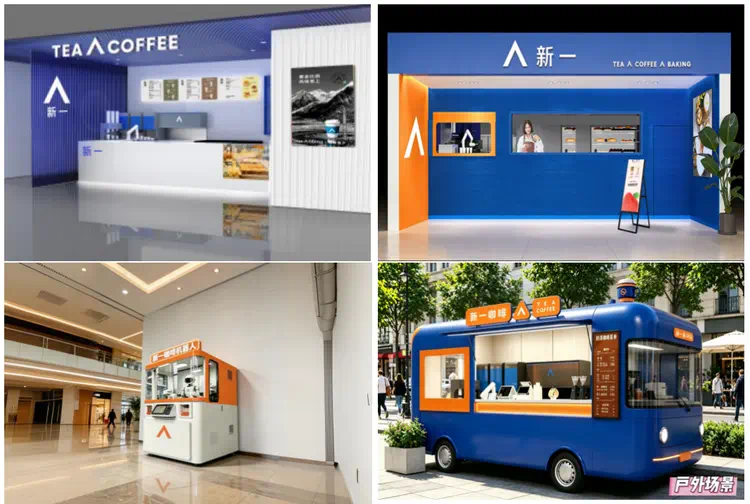
"As long as it can fit a set of robot systems, that's enough. We want to create the most ultimate small shop."

The extremely small area means extremely low rental pressure. Coupled with the high human efficiency of "human-machine collaboration," the store's risk resistance is greatly enhanced. In the previous trial operation shop in Wangjing, even facing away from the main road and being sandwiched by well-known major brands nearby, NewOne Coffee still achieved the excellent result of covering two days' rent with revenue.

3

A Hybrid Approach:

Make Your Store Earn Money from Morning to Night

Many coffee shop owners share a pain point: business concentrates in the morning. Meanwhile, milk tea shops and coffee shops do better business in the afternoon. NewOne Coffee's solution lies in being "hybrid."

Although its Chinese name is "NewOne Coffee," its English name is TEA^COFFEE^BAKING – with coffee and tea beverage SKUs basically balanced, and the product line combination of coffee + tea beverages + baking covers both breakfast and afternoon tea periods.

"Most coffee shop revenue is generated in the morning, and milk tea shop revenue is generated in the afternoon. We use a hybrid approach to maximize time utilization," the founder of NewOne explained.

This means you're not opening a simple coffee shop, but a super collection store covering all time periods and consumers across all age groups. Whether it's a latte with bread in the early morning or fruit tea in the afternoon, your store can meet the demand.

4

Embracing Big Data, Finding Popular Products from Popular Ones

For partners, the biggest concerns are slow product updates and excessive reliance on staff skills. NewOne Coffee's robot system can handle up to hundreds of SKUs, flexibly meeting different consumer taste preferences.

More noteworthy is its product selection logic. The team employs a big data-driven product selection model, featuring a dynamic global raw material insight system that continuously tracks market conditions and quality data from various producing regions. It uses a non-binding selection model, allowing quick switching to other high-quality regions if problems arise in a specific one. Through AI-powered second-level analysis of global online data, it accurately identifies trending elements. Robots standardize recipe execution, enabling agile development from selection to launch in just two weeks.

"In the past, Jinri Toutiao (Today's Headlines) said, 'What you want to see is the headline.' Here, 'What you want to eat is the signature.'" This means partners don't need to rack their brains developing new products; the system automatically helps filter the next potential hit.

5

Private Domain Accumulation:

Helping You Lock in Thousands of Customers Before Opening

In an era of increasingly expensive traffic, NewOne Coffee leverages its digital capabilities. Before the China World Center store even opened, it had already accumulated thousands of real customers in its private domain.
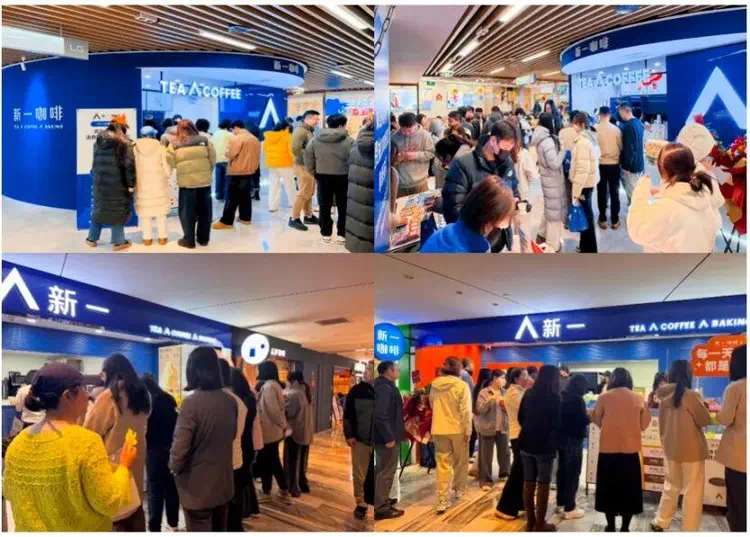
Because the system automates a large amount of order receiving and production work, staff can focus more energy on customer private domain operations. This means once you partner to open a store, you're not facing cold machines or frantic food prep. You only need to focus on one thing – making friends with customers and managing your community well.

"One person, one machine, one store" is the new quality productivity NewOne Coffee brings to the tea and coffee industry. We are looking for city partners who, like us, believe technology can change lives and are willing to embrace the future.

6

Rapid Payback Model, Empowering the First Batch of Joint-venture Entrepreneurs

To rapidly deploy nationwide and support the first batch of high-quality city partners, NewOne Robot has launched a rapid payback joint-venture policy, exclusive to the first 20 joint-venture partner stores, creating a new entrepreneurial model with ultra-low investment and ultra-fast payback in the industry.

Different from the traditional tea and coffee industry's high brand cooperation fees, management fees, training fees, and other multiple charges, this first batch of joint-venture clients can enjoy exclusive benefits with partial cooperation fees fully waived. Partners only need to bear the store security deposit, rent, basic equipment costs, and initial material costs to officially operate the store, with no hidden fees or extra brand premium costs.

This model fundamentally compresses initial investment costs, significantly lowering the entrepreneurial barrier. Traditional tea and coffee shops have high upfront investment and generally long payback periods. Relying on NewOne Coffee's advantages of high human efficiency, all-day profitability, automated operation, plus the exclusive joint-venture policy, partners' upfront investment is halved, cost recovery cycles are greatly shortened. Combined with the store's daily revenue capability of over ten thousand yuan, it truly enables lightweight asset entrepreneurship and rapid payback, thoroughly solving the core pain points of high investment risk and slow payback for small and micro entrepreneurs.

If you wish to own a robot-operated store with low investment cost, high human efficiency, a tech-savvy feel, and all-day profitability, you might want to learn more about NewOne Coffee's partnership policy.

Perguntas relacionadas

QWhat is the core business model innovation of the 'XinYi Coffee' robot store?

AThe core innovation is the 'one person, one machine, one store' model. This means each store operates with just one staff member supported by a fully integrated robotic application system called 'Robot in store,' which automates the entire process from ordering to drink preparation.

QHow does 'XinYi Coffee' address the issue of limited peak business hours common in traditional cafes and tea shops?

AIt employs a composite product strategy. The store offers a balanced mix of coffee, tea drinks, and baked goods. This combination attracts customers throughout the day, covering both morning coffee/breakfast and afternoon tea time, thus maximizing revenue across all business hours.

QWhat is a key advantage of the 'XinYi Coffee' system for franchisees regarding product development and selection?

AThe system uses big data and AI for dynamic product selection. It analyzes global trends and online data to identify popular elements and potential bestsellers. The robotic system can then standardize the execution of these new recipes, allowing for agile product development and updates within approximately two weeks.

QBesides reducing labor costs, what other operational benefit does the automation provide for store staff according to the article?

AAutomation frees up the single staff member from most order-taking and preparation tasks. This allows them to focus their energy on customer relationship management and private community (私域) operations, building loyalty and engaging with customers on a personal level even before the store officially opens.

QWhat is the primary financial incentive offered to the first 20 franchise partners under 'XinYi's' rapid return-on-investment policy?

AThe policy offers an ultra-low entry cost structure. For the first 20 partners, certain franchise fees are waived. Partners are mainly responsible for the store deposit, rent, basic equipment, and initial supplies, with no hidden costs or brand premium charges. This significantly lowers the initial investment and shortens the payback period.

Leituras Relacionadas

How to Define "Real U.S. Stocks": Differences Between On-Chain Tokens, Price Contracts, and Direct Broker Connections

**Title:** Defining "Real US Stocks": Differences Among On-Chain Tokens, Price Contracts, and Broker-Direct Access **Summary:** In 2026, using stablecoins to purchase US stocks is mainstream, but products marketed as "buying US stocks with USDT" offer fundamentally different assets. This article analyzes three primary models. **1. Tokenized Stocks:** These are on-chain tokens representing economic exposure to underlying stocks, held by an issuer or custodian. They offer benefits like 24/7 trading and DeFi composability (e.g., use as loan collateral). However, users lack direct legal shareholder status; dividends may not be paid in cash, and voting rights are typically non-binding advisory expressions. Examples include platforms like Ondo Finance. **2. Stock Futures / Equity Perpetuals:** These are derivative contracts tracking a stock's price, allowing leveraged long/short positions 24/7, similar to crypto perpetuals. They offer high efficiency and flexibility but involve funding fees, which can be a significant long-term cost, especially during strong trends. Crucially, they confer no ownership rights (dividends, voting) to the holder. **3. Broker-Direct Model:** This model provides access to real securities via licensed broker-dealers. Stocks/ETFs are bought and held within the US clearing and custodial system (e.g., DTCC), making it the only path to genuine stock ownership. Users receive cash dividends and formal proxy voting rights (where applicable). It supports thousands of stocks and ETFs, far exceeding the coverage of the other two models. Key advantages include no funding fees, a clean cost structure for long-term holds, and the potential to transfer holdings to other brokers. Some platforms facilitate stablecoin (USDT/USDC) deposits, reducing reliance on traditional banking. A critical distinction exists *within* the broker-direct model: the underlying brokerage architecture (e.g., Fully Disclosed IB, Omnibus IB, Self-Clearing) determines how client assets are held, protected, and how safeguards like SIPC insurance are conveyed. Users should verify the specific clearing structure and regulatory compliance of any platform. In conclusion, "buying US stocks with USDT" can mean holding an on-chain economic proxy (Tokenized Stocks), trading a price derivative (Stock Futures), or owning the actual security (Broker-Direct). For users seeking full ownership rights and long-term investment, the broker-direct model is the definitive choice, though its implementation details require careful scrutiny.

marsbitHá 39m

How to Define "Real U.S. Stocks": Differences Between On-Chain Tokens, Price Contracts, and Direct Broker Connections

marsbitHá 39m

NVIDIA Launches DSX Platform, Expanding into AI Factory Infrastructure

NVIDIA has unveiled the DSX platform at its GTC Taipei event, marking a strategic expansion from GPU sales into comprehensive AI factory infrastructure solutions. The platform addresses challenges like power supply, cooling, and resource orchestration as AI models scale, shifting the industry focus from single-chip performance to overall infrastructure efficiency. DSX integrates NVIDIA's chips, systems, software, and partner technologies to cover the entire AI factory lifecycle—from design and simulation to deployment and operations. It aims to accelerate deployment, improve reliability and operational efficiency, and reduce the cost per generated token in AI inference. The software suite includes DSX MaxLPS, which uses 45°C liquid cooling and rack-level optimization to allow up to 40% more GPUs per megawatt, and DSX OS, an open-source platform for AI factory operations. The platform also encompasses reference designs, digital twin simulation (DSX Sim), dynamic workload adjustment based on grid conditions (DSX Flex), and data exchange between systems. Early adopters include cloud providers like CoreWeave and Lambda. Major hardware partners, including Dell, HPE, Lenovo, and Supermicro, are developing DSX-ready systems. Pilot projects for DSX Flex are underway with energy providers. Strategically, DSX represents NVIDIA's ongoing transition from an AI chip supplier to a full-stack AI infrastructure platform provider, aiming to set industry standards and solidify its market leadership.

marsbitHá 44m

NVIDIA Launches DSX Platform, Expanding into AI Factory Infrastructure

marsbitHá 44m

After Burning Tens of Billions of Dollars in Tokens, Silicon Valley Giants Start Limiting Employee Token Usage

After burning tens of billions of dollars on AI tokens, major Silicon Valley firms are now restricting employee usage. Companies like Microsoft, Uber, and Salesforce, which heavily promoted AI for "efficiency," are facing a cost crisis. The practice of "tokenmaxxing"—pushing employees to maximize AI tool usage—led to wasteful spending on trivial tasks like checking the weather or writing birthday messages, with studies showing significant hidden costs for bug fixes and code rewrites. The core issue is a misalignment between individual productivity gains and actual business value. While employees use AI to automate tasks they dislike, such as writing reports, this often doesn't translate to increased company revenue or improved core business outcomes. For instance, AI-generated code speeds up development but also sees an 800% increase in "code churn" (code being discarded or rewritten). As a result, only 14% of CFOs report seeing a clear, measurable return on AI investments. Firms are now shifting strategies. Microsoft has revoked most internal licenses for Claude Code, while others are implementing monitoring and cost controls. New tools from companies like Harness and CloudZero aim to track AI spending and tie costs to business results. Some AI vendors, like HubSpot, are moving from token-based pricing to charging based on outcomes, such as "resolved conversations" or "leads generated." This represents a necessary correction in the AI adoption cycle. The challenge now is for companies to move beyond using AI merely to speed up old tasks and instead rethink their workflows and business models fundamentally. The future of enterprise AI depends on proving its value, not just its usage.

marsbitHá 1h

After Burning Tens of Billions of Dollars in Tokens, Silicon Valley Giants Start Limiting Employee Token Usage

marsbitHá 1h

Trading

Spot
Futuros

Artigos em Destaque

Como comprar ONE

Bem-vindo à HTX.com!Tornámos a compra de Harmony (ONE) simples e conveniente.Segue o nosso guia passo a passo para iniciar a tua jornada no mundo das criptos.Passo 1: cria a tua conta HTXUtiliza o teu e-mail ou número de telefone para te inscreveres numa conta gratuita na HTX.Desfruta de um processo de inscrição sem complicações e desbloqueia todas as funcionalidades.Obter a minha contaPasso 2: vai para Comprar Cripto e escolhe o teu método de pagamentoCartão de crédito/débito: usa o teu visa ou mastercard para comprar Harmony (ONE) instantaneamente.Saldo: usa os fundos da tua conta HTX para transacionar sem problemas.Terceiros: adicionamos métodos de pagamento populares, como Google Pay e Apple Pay, para aumentar a conveniência.P2P: transaciona diretamente com outros utilizadores na HTX.Mercado de balcão (OTC): oferecemos serviços personalizados e taxas de câmbio competitivas para os traders.Passo 3: armazena teu Harmony (ONE)Depois de comprar o teu Harmony (ONE), armazena-o na tua conta HTX.Alternativamente, podes enviá-lo para outro lugar através de transferência blockchain ou usá-lo para transacionar outras criptomoedas.Passo 4: transaciona Harmony (ONE)Transaciona facilmente Harmony (ONE) no mercado à vista da HTX.Acede simplesmente à tua conta, seleciona o teu par de trading, executa as tuas transações e monitoriza em tempo real.Oferecemos uma experiência de fácil utilização tanto para principiantes como para traders experientes.

293 Visualizações TotaisPublicado em {updateTime}Atualizado em 2025.03.21

Como comprar ONE

Discussões

Bem-vindo à Comunidade HTX. Aqui, pode manter-se informado sobre os mais recentes desenvolvimentos da plataforma e obter acesso a análises profissionais de mercado. As opiniões dos utilizadores sobre o preço de ONE (ONE) são apresentadas abaixo.

活动图片