Resolv exploit triggers USR depeg after $80M uncollateralized mint

ambcryptoPublicado em 2026-03-23Última atualização em 2026-03-23

Resumo

Resolv protocol was exploited due to a private key compromise, leading to an unauthorized mint of approximately $80M in unbacked USR stablecoins. This inflated the total supply by 71M tokens, causing a severe depeg—USR fell 56% to around $0.19. The team paused contracts, burned 9M of the attacker’s tokens, and confirmed that underlying collateral remains intact with only $0.5M in losses from redemptions. Recovery efforts include allowlisted redemptions and tracing illicit tokens. The incident highlights risks from over-reliance on off-chain controls in DeFi minting mechanisms.

Resolv has paused its protocol after a private key compromise enabled a malicious actor to mint approximately $80M in uncollateralized USR. This triggered a sharp depeg and raised concerns about the stablecoin’s integrity.

In an update shared, the team said the attacker gained unauthorized access to its infrastructure and minted new USR tokens without backing. Smart contracts were quickly paused, and around 9M USR held by the attacker has since been burned.

Resolv stated that its underlying collateral was not directly compromised. Also, the only confirmed loss so far is roughly $0.5M in redemptions processed before the pause.

Exploit inflates USR supply rather than draining funds

Unlike typical DeFi exploits that drain protocol funds, the Resolv incident centers on supply inflation.

Before the incident, around 102M USR was in circulation. Following the exploit, an additional ~71M USR was minted without collateral. This effectively diluted the backing of the stablecoin.

This pushed total supply far above the value of the protocol’s assets, altering the relationship between supply and collateral.

The team said the exploit resulted from a compromised private key tied to infrastructure access, rather than a failure of its underlying collateral system.

Design assumptions exposed in minting process

While Resolv attributed the breach to unauthorized access, the incident has drawn attention to how minting authority was structured.

The exploit was made possible because a privileged role could authorize token issuance without sufficient on-chain validation of collateral backing.

This meant that once access was obtained, large amounts of USR could be minted without checks tied to deposited assets.

Such architecture relies on trusted off-chain controls to enforce limits — an assumption that can break down if those controls are compromised.

USR loses peg as market confidence drops

Market reaction to the exploit was swift, with USR losing its dollar peg.

At the time of writing, USR was trading near $0.19, down more than 56% over 24 hours, according to CoinMarketCap data. The sharp decline reflects a repricing of the token as supply expanded beyond its collateral base.
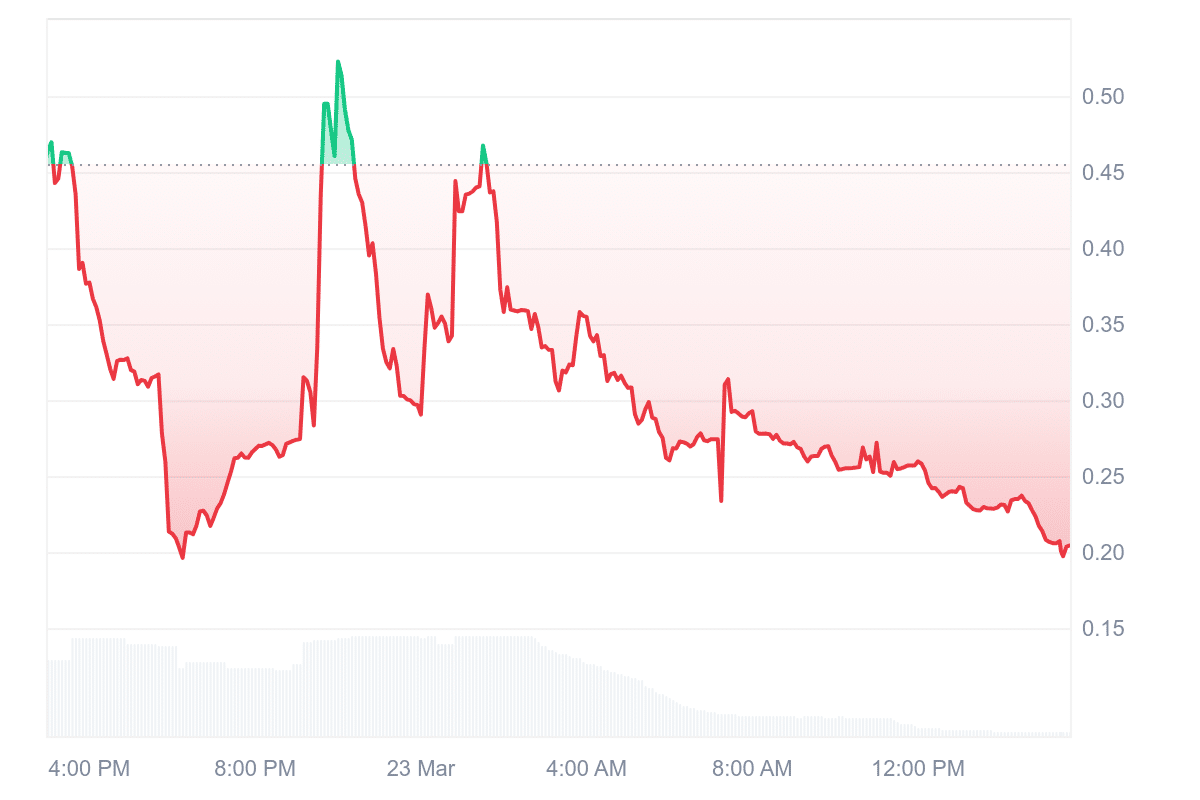
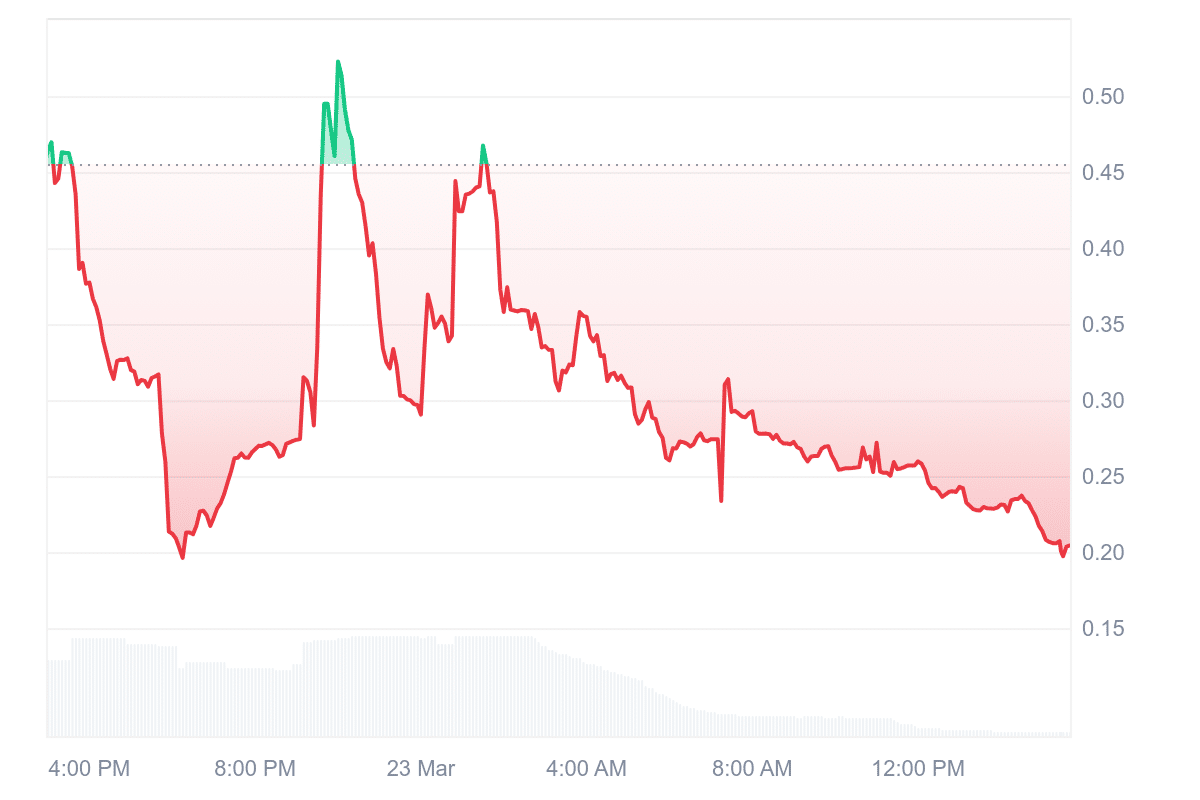
Source: CoinMarketCap

Trading activity has also weakened significantly, with volumes dropping as users exit positions or avoid exposure during the recovery process.

Recovery efforts underway as redemptions planned

Resolv said it is preparing to enable redemptions for pre-incident USR holders, starting with allowlisted users.

The protocol currently holds approximately $141M in assets, and the team is working with partners, analytics firms, and law enforcement to trace and contain illicitly minted tokens.

Users have been advised not to trade USR or related assets during the recovery phase. Post-exploit activity could impact the outcome of the process.

Stablecoin integrity under scrutiny

The incident highlights a broader risk in DeFi systems where critical safeguards depend on off-chain controls rather than enforced on-chain limits.

Although Resolv’s collateral pool remains intact, the ability to mint unbacked tokens has undermined confidence in the system’s accounting.

As the situation unfolds, the key challenge will be restoring trust in USR’s backing and stabilizing its supply.


Final Summary

  • The Resolv exploit inflated USR supply by $80M without draining collateral, exposing risks tied to off-chain control mechanisms.
  • USR’s sharp depeg reflects a loss of market confidence, with recovery now dependent on isolating illicit supply and restoring backing integrity.


Perguntas relacionadas

QWhat was the primary method used by the attacker to exploit the Resolv protocol?

AThe attacker gained unauthorized access to Resolv's infrastructure through a compromised private key, which allowed them to mint approximately $80M in uncollateralized USR tokens.

QHow did the exploit mechanism in this incident differ from a typical DeFi attack?

AUnlike typical DeFi exploits that drain protocol funds, this incident centered on supply inflation by minting new, unbacked tokens rather than stealing existing collateral.

QWhat was the immediate market consequence of the exploit on the USR stablecoin?

AThe USR stablecoin lost its dollar peg, trading near $0.19 at the time of writing, which represents a decline of more than 56% over 24 hours.

QWhat key vulnerability in the protocol's design did this exploit expose?

AThe exploit exposed a vulnerability where a privileged role could authorize token issuance without sufficient on-chain validation of collateral backing, relying instead on trusted off-chain controls.

QWhat are the main steps Resolv is taking for recovery according to the article?

AResolv has paused the protocol, burned approximately 9M USR held by the attacker, is preparing to enable redemptions for pre-incident holders, and is working with partners and law enforcement to trace illicitly minted tokens.

Leituras Relacionadas

Dalio Warns: AI Boom Shows Signs of a Bubble, Day of Reckoning Will Be the Time of Burst

Ray Dalio, founder of Bridgewater Associates, warns that the current artificial intelligence investment boom shows classic signs of a bubble, which he expects will eventually burst. In a Bloomberg Television interview, he noted that great technological revolutions often lead to capital inflows that create bubbles, making it difficult for investors and companies to calibrate their spending accurately—either overspending to capture market share or underspending and losing their competitive position. This caution comes amid significant rallies in AI-related assets, particularly chipmakers, driven by soaring demand for data centers and high-bandwidth chips, raising debates about overheating valuations. In contrast, Nvidia CEO Jensen Huang recently asserted that investors embracing the AI wave would see "crazy" returns and dismissed concerns over return on investment for data center spending as outdated. Dalio, however, focuses on the risks in the profit realization phase. He argues that bubbles tend to show signs of破裂 when markets transition from investment to the need for tangible returns, describing the burst as a process of converting paper wealth into cash. While acknowledging AI's intrinsic value, he expressed concern over the future profitability of some AI companies, suggesting the market is repeating a familiar pattern. The 76-year-old billionaire, who fully exited Bridgewater in 2025, has a net worth estimated at $21.5 billion according to the Bloomberg Billionaires Index.

marsbitHá 3m

Dalio Warns: AI Boom Shows Signs of a Bubble, Day of Reckoning Will Be the Time of Burst

marsbitHá 3m

Privacy Coin Crisis of Confidence! ZEC Plunges Over 56% in a Single Day

Zcash (ZEC), a leading privacy-focused cryptocurrency, experienced a severe crash on June 5th, plummeting over 56% in a single day and erasing nearly two months of gains. The flash crash was triggered by the disclosure of a critical zero-knowledge proof vulnerability within Zcash's Orchard privacy pool, which had existed since the pool's launch in May 2022. The flaw theoretically allowed an attacker to forge unlimited ZEC undetectably due to the pool's privacy features. The vulnerability was discovered on May 29th by independent security researcher Taylor Hornby during a proactive audit commissioned by Shielded Labs, utilizing AI-assisted analysis. The Zcash development team responded swiftly, implementing an emergency soft fork to disable Orchard transactions on June 2nd and executing a permanent hard fork fix (NU6.2) on June 3rd. Despite the technical fix, a major crisis of confidence emerged. The core issue is that Orchard's privacy design makes it cryptographically impossible to prove whether the vulnerability was exploited over the past four years, casting permanent doubt on the historical supply integrity of ZEC. While Shielded Labs argues exploitation was unlikely, the inability to provide definitive proof has severely damaged market trust. This sentiment was exacerbated when BitMEX co-founder Arthur Hayes, a prominent ZEC supporter, announced he was selling his entire position. He stated that privacy assets require "perfect security" rather than "probable safety." The combined effect of the disclosure and Hayes's exit ignited widespread panic selling, leading to massive liquidations and significant price decline. Analysts note the event highlights a fundamental tension within privacy coins: the conflict between verifiable supply and cryptographic privacy.

链捕手Há 6m

Privacy Coin Crisis of Confidence! ZEC Plunges Over 56% in a Single Day

链捕手Há 6m

Trading

Spot
Futuros

Artigos em Destaque

Como comprar RESOLV

Bem-vindo à HTX.com!Tornámos a compra de Resolv (RESOLV) simples e conveniente.Segue o nosso guia passo a passo para iniciar a tua jornada no mundo das criptos.Passo 1: cria a tua conta HTXUtiliza o teu e-mail ou número de telefone para te inscreveres numa conta gratuita na HTX.Desfruta de um processo de inscrição sem complicações e desbloqueia todas as funcionalidades.Obter a minha contaPasso 2: vai para Comprar Cripto e escolhe o teu método de pagamentoCartão de crédito/débito: usa o teu visa ou mastercard para comprar Resolv (RESOLV) instantaneamente.Saldo: usa os fundos da tua conta HTX para transacionar sem problemas.Terceiros: adicionamos métodos de pagamento populares, como Google Pay e Apple Pay, para aumentar a conveniência.P2P: transaciona diretamente com outros utilizadores na HTX.Mercado de balcão (OTC): oferecemos serviços personalizados e taxas de câmbio competitivas para os traders.Passo 3: armazena teu Resolv (RESOLV)Depois de comprar o teu Resolv (RESOLV), armazena-o na tua conta HTX.Alternativamente, podes enviá-lo para outro lugar através de transferência blockchain ou usá-lo para transacionar outras criptomoedas.Passo 4: transaciona Resolv (RESOLV)Transaciona facilmente Resolv (RESOLV) no mercado à vista da HTX.Acede simplesmente à tua conta, seleciona o teu par de trading, executa as tuas transações e monitoriza em tempo real.Oferecemos uma experiência de fácil utilização tanto para principiantes como para traders experientes.

268 Visualizações TotaisPublicado em {updateTime}Atualizado em 2026.06.02

Como comprar RESOLV

Discussões

Bem-vindo à Comunidade HTX. Aqui, pode manter-se informado sobre os mais recentes desenvolvimentos da plataforma e obter acesso a análises profissionais de mercado. As opiniões dos utilizadores sobre o preço de RESOLV (RESOLV) são apresentadas abaixo.

活动图片