Research Debunks AI Layoff Myth: 80% of Companies Cut Jobs, None Made Money From It

marsbitPublicado em 2026-05-13Última atualização em 2026-05-13

Resumo

Research Debunks AI Layoff Myth: 80% of Firms That Cut Jobs Saw No Financial Gain A Gartner survey of 350 large enterprises (revenue >$10B) found 80% that deployed AI/automation conducted layoffs, but found no positive correlation between the scale of layoffs and financial return. Companies that cut more jobs did not outperform those that cut fewer. The highest returns were achieved by "human-amplified" businesses using AI to augment employee productivity rather than replace them. Meanwhile, nearly 50,000 U.S. jobs were cut due to AI in the first four months of 2026, with tech sector layoffs hitting a three-year high. The report suggests that current AI-driven layoffs may often be small-scale experiments or "AI washing"—using AI as a pretext for cuts driven by other economic pressures. Short-term challenges are significant, with over 40% of AI agent projects predicted to be cancelled by 2027 due to cost and value issues. However, Gartner forecasts AI will become a net job creator by 2028-2029, creating new roles that AI cannot fulfill. Despite high project failure rates, AI software spending is projected to grow rapidly, from $86.4B in 2025 to $376.3B in 2027.

Author: Claude, Shenchao TechFlow

Shenchao Introduction: A Gartner survey of 350 companies with annual revenues exceeding $1 billion shows that 80% of firms that have deployed AI or automation technologies have implemented layoffs, but there is no positive correlation between the layoff rate and return on investment—companies that cut more jobs aren't earning more than those that cut fewer.

Companies achieving high returns are actually those using AI to amplify employee output rather than replace employees. Meanwhile, in the first four months of 2026, nearly 50,000 positions have been cut due to AI, and tech industry layoffs have hit a new high since 2023.

The logic of companies using AI to replace employees is being contradicted by data.

According to a Fortune report on May 11, a survey by research and advisory firm Gartner of 350 global corporate executives found that companies conducting major layoffs in the name of AI have not gained better financial returns as a result. The surveyed companies all have annual revenues exceeding $1 billion and are already piloting or deploying AI agents, intelligent automation, or autonomous technologies.

Helen Poitevin, Vice President Analyst at Gartner and lead researcher for the study, told Fortune: "Focusing solely on layoffs to extract value from AI is a short-sighted move. Purely chasing returns by cutting headcount is likely to lead most companies down a dead-end with limited gains."

This survey was completed in Q3 2025. Its conclusion is bluntly glaring: Layoffs create budgetary space, not return on investment.
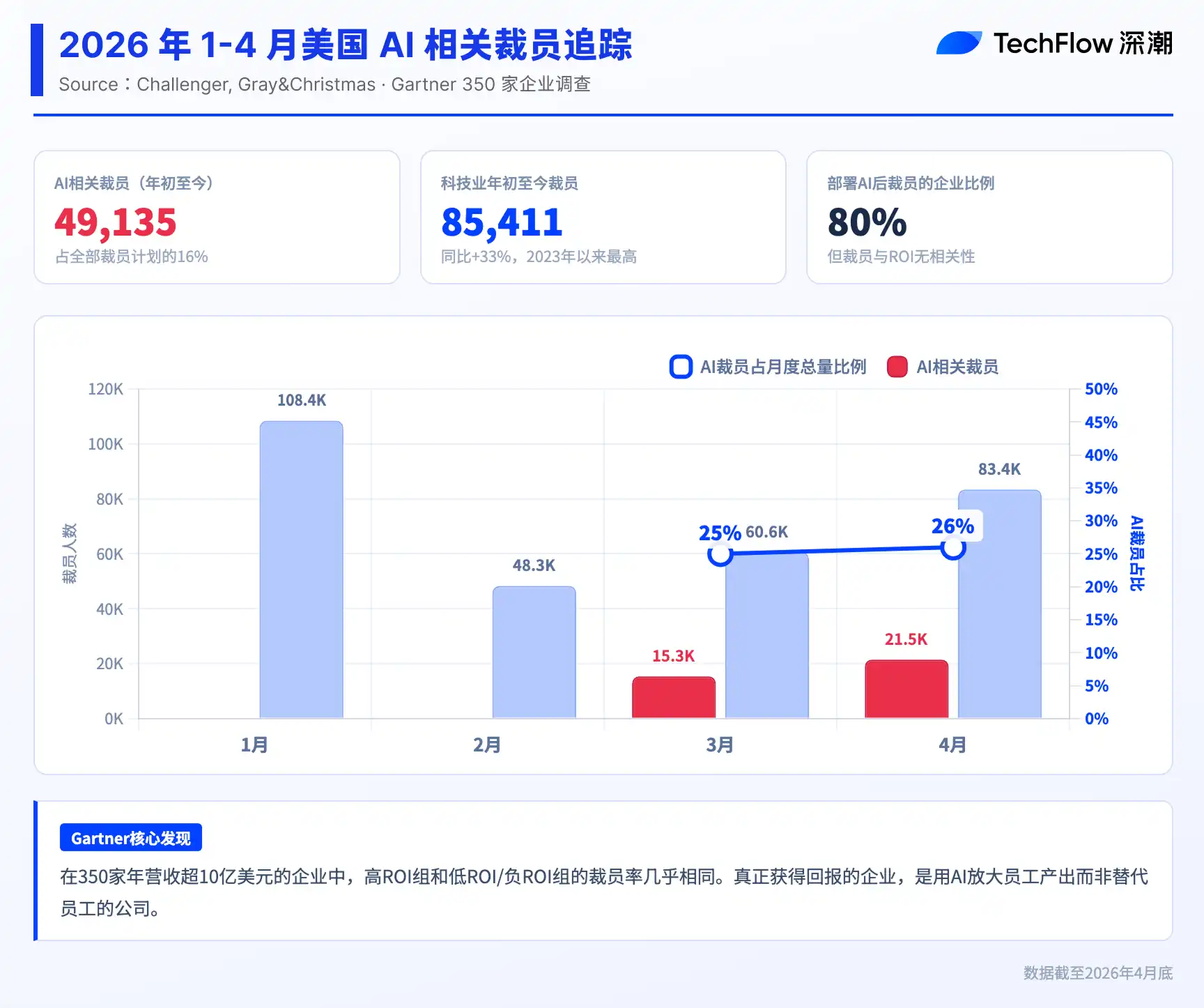
80% of Companies Cut Jobs, But Those Cutting More Aren't Earning More Than Those Cutting Less

Gartner's core finding is: Among companies that have deployed autonomous business capabilities, about 80% reported layoff actions. However, there is almost no difference in the proportion of layoffs between high-return companies and low-return (or even performance-deteriorating) companies.

In other words, from a statistical perspective, there is no discernible causal relationship between cutting jobs and making money.

The survey shows that companies achieving the highest returns are taking an opposite path. They position AI as "people amplification," using technology to enhance the output efficiency of existing employees rather than directly replacing human labor. Poitevin calls this model the "human-amplified business," where AI empowers humans rather than replaces them.

In another independent Gartner survey targeting CEOs, about one-third of executives expect AI to assist humans in decision-making but not make independent decisions, while another 27% expect AI to operate autonomously with minimal or no human intervention. The divergence between these two approaches is deepening.

Nearly 50,000 Jobs Cut Due to AI in First Four Months of This Year, Tech Industry Layoffs Hit Three-Year High

Gartner's research conclusions sharply contrast with the current reality of the job market.

According to the latest report released in May by outplacement firm Challenger, Gray & Christmas, AI has been the primary reason for U.S. corporate layoffs for two consecutive months. In April 2026, 21,490 positions were cut due to AI, accounting for 26% of the total layoffs of 83,387 that month. Cumulatively for the first four months of 2026, positions cut due to AI reached 49,135, representing about 16% of the year's total layoffs so far, up from 13% at the end of March.

Andy Challenger, Chief Revenue Officer at Challenger, summarized it pointedly: "Whether individual roles are truly being replaced by AI or not, the budget for those roles is being taken by AI."

By industry, the tech sector is the hardest hit. The tech industry cut 33,361 jobs in April, with a year-to-date total of 85,411, a 33% increase year-over-year, the highest for the period since 2023. Cognizant plans to cut 12,000 to 15,000 jobs globally, Cloudflare is laying off about 1,100 employees (approximately 20% of its workforce), Coinbase is cutting 14% of its staff, and Snap is eliminating 1,000 positions—all citing AI as a core driver.

Contrasting with the layoff wave is a sharp contraction in hiring. In April, companies announced only 10,049 new hiring plans, a staggering 69% decrease month-over-month and a 38% drop year-over-year.

"AI Washing" Layoffs: How Many Layoffs Are Really Due to AI?

A recurring question is raised: How many of the layoffs implemented by companies in the name of AI are genuinely driven by AI?

OpenAI CEO Sam Altman directly raised this question in an interview this past February. He acknowledged the existence of so-called "AI washing" phenomena: companies packaging layoffs they would have conducted anyway as AI-driven structural adjustments. "I don't know the exact percentage, but there is certainly some AI washing, where people attribute layoffs they were going to do anyway to AI," Altman said.

Deutsche Bank analysts also noted in a recent research report that "AI redundancy washing will be a prominent feature of 2026," with large companies using AI as a rhetorical shield for layoffs, while actual drivers may be tariffs, economic uncertainty, or other cost pressures.

Gartner's Poitevin leans towards a milder interpretation: current AI-related layoffs are more like companies "testing the waters" rather than genuine structural resets. "In our view, this looks more like a one-off, small-scale experiment for many companies, not something that translates into full return on AI investment."

Long-term Forecast: AI to Become a Net Job Creator by 2028-2029

Gartner's stance is distinctly two-sided.

Short-term data is not optimistic. Previous Gartner research shows that AI agents successfully complete standard office tasks about 30% to 35% of the time. Gartner also predicts that over 40% of AI agent projects will be canceled by the end of 2027 due to cost overruns, unclear business value, and insufficient risk management.

But Gartner offers an optimistic long-term forecast: autonomous business will begin to become a net job creator between 2028 and 2029, when new types of jobs that AI cannot perform will emerge. Poitevin emphasizes: "In the long term, autonomous business will create more work for humans, not less. Structural factors like demographic decline and high-trust consumption scenarios will ensure that human capital remains central to operating, governing, and scaling autonomous systems."

On the spending front, Gartner expects AI agent software spending to grow from $86.4 billion in 2025 to $206.5 billion in 2026, and to $376.3 billion in 2027. Even with most projects failing, capital is still accelerating its influx.

This creates an absurd yet real situation: corporate layoffs have not brought returns, AI project failure rates remain high, but no one is willing to get off the ride.


Perguntas relacionadas

QWhat was the main finding of the Gartner study regarding AI-driven layoffs and financial performance?

AThe study found that while 80% of companies deploying AI reported layoffs, there was no positive correlation between the rate of layoffs and the company's return on investment. Companies that laid off more people did not see better financial returns than those that laid off fewer.

QAccording to the article, what is the 'human-amplified business' model, and how does it relate to AI investment success?

AThe 'human-amplified business' model uses AI to enhance and amplify the output of existing employees rather than to directly replace them. The study found that companies adopting this approach were the ones achieving the highest returns on their AI investments.

QWhat does the term 'AI washing' refer to in the context of corporate layoffs?

A'AI washing' refers to the practice where companies blame layoffs on AI-driven structural changes when, in reality, the layoffs were planned or driven by other factors like economic uncertainty or cost pressures, using AI as a rhetorical shield.

QWhat were the key statistics about AI-related job losses in the first four months of 2026, according to the article?

AIn the first four months of 2026, 49,135 jobs were cut due to AI, accounting for about 16% of total layoffs in that period. In April 2026 alone, 21,490 jobs (26% of the month's total) were attributed to AI.

QWhat is Gartner's long-term prediction regarding AI's impact on employment by 2028-2029?

AGartner predicts that autonomous business powered by AI will become a net creator of jobs by 2028-2029. New types of work that AI cannot perform are expected to emerge, and human capital will remain central to operating and governing these systems.

Leituras Relacionadas

Deconstructing the U.S. Stock Quantum Computing Sector: IonQ, Rigetti, D-Wave, Which of These Concept Stocks is Worth Betting On?

**Title:** Analyzing the US Quantum Computing Race: IonQ, Rigetti, D-Wave – Which Concept Stock is Worth Betting On? **Summary:** The podcast discusses the resurgence of quantum computing as a national priority for both the US and China, driven by its potential to break current encryption, revolutionize drug discovery, finance, and logistics. The core challenge is commercializing the technology, which is hampered by high error rates in quantum bits (qubits). Quantum error correction, requiring thousands of physical qubits per reliable logical qubit, is key but years away. The analysis compares three main publicly traded US quantum computing firms: * **IonQ (Ion Trap):** Considered the most financially stable with the fastest commercial progress (2025 revenue: $130M, +202%) and high-quality clients. Its valuation is very high, pricing in significant future growth. * **Rigetti (Superconducting):** Seen as the highest-risk, highest-potential-reward bet. It has the smallest revenue but recently launched a 108-qubit system. Its valuation multiples are extreme, making it highly sensitive to news. * **D-Wave (Quantum Annealing):** Has the most unique positioning with real-world enterprise clients today (e.g., Mastercard, Volkswagen) solving optimization problems. Its recent acquisition moves it into general-purpose quantum computing ("dual-platform"), adding execution risk. Major tech giants like Google, IBM, and Microsoft are also heavily invested, pursuing various technical approaches. Nvidia is positioning itself as the essential bridge between classical and quantum computing. The investment phase is likened to AI in 2018-2020: promising underlying technology with accelerating breakthroughs but a commercial inflection point still 3-7 years away, suggesting potential for a market correction ("bubble washout"). For investors, suggested approaches include gaining exposure through tech giants with quantum divisions (e.g., Google, IBM) or using niche ETFs like WQTM for pure-play quantum exposure, rather than direct stock picks in the highly volatile pure-play companies at this early stage.

marsbitHá 11m

Deconstructing the U.S. Stock Quantum Computing Sector: IonQ, Rigetti, D-Wave, Which of These Concept Stocks is Worth Betting On?

marsbitHá 11m

From Parallel Finance to Mainstream Finance: The On-Chain Securities Era Ushers in a Historic Window

From Parallel Finance to Mainstream: The Dawn of On-Chain Securities For over a decade, the crypto industry has operated as a parallel financial system with its own currencies, markets, and assets—from Bitcoin and ICOs to DeFi, NFTs, and memecoins. Despite building a robust internal ecosystem, a wall has separated it from the traditional financial world. That barrier is now crumbling. The industry's first act was one of internal evolution: ICOs streamlined fundraising, DeFi recreated financial services on-chain, and layer-2 networks competed for scalability—all within the crypto bubble. While innovative, this cycle remained closed, with capital and users circulating internally, leading to volatile boom-bust cycles. Even Bitcoin ETFs, while attracting Wall Street capital, merely provided a channel to buy crypto assets without bridging the systems. The next, larger narrative is Real-World Assets (RWA) moving on-chain. This involves tokenizing stocks, bonds, funds, and future cash flows. Blockchain can compress the complex traditional processes of trading, settlement, clearing, and custody into a seamless, automated network operating in seconds. This shift is creating a new financial gateway: the native crypto securities broker. This entity will combine functions of an exchange, broker, bank, and custodian into a unified global financial operating system. Consequently, the next major battleground won't be the "public chain wars" focused on speed and cost, but the competition to build the financial infrastructure capable of hosting high-quality, liquid real-world assets. Access to global equities, index funds, or stakes in companies like SpaceX could erase the boundary between crypto and traditional finance, unlocking a market orders of magnitude larger than crypto's current valuation. In summary, after years of creating a separate financial world, crypto's next decade will be defined by its integration into the existing global financial system, marking the true beginning of its largest growth story.

marsbitHá 32m

From Parallel Finance to Mainstream Finance: The On-Chain Securities Era Ushers in a Historic Window

marsbitHá 32m

Wang Chuan: When the Neighbor Old Wang Made 30x on Memory Stocks, How to Avoid Anxiety (Part Six) - The Trap of Commoditized Goods

Wang Chuan: When the Neighbor Lao Wang Made 30x on Storage Stocks, How to Stay Anxiety-Free (Part 6) - The Trap of Commoditized Goods. This essay uses historical and current examples to analyze the cyclical and high-risk nature of the data storage industry. It begins with the 1990s rise and dramatic fall of Iomega, whose stock soared over 160x in 18 months before collapsing 97% from its peak, illustrating the fleeting success of storage "meme stocks." The core problem is that storage products, like DRAM and flash memory, are highly commoditized. This leads to extreme volatility: prices have plummeted over 80% multiple times, and company stocks often crash 95% or go bankrupt. The industry's dynamic is defined by "elastic demand facing heavy-asset, long-cycle, rigid supply." When demand spikes and supply is fixed, prices skyrocket, as seen recently with AI-driven demand for High Bandwidth Memory (HBM). Companies like Sandisk and Micron have reported massive revenue and gross margin jumps (e.g., Sandisk's gross margin rising from 22.5% to 78.3%) despite minimal increases in production volume. However, these high margins are self-defeating. They incentivize massive new capacity investments (hundreds of billions planned from 2026), with supply expected to surge by late 2027. Once new supply meets demand, prices and profits will crash, potentially leading to a scenario where "selling more results in earning less." The article debunks the safety of long-term supply agreements, comparing them to fragile non-aggression pacts easily broken when market conditions shift. It warns that when an industry is highly profitable but trades at low P/E ratios, the risk is greatest, as plummeting prices quickly erase those earnings. Multiple asymmetric risks loom, including economic recession, reduced AI spending, faster-than-expected capacity expansion (especially from Chinese firms), and technological innovations that reduce memory requirements. In conclusion, the storage sector is a cyclical trap where periods of euphoric profits are often precursors to devastating downturns, luring unprepared investors into a "wealth incinerator."

marsbitHá 42m

Wang Chuan: When the Neighbor Old Wang Made 30x on Memory Stocks, How to Avoid Anxiety (Part Six) - The Trap of Commoditized Goods

marsbitHá 42m

Wang Chuan: When the neighbor Lao Wang earned thirty times from investing in memory storage stocks, how can you still avoid anxiety (6) - The trap of homogeneous products

The article, "Wang Chuan: How to Remain Unanxious After Neighbor Lao Wang's Thirty-Fold Gain on Storage Stocks (Part 6) - The Trap of Commoditized Goods," analyzes the cyclical and perilous nature of the data storage industry through historical and current case studies. It begins with the example of Iomega, whose Zip drives led to a stock surge of over 160x in the mid-1990s before collapsing over 97% from its peak due to competition from cheaper CD-R technology. This pattern is characteristic of storage, where products like DRAM are highly commoditized, leading to extreme price volatility. The sector has seen prices crash over 80% multiple times, with companies often facing bankruptcy. The core dynamic is "elastic demand facing heavy-asset, long-cycle, rigid supply." High prices attract new capacity, but the long lead time means supply eventually overshoots, causing sharp price corrections. The current AI-driven boom, exemplified by surging demand for High-Bandwidth Memory (HBM), has led to skyrocketing prices and profit margins for companies like SanDisk and Micron, despite relatively flat production volumes. However, the author warns this high-margin environment is self-defeating. The high profits are already triggering massive new capacity investments (hundreds of billions starting 2026), with supply expected to ramp up by late 2027. When supply catches up, total revenue and profits may fall even as more units are sold. Long-term supply agreements offer little protection, as buyers can find ways to renegotiate if market prices drop, similar to fragile political treaties. Key risks include economic downturns, cuts in AI spending, faster-than-expected capacity expansion (especially from Chinese firms), and innovations in chip/algorithm design that reduce memory needs. A critical trap is that at the cycle's peak, storage stocks often appear cheap with low P/E ratios, luring value investors just before an impending downturn where profits evaporate. The conclusion cautions that for commoditized goods like storage, high margins inevitably destroy themselves, and the current asymmetry favors downside risk over further upside. The neighbor's dream of easy wealth from storage stocks is portrayed as a precarious illusion.

链捕手Há 1h

Wang Chuan: When the neighbor Lao Wang earned thirty times from investing in memory storage stocks, how can you still avoid anxiety (6) - The trap of homogeneous products

链捕手Há 1h

Trading

Spot
Futuros
活动图片