Report: Cryptocurrency Owners Lost $30 Million Due to Rising 'Wrench' Attacks Worldwide

cryptonews.ruPublicado em 2026-08-06Última atualização em 2026-08-06

Resumo

**Report: Cryptocurrency Owners Lose $30 Million Due to Rising "Wrench Attack" Threats Worldwide** A new report by Chainalysis highlights the alarming rise of so-called "wrench attacks"—physical crimes like home invasions, kidnappings, and hostage situations targeting cryptocurrency owners—which have resulted in an estimated $30 million in losses. Unlike typical online crypto crimes, these violent, in-person attacks often occur at a victim's doorstep. France has become a global epicenter for this trend. By mid-2026, the country recorded 30 publicly known violent incidents, a significant jump from 19 in all of 2025. French officials have reported over 70 such cases. This surge is linked to major data leaks, where information on wealthy crypto holders—including names, addresses, and asset details—was stolen and sold to criminal groups, fueling targeted attacks. While attacks in France are more frequent, they are also less successful. Only 26% of attempted thefts resulted in a ransom payment by mid-2026, down from 49% in 2025. Attacks have also become more erratic, with criminals increasingly targeting the victim's family or acquaintances instead of the asset holder directly. Once stolen, funds are moved through various channels. Some criminals send assets directly to centralized exchanges (making them easy to trace), while others use decentralized exchanges and bridges to obfuscate trails. A third group appears linked to organized crime, funneling money through laundering n...

These crimes fall into a category that security researchers refer to as "wrench attacks." The term originates from an old internet joke about hacking: no matter how secure a password is, a criminal can bypass it with a five-dollar wrench and physical pressure. In practice, this means home invasions, kidnappings, and hostage situations targeting owners of cryptocurrency assets.

In its latest research, Chainalysis explained that this scheme differs from typical cryptocurrency crimes. Most thefts occur online through hacks, scams, and ransomware. Wrench attacks happen in person, often right at the victim's front door.

France Becomes a Global Epicenter of This Problem

France has become a focal point of this trend. According to Chainalysis, by mid-2026, the country had recorded 30 publicly known violent incidents, compared to just 19 in the entire previous year. French Interior Minister Laurent Nuñez stated in June that authorities had recorded over 70 violent incidents related to cryptocurrencies—a figure significantly higher than official data. Nuñez announced plans to create a rapid alert system to protect people working in the cryptocurrency industry who may be at risk.
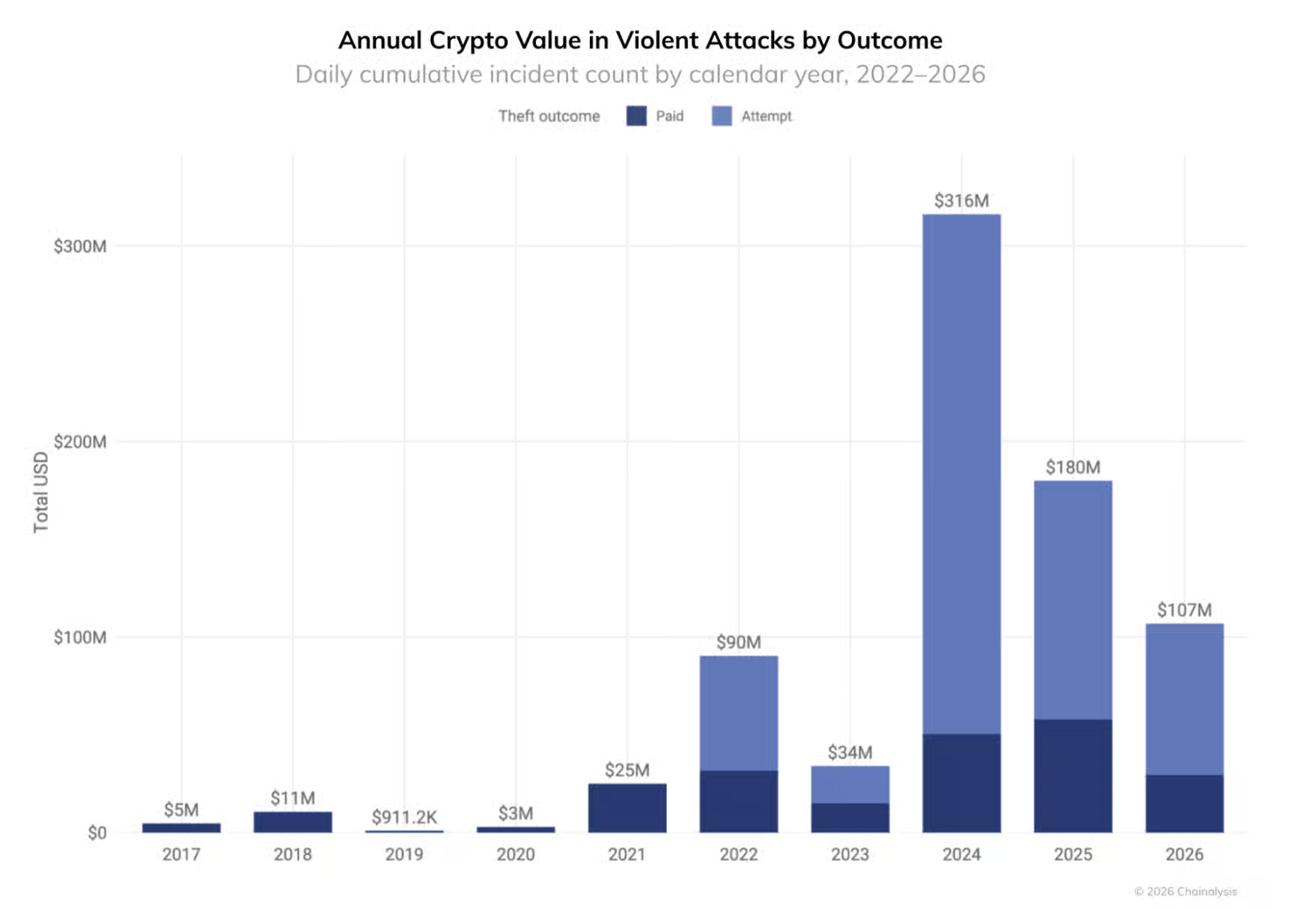
Image source: Chainalysis study titled "An estimated $30 million was stolen in violent cryptocurrency attacks in 2026, with France becoming a 'hotspot'."

Chainalysis linked the surge in attacks in France to a data leak. A French tax official is accused of stealing and selling files containing information on wealthy cryptocurrency owners, including names, addresses, phone numbers, and account balance data. It is suspected that criminal groups purchased this information and used it to plan attacks. A second leak, reported in January by the cryptocurrency tax company Waltio, led to the exposure of approximately 50,000 additional user records.

These numbers show how significant these stolen data were. Before 2025, France averaged less than one attack per month. Research by the blockchain analytics company Chainalysis showed that in 2025, this rate increased to 1.9 attacks per month, then sharply rose to 4.6 per month in the first half of 2026.

Attackers More Often Fail in France

Not every attempt is successful. Chainalysis reported that only 26% of attempted violent thefts by the end of June resulted in ransom payments, down from 49% in 2025 and 67% in 2024. The researchers who prepared the report directly linked the decrease in success rate to France, noting that attacks in this country are "more numerous, more chaotic," and less likely to succeed than the targeted attacks characteristic of previous years.
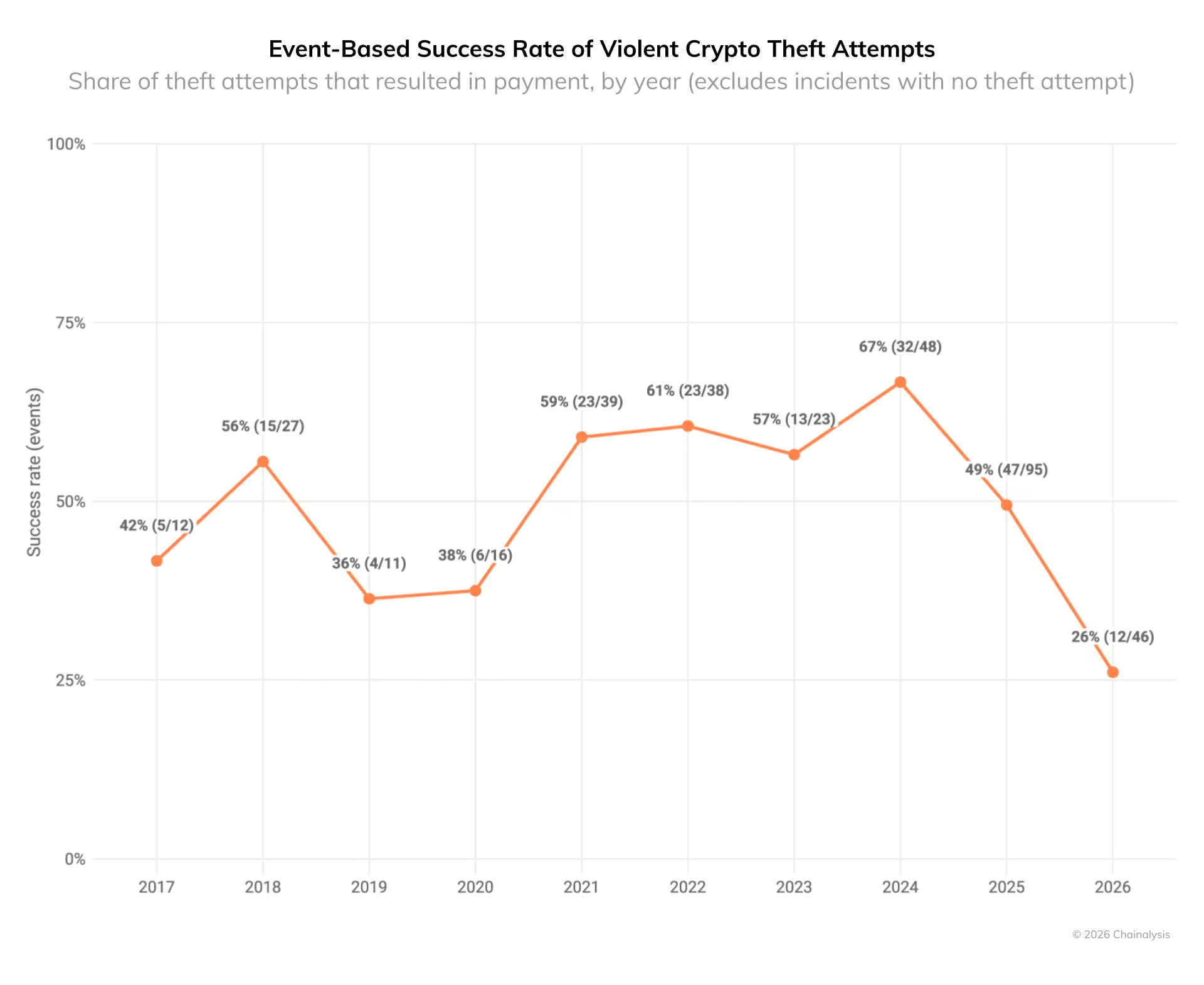
Image source: Chainalysis study titled "An estimated $30 million was stolen in violent cryptocurrency attacks in 2026, with France becoming a hotspot."

The nature of attacks is also changing worldwide. Home invasions accounted for 37% of recorded incidents in 2026, compared to 26% in 2023. The number of kidnappings also increased—from 39% of cases in 2023 to 52% now. Attackers have also begun targeting family members and acquaintances of the cryptocurrency owner instead of acting directly against them. Chainalysis found that such tactics were used in roughly a quarter to a third of cases worldwide, but in France, they were used in over 40% of cases.

Stolen Funds Reveal Who Is Behind the Attacks

Once an attack is successful, the stolen cryptocurrency needs to be moved somewhere. Chainalysis traced the money flows and identified three levels of complexity in criminal schemes. Some attackers send the stolen funds directly to a centralized exchange—a mistake that allows investigators to easily track and catch them. Others use decentralized exchanges (DEX) and cross-chain bridges to cover their tracks. A third group appears to be linked to organized crime: funds pass through money laundering networks associated with drug trafficking and terrorism financing.

JUNALCO Fights Organized Crime

French authorities view this wave of crimes as an expression of organized crime. The country's specialized unit for combating organized crime, known as JUNALCO, has made about 200 arrests and filed 88 charges related to cryptocurrency-linked attacks; 75 suspects are in pre-trial detention.

In its latest crime analysis, Chainalysis explained that the risk primarily falls on locals rather than tourists. In France, 93% of victims whose residence is known were locals; researchers believe this pattern indicates careful planning by the attackers, whether using data leaks, social media, or blockchain tracking.

Cryptocurrency Owners Face the Need to Enhance Security Measures

For cryptocurrency owners, the report's recommendations are simple. Do not flaunt large assets, do not disclose information about asset storage, and treat any leak of personal information as a security threat, not just a privacy violation.

In the second half of 2026, it will become clear whether France's measures lead to a slowdown in crime rates. Stay tuned for updates from JUNALCO on new arrests, the implementation of the rapid alert system proposed by Nuñez, as well as Chainalysis's year-end data, which will confirm whether 2026 becomes the worst year on record for violent crimes related to cryptocurrencies.

end-content

Perguntas relacionadas

QWhat is the main cause behind the surge in 'wrench attacks' against cryptocurrency owners in France, according to the article?

AThe surge is primarily linked to data breaches. A French tax official was accused of stealing and selling files containing information on wealthy cryptocurrency owners, which criminal groups then used to plan attacks. A second leak reported by Waltio in January exposed an additional 50,000 user records.

QHow does the success rate of violent crypto theft attempts in France compare to previous years?

AThe success rate has declined sharply. By the end of June, only 26% of attempts led to a ransom payout, which is significantly lower than the rates of 49% in 2025 and 67% in 2024.

QWhat significant change in the pattern of these attacks is noted, especially in France?

AAttackers have increasingly started targeting the family members or acquaintances of crypto owners instead of targeting the owners directly. This tactic was used in over 40% of cases in France, compared to about a quarter to a third of cases globally.

QWhat are the three levels of sophistication identified by Chainalysis in how stolen cryptocurrency is moved after an attack?

A1. Sending stolen funds directly to a centralized exchange, which makes tracking easy. 2. Using decentralized exchanges (DEX) and cross-chain bridges to obfuscate the trail. 3. Moving funds through money laundering networks linked to drug trafficking and terrorist financing, which appears to be tied to organized crime.

QWhat actions have French authorities taken in response to the wave of crypto-related violent crimes, and what is JUNALCO?

AFrench authorities have treated these crimes as organized crime. The country's specialized unit against organized crime, JUNALCO, has made around 200 arrests and filed 88 charges related to crypto-linked attacks, with 75 suspects held in pre-trial detention.

Leituras Relacionadas

Capital is Moving from Cryptocurrency Speculation to Tokenized RWA Assets

In 2026, tokenized real-world assets (RWA) became one of the fastest-growing areas in crypto. Investors, weary of market volatility, are shifting capital from speculative crypto trading towards assets offering stable yield. These include tokenized government bonds (e.g., T-bills), private credit, real estate income, commodities, and money market funds. Data shows a clear preference for transparent, regulated products. Deposits into RWA protocols more than tripled year-on-year, reaching $7.4 billion in Q2, while spot trading activity surged 220%. The total on-chain value of tokenized RWAs exceeded $30 billion in 2026, more than doubling from the previous year, and approached $38 billion by August. RWA acts as a bridge between traditional finance and blockchain, not a replacement. It allows banks and asset managers to launch regulated products on public blockchains, while DeFi users gain access to previously unavailable real-world assets. Blockchain provides 24/7 settlements, transparency, programmability, and lower fees, while traditional finance contributes capital, regulation, and proven products. Tokenized private credit remains the largest RWA category (over $7 billion on-chain), benefiting from blockchain's cost reduction and transparency. Treasury bills are the fastest-growing institutional segment, driven by higher interest rates. Tokenized commodities, especially gold, are expanding, combining asset safety with blockchain trading ease. Real estate, though smaller, is also growing steadily. Tokenization is increasingly viewed as core financial infrastructure.

cryptonews.ruHá 56m

Capital is Moving from Cryptocurrency Speculation to Tokenized RWA Assets

cryptonews.ruHá 56m

Lone Bitcoin Miner Defies All Odds, Hits $200,000 Jackpot with Block Reward

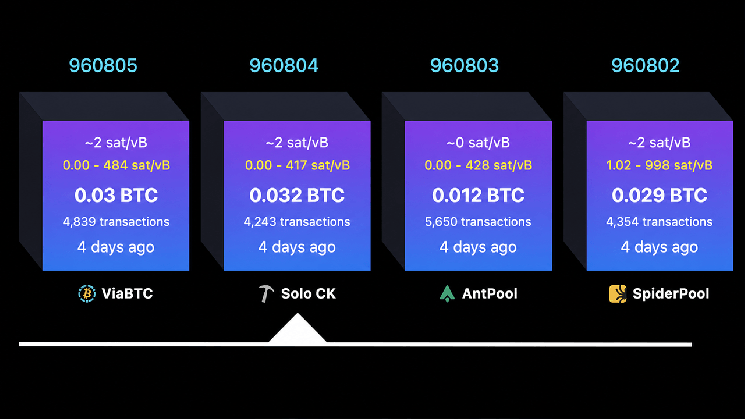
A solo Bitcoin miner, contrary to all predictions, won a $200,000 jackpot as a block reward. The payment went to an address linked to CKPool, a solo-mining service. This was the 317th solo block found by the pool. The reward consisted of the 3.125 BTC fixed subsidy and about 0.032 BTC in transaction fees from 4,243 transactions. CKPool operator Dr -ck (Con Kolivas) confirmed the win, noting the miner's hashrate was "extremely volatile, presumably rented," peaking at 100 PH/s. This represented about 0.011% of Bitcoin's total network hashrate. At that level, a miner could statistically expect to find a block roughly every 64 days, far more likely than for a typical small home setup. Solo mining differs from pool mining, where rewards are shared based on contributed work. In solo mining, a miner gets nothing unless they personally find a block, but then receives the entire reward. CKPool charges a ~2% fee on blocks found. Dr -ck noted the hashrate pattern suggested rented computing power, a practice making solo wins more accessible. He also highlighted this was the first mainnet block mined after integrating Stratum V2 code into ckpool, though the block itself was found using the older Stratum V1 protocol. Against a backdrop of mining concentration in large industrial pools, such solo finds remain rare but demonstrate that anyone with sufficient hashrate can claim a full reward without corporate or government permission. The block subsidy will remain 3.125 BTC until the next halving around April 2028. The miner's identity remains unknown, as is typical. Bitcoin's mining difficulty is due for an adjustment, and network hashrate has declined from late 2025 peaks, partly due to competition for power and hardware from AI data centers.

cryptonews.ruHá 57m

Lone Bitcoin Miner Defies All Odds, Hits $200,000 Jackpot with Block Reward

cryptonews.ruHá 57m

Blackrock Leads with $305 Million Inflow into Bitcoin and Ether ETFs

Money continued to flow rapidly into the largest cryptocurrency ETFs. Bitcoin and Ethereum ETFs collectively attracted over $305 million in inflows, with BlackRock again leading the charge, marking the third consecutive session of strong institutional demand. The broader market picture was mixed. Hyperliquid ($HYPE) ETFs finally saw renewed buying interest, while XRP ($XRP) ETFs faced outflows, and Solana-based products remained stagnant. In a strong session, Bitcoin ETFs recorded a net inflow of $244.42 million across five funds. BlackRock's IBIT dominated with $196.83 million, followed by ARK 21Shares' ARKB at $37.63 million and Fidelity's FBTC at $11.28 million. Vaneck's HODL was the sole fund to see an outflow (-$14.67 million), barely impacting the category's overall positive trend. Total trading volume reached $1.58 billion. Ethereum ETFs also continued their positive run, attracting $60.86 million. BlackRock's ETHA led with $50.34 million. The staking-oriented ETHB and Fidelity's FETH followed. No Ethereum ETF saw outflows. Among smaller tokens, Hyperliquid ETFs saw a minor but notable inflow of ~$966,690, potentially signaling easing selling pressure. Conversely, XRP ETFs experienced a $3.58 million outflow. Solana ETFs saw no net activity. The session solidified Bitcoin and Ethereum as the focal point for institutional capital, with BlackRock as the dominant source of demand, while activity in altcoin ETFs remained volatile.

cryptonews.ruHá 58m

Blackrock Leads with $305 Million Inflow into Bitcoin and Ether ETFs

cryptonews.ruHá 58m

Trading

Spot
活动图片