Author:Our Crypto Talk
Compiled by: Jiahuan, ChainCacther
In 2018, a guy lost $15,000 when his wallet was hacked. No fancy degree. No prestigious connections. No backing from a VC fund or a three-letter government agency. Just an ordinary retail investor, like thousands of others, who got burned during the ICO boom.
Most people would probably quit the crypto space forever, angry.
This guy opened a blockchain explorer and started tracing where his money went.
Seven years later, he is responsible for recovering hundreds of millions of dollars in stolen funds, getting scam artists arrested across multiple continents, exposing North Korean state-sponsored hacking operations, and making every bad actor in the industry think twice before moving even $1 on-chain.

His name? No one knows. His true face? Never revealed. His avatar? A cartoon platypus in a trench coat.
This is the story of ZachXBT, the most feared investigator in the cryptocurrency space, and it explains why his next report could be the biggest bombshell the industry has ever seen.
From Victim to Vigilante
ZachXBT's origin story reads like something out of a comic book.
He entered the crypto space around 2017, right at the peak of the ICO craze. Like most retail investors at the time, he put money into projects that promised to change the world but delivered nothing. Rug pulls, shitcoins, influencer-pumped garbage. The usual.
But the real turning point was 2018. His Electrum wallet was hacked. About $15,000, gone. For a retail investor, that's not exactly rounding error. That's real money. A loss like that either makes you quit forever or makes you go down the rabbit hole.
He chose the rabbit hole.
He began teaching himself how to read on-chain data. Transaction flows, wallet clustering, mixer patterns, exchange deposits. He combined this with old-school OSINT (Open Source Intelligence), scraping Twitter, Discord, Telegram, Instagram, even court records to build profiles of the people behind the wallets.
By 2020, he started posting his findings publicly on X. Short threads at first. Phishing scams, influencer pump-and-dumps, small-time grifters. Nothing that would make mainstream headlines.
Then the threads got longer. The evidence got more solid. The targets got bigger.
The self-appointed detective of cryptocurrency was born.
A Track Record That Speaks
This is exactly what separates ZachXBT from every other "crypto detective" on the internet. These aren't accusations based on hunches or gut feelings. This is forensic-level, evidence-backed work that has led directly to real-world consequences.
Some highlights:
Directly recovered over $210 million. That's funds tracked down and returned to victims, not theoretical numbers. Additionally, over $225 million in indirect seizures are linked to his investigations.
The $243 Million Bitcoin Heist (2024). This one is just absurd. ZachXBT was sitting in an airport when he noticed suspicious cash-out activity on-chain. He traced the funds, identified three suspects via their lavish social media spending (because of course they flaunted it), assisted law enforcement in the arrest of two of them, and facilitated the seizure of over $79 million within weeks. All from an airport terminal. While most people were scrolling Instagram waiting for their boarding call.
Exposing the Lazarus Group. He linked North Korea's infamous state-sponsored hacking unit to 25+ separate hacks worth over $200 million, plus their infiltration of Web3 dev teams. This is nation-state level intelligence work done by one anonymous person with a laptop.
The BAYC Phishing Ring (2022). Tracked over $2.5 million stolen through a fake Bored Ape website. Led to the arrest of five individuals by French authorities.
Taking Down Influencers. Lark Davis (over $1.2M in undisclosed profits). Logan Paul's involvement with Elongate, Ethereum Max, and DinkDoink. BitBoy Crypto's paid promotions for outright scams. ZachXBT didn't just name these people, he showed the wallet trails, transaction receipts, and money flows that proved exactly what was happening.
The Machi Big Brother Case. He alleged the misappropriation of over $17 million from Formosa Financial. The subject sued him for libel. The crypto community crowdfunded over $1 million for ZachXBT's legal defense. The lawsuit was dropped.
Government-Linked Theft (Jan 2026). He tracked over $40 million stolen from a US government-seized wallet to the son of a contractor executive responsible for the seized crypto. Even the people guarding the seized funds aren't safe from his scrutiny.
The list goes on. The $70M Pixelmon misuse. The DeGods NFT recovery. The Coinbase impersonation ring. Hardware wallet scams. This one person has been involved in more cases than most law enforcement cybercrime units.
Why He Matters More Than You Think
Cryptocurrency has a regulation problem. It's well known. Government agencies are slow, siloed, and often clueless about how blockchain technology actually works. Exchanges have conflicts of interest. Projects mark their own homework.
Into this vacuum stepped an anonymous investigator doing the work that billion-dollar companies and federal agencies either couldn't or wouldn't do.
ZachXBT has worked with the FBI, the Secret Service, and French cyber police, but he doesn't work for any of them. He is completely independent. That independence is why he's effective. He doesn't need approval to publish. He doesn't have a legal department to water down his findings. He isn't accountable to shareholders or political appointees.
He is accountable only to the blockchain. The data is the data.
This matters because the deterrent effect is real. Scammers now know that moving stolen funds isn't the end of the story. It might be the start of a public investigation that ends with their real name, transaction history, and mugshot splashed across Crypto Twitter.
Before ZachXBT, the math for a crypto scammer was simple: steal money, wash it through a mixer, cash out, disappear. Now, there's a non-trivial chance that a cartoon platypus will track every dollar, post the evidence to nearly a million followers, and hand the case file to law enforcement.
That changes behavior. That's real impact.
The Business Model of Being Crypto's Batman
This is what makes ZachXBT even more interesting. He isn't backed by a fund. He doesn't run a company. For years, he worked almost entirely for free.
His funding comes from community donations (~$1.3M since 2021), occasional bounties, and crowdfunding during crises like the libel lawsuit. In 2024, he stopped doing purely pro bono work due to overwhelming demand, which is completely understandable when you consider the volume of cases he handles.
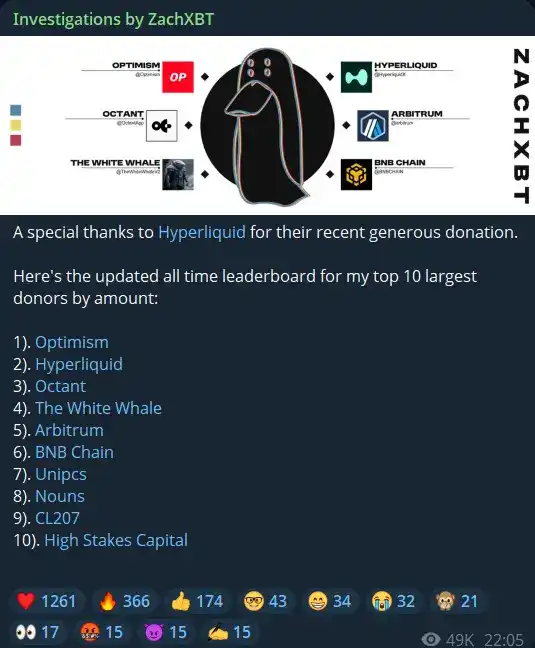
He is also an advisor to Paradigm, one of the largest crypto venture funds, and recently (Nov 2025) partnered with BNB Chain for proactive security reporting. These relationships give him resources and reach without compromising his independence.
But the core of his operation remains one person, one laptop, and an internet connection, doing work that entire departments at major institutions struggle to replicate.
February 26th: The Next Bombshell
Now we get to what's happening right now.
On February 23, 2026, ZachXBT posted this:
"Update: A major investigation will be released on February 26th involving one of crypto's most profitable businesses where multiple employees abused internal data for insider trading over a long period of time."
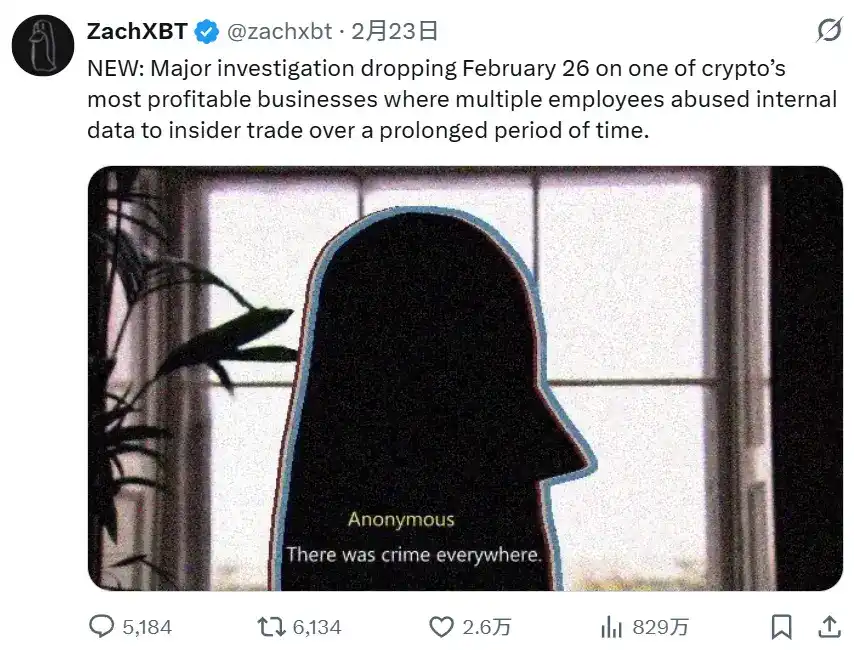
The post already has millions of views. Thousands of replies. The speculation is running wild.
The crypto community is trying to figure out which company he's talking about. Rumors point to a top exchange or a large DeFi/trading firm, likely one of the most profitable entities in the entire industry. Prediction markets have opened up around the reveal.
And the part that perfectly captures the absurdity of this industry: People are apparently trying to insider trade on ZachXBT's insider trading investigation. He's been joking about the irony in the replies.
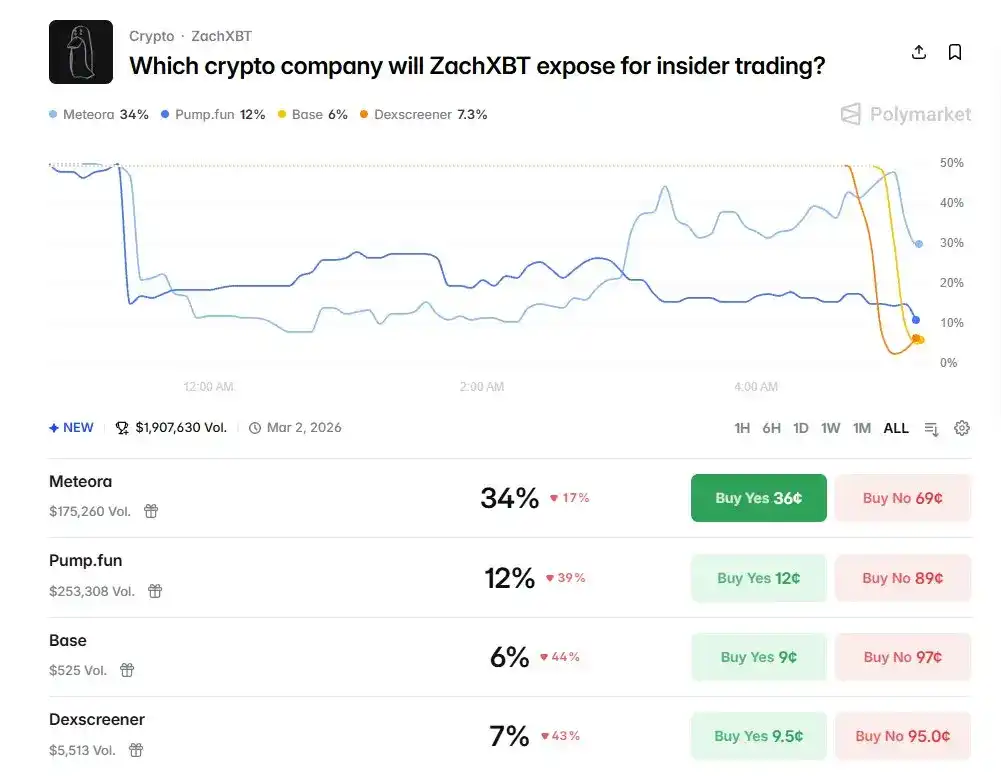
Think about that. This person is about to expose employees at a major company using internal data for front-running, and people are trying to front-run his report on front-running. Crypto never changes.
But ZachXBT's track record suggests this won't be some vague accusation. When he says he has an investigation, he has the wallets, the timestamps, the transaction flows, and the connections. Every single time.
If this one lands like his previous work, we could see executive resignations, regulatory scrutiny, criminal referrals, and a massive crisis of confidence for whatever company finds itself in his crosshairs.
The Bigger Picture
ZachXBT represents something the crypto industry desperately wants but rarely produces: permissionless accountability.
He didn't wait for the SEC to figure out blockchain analytics. He didn't wait for exchanges to self-regulate. He didn't wait for VC-backed security firms to build tools and charge enterprise subscription fees. He just started doing the work, publicly, for free, with receipts.
In an industry that constantly talks about decentralization and trustlessness, ZachXBT is the closest thing to a decentralized law enforcement mechanism that actually works. One person, outside all institutions, using publicly available data and sheer persistence to hold the powerful accountable.
Crypto has never been short on heroes and villains. Most heroes are founders building protocols or investors timing trades correctly. ZachXBT is different. He's a hero because he chose to protect people, not profit from them.
He turned a $15,000 loss into a mission that has recovered hundreds of millions for others.
And on February 26th, he's about to remind the entire industry why that cartoon platypus is the last person you want investigating your company.
Stay tuned







