Rented Mac Computers Provide Attackers with Root Access via Screen Sharing Function Login

cryptonews.ruPublished on 2026-08-18Last updated on 2026-08-18

Abstract

CISA has elevated the severity rating of a macOS Screen Sharing vulnerability to a critical 9.8 out of 10. The flaw, tracked as CVE-2026-65400, resides in how the feature handles authentication via the Secure Remote Password protocol, potentially allowing an attacker to gain access before password verification occurs. Attackers have already exploited this by targeting internet-exposed Macs, gaining root access via port 5900, and silently installing Monero cryptocurrency mining software. While the Screen Sharing feature is disabled by default, it's commonly used on "bare metal" Macs rented from hosting providers. Security researchers identified tens of thousands of potentially vulnerable hosts online, with many being these hourly-rented machines. Apple has issued patches in macOS versions Tahoe 26.6.1, Sequoia 15.7.9, and Sonoma 14.8.9, urging all users to apply updates immediately.

On Friday, CISA raised the severity rating of a macOS screen sharing function vulnerability to critical — 9.8 out of 10.

Dutch investigators reported that attackers gained root privileges on internet-connected Mac computers and stealthily installed Monero mining software.

From 7.1 to 9.8 in a Week

When Apple released the patch, CISA scored this bug, tracked as CVE-2026-65400, at 7.1 in the National Vulnerability Database. The agency then revised the score to 9.8, which is close to the top of the CVSS scale.

The Dutch National Cybersecurity Centre took a similar approach. An August 12th update amended its initial advisory, stating that a publicly available proof-of-concept code is in circulation and active abuse has been confirmed.

As of Friday, this vulnerability had not been added to the federal catalog of Known Exploited Vulnerabilities maintained by the Cybersecurity and Infrastructure Security Agency. Apple's own entry in the Dutch agency's CVE registry still had the older 7.1 rating.

The vulnerability relates to how the Screen Sharing function handles authentication. Huntress trac the cause to a flaw in the service's use of the Secure Remote Password protocol, which is used to verify the user before granting access.

Huntress says that in practice, this causes the Mac to believe an outsider has already logged in. The failure occurs before the password check. Resetting or deleting screen sharing passwords does not eliminate this possibility.

"Anyone using Apple’s Screen Sharing feature on any supported version of macOS must immediately install the latest security updates," wrote Huntress researcher Ryan Doud.

Apple released this patch in macOS Tahoe 26.6.1, Sequoia 15.7.9, and Sonoma 14.8.9 on August 6th.

Tens of Thousands of Rented Mac Computers Are Affected

The NCSC stated that the victims' computers were fully compromised. In every case examined by researchers, the attacker gained access to the system via port 5900, the standard port for screen sharing, which remained open to the internet.

They then obtained root privileges and deployed a Monero cryptocurrency miner ($XMR). The Dutch agency did not disclose the number of affected systems or name a suspect.

The Screen Sharing function is disabled by default. However, it is a standard tool for managing Macs running on "bare metal," meaning physical Apple hardware rented and used in remote data centers, where most of the risk is concentrated.

According to Doud, using the internet scanning tool Censys, he discovered "tens of thousands of potentially vulnerable hosts." Many of these, Huntress claims, are machines rented by the hour from hosting providers.

Cryptopolitan reported on the Reaper malware, which exploits Script Editor to empty wallets, and macOS malfunctions that prompt victims to insert malicious commands into the Terminal.

Cryptojacking, the theft of computing power to obtain cryptocurrency, has long been a hallmark of Monero. Unlike specialized mining rigs, Monero cryptocurrency can be mined on regular CPUs, and transactions are private by default.

The profit from each hacked Mac is low. On Monday, the price estimated roughly 432 $XMR produced by the Monero network per day to be worth approximately $179,000, distributed among all miners. On Monday, $XMR traded at $413.47, up about 0.9% over the previous 24 hours.


Related Questions

QWhat vulnerability in macOS was escalated to a critical severity rating of 9.8 by CISA?

ACISA escalated the severity rating of a vulnerability in the macOS Screen Sharing function's authentication handling, tracked as CVE-2026-65400, to a critical 9.8 out of 10.

QHow did attackers gain root access to the compromised Mac computers according to the article?

AAttackers gained root access by exploiting the Screen Sharing vulnerability to access systems via port 5900, which was left open to the internet on the victim computers.

QWhat specific malware did the attackers deploy after compromising the Mac systems?

AAfter gaining root access, the attackers deployed a Monero cryptocurrency mining software (cryptojacking malware) on the compromised Mac systems.

QAccording to a Huntress researcher, how many potentially vulnerable hosts were found using an internet scanning tool?

AA Huntress researcher, using the Censys internet scanning tool, found 'tens of thousands of potentially vulnerable hosts,' many of which were machines rented by the hour from hosting providers.

QWhich macOS versions received the security patch from Apple to fix this Screen Sharing vulnerability?

AApple released the security patch in macOS Tahoe 26.6.1, Sequoia 15.7.9, and Sonoma 14.8.9 on August 6th to fix this vulnerability.

Related Reads

Anthropic: Many Internal Products Were Never Released

Anthropic recently filed its S-1 with the SEC, highlighting strong enterprise retention and monetization as customers embed Claude into critical business processes. Dianne Na Penn, product lead for Anthropic's Research and Labs team, discussed on The Skip podcast how the research-driven company plans products. Rather than spending three months on an annual plan that becomes obsolete in two weeks, Anthropic plans monthly, grounded in high-level assumptions about the next 6–12 months, avoiding reactive feature-chasing. Claude Code emerged not suddenly but through long experimentation by API customers and internal/external users; the command-line interaction paradigm plus a harness enabling more agent loops created the real chemistry. The team debated offering a fine-tuning API but concluded core models iterate too fast—enterprises risk being two or three generations behind by the time they finish post-training and deployment. Prioritization between research and user feedback relies on ongoing discussion with research leads; PMs articulate user impact rather than dictating training parameters. Many internal prototypes are never released, serving to spark ideas or validate technology. The company focuses on To B and enterprise markets for stability. Culture emphasizes diverse backgrounds, growth mindset, extreme transparency, and first-principles thinking; employees are encouraged to question assumptions, even to senior scientists, with curiosity and mutual trust. Onboarding is intentionally intense—new PMs complete user research, evals, and roadmaps within two to three weeks—to force execution. Small teams mean each person covers multiple areas, driving cross-functional communication and rapid learning. An annual bootcamp teaches building products that ride exponential model capability gains. Anthropic also employs forward-deployed engineers to help enterprises scale deployments, and some have transitioned into PM roles, bringing deep customer context back to research and engineering teams.

marsbit16m ago

Anthropic: Many Internal Products Were Never Released

marsbit16m ago

Democrats Plan to Investigate Apple, Meta and Musk, Trump's Silicon Valley Allies Face 'Reckoning'

Democrats, after winning majorities in both chambers of Congress, are rapidly setting investigative priorities targeting Trump's Silicon Valley allies. The House is preparing to examine Trump's use of Musk's AI chatbot Grok in planning a military operation to abduct Venezuelan President Maduro; Apple and Meta are under scrutiny over an ICE tracking app and local government data center agreements, respectively. The probe scope may extend well beyond these three companies, reviewing major corporations' most controversial business activities over the past two years and their ties to the Trump administration. Since Trump's second term, tech billionaires and executives have frequently attended White House events, donated to his ballroom project, and given gifts, while companies backed by Trump family members and Wall Street executives received billions in government funding. Groundwork Collaborative labeled Big Tech, private prison operators, and natural gas firms as "high-value" targets. Even before formal investigations begin, companies are preparing: Washington law firms are holding emergency meetings to advise founders and executives on congressional inquiries, and many are seeking to become Musk's personal counsel, anticipating subpoenas and high-profile legal work. Some VCs advise startups to close financing before year-end in case executives are called to testify or Pentagon spending shifts. Incoming House Oversight Committee Chairman Robert Garcia warned companies to "hire lawyers," and Senator Ed Markey said tech executives will need plenty of paper for subpoenas. Lawyers expect Democratic control of Congress to accelerate and intensify investigations, with detailed corporate inquiries potentially more effective than letters to Trump agencies since companies are more likely to respond and disclose dealings with officials. Apple, Meta, X, and Musk did not immediately respond to requests for comment. Covington & Burling lawyer Robert Kelner said the investigative wave is all but certain: "We've been telling clients, winter is coming. Now, winter is here."

marsbit1h ago

Democrats Plan to Investigate Apple, Meta and Musk, Trump's Silicon Valley Allies Face 'Reckoning'

marsbit1h ago

Anthropic's Strongest Model 4 Revealed for the First Time: RSI Soars at 2x Speed

Anthropic's unreleased "Model 4," reportedly trained between September and October, has surfaced via a third-party METR evaluation, scoring 178.6 on Anthropic's internal Aggregate Evaluation Capability Index (AECI)—outpacing public models Opus 5.5 (174.5) and Mythos 5.1 (172.5). Model 4 passed all 15 benchmarks at above 50% accuracy, a first compared with Opus 4.6 nine months earlier; removing three flawed benchmarks would push its score to 179.7. METR's 11-week investigation of internal data concludes Anthropic's model improvement has roughly doubled, with an inflection point in October 2025: AECI growth accelerated from about 15 points per year to 29 points per year (1.9x), meaning one year now covers what previously took two. Notably, METR estimates about 80% of this acceleration stems from AI assisting its own R&D rather than increased training compute, researcher headcount, or inference scaling—Claude is effectively helping build a stronger Claude. Internal employee surveys report self-assessed productivity gains rising from 1.3–1.4x in spring 2025 to about 5x by June and roughly 12x by October with Model 4, as researchers shift from using Claude as autocomplete to orchestrating many parallel agents, cutting idea-to-experiment time by up to 80%. METR researcher Ryan Greenblatt calls the report a signal pointing toward ASI within one to two years. Roughly 100 pages were submitted to Anthropic, but much of the most sensitive evidence—including a table forecasting future model capability scores—was redacted in the public version. METR sees no obvious bottleneck in algorithms, compute, or data over the next 12 months, and no brake in sight.

marsbit1h ago

Anthropic's Strongest Model 4 Revealed for the First Time: RSI Soars at 2x Speed

marsbit1h ago

US 401(k) proposal leaves door open to altcoins, but hurdles remain

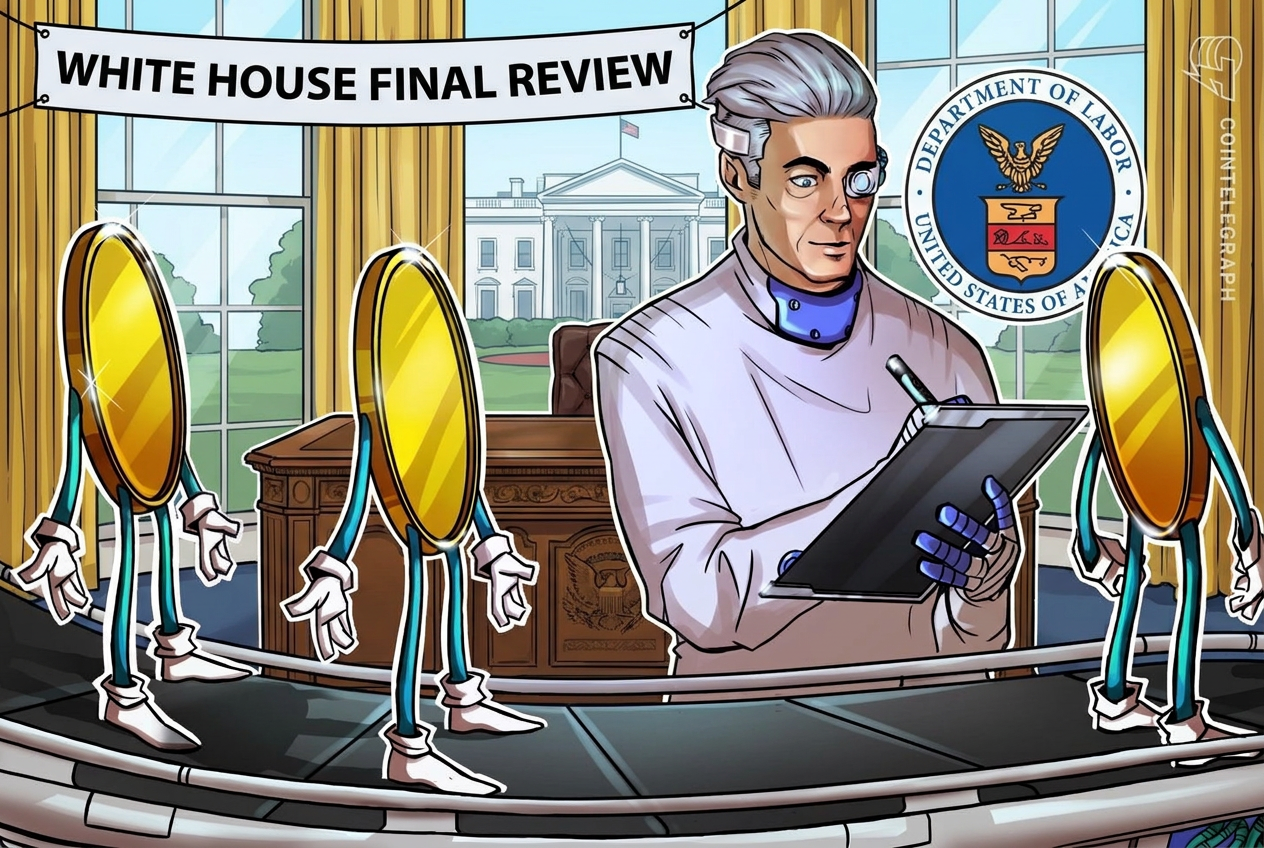
A proposed US Labor Department rule could allow smaller cryptocurrencies (altcoins) in 401(k) retirement plans, but experts say they face more hurdles than Bitcoin and Ether. The rule, now under White House final review, aims to ease offering alternative investments like crypto while giving employers and plan managers more legal protection. It doesn't specify which digital assets qualify or set a minimum market cap, but directs plan managers to weigh six factors: performance, fees, liquidity, valuation, benchmarks and complexity. Experts expect Bitcoin and Ether to be offered first given their established markets and investment products. Teresa Goody Guillén of Bellementis PLLC said altcoins aren't automatically excluded, but plan managers must show their choices are prudent, noting "big doesn't mean suitable, and small doesn't mean disqualified." Bernardo Brites of Trace Finance said most tokens fail on track record or benchmark, and the practical test is whether a plan committee can document a reliable daily price from a regulated wrapper. ETFs and managed funds will likely precede direct crypto holdings, fitting existing custody and recordkeeping systems. Brites expects some crypto options by 2027, ETFs at larger employers later that year, and wider availability by 2028, noting the rule changes legal risk, not infrastructure. Legal uncertainty remains: the proposal offers some lawsuit protection but doesn't prevent suits, and future administrations could reverse the rule, potentially making employers hesitant.

cointelegraph6h ago

US 401(k) proposal leaves door open to altcoins, but hurdles remain

cointelegraph6h ago

Russia finalizes crypto trading rules ahead of Nov. 17 rollout

Russia’s central bank has finalized rules allowing exchanges to offer Bitcoin, Ether and Tether USDt to retail investors starting Nov. 17. Non-qualified investors can buy up to 300,000 rubles (about $3,700) in crypto annually through each intermediary, including brokers, asset managers and crypto exchange providers. Qualified investors face no purchase limits, but all investors must pass a mandatory test before trading. The directive builds on legislation signed by President Vladimir Putin on Aug. 4 establishing a regulated crypto market under central bank oversight. On Aug. 11, the Bank of Russia published draft regulations identifying BTC, ETH and USDT as eligible for public trading based on market capitalization, average daily trading volume and at least five years of price history on foreign exchanges. The law took effect Sept. 1, and the Bank of Russia later authorized Sberbank, the country’s largest bank, to offer crypto exchange services in October. Moscow Exchange, Russia’s largest securities exchange and a publicly traded company, is preparing to launch crypto trading on Dec. 1, initially offering the three cryptocurrencies through pilot transactions. While expanding regulated access, Russia is also tightening restrictions outside those channels. Direct peer-to-peer crypto trading will be prohibited starting July 1, 2027, transfers from regulated digital accounts to self-custody wallets are already banned, and cryptocurrency cannot be used to pay for goods and services.

cointelegraph7h ago

Russia finalizes crypto trading rules ahead of Nov. 17 rollout

cointelegraph7h ago

Trading

Spot
活动图片