Reframing Ethereum's Valuation: Why the Fee Model is Wrong, and the 'Treasury Logic' is the Future?

marsbitPublicado em 2026-05-28Última atualização em 2026-05-28

Resumo

"Rethinking Ethereum's Value: The 'Vault Logic' Framework" Traditional valuation models incorrectly treat Ethereum as a company, valuing ETH based on transaction fees ("revenue"). This is flawed. Fees are network friction; a successful network aims to reduce them to zero. Ethereum's average fee has dropped from over $50 in 2021 to around $0.20 today, while transaction volume has tripled. Instead, view Ethereum as a digital vault securing ~$250 billion in on-chain assets (stablecoins, RWAs, L2 bridged funds, wBTC, etc.). Post-merge, Ethereum's security is directly purchased with its own asset: ETH. To attack the network, an attacker must acquire and control staked ETH. Therefore, the vault's security level is intrinsically tied to ETH's market value. Currently, the value of all staked ETH is only ~$72B, protecting ~$250B in assets—a dangerous imbalance. For robust security, the staked ETH securing the network should be valued significantly *higher* than the total value it protects. Applying a conservative security multiplier suggests ETH's fair value should be closer to ~$6,900 (vs. ~$2,070 currently). As on-chain asset value grows into the trillions, ETH's price must rise proportionally to maintain this security budget. Comparisons to free infrastructure like Linux or low-margin utilities like the DTCC are misguided. Their security is provided externally (community, law, banks). Ethereum's security is internal and must be purchased in the open market using ETH. ETH is not...

Author: Tom Dunleavy, Head of Venture Capital at Varys Capital

Compilation: Yuliya, PANews

Editor's Note: The market currently commonly views Ethereum as a traditional enterprise, calculating its price-to-earnings ratio based on the fees it generates and concluding it is overvalued. However, Tom Dunleavy proposes a completely different framework: fees are not revenue but network friction; Ethereum is not a company but a "treasury" safeguarding hundreds of billions of dollars in assets, with ETH itself being the lock. The following is a compilation of the original text:

TLDR

  • Stop focusing on fees to value Ethereum. Fees are a stumbling block; a successful network will inevitably strive to reduce fees to zero. ETH fees have dropped from over $50 at their peak in 2021 to around $0.20 now, while transaction volume has more than tripled. Plummeting fees signify network success, not failure.

  • After transitioning to Proof-of-Stake (PoS), ETH became the lock protecting the asset treasury. To attack Ethereum, you must control the staked ETH. Controlling one-third can paralyze the network; controlling two-thirds can falsify records. Either way, the cost of malicious action is calculated in ETH, and upon acting maliciously, this ETH is directly burned by the system. This tightly binds ETH's value to the network's security. No network operated this way before the staking mechanism existed.

  • Currently, there are about $250 billion in assets on the Ethereum chain (including stablecoins, tokenized assets, L2 network cross-chain funds, etc.), but the total value of staked ETH protecting these assets is only about $72 billion. This is like using a cheap, flimsy lock to protect a safe full of gold bars. Logically, ETH's fair price should be around $6,900 (currently only $2,070). If on-chain assets grow to trillions in the future, ETH's price must rise to tens of thousands to match its security responsibility.

  • Statements like "Ethereum is like the free Linux system" or "like DTCC (Depository Trust & Clearing Corporation)" are incorrect. The security of Linux and DTCC is provided externally (e.g., the open-source community's goodwill or the legal backing of governments and banks). But Ethereum's security is purchased using its own token, ETH. Therefore, ETH must be valuable, while Linux does not need to be.

  • If ETH fails, Crypto will likely fail as well.

Fees Are Not Revenue, But Friction

Last week, Bankless founder David Hoffman said he finally sold all his ETH, causing a stir in the crypto community. While I respect David's decision, I believe the way people evaluate ETH and other PoS public chains is long outdated. I've discussed my new framework with many people on podcasts, but it seems it hasn't sunk in (perhaps due to my explanation), so today I'll lay it all out clearly at once.

New things require new perspectives. Here's introducing a brand new ETH valuation model.

Many view Ethereum as a company, treating the fees collected as its operating revenue. Seeing fees decrease, they think this "company" is failing and the token is overpriced. This is completely backward; once you understand it, you'll never see it that way again.

In reality, fees are like taxes; the higher they are, the less willing people are to use the network. Lower fees encourage more people to participate, leading to more applications and capital on-chain. The data doesn't lie: the fee per transaction has dropped from over $50 in 2021 to around $0.20 now, but transaction volume has hit new highs, more than triple that of 2021, with L2s handling about 85% of transactions now. It's cheaper to use, and more people are using it. A successful settlement network should aim to reduce tolls to zero.
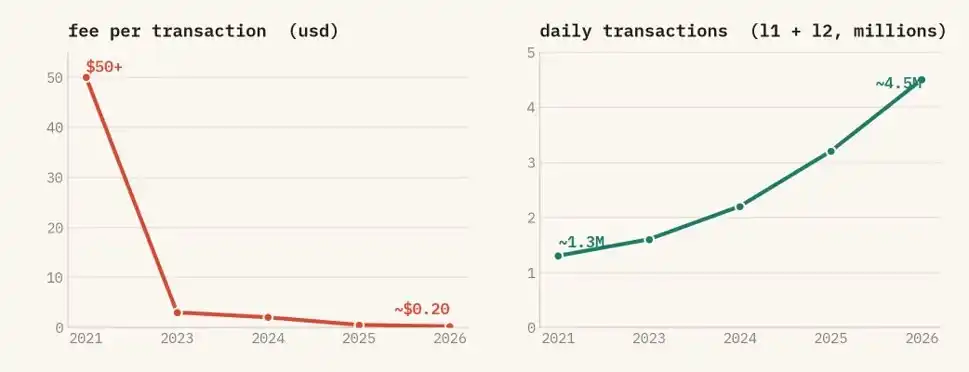
Ethereum's fees have plummeted, yet transaction volume is at a record high. It's become cheaper, and more people are using it. L2s now handle roughly 85% of the throughput.

So, if fees are the wrong metric, what is the right one?

Ethereum Is a Grand Treasury, ETH Is the Lock

Stop viewing Ethereum as a company; think of it as a massive treasury. This treasury holds approximately $160 billion in stablecoins, $20 billion in RWAs (like U.S. Treasuries, money market funds, and private credit), $35 billion in L2 cross-chain assets (with L2 networks inheriting Ethereum's consensus by design). Additionally, there's about $12 billion in wrapped Bitcoin and around $20 billion distributed across DeFi positions, NFTs, and on-chain treasuries. That totals roughly $250 billion in on-chain assets, growing each quarter.

The safety of the treasury depends entirely on that lock. And everyone has miscalculated the value of this lock. On Ethereum, this lock is forged from ETH.

In the old Proof-of-Work (PoW) system, you used mining hardware to secure the network. The lock was bought externally; its cost wasn't tied to the token's value. But now, with staking (PoS), everything has changed. To attack Ethereum now, you must buy and control the staked ETH. The lock is made from the token itself. This means the treasury's security level and the token's market price become one and the same. You can't separate them.

The Current State: A Lock Cheaper Than the Safe

This is the issue the market is ignoring. Today, the total value of all staked ETH protecting Ethereum is only $72 billion. But the assets it protects are worth $250 billion. The money in the safe is worth over twice as much as the lock protecting it.
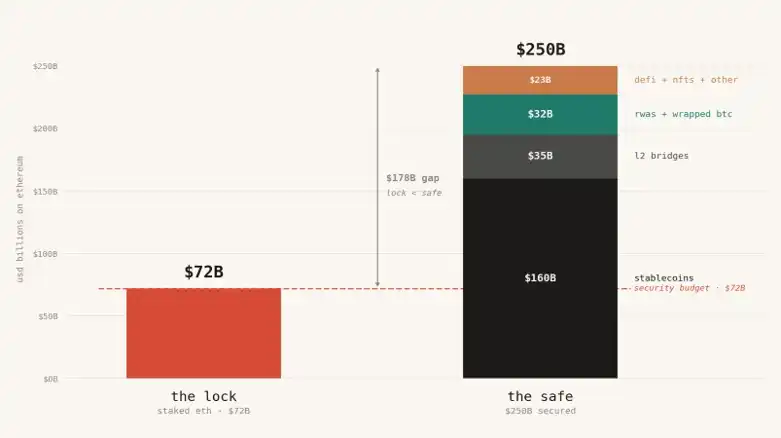
This is extremely dangerous. If what you're protecting is worth more than the cost of attacking it, your treasury is fundamentally insecure. For Ethereum to securely protect this $250 billion, the defensive staked capital must be greater than $250 billion, not less than one-third of it.

Currently, only about 30% of ETH is staked. So, simply to make this 30% stake equal the on-chain assets, ETH's total market capitalization would need to be over three times the on-chain assets (1 divided by 0.30). Currently, ETH's market cap is roughly equal to the assets it protects (around 1x). But by my logic, it should be over 3x. Calculating with the current $250 billion, ETH's fair price should be around $6,900, not the current $2,070. That is, even without a single new dollar entering, based solely on the assets it currently protects, ETH's price should more than triple. This aligns directionally with the model of BitMine Chairman Tom Lee.

"But Circle can freeze USDC, so it doesn't need ETH's protection at all."

Every time I say this, someone jumps in with this rebuttal, but it's fundamentally wrong. Here's why:

People think that if Ethereum is attacked, Circle, the issuer of USDC, can just freeze the attacker's address and reissue the tokens. So those hundreds of billions shouldn't count toward Ethereum's security responsibility.

But consider: Circle's freezing mechanism operates based on smart contracts; it executes on Ethereum and relies on Ethereum's ledger. If Ethereum's consensus is broken, there is no universally agreed-upon honest chain, and the freeze mechanism cannot function.

Furthermore, Circle could have chosen not to use Ethereum, opting for a private database instead. They chose Ethereum precisely for its neutrality, deep liquidity, and compatibility with other projects. Since they enjoy these benefits, the trade-off is: USDC's lifeline is tied to Ethereum's security. You want the benefits, you bear the dependency risk.

Moreover, people always assume the attacker wants to steal USDC. That's not it at all. If Ethereum collapses, that $150+ billion isn't stolen; it becomes trapped on a chain with no consensus, unable to be redeemed, with all loans and trades based on it thrown into chaos. The value of these assets isn't taken by a thief; it's destroyed. And that destroyed value is precisely the important factor for security considerations.

An attacker doesn't even need to steal money to profit. They can short ETH, short the entire ecosystem, or they could simply be a hostile actor profiting from paralyzing the network. The more money on-chain, the greater their incentive to cause destruction. Therefore, our security budget must grow alongside the total on-chain assets, not just guard against the small change a thief might steal.

As long as you put money on Ethereum, you consume its security, regardless of whether you have a "freeze" button. All the money must be counted.

"Ethereum is just Linux" or "Ethereum is DTCC."

Another rebuttal favored by the intellectually inclined.

  • First argument: Ethereum is like the Linux system. It's underlying infrastructure, powering the internet, but as an asset, it's worthless. Open-source infrastructure is a free public good; the money is made by the applications running on top, not the underlying protocol. So ETH will be the same: immensely important, yet utterly worthless.

  • Second argument: Ethereum is like DTCC (Depository Trust & Clearing Corporation), the infrastructure behind almost all U.S. securities transactions. DTCC processed $370 trillion in transactions in 2024, with revenues of about $2.5 billion but profits under $500 million. It's critically important, heavily regulated, but its value is only a tiny fraction of the transaction volume. Infrastructure is cheap; even if you can't live without it, even if Ethereum processes endless future transactions, it will only capture meager utility profits, nothing more.

Both arguments fail in the same place.

The security of Linux and DTCC is borrowed externally. Linux relies on the open-source community, reputation, and decades of code review. DTCC relies on U.S. law, federal regulators, and the backing of major banks with dollars and treasuries. Their security guarantees are outside the system. This is precisely why DTCC can settle massive wealth while capturing almost no value itself. It's a member-owned utility designed to operate at cost; it doesn't need a valuable token because trust is provided by the government and banks.

Ethereum has no such external shelter. No government enforces it. No member banks back it. No law can reverse stolen settlements. The only barrier between Ethereum and an attacker is the market value of the staked ETH used to secure it. Ethereum must purchase security for every block, in the open market, with its own asset.

This is the fundamental difference. Linux is software; no one is required to own a scarce asset to run it. DTCC provides collateral in dollars, external to itself. Ethereum's collateral is ETH, internal to itself. You cannot commoditize it to zero because security is not a line of code; it's a quantum of value that must be locked up and put at risk. Strip ETH of its value, and you haven't built a leaner Linux. You've built a chain with no collateral, one no one would trust with a single dollar.

So, stop comparing Ethereum to Linux or DTCC. You should compare it to the dollars and treasuries backing DTCC. No one values the dollar based on how many fees DTCC earns. You'd evaluate the clearing house's fees separately and evaluate the dollars and treasuries serving as the system's collateral—its monetary base—valued in trillions. ETH is not the clearing house. ETH is the collateral building the clearing house. That's the asset you're buying.

Linux never needed a treasury. Ethereum's security budget *is* a treasury, and it's denominated in ETH.

Looking Ahead and Market Dynamics

Following this line of thought. This model doesn't look at fees or market hype at all. It focuses on one core question: How much money will be settled on Ethereum in the future? To protect that money, how much must ETH be worth?

Stablecoins are poised to break $1 trillion in the coming years. RWA tokenization could reach several trillion by 2030. Add in various on-chain applications, and the assets Ethereum protects could soar from the current $250 billion to several trillion. Maintaining that "over 3x" security ratio constant, you can calculate how high ETH's price must rise as capital grows.
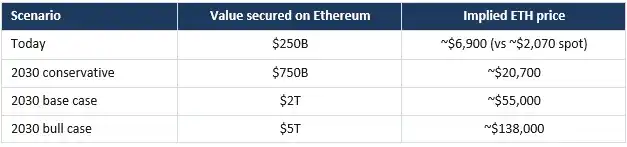
Even if you're more pessimistic and lower the security ratio a bit, it doesn't matter. On-chain capital is growing (that's the variable), and the security ratio (that's the leverage)—no matter how you calculate it, the trend is upward.

"This is blind optimism. The market will never price it this way."

This is the most pertinent rebuttal. Indeed, I'm saying what ETH "should" be worth, not what the market will price it at immediately. There's no forced arbitrage mechanism to close the gap. And my logic of "ETH should rise" has indeed been contradicted by its price performance over the past few years. Let's address each point.

  • About what bridges the gap: Ethereum is not an arbitrage; it's demand for the asset that prices the entire system. As value settles on Ethereum, ETH is used as collateral, paired trading asset, and staked to earn the network's base yield. This demand grows with the activity it supports. Reserve assets aren't priced on revenue; they're priced by how desperately the surrounding system needs to hold them. Gold is worth over $18 trillion without generating any cash flow. ETH is the reserve asset of on-chain finance, and this framework merely measures how large that reserve must be.

  • About the staking multiplier: My mental model treats the staking multiplier as a range, not a fixed target. At the current staking rate, parity (staked ETH equals protected value) is around 3.3x. A reasonable range spans from a lenient 1.7x to a strict 5x, where the cost to attack via a two-thirds stake equals the entire protected value. Price tracks protected value at some multiplier within this band. Fixing it to a specific number undermines rigor; this is also where rational people can disagree without breaking the model.

  • About reflexivity: The model does have more than one equilibrium, and nothing definitively selects the highest one. Today, Ethereum is secure enough with below-threshold coverage because acquiring a one-third stake is illiquid, slashing is brutally punitive, and the social layer can fork out an attacker. This is real. But these defenses determine whether an attack succeeds, not whether coverage is sufficient as risks escalate. Thin coverage may be tolerable when protecting $250 billion. When it involves two or five trillion in regulated institutional capital, coverage is no longer an academic question. The gradient to close the gap increases monotonically with adoption.

Finally, the most contradictory aspect is ETH's price over the past 5 years. Logically it should rise, but it has consistently fallen. I think the main reason is: previously, there wasn't enough money on-chain for people to see security as a major issue. When there was only $50 billion on-chain, nobody worried; when it grew to $175 billion, people started feeling uneasy; when it reaches $1 trillion, the first question large institutions ask before entering will undoubtedly be: "Is this chain secure?" And the answer to that question depends entirely on ETH's price. My model can't predict the exact day it will rise, but it tells you that as on-chain capital grows, this upward pressure will intensify. And "on-chain capital is growing" is a point even bears cannot deny.

Some counter with Bitcoin, saying Bitcoin's security budget is negligible compared to its market cap. But Bitcoin primarily protects itself. Ethereum protects other people's dollars and various assets—a far greater responsibility! And the trend is clear: more ETH is being staked, compliant products are continuously buying ETH, and as on-chain activity grows, the burn mechanism is constantly destroying ETH. All of this corroborates the demand growth I describe.

Those who only focus on fees and cash flow will continue shouting that ETH is overvalued. They've completely reversed cause and effect. On-chain activity comes first, and then security is needed. ETH must be valuable to secure the entire ecosystem. Fees are stumbling blocks you should strive to eliminate, not the chips you use to value ETH.


Perguntas relacionadas

QAccording to the article, why is it wrong to value Ethereum based on transaction fees?

AThe article argues that viewing transaction fees as revenue, akin to a company's income, is a flawed approach. Instead, fees are considered 'friction' or a 'tax' on the network. A successful settlement network aims to minimize this friction to encourage usage, not maximize it. The data shows that while average transaction fees have dropped significantly since 2021, transaction volume has tripled, indicating success, not failure.

QWhat is the central metaphor used to describe Ethereum's role and ETH's value in the new valuation framework?

AThe central metaphor is that Ethereum is a 'vault' or 'treasury' securing valuable assets, and ETH is the 'lock' on that vault. The security of the entire network is intrinsically linked to the market value of the staked ETH, which acts as the collateral that must be controlled or attacked to compromise the system.

QHow does the author justify the claim that Ethereum's current security budget (staked ETH value) is insufficient?

AThe author compares the total value of assets secured on Ethereum (estimated at $250 billion, including stablecoins, RWAs, L2 bridged funds, etc.) to the total value of staked ETH securing it (approximately $72 billion). This creates a dangerous imbalance where the 'lock' is cheaper than the contents of the 'vault.' For the network to be adequately secure, the defensive capital (staked ETH value) should be a multiple of the total value it protects.

QWhy does the author argue that comparing Ethereum to Linux or the DTCC is fundamentally incorrect?

AThe author states that both Linux and the DTCC derive their security and trust from external sources (open-source community reputation/government backing and legal/regulatory frameworks with bank guarantees, respectively). Ethereum has no such external backing; its only security is the market value of the staked ETH itself. Therefore, ETH cannot be commoditized to zero value because the network must 'buy' its security in the open market using its native asset.

QWhat is the primary driver for ETH's future price appreciation according to the 'treasury logic' framework presented?

AThe primary driver is the projected growth in the total value of assets settled and secured on the Ethereum network (e.g., stablecoins reaching trillions, tokenized RWAs). As this protected value increases, the market value of ETH must rise proportionally to maintain a sufficient security budget (the 'lock' must be valuable enough to protect the growing 'vault'). This creates a direct, non-speculative link between on-chain economic activity and ETH's valuation.

Leituras Relacionadas

Trading

Spot
Futuros

Artigos em Destaque

O que é ETH 2.0

ETH 2.0: Uma Nova Era para o Ethereum Introdução ETH 2.0, amplamente conhecido como Ethereum 2.0, marca uma atualização monumental à blockchain do Ethereum. Esta transição não é meramente uma mudança estética; visa melhorar fundamentalmente a escalabilidade, segurança e sustentabilidade da rede. Com uma mudança do mecanismo de consenso em Proof of Work (PoW), intensivo em energia, para um Proof of Stake (PoS) mais eficiente, o ETH 2.0 promete uma abordagem transformadora ao ecossistema blockchain. O que é ETH 2.0? ETH 2.0 é um conjunto de atualizações distintas e interconectadas focadas na otimização das capacidades e desempenho do Ethereum. Esta reformulação foi projetada para abordar desafios críticos que o mecanismo atual do Ethereum enfrentou, particularmente em relação à velocidade das transações e à congestão da rede. Objetivos do ETH 2.0 Os principais objetivos do ETH 2.0 giram em torno da melhoria de três aspectos centrais: Escalabilidade: Com o objetivo de melhorar significativamente o número de transações que a rede pode manejar por segundo, o ETH 2.0 procura ultrapassar a limitação atual de aproximadamente 15 transações por segundo, alcançando potencialmente milhares. Segurança: Medidas de segurança melhoradas são integrais ao ETH 2.0, especialmente através da resistência aprimorada contra ciberataques e da preservação do ethos descentralizado do Ethereum. Sustentabilidade: O novo mecanismo PoS foi projetado não apenas para melhorar a eficiência, mas também para reduzir drasticamente o consumo de energia, alinhando a estrutura operacional do Ethereum com considerações ambientais. Quem é o Criador do ETH 2.0? A criação do ETH 2.0 pode ser atribuída à Ethereum Foundation. Esta organização sem fins lucrativos, que desempenha um papel crucial no apoio ao desenvolvimento do Ethereum, é liderada pelo co-fundador notável Vitalik Buterin. A sua visão de um Ethereum mais escalável e sustentável tem sido a força motriz por trás desta atualização, envolvendo contribuições de uma comunidade global de desenvolvedores e entusiastas dedicados a melhorar o protocolo. Quem são os Investidores do ETH 2.0? Embora os detalhes sobre os investidores do ETH 2.0 não tenham sido tornados públicos, é sabido que a Ethereum Foundation recebe apoio de várias organizações e indivíduos no espaço da blockchain e tecnologia. Esses parceiros incluem firmas de capital de risco, empresas de tecnologia e organizações filantrópicas que compartilham um interesse mútuo em apoiar o desenvolvimento de tecnologias descentralizadas e infraestrutura de blockchain. Como Funciona o ETH 2.0? ETH 2.0 é notável por introduzir uma série de características chave que o diferenciam do seu predecessor. Proof of Stake (PoS) A transição para um mecanismo de consenso PoS é uma das mudanças de destaque do ETH 2.0. Ao contrário do PoW, que depende da mineração intensiva em energia para a verificação de transações, o PoS permite que os utilizadores validem transações e criem novos blocos de acordo com a quantidade de ETH que apostam na rede. Isso leva a uma maior eficiência energética, reduzindo o consumo em aproximadamente 99,95%, tornando o Ethereum 2.0 uma alternativa consideravelmente mais ecológica. Shard Chains As shard chains são outra inovação crítica do ETH 2.0. Estas cadeias menores operam em paralelo com a cadeia principal do Ethereum, permitindo que várias transações sejam processadas simultaneamente. Esta abordagem melhora a capacidade geral da rede, abordando preocupações de escalabilidade que têm atormentado o Ethereum. Beacon Chain No coração do ETH 2.0 está a Beacon Chain, que coordena a rede e gere o protocolo PoS. Ela atua como uma espécie de organizador: supervisiona os validadores, garante que as shards permaneçam conectadas à rede e monitora a saúde geral do ecossistema blockchain. Linha do Tempo do ETH 2.0 A jornada do ETH 2.0 tem sido marcada por vários marcos chave que traçam a evolução desta atualização significativa: Dezembro de 2020: O lançamento da Beacon Chain marcou a introdução do PoS, preparando o caminho para a migração para o ETH 2.0. Setembro de 2022: A conclusão de “The Merge” representa um momento crucial em que a rede Ethereum fez a transição com sucesso de um quadro PoW para um PoS, anunciando uma nova era para o Ethereum. 2023: O lançamento esperado das shard chains visa melhorar ainda mais a escalabilidade da rede Ethereum, solidificando o ETH 2.0 como uma plataforma robusta para aplicações e serviços descentralizados. Características Chave e Benefícios Escalabilidade Melhorada Uma das vantagens mais significativas do ETH 2.0 é a sua escalabilidade melhorada. A combinação de PoS e shard chains permite que a rede expanda a sua capacidade, permitindo que acomode um volume de transações muito maior em comparação com o sistema legado. Eficiência Energética A implementação do PoS representa um enorme passo em direção à eficiência energética na tecnologia blockchain. Ao reduzir drasticamente o consumo de energia, o ETH 2.0 não só reduz os custos operacionais, mas também se alinha mais estreitamente com os objetivos globais de sustentabilidade. Segurança Aprimorada Os mecanismos atualizados do ETH 2.0 contribuem para uma segurança melhorada em toda a rede. O uso do PoS, juntamente com medidas de controle inovadoras estabelecidas através das shard chains e da Beacon Chain, assegura um maior grau de proteção contra potenciais ameaças. Custos Mais Baixos para os Utilizadores À medida que a escalabilidade melhora, os efeitos sobre os custos de transação também serão evidentes. Aumentada a capacidade e reduzida a congestão, espera-se que isso se traduza em taxas mais baixas para os utilizadores, tornando o Ethereum mais acessível para transações do dia a dia. Conclusão ETH 2.0 marca uma evolução significativa no ecossistema da blockchain do Ethereum. Ao abordar questões fundamentais como a escalabilidade, o consumo de energia, a eficiência das transações e a segurança geral, a importância desta atualização não pode ser subestimada. A transição para o Proof of Stake, a introdução das shard chains e o trabalho fundamental da Beacon Chain são indicativos de um futuro em que o Ethereum pode atender à crescente demanda do mercado descentralizado. Em uma indústria movida pela inovação e progresso, o ETH 2.0 representa um testemunho das capacidades da tecnologia blockchain em pavimentar o caminho para uma economia digital mais sustentável e eficiente.

100 Visualizações TotaisPublicado em {updateTime}Atualizado em 2024.12.03

O que é ETH 2.0

O que é ETH 3.0

ETH3.0 e $eth 3.0: Uma Análise Profunda do Futuro do Ethereum Introdução No ambiente em rápida evolução da criptomoeda e da tecnologia blockchain, o ETH3.0, frequentemente denotado como $eth 3.0, emergiu como um tema de considerável interesse e especulação. O termo abrange dois conceitos principais que merecem esclarecimento: Ethereum 3.0: Esta representa uma potencial atualização futura destinada a aumentar as capacidades da atual blockchain do Ethereum, focando especialmente na melhoria da escalabilidade e desempenho. ETH3.0 Meme Token: Este distinto projeto de criptomoeda procura aproveitar a blockchain do Ethereum na criação de um ecossistema centrado em memes, promovendo o envolvimento na comunidade de criptomoedas. Compreender esses aspectos do ETH3.0 é essencial não apenas para entusiastas de criptomoedas, mas também para aqueles que observam as tendências tecnológicas mais amplas no espaço digital. O que é ETH3.0? Ethereum 3.0 Ethereum 3.0 é promovido como uma atualização proposta para a rede Ethereum já estabelecida, que tem sido a espinha dorsal de muitas aplicações descentralizadas (dApps) e contratos inteligentes desde a sua criação. As melhorias vislumbradas concentram-se principalmente na escalabilidade—integrando tecnologias avançadas como sharding e provas de conhecimento zero (zk-proofs). Essas inovações tecnológicas visam facilitar um número sem precedentes de transações por segundo (TPS), potencialmente alcançando milhões, abordando assim uma das limitações mais significativas enfrentadas pela tecnologia blockchain atual. A melhoria não é meramente técnica, mas também estratégica; visa preparar a rede Ethereum para uma adoção generalizada e utilidade em um futuro marcado por uma maior demanda por soluções descentralizadas. ETH3.0 Meme Token Em contraste com o Ethereum 3.0, o ETH3.0 Meme Token aventura-se por um domínio mais leve e divertido, combinando a cultura dos memes da internet com a dinâmica das criptomoedas. Este projeto permite que os usuários comprem, vendam e negociem memes na blockchain do Ethereum, proporcionando uma plataforma que fomenta o envolvimento da comunidade através da criatividade e interesses compartilhados. O ETH3.0 Meme Token visa demonstrar como a tecnologia blockchain pode interseccionar com a cultura digital, criando casos de uso que são tanto divertidos quanto financeiramente viáveis. Quem é o Criador do ETH3.0? Ethereum 3.0 A iniciativa em direção ao Ethereum 3.0 é impulsionada principalmente por um consórcio de desenvolvedores e pesquisadores dentro da comunidade Ethereum, notavelmente incluindo Justin Drake. Conhecido por suas percepções e contribuições para a evolução do Ethereum, Drake tem sido uma figura proeminente nas discussões sobre a transição do Ethereum para uma nova camada de consenso, referida como “Beam Chain”. Esta abordagem colaborativa ao desenvolvimento significa que o Ethereum 3.0 não é fruto de um único criador, mas sim uma manifestação da engenhosidade coletiva focada no avanço da tecnologia blockchain. ETH3.0 Meme Token Os detalhes sobre o criador do ETH3.0 Meme Token são atualmente indetectáveis. A natureza dos tokens de meme frequentemente leva a uma estrutura mais descentralizada e impulsionada pela comunidade, o que poderia explicar a falta de atribuição específica. Isso alinha-se com a ethos da comunidade de criptomoedas mais ampla, onde a inovação geralmente surge de esforços colaborativos em vez de esforços individuais. Quem são os Investidores do ETH3.0? Ethereum 3.0 O apoio ao Ethereum 3.0 provém principalmente da Fundação Ethereum, juntamente com uma comunidade entusiástica de desenvolvedores e investidores. Esta associação fundacional proporciona um grau significativo de legitimidade e melhora as perspectivas de uma implementação bem-sucedida, uma vez que aproveita a confiança e credibilidade construída ao longo de anos de operações de rede. Em um clima em rápida mudança no mundo das criptomoedas, o apoio da comunidade desempenha um papel crucial no impulso ao desenvolvimento e adoção, posicionando o Ethereum 3.0 como um sério candidato a futuros avanços na blockchain. ETH3.0 Meme Token Embora as fontes atualmente disponíveis não forneçam informações explícitas sobre as fundações ou organizações de investimento que apoiam o ETH3.0 Meme Token, é indicativo do modelo típico de financiamento para tokens de meme, que frequentemente depende de apoio base e engajamento da comunidade. Os investidores em tais projetos costumam consistir em indivíduos motivados pelo potencial de inovação impulsionada pela comunidade e pelo espírito de cooperação encontrado dentro da comunidade cripto. Como Funciona o ETH3.0? Ethereum 3.0 As características distintivas do Ethereum 3.0 residem em sua proposta de implementação de sharding e tecnologia zk-proof. Sharding é um método de partição da blockchain em partes menores e gerenciáveis ou “shards”, que podem processar transações simultaneamente em vez de sequencialmente. Esta descentralização do processamento ajuda a prevenir congestionamentos e garante que a rede permaneça responsiva mesmo sob carga pesada. A tecnologia de prova de conhecimento zero (zk-proof) contribui com outra camada de sofisticação ao permitir a validação de transações sem revelar os dados subjacentes envolvidos. Este aspecto não apenas melhora a privacidade, mas também aumenta a eficiência geral da rede. Há também conversas sobre a incorporação de uma Máquina Virtual Ethereum de conhecimento zero (zkEVM) nesta atualização, amplificando ainda mais as capacidades e utilidade da rede. ETH3.0 Meme Token O ETH3.0 Meme Token distingue-se ao capitalizar sobre a popularidade da cultura dos memes. Estabelece um mercado para que os usuários participem da negociação de memes, não apenas para entretenimento, mas também para potencial ganho econômico. Ao integrar recursos como staking, provisão de liquidez e mecanismos de governança, o projeto fomenta um ambiente que incentiva a interação e participação da comunidade. Ao oferecer uma mistura única de entretenimento e oportunidade econômica, o ETH3.0 Meme Token visa atrair um público diversificado, variando de entusiastas de criptomoedas a conhecedores casuais de memes. Cronologia do ETH3.0 Ethereum 3.0 11 de novembro de 2024: Justin Drake sugere a próxima atualização do ETH 3.0, centrada nas melhorias de escalabilidade. Este anúncio sinaliza o início de discussões formais sobre a futura arquitetura do Ethereum. 12 de novembro de 2024: A proposta antecipada para Ethereum 3.0 deve ser revelada no Devcon em Bangkok, preparando o cenário para um feedback mais amplo da comunidade e potenciais próximos passos no desenvolvimento. ETH3.0 Meme Token 21 de março de 2024: O ETH3.0 Meme Token é oficialmente listado no CoinMarketCap, marcando sua entrada no domínio público das criptomoedas e aumentando a visibilidade de seu ecossistema baseado em memes. Pontos Chave Em conclusão, Ethereum 3.0 representa uma evolução significativa dentro da rede Ethereum, focando em superar limitações quanto à escalabilidade e desempenho através de tecnologias avançadas. As atualizações propostas refletem uma abordagem proativa às futuras demandas e usabilidade. Por outro lado, o ETH3.0 Meme Token encapsula a essência da cultura impulsionada pela comunidade no espaço das criptomoedas, aproveitando a cultura dos memes para criar plataformas envolventes que incentivam a criatividade e participação dos usuários. Compreender os distintos propósitos e funcionalidades do ETH3.0 e $eth 3.0 é fundamental para qualquer pessoa interessada nos desenvolvimentos contínuos dentro do espaço cripto. Com ambas as iniciativas a pavimentar caminhos únicos, elas sublinham coletivamente a natureza dinâmica e multifacetada da inovação em blockchain.

100 Visualizações TotaisPublicado em {updateTime}Atualizado em 2024.12.03

O que é ETH 3.0

Como comprar ETH

Bem-vindo à HTX.com!Tornámos a compra de Ethereum (ETH) simples e conveniente.Segue o nosso guia passo a passo para iniciar a tua jornada no mundo das criptos.Passo 1: cria a tua conta HTXUtiliza o teu e-mail ou número de telefone para te inscreveres numa conta gratuita na HTX.Desfruta de um processo de inscrição sem complicações e desbloqueia todas as funcionalidades.Obter a minha contaPasso 2: vai para Comprar Cripto e escolhe o teu método de pagamentoCartão de crédito/débito: usa o teu visa ou mastercard para comprar Ethereum (ETH) instantaneamente.Saldo: usa os fundos da tua conta HTX para transacionar sem problemas.Terceiros: adicionamos métodos de pagamento populares, como Google Pay e Apple Pay, para aumentar a conveniência.P2P: transaciona diretamente com outros utilizadores na HTX.Mercado de balcão (OTC): oferecemos serviços personalizados e taxas de câmbio competitivas para os traders.Passo 3: armazena teu Ethereum (ETH)Depois de comprar o teu Ethereum (ETH), armazena-o na tua conta HTX.Alternativamente, podes enviá-lo para outro lugar através de transferência blockchain ou usá-lo para transacionar outras criptomoedas.Passo 4: transaciona Ethereum (ETH)Transaciona facilmente Ethereum (ETH) no mercado à vista da HTX.Acede simplesmente à tua conta, seleciona o teu par de trading, executa as tuas transações e monitoriza em tempo real.Oferecemos uma experiência de fácil utilização tanto para principiantes como para traders experientes.

3.1k Visualizações TotaisPublicado em {updateTime}Atualizado em 2025.03.21

Como comprar ETH

Discussões

Bem-vindo à Comunidade HTX. Aqui, pode manter-se informado sobre os mais recentes desenvolvimentos da plataforma e obter acesso a análises profissionais de mercado. As opiniões dos utilizadores sobre o preço de ETH (ETH) são apresentadas abaixo.

活动图片