Reddit Crypto Discussion: Tech Stocks Surge for 8 Months, Is the Crypto Community Starting to 'Accept Fate'?

marsbitPublicado em 2026-06-02Última atualização em 2026-06-02

Resumo

Reddit Crypto Discussion: Has the Community 'Given Up' as Tech Stocks Soar? A recent post on Reddit's r/CryptoMarkets asking if the crypto market feels "dead" compared to surging tech stocks has sparked intense debate. The discussion highlights a community grappling with underperformance: Bitcoin is down ~44% from its October 2025 high and ~20% YTD in 2026, while the S&P 500 and Nasdaq 100 have gained significantly. The debate features classic opposing views. Some users, citing Bitcoin's history, are "cycle believers" who anticipate a return to form, arguing it has "died" many times before. Others counter that crypto's narratives keep shifting without delivering a stable, compelling real-world use case beyond speculation. A prevalent third view pinpoints AI as the core issue: the tech sector's transformative boom is absorbing all attention and capital, while crypto lacks a comparable, impactful utility. Data supports the pessimistic mood. Bitcoin spot ETFs saw their largest monthly net outflow in May 2026 (~$2.3B), indicating institutional de-risking. The Crypto Fear & Greed Index has fallen to "Fear" levels. When asked about the timing of a potential market rotation back to crypto, answers are uncertain. A key practical point raised is the current high-interest-rate environment, which makes stable yields from cash and bonds attractive, reducing incentive to move into volatile assets like crypto. The underlying anxiety, as one user summarized, is "opportunity cost"—the w...

Recently, a post on the Reddit subreddit r/CryptoMarkets quietly gained popularity. The poster, harukasweet, asked only one question:

"The crypto market feels lifeless. Compared to tech stocks, the crypto market has been dormant over the past year. Will the capital rotation happen again? Or have people given up on crypto?"

This post, tinged with expectation and pathos, sparked over a hundred replies. It becomes clear that not only is the Chinese crypto community discussing this issue; the reality that only crypto isn't rising is now stimulating the sentiment of the entire crypto community indiscriminately, regardless of language.

The intensity of the debate isn't due to someone presenting new evidence, but because each side is using the other's failure to prove their own correctness. This atmosphere of mutual criticism in the discussion is itself a microcosm of the current crypto community's sentiment.

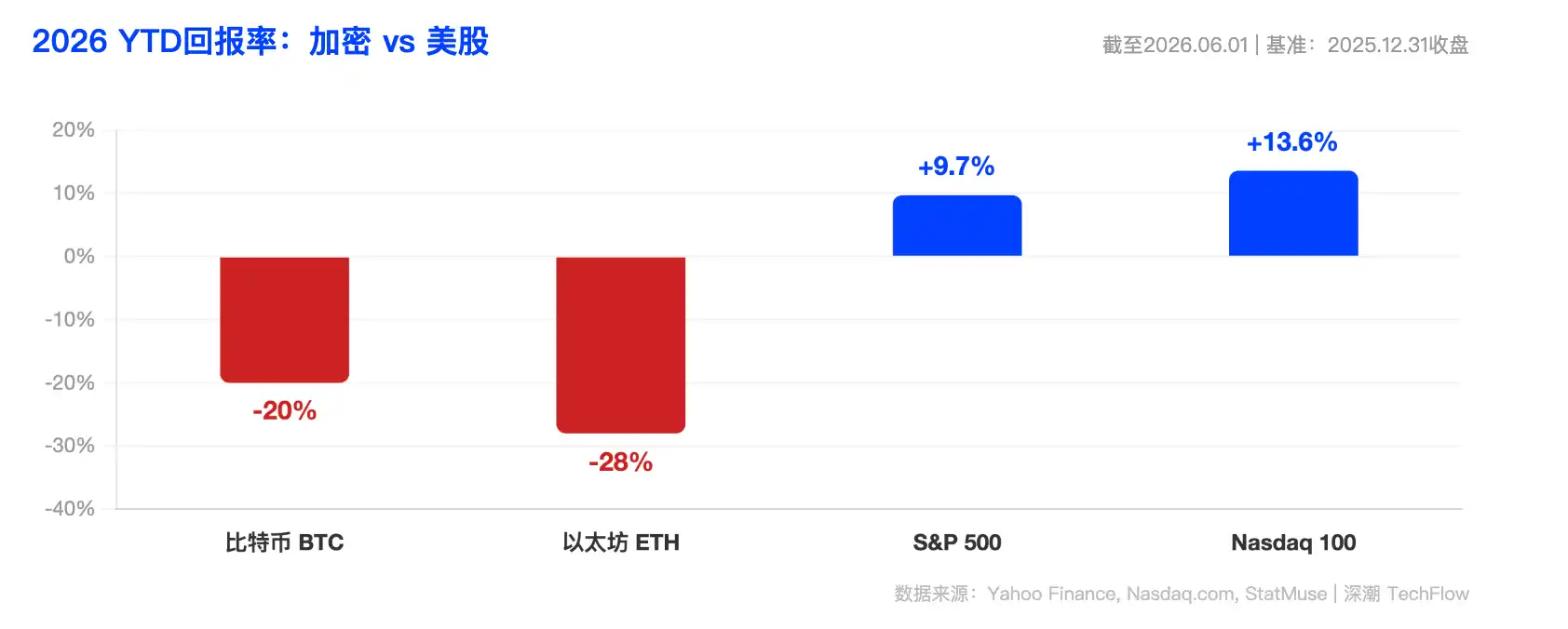
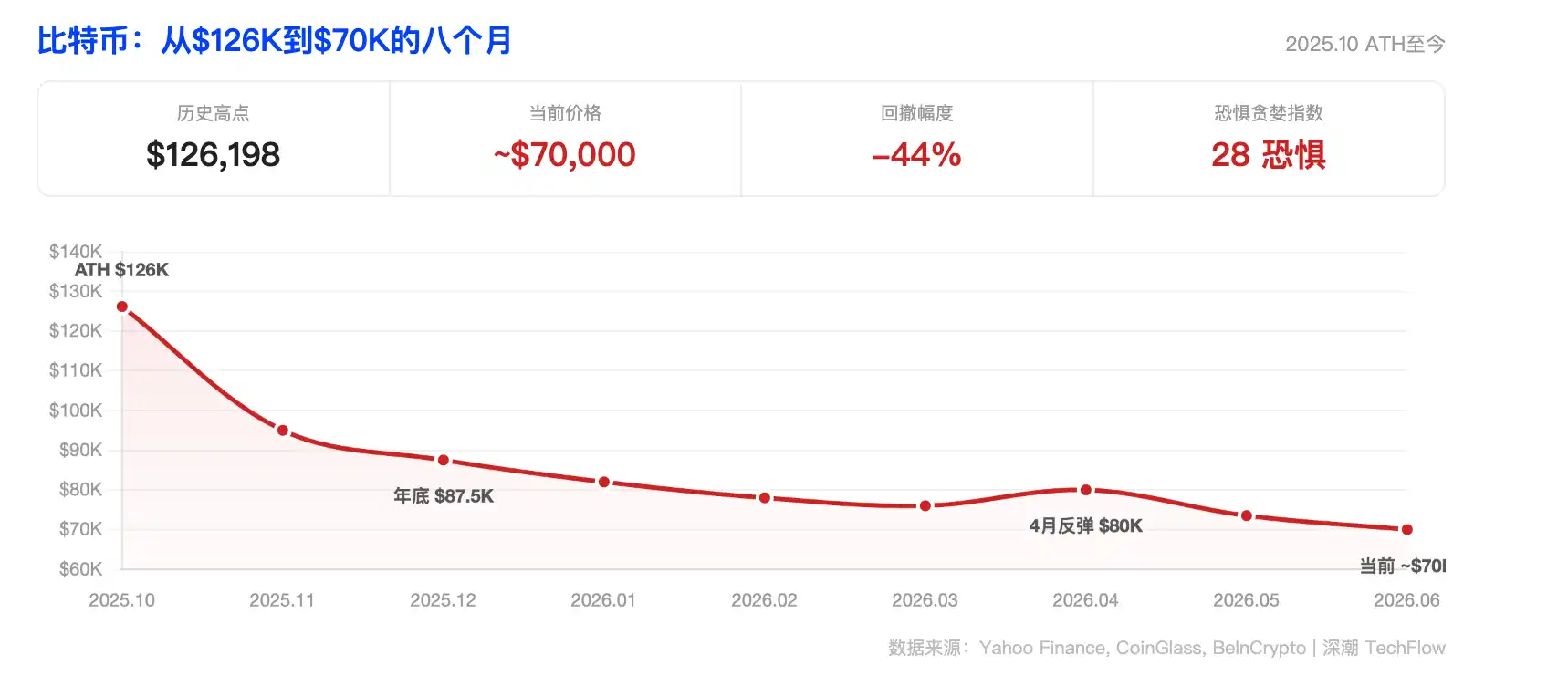
Bitcoin has retreated from its October 2025 all-time high of $126,198 to around $70,000 currently, a drop of about 44%; its Year-to-Date (YTD) decline for 2026 is about 20%. During the same period, the S&P 500 is up about 9.7% YTD. The Nasdaq 100 is up about 13.6%.

With one line rising and the other falling, the gap between them can no longer be described as merely "underperforming."
"Bitcoin Has Died Over 800 Times" vs "The Narrative Really Can't Hold Up This Time"

The most tense exchange in the Reddit discussion occurred between users Giordano86 and think_harder_plz.

Giordano86 is a classic cycle believer: "Be greedy when others are fearful. Markets have cycles. People will soon rotate back into Bitcoin." When someone rebutted, he directly threw out data: "Go look at Bitcoin's 17-year history and tell me you haven't seen cycles. Bitcoin has 'died' over 800 times, it's fine."

Another user, Powerful_Respect_400, was more direct: "I've been here since 2017. The 2017 bull run, the 2021 bull run, 2025... every four years. We might have to wait until 2029."

think_harder_plz's counterattack was equally sharp: Bitcoin's narrative has been constantly "upgrading," from peer-to-peer electronic cash, to digital gold, to an inflation hedge, to an institutional reserve asset. "Every time an old narrative fails, a new one is swapped in." His conclusion: "Cryptocurrency hasn't existed long enough to make such confident assertions. This is the beginning of the end."

Interestingly, another user, keepitcasualbrah, accurately pinpointed the self-contradiction in this statement:

You say in the first part "hasn't existed long enough to conclude," and in the latter part conclude "this is the beginning of the end." This rebuttal gained considerable agreement.
AI Stole the Attention, But What Crypto Truly Lost Was 'Use Cases'

If it were just the old tunes of cycle theory versus end-of-theory, this post wouldn't have triggered so many replies. What truly hit the nerve was the third type of voice: the crypto market is losing not to a bear market, but to AI.

The comment by user optifree1 was heavily cited: "The tech industry is experiencing a once-in-decades productivity revolution, AI is genuinely changing how people work and live. This wave of enthusiasm has sucked away attention from all other markets, and cryptocurrency hasn't yet found any use case with influence close to that of the AI boom."

Crypto's structural issues are indeed evident. Several users corroborated the same judgment from different angles:

The crypto market lacks real use cases for support. User i_am_13th_panic pointed out that despite crypto companies' efforts to expand applications, the only solid use for most cryptocurrencies is "to speculate with it, use it to speculate, or stake it."

User Usually_Sunny raised a sharper paradox: For a currency to be "useful," its value must be relatively stable, but Bitcoin's core investment logic is precisely built on price volatility.

The poster harukasweet also admitted: "Yes, only stablecoins are somewhat useful, DeFi maybe has some use, but too many hacks."

Data Perspective: Institutions Are Pulling Out, Not Just Retail

The Reddit discussion is emotional, but capital flows provide colder validation.

According to BeInCrypto data, Bitcoin spot ETFs recorded approximately $2.3 billion in net outflows in May 2026, the largest monthly outflow for the year and the largest since November 2025. The preceding April and March saw net inflows of about $1.97 billion and $1.32 billion, respectively. Cumulative net ETF inflows have dropped from $58.09 billion in April to $55.79 billion.
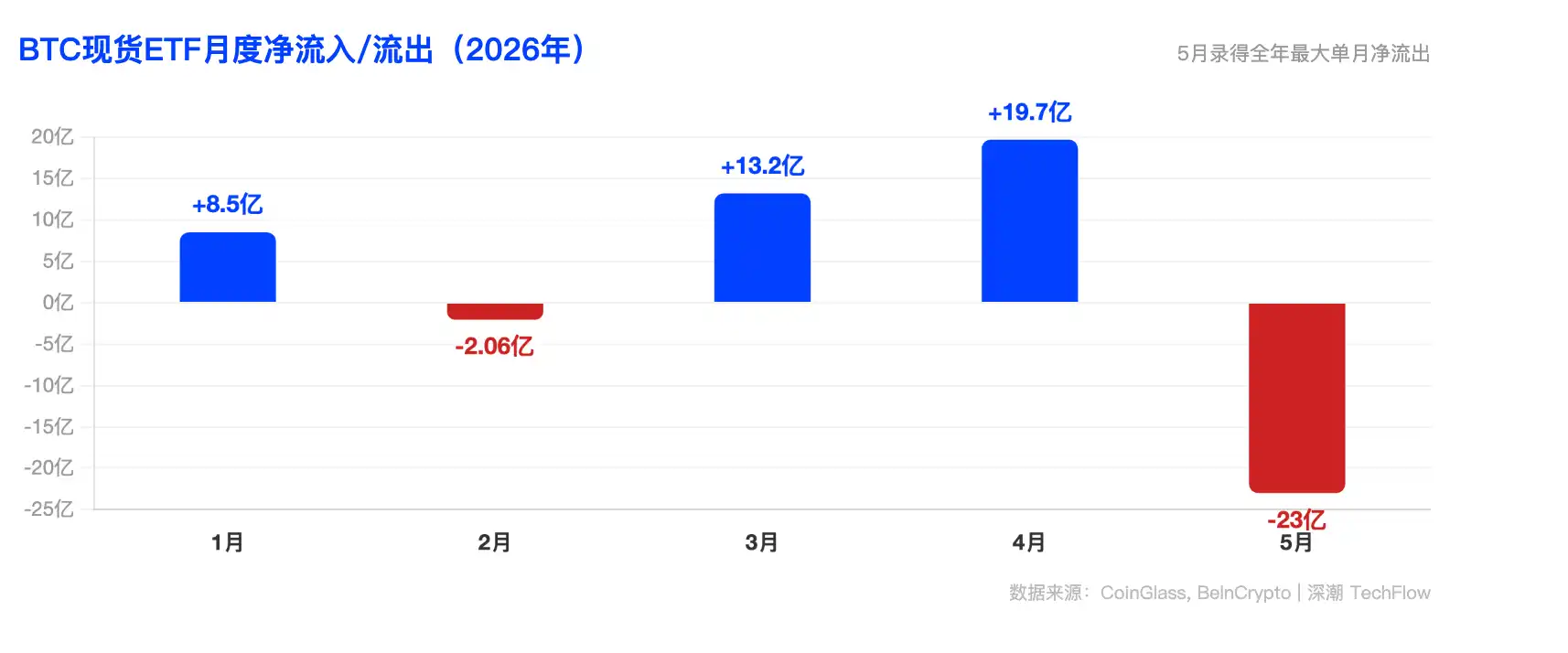
In May, BTC fell only about 3.7%, but the ETF outflow scale was over 10 times the $206 million net redemption in February. Institutions' speed of de-risking is noticeably faster than what the price decline itself suggests.

Meanwhile, the Fear & Greed Index dropped to 28 (Fear), with market sentiment at its lowest level in 2026.

So When Is the Next Rotation Coming?

This is the question the poster harukasweet repeatedly pressed. The answers varied widely, but the honesty was surprisingly high.

User only_linear_joseph's analysis was more pragmatic: Cash and bond yields are now very competitive, which was rare before. As long as the high-interest-rate environment persists, capital has no incentive to flow from fixed income to high-volatility assets. After discussing with the poster, he even self-corrected a contradiction: If inflation remains high, the Fed won't cut rates, and crypto will continue to be left out in the cold.

No one gave a definitive answer. But one comment in the thread perhaps summarizes most people's true state of mind: When asked "what's the hurry," user harukasweet replied with two words: "Opportunity cost."

Every day money isn't in the crypto market is money making gains elsewhere. This is the real source of anxiety in the current crypto community—not "will it come back," but "what am I missing while waiting for it to come back."

Data as of June 2, 2026. This article is an observation of sentiment and does not constitute investment advice.


Perguntas relacionadas

QWhat are the two main opposing viewpoints regarding Bitcoin's future as discussed in the Reddit thread?

AThe two main opposing viewpoints are the cyclical believers and the 'endgame' believers. Cyclical believers, like user Giordano86, argue that Bitcoin operates on predictable multi-year cycles and will recover as it has in the past. 'Endgame' believers, like user think_harder_plz, argue that Bitcoin's narrative keeps shifting as old use cases fail and that this period might mark the beginning of its decline, citing its relatively short history.

QAccording to the article, what major technological trend is currently diverting attention and capital away from the cryptocurrency market?

AAccording to the article and user comments, the major trend is the Artificial Intelligence (AI) revolution. Users like optifree1 argue that AI is a once-in-a-decades productivity revolution with real-world impact, drawing attention and capital away from cryptocurrencies, which are seen as lacking comparable widespread, practical use cases.

QWhat key structural problem with cryptocurrencies is highlighted by the Reddit users?

AThe key structural problem highlighted is the lack of real-world, practical use cases. Users point out that most cryptocurrencies primarily serve purposes like speculation, trading, or staking. A paradox is noted: for a currency to be broadly 'useful,' it needs price stability, but Bitcoin's core investment thesis is built on price volatility. Only stablecoins are acknowledged as having consistent utility.

QWhat does the data on Bitcoin ETF flows in May 2026 indicate about institutional sentiment?

AThe data indicates a significant shift to negative institutional sentiment. In May 2026, Bitcoin spot ETFs recorded approximately $2.3 billion in net outflows, the largest single-month outflow for the year and the largest since November 2025. This outflow was over 10 times larger than the net redemptions in February, suggesting institutions are de-risking at a pace faster than the modest 3.7% price decline that month would imply.

QWhat does the user 'harukasweet' identify as the true source of anxiety for the current crypto community?

AUser harukasweet identifies 'opportunity cost' as the true source of anxiety. The concern is not just whether cryptocurrency prices will recover, but what potential gains in other markets (like the surging tech stocks) are being missed while waiting for a crypto market revival. This fear of missing out on better-performing assets is the core driver of current community frustration.

Leituras Relacionadas

Former CFTC Chairman, Circle President Tarbert: Preaching Long-Termism While Cashing Out $30 Million Himself

Former CFTC Chairman and Circle President Heath Tarbert has consistently advocated for a long-term vision in public, urging patience from investors as Circle’s stock price has fallen significantly from its peak. However, it has been revealed that since Circle’s IPO, Tarbert has continuously sold his CRCL shares through pre-arranged trading plans, cashing out approximately $30 million, without making any public market purchases. This contrast between his public messaging and personal actions has drawn criticism. Tarbert joined Circle in July 2023 as Chief Legal Officer, leveraging his regulatory experience to help guide the company through its IPO and expansion. Despite promoting stablecoins as long-term infrastructure, he established a 10b5-1 trading plan just before Circle went public, leading to substantial stock sales over the following year. In March 2026, he initiated another plan to sell more shares. His career trajectory highlights a pattern of moving between high-level regulatory roles and influential positions in the financial sector. After resigning as CFTC Chairman in early 2021, he joined Citadel Securities as Chief Legal Officer just 27 days later, during a period of intense regulatory scrutiny for the firm. He later joined Circle, aiding its efforts to navigate regulatory challenges for its public listing. While Tarbert's expertise in policy and compliance is valuable to companies like Circle, his actions—advocating long-term confidence while personally divesting—raise questions about the alignment between his public statements and his private financial decisions, leaving investors who followed his advice to bear the market risks.

marsbitHá 14m

Former CFTC Chairman, Circle President Tarbert: Preaching Long-Termism While Cashing Out $30 Million Himself

marsbitHá 14m

Gate Research Institute: The 'Wall Street-ization' Wave of Crypto Financial Products – Competition or Integration?

The article titled "Gate Research Institute: Are Crypto Financial Products Sparking a 'Wall Street' Wave—Competition or Convergence?" explores the evolving relationship between the crypto ecosystem and traditional finance (TradFi). The piece begins by reflecting on Bitcoin's original 2009 vision of decentralization, disintermediation, and moving away from banks. It then contrasts this with the 2024 landscape, where key crypto assets like Bitcoin are increasingly held through Wall Street products like ETFs issued by giants like BlackRock. The article questions whether this signifies that TradFi is systematically taking over the rights to issue, price, custody, and distribute crypto financial assets. The core argument is that this is not a zero-sum takeover but rather a bidirectional convergence where each side addresses the other's weaknesses. Crypto offers 24/7 global markets, programmable settlement, and open access but lacks compliant channels, institutional-grade custody, deep fiat liquidity, and mainstream distribution. TradFi possesses these but is constrained by legacy systems, limited operating hours, and slow settlement. Two primary convergence paths are highlighted: * **Path A (CEX to TradFi):** Exemplified by Gate, which has progressed from offering tokenized stocks and CFDs to providing direct, real stock trading (US, Hong Kong, South Korea) within its platform, using USDT. * **Path B (TradFi to Crypto):** Exemplified by Robinhood, which has integrated crypto trading, acquired exchanges like Bitstamp, and is moving traditional assets like stocks onto the blockchain via tokenization and its own Layer 2. Both paths are ultimately competing to become the next-generation, unified financial account—a "super account" where users can seamlessly trade cryptocurrencies, stocks, ETFs, RWA (Real World Assets), and tokenized treasury products in one interface. The growth of RWA and tokenized treasuries (e.g., BlackRock's BUIDL) is presented as the asset-layer fusion, providing stable, yield-bearing assets on-chain and acting as a bridge between the two worlds. In conclusion, the "Wall Street-ization" of crypto is framed as a mutual transformation. Decentralized ideals persist in the protocol layer, while at the application layer, a more efficient, global, and accessible unified capital market is emerging from this convergence. The future competition lies not between crypto exchanges and stockbrokers, but between platforms vying to offer the most comprehensive asset coverage, liquidity, and user experience within a single account.

marsbitHá 18m

Gate Research Institute: The 'Wall Street-ization' Wave of Crypto Financial Products – Competition or Integration?

marsbitHá 18m

Claude's Major New Feature: Screen Recording + Voice, Distilling Your Skills into AI Tasks in One Click

Claude has introduced a major new feature called "Record a Skill," available for Pro, Max, and Team users. This function, found in the Claude desktop app's CoWork menu, allows users to create reusable AI skills simply by recording their screen and providing voice narration while performing a task. Claude then automatically analyzes the recording and generates a functional Skill. A hands-on test confirmed the feature works seamlessly. Users start recording via the Skills manager, perform their workflow while verbally explaining the steps and logic, and avoid including sensitive information. After recording, Claude processes the content and creates the Skill, which can be saved and later invoked with a slash command (/). This eliminates the need for manual adjustments or writing complex instruction files. The innovation goes beyond mere efficiency. Previously, creating a Skill required writing a detailed SKILL.md file in Markdown—a significant barrier for non-technical users. "Record a Skill" bypasses this by directly capturing both actions and the implicit reasoning shared in the narration. This lowers the barrier to knowledge transfer and automation, addressing a core challenge in corporate knowledge management: the difficulty of getting experts to write and maintain documentation. However, the feature also highlights a shift in the nature of work. A case study from March 2026 showed a freelancer whose five-year client relationship was effectively replaced by a hand-coded Claude Skill automating their content workflow. With the even lower barrier of screen recording, the ability to distill personal expertise into automatable skills accelerates this trend. The "moat" for work is moving from simply knowing how to do a task to mastering tasks that are difficult or impossible to automate.

marsbitHá 23m

Claude's Major New Feature: Screen Recording + Voice, Distilling Your Skills into AI Tasks in One Click

marsbitHá 23m

Feeding AI "Noise" Can Also Boost Scores, This Work Enables Positive Transfer with Noise

Feeding "Noise" to AI Can Improve Performance: A Method Enables Positive Transfer from Noise This work, Semi-Supervised Noise Adaptation (SSNA), introduces a Noise Adaptation Framework (NAF) that challenges traditional transfer learning. Instead of requiring a labeled source domain of real data (e.g., images, text), NAF uses randomly generated Gaussian noise as the source. For a target task with C classes, it constructs C noise clusters by sampling from Gaussian distributions. Although this synthetic noise contains no semantic meaning, NAF trains it to form a discriminative class structure in a shared representation space—clustering same-class noise and separating different classes. The key is aligning this learned structure from the noise domain to the real, sparsely labeled target domain. A small number of target labels are still essential to establish the correspondence between noise clusters and actual classes. The training objective combines: 1) supervised loss on the few labeled target samples, 2) classification loss for the noise to build its structure, and 3) a distribution alignment loss (using Negative Domain Similarity) to minimize the gap between the noise and target domains in the shared space. Experiments show significant gains in few-label settings. With just 4 labels per class, NAF with a ResNet-18 backbone improves accuracy over a standard supervised baseline (ERM) by +12.35% on CIFAR-10, +7.61% on CIFAR-100, +4.38% on DTD-47, and +2.74% on Caltech-101. It also benefits fine-grained datasets and scales to ImageNet-1K (with 100 labels/class) and text classification (AG News). NAF can be integrated into existing semi-supervised methods like FixMatch for further gains. Ablation studies confirm the transferred benefit comes from the discriminative structure of the noise, not randomness itself. Collapsing all noise into a single point causes negative transfer, while increasing separation between noise cluster centers improves performance. The amount of noise per class is less critical once a basic structure forms. In conclusion, this work demonstrates that for positive transfer, the semantic content of source data may not be necessary. What can be effectively transferred is the *organizational structure* of categories within a representation space. This offers a promising alternative for scenarios where real source data is unavailable due to privacy, copyright, or procurement constraints.

marsbitHá 24m

Feeding AI "Noise" Can Also Boost Scores, This Work Enables Positive Transfer with Noise

marsbitHá 24m

Trading

Spot
活动图片




