Recently, a post on the Reddit subreddit r/CryptoMarkets quietly gained popularity. The poster, harukasweet, asked only one question:
"The crypto market feels lifeless. Compared to tech stocks, the crypto market has been dormant over the past year. Will the capital rotation happen again? Or have people given up on crypto?"
This post, tinged with expectation and pathos, sparked over a hundred replies. It becomes clear that not only is the Chinese crypto community discussing this issue; the reality that only crypto isn't rising is now stimulating the sentiment of the entire crypto community indiscriminately, regardless of language.

The intensity of the debate isn't due to someone presenting new evidence, but because each side is using the other's failure to prove their own correctness. This atmosphere of mutual criticism in the discussion is itself a microcosm of the current crypto community's sentiment.
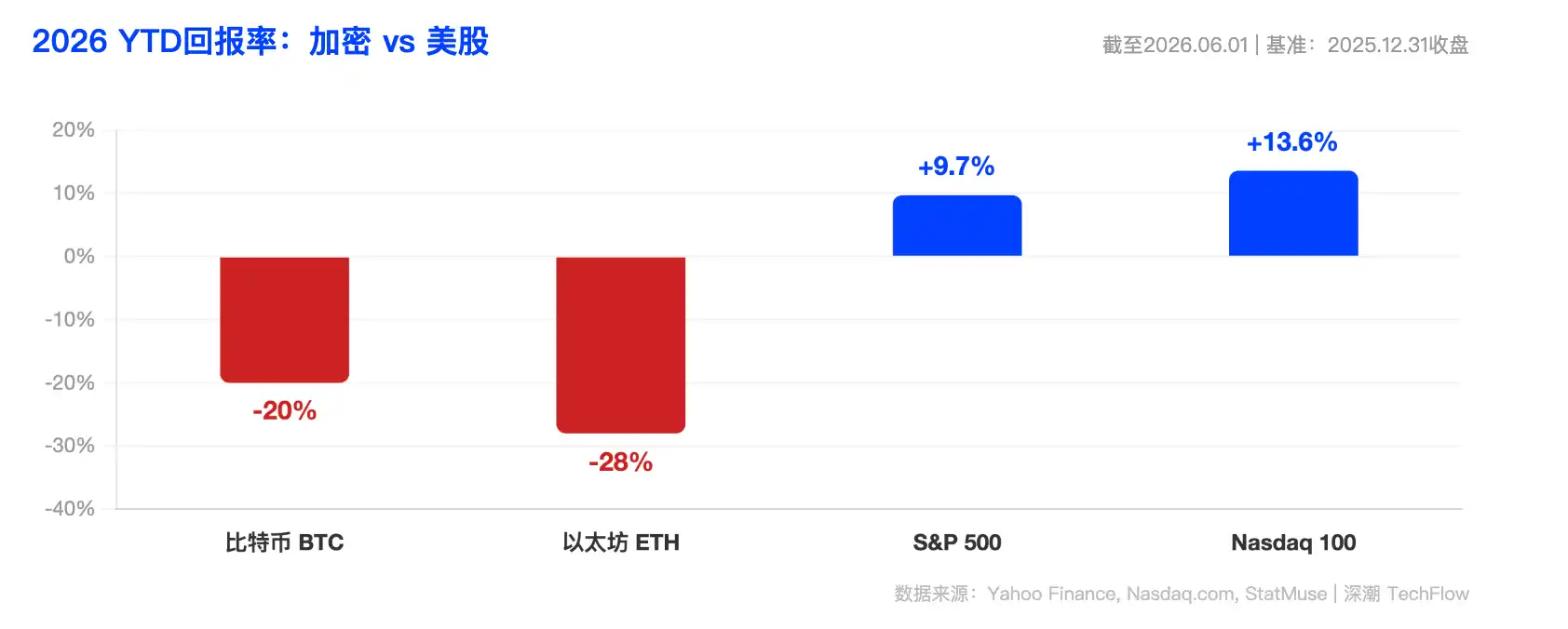
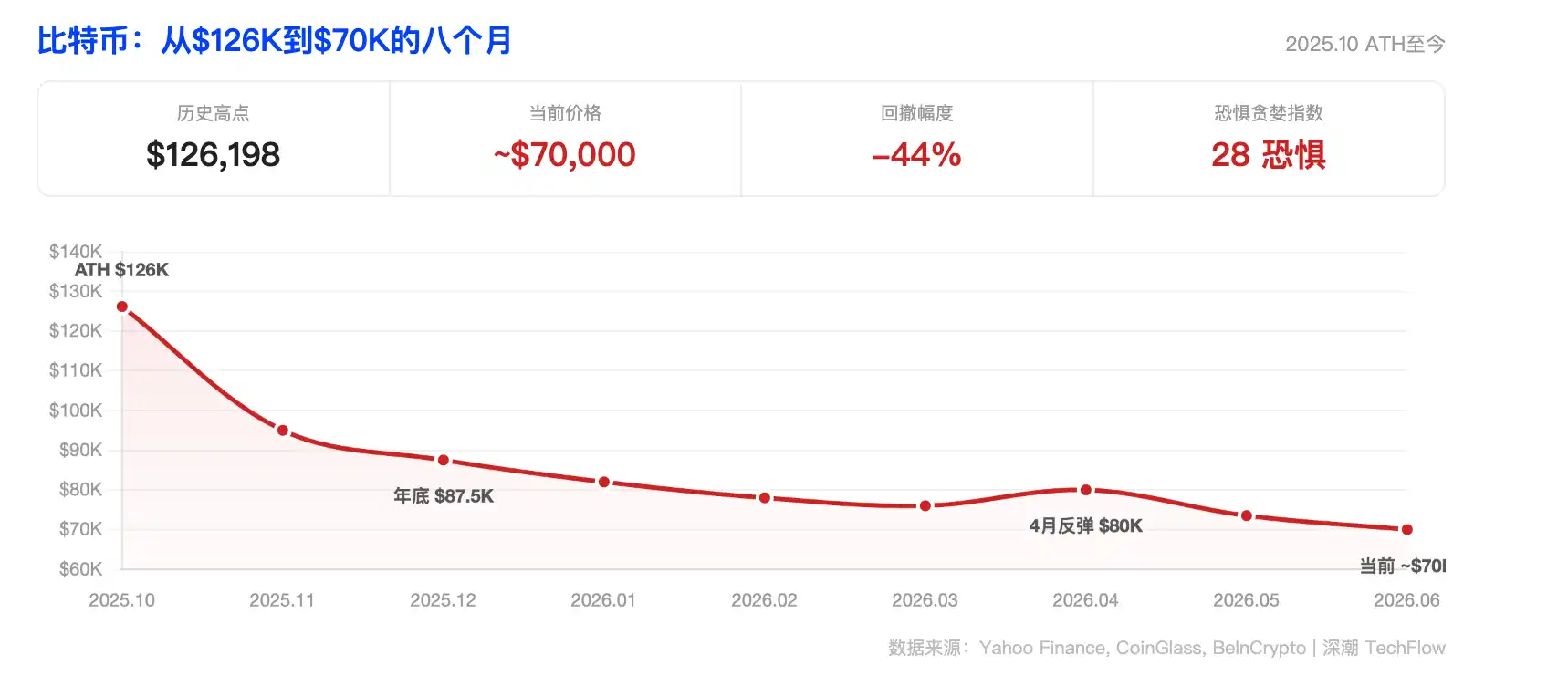
Bitcoin has retreated from its October 2025 all-time high of $126,198 to around $70,000 currently, a drop of about 44%; its Year-to-Date (YTD) decline for 2026 is about 20%. During the same period, the S&P 500 is up about 9.7% YTD. The Nasdaq 100 is up about 13.6%.
With one line rising and the other falling, the gap between them can no longer be described as merely "underperforming."
"Bitcoin Has Died Over 800 Times" vs "The Narrative Really Can't Hold Up This Time"
The most tense exchange in the Reddit discussion occurred between users Giordano86 and think_harder_plz.
Giordano86 is a classic cycle believer: "Be greedy when others are fearful. Markets have cycles. People will soon rotate back into Bitcoin." When someone rebutted, he directly threw out data: "Go look at Bitcoin's 17-year history and tell me you haven't seen cycles. Bitcoin has 'died' over 800 times, it's fine."
Another user, Powerful_Respect_400, was more direct: "I've been here since 2017. The 2017 bull run, the 2021 bull run, 2025... every four years. We might have to wait until 2029."
think_harder_plz's counterattack was equally sharp: Bitcoin's narrative has been constantly "upgrading," from peer-to-peer electronic cash, to digital gold, to an inflation hedge, to an institutional reserve asset. "Every time an old narrative fails, a new one is swapped in." His conclusion: "Cryptocurrency hasn't existed long enough to make such confident assertions. This is the beginning of the end."
Interestingly, another user, keepitcasualbrah, accurately pinpointed the self-contradiction in this statement:
You say in the first part "hasn't existed long enough to conclude," and in the latter part conclude "this is the beginning of the end." This rebuttal gained considerable agreement.
AI Stole the Attention, But What Crypto Truly Lost Was 'Use Cases'
If it were just the old tunes of cycle theory versus end-of-theory, this post wouldn't have triggered so many replies. What truly hit the nerve was the third type of voice: the crypto market is losing not to a bear market, but to AI.
The comment by user optifree1 was heavily cited: "The tech industry is experiencing a once-in-decades productivity revolution, AI is genuinely changing how people work and live. This wave of enthusiasm has sucked away attention from all other markets, and cryptocurrency hasn't yet found any use case with influence close to that of the AI boom."
Crypto's structural issues are indeed evident. Several users corroborated the same judgment from different angles:
The crypto market lacks real use cases for support. User i_am_13th_panic pointed out that despite crypto companies' efforts to expand applications, the only solid use for most cryptocurrencies is "to speculate with it, use it to speculate, or stake it."
User Usually_Sunny raised a sharper paradox: For a currency to be "useful," its value must be relatively stable, but Bitcoin's core investment logic is precisely built on price volatility.
The poster harukasweet also admitted: "Yes, only stablecoins are somewhat useful, DeFi maybe has some use, but too many hacks."
Data Perspective: Institutions Are Pulling Out, Not Just Retail
The Reddit discussion is emotional, but capital flows provide colder validation.
According to BeInCrypto data, Bitcoin spot ETFs recorded approximately $2.3 billion in net outflows in May 2026, the largest monthly outflow for the year and the largest since November 2025. The preceding April and March saw net inflows of about $1.97 billion and $1.32 billion, respectively. Cumulative net ETF inflows have dropped from $58.09 billion in April to $55.79 billion.
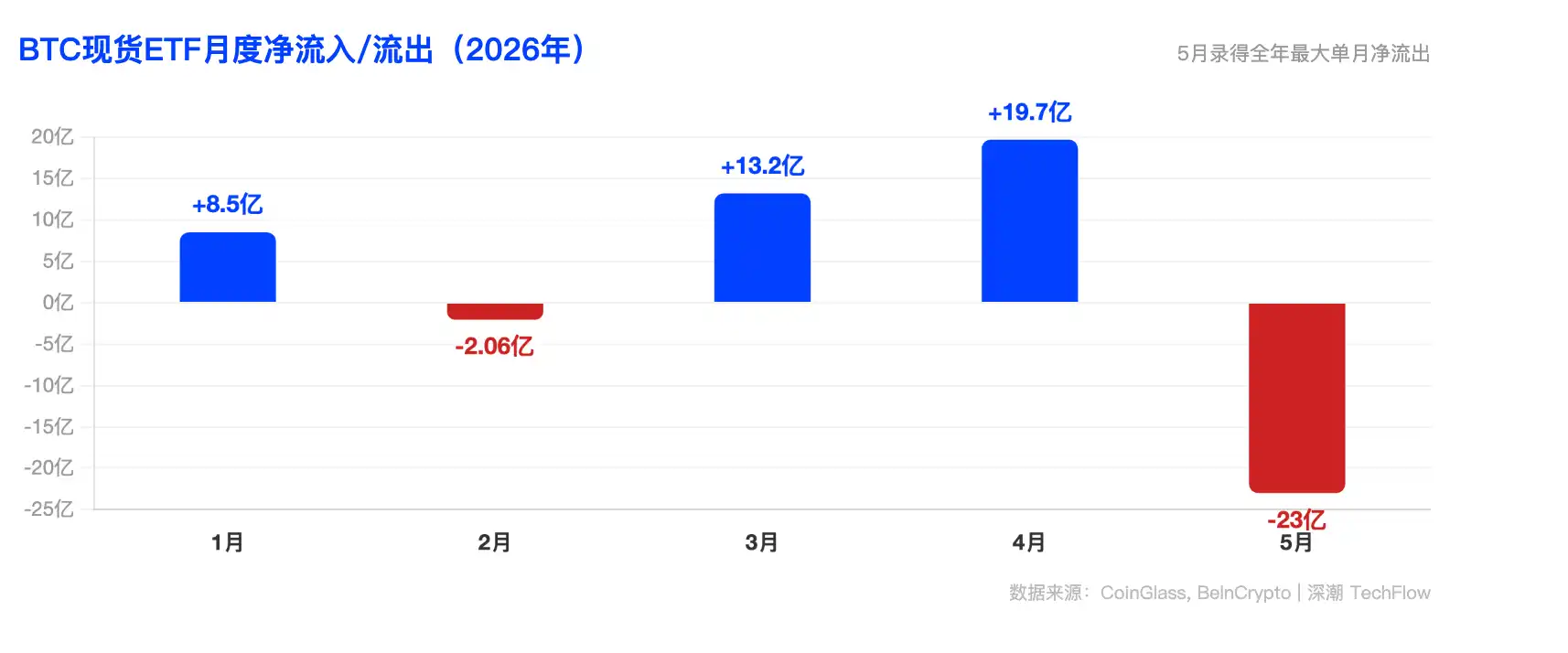
In May, BTC fell only about 3.7%, but the ETF outflow scale was over 10 times the $206 million net redemption in February. Institutions' speed of de-risking is noticeably faster than what the price decline itself suggests.
Meanwhile, the Fear & Greed Index dropped to 28 (Fear), with market sentiment at its lowest level in 2026.
So When Is the Next Rotation Coming?
This is the question the poster harukasweet repeatedly pressed. The answers varied widely, but the honesty was surprisingly high.
User only_linear_joseph's analysis was more pragmatic: Cash and bond yields are now very competitive, which was rare before. As long as the high-interest-rate environment persists, capital has no incentive to flow from fixed income to high-volatility assets. After discussing with the poster, he even self-corrected a contradiction: If inflation remains high, the Fed won't cut rates, and crypto will continue to be left out in the cold.
No one gave a definitive answer. But one comment in the thread perhaps summarizes most people's true state of mind: When asked "what's the hurry," user harukasweet replied with two words: "Opportunity cost."
Every day money isn't in the crypto market is money making gains elsewhere. This is the real source of anxiety in the current crypto community—not "will it come back," but "what am I missing while waiting for it to come back."
Data as of June 2, 2026. This article is an observation of sentiment and does not constitute investment advice.