Red Alert: Bank of Japan's 25bp Rate Hike Imminent, Are US Stocks and Crypto Set for a Repeat of the 2024 Flash Crash?

marsbitPublicado em 2026-06-11Última atualização em 2026-06-11

Resumo

Japanese central bank likely to raise interest rates by 25 basis points to 1.0% in June, its highest level since 1995, with market probability at 98%. This move, driven by persistent inflation risks from energy costs and a weak yen, risks triggering a "carry trade" unwind. Investors who borrowed cheap yen to invest in higher-yield assets like US stocks and crypto may be forced to sell, potentially causing significant volatility. An estimated $500 billion in yen-funded positions remains vulnerable. This could mirror the August 2024 flash crash, where a yen surge triggered a global stock sell-off and a sharp Bitcoin drop. High-valuation AI and tech stocks are particularly sensitive to tighter global liquidity and rising energy costs. Cryptocurrencies, as high-beta assets, face amplified risk from higher leverage costs and competing for scarcer market liquidity. Analysts warn of short-term pressure on risk assets, advising caution regarding leverage amid heightened volatility.

Original | Odaily Planet Daily (@OdailyChina)

Author | Qin Xiaofeng (@QinXiaofeng 888 )
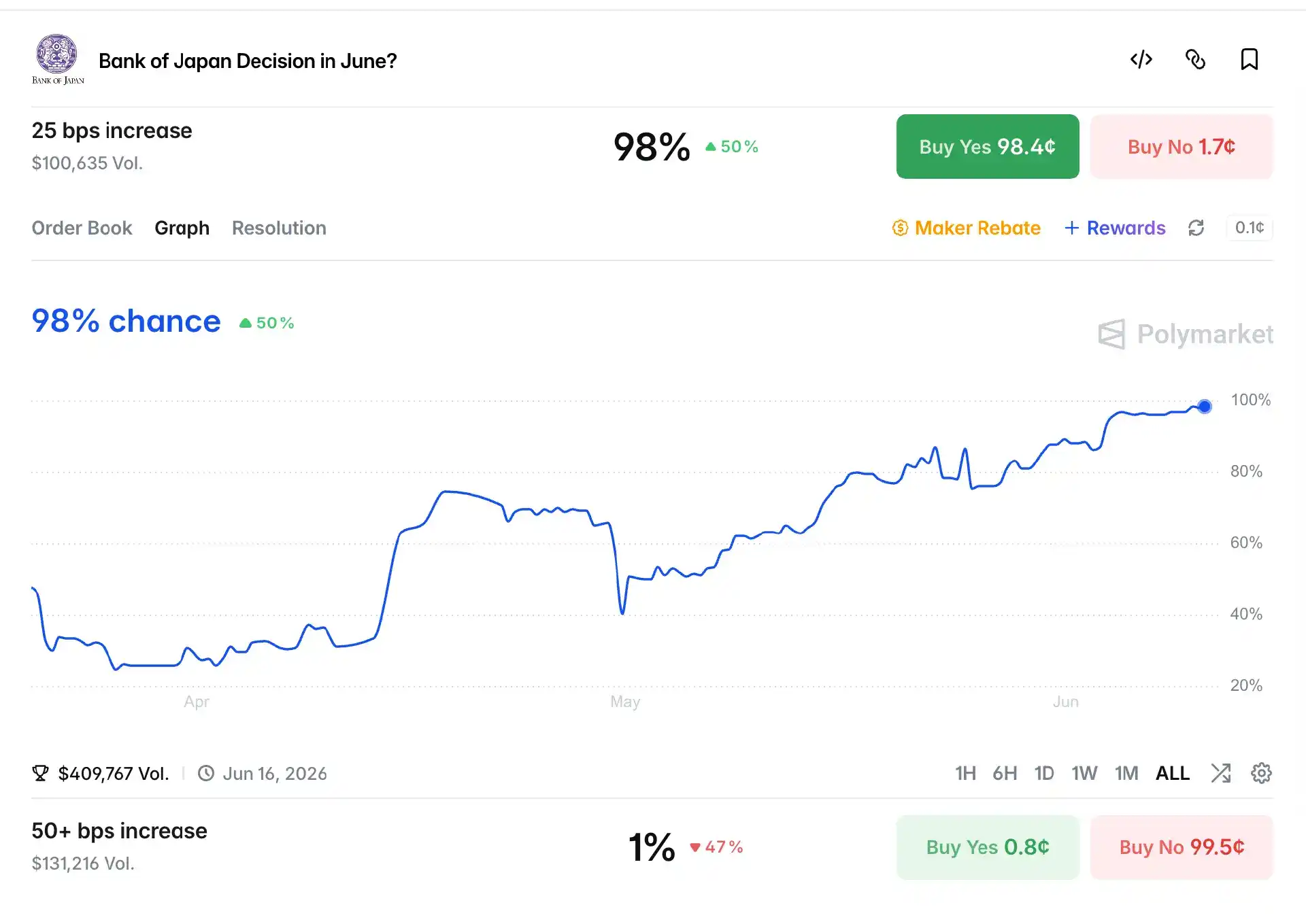
According to Nikkei News, the Bank of Japan (BoJ) is expected to raise its short-term policy rate from 0.75% to 1.0% during the monetary policy meeting on June 15-16, which would be the highest policy rate level since 1995. Currently, market pricing for a rate hike is extremely high, with the probability of a "25bp (basis point) hike" on PolyMarket surging from 25% in early April to 98%.
With a BoJ rate hike imminent, a large number of investors engaged in yen carry trades may be forced to sell overseas assets, convert back to yen, and repay loans, triggering a chain reaction and amplifying volatility in global risk assets—the flash crash in August 2024 serves as a classic example, where a sharp yen appreciation led to a short-term plunge in global stock markets, with Bitcoin plummeting nearly $20,000 in a single day, a maximum drop of 15%.

Odaily Planet Daily will analyze the macro backdrop and transmission mechanism of the BoJ rate hike, and focus on assessing the risk impact on AI tech stocks and cryptocurrencies for readers' reference.

1. Inflation Risks Drive BoJ Rate Hike

Over the past two years, hawkish voices within the BoJ have grown increasingly strong, culminating in the end of a 17-year negative interest rate policy in March 2024, raising the policy rate from -0.1% to a range of 0% to 0.1%, marking the first rate hike in this cycle. In July 2024, the BoJ hiked rates again by 15bp to 0.25% and announced a gradual balance sheet reduction; in January and December 2025, it raised rates by 25bp each, bringing the rate to 0.75%; rates remained unchanged in the first three meetings of 2026. The following outlines the BoJ's rate hikes in several meetings:
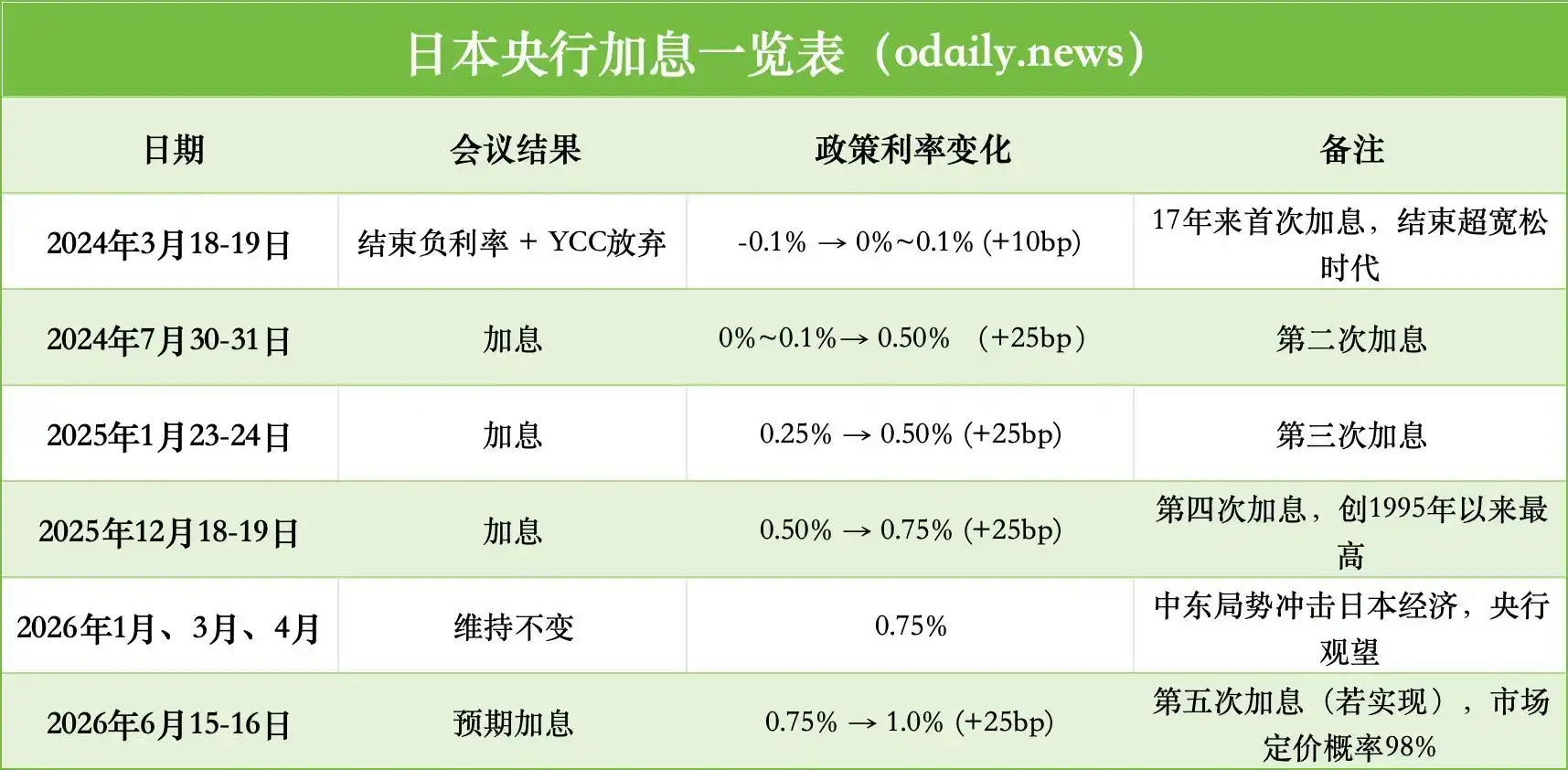
After keeping rates unchanged for half a year, why is the BoJ now eager to embark on a new round of rate hikes? This hike primarily stems from two aspects.

First, energy shocks and imported inflation pressure. As oil price volatility occurred due to Middle East conflicts in the first half of the year, Japan, highly dependent on imported energy, saw a significant rise in import costs. The Corporate Goods Price Index (CGPI) rose 6.3% year-on-year in May, the fastest pace since 2023, with petroleum products up 9.6% and utilities up 8.5%. The BoJ expects core CPI for fiscal 2026 to rise to 2.5-3.0%, far above the established 2% target.

Second, a weak yen exacerbates imported inflation. The current USD/JPY exchange rate continues to hover around the 158-160 high, nearing historically extreme weakness. The sharp depreciation of the yen directly weakens the import purchasing power of Japanese companies, leading to a significant increase in import costs for commodities such as energy and raw materials, further pushing up domestic prices. Although Japan's Ministry of Finance has repeatedly intervened in the foreign exchange market, the effects have been limited and unsustainable. This situation is forcing the BoJ to tighten monetary policy (i.e., raise rates) at the June meeting to avoid runaway inflation expectations.

In a speech on June 3, BoJ Governor Kazuo Ueda explicitly shifted the narrative towards fighting inflation, emphasizing that if upside risks to prices outweigh downside risks to the economy, the pros and cons of a rate hike must be discussed.

Reuters, citing three informed sources, reported that unless the Middle East conflict escalates sharply, the BoJ will raise rates in June and may slow the pace of bond portfolio reduction to maintain market stability. Bloomberg and institutions like ING maintain similar judgments and expect the BoJ to hike a total of 50bp in 2026.

This series of changes marks Japan's shift from the "world's last lender" to a normalizing central bank, posing a direct challenge to global assets reliant on cheap yen financing.

2. Unwinding Yen Carry Trades, Sustained Liquidity Tightening

The Bank of Japan's prolonged maintenance of ultra-loose monetary policy has made yen carry trades a key component of global liquidity over the past decade. Investors borrow yen at near-zero interest rates and invest in high-yielding assets like US stocks, tech stocks, emerging markets, and cryptocurrencies to earn interest differentials and capital gains.

The BoJ's upcoming rate hike will directly increase yen financing costs and could trigger yen appreciation (USD/JPY decline), forcing leveraged investors to unwind positions, creating a positive feedback loop: yen appreciation leads to expanding exchange rate losses → rising financing costs → forced investor deleveraging → large-scale selling of risk assets → further decline in asset prices → triggering more stop-losses → intensifying unwinding pressure.

Historically, every BoJ policy tightening signal has triggered severe market volatility.

On July 31, 2024, the BoJ hiked rates by 15bp to 0.25% and announced gradual balance sheet reduction, coupled with weak US employment data, triggering severe global market turbulence. At that time, South Korea's two major stock indices (KOSPI and KOSDAQ) plunged simultaneously, triggering circuit breakers; Japanese stocks crashed, with the Nikkei 225 plummeting 12.4% in a single day, accumulating a weekly loss of over 20%, the worst performance since 1987; global stock markets fell in tandem, with US stocks and tech stocks adjusting synchronously, and the VIX fear index soaring. Crypto also suffered heavy losses, with Bitcoin and ETH plunging over 30% in just a week, and leveraged liquidations surging.

According to Morgan Stanley estimates, although a significant number of positions have been gradually unwound since 2024, there are still approximately $500 billion in outstanding yen-funded positions in the market. Although the market has priced in some risks in advance, these positions still pose a significant hidden danger. Morgan Stanley warns that a rapid yen appreciation could trigger chain unwinding during periods of thin liquidity, especially impacting high-leverage assets severely.

J.P. Morgan's Global Head of Market Strategy, Dubravko Lakos-Bujas, and FX strategist Meera Chandan both pointed out that the policy divergence between the BoJ and the Federal Reserve will increase the instability of carry trade unwinding, potentially leading to a valuation reassessment of global risk assets.

3. Global Risk Assets Take a Hit, US Stocks and Crypto Not Spared

The AI-driven tech frenzy was the main theme for US stocks in the first half of 2026, with chip stocks like Nvidia and Broadcom and hyperscale cloud service providers leading the Nasdaq to repeatedly hit new highs.

However, entering June, significant rotation and pullbacks emerged in the market, particularly on June 5, when US stocks experienced their most severe single-day pullback of 2026 so far. The Nasdaq plunged 4.18%, marking its largest single-day drop since April 2025; the S&P 500 fell 2.64%, ending a nine-week winning streak; the Dow fell 1.35%, the Philadelphia Semiconductor Index plummeted over 10%, with core AI stocks like Nvidia, Broadcom, Micron, and Marvell leading the declines. (Recommended reading: "Nasdaq Drops 4.2% in a Day, Did 'Black Friday' Puncture the US Stock Bubble?")

The US stock market pullback is due to macro factors like geopolitical tensions and Fed policy uncertainty, but an undeniable factor is also the potential impact of the BoJ's impending rate hike.

First, liquidity tightening will directly hit high-valuation growth stocks. AI companies have massive capital expenditure scales and are highly dependent on cheap financing. Unwinding yen carry trades will reduce inflows of global risk-seeking capital, with high-beta tech stocks bearing the brunt. Semiconductor leaders like Nvidia and Broadcom, as well as hyperscalers like Meta and Microsoft, have extremely high valuation sensitivity and are highly susceptible to selling. Investing.com analysis points out that high-valuation growth sectors are most sensitive to changes in global liquidity; once carry trade unwinding begins, rapid deleveraging often occurs.

Second, rising energy costs will significantly compress AI profit margins. Middle East conflicts pushing up oil prices lead to a sharp increase in data center power and cooling costs, forming a "stagflationary" macro environment alongside BoJ rate hikes, severely testing the sustainability of the AI business model.

BitMex founder Arthur Hayes explicitly warned in his latest article "Reality Test": "The energy reality is testing the market's current 'dreaming' state." High oil prices not only raise operating costs but may also slow the growth of corporate token usage, further dampening AI-related revenue expectations.

Lastly, mega IPO supply shocks and political regulatory risks. Giants like SpaceX, Anthropic, and OpenAI plan to list intensively in the second half of 2026, with valuations often at hundreds of times sales; lock-up expirations will bring massive supply pressure. Meanwhile, Trump may shift to an anti-AI stance for midterm elections, increasing regulatory uncertainty.

As the highest-beta global risk asset, cryptocurrencies are even more precarious. On one hand, the BoJ rate hike brings rising global financing costs, directly increasing the cost of leveraged crypto trading, forcing large-scale liquidation of crypto leveraged positions; on the other hand, in competing for liquidity with AI, AI capital expenditure has already absorbed substantial market funds, leaving crypto lagging behind, and BoJ action will further tighten marginal liquidity.

Yahoo Finance analyst Lockridge Okoth stated that the 98% probability of a rate hike could trigger the next liquidity shock for Bitcoin. Investing.com analysis points out that yen appreciation and BTC weakness often move in high synchrony, a typical signal of rising global risk aversion.

Arthur Hayes has also emphasized in multiple analyses that the dynamics of yen carry trades remain one of the key variables affecting Bitcoin liquidity, reminding investors to pay attention to short-term liquidity shocks triggered by policy signals. In recent articles, Arthur Hayes emphasized the need to be wary of the combined impact of short-term energy costs and monetary policy risks; BTC/ETH may adjust alongside risk assets in the short term, with the long-term outlook depending on liquidity restarting.

Conclusion:

The rekindled concerns over a BoJ rate hike are not an isolated event but a signal of marginal tightening in global liquidity. Particularly with the current Middle East geopolitical conflict pushing oil prices higher, AI capital expenditure consuming liquidity, and multiple factors like Fed policy uncertainty superimposed, the buffer space is further compressed.

For investors, global risk assets—especially high-leverage, high-valuation sectors (AI tech stocks and cryptocurrencies)—may face significant downward pressure in the short term, with volatility set to rise noticeably. It is crucial to remain highly vigilant and mindful of leverage risks.


Perguntas relacionadas

QWhat is the main reason the Bank of Japan (BOJ) is expected to raise interest rates by 25 basis points in June 2026?

AThe main reason is to combat inflation. Two key factors are driving this: energy price shocks and input inflation due to rising oil prices from Middle East conflicts, and a persistently weak Yen (USD/JPY near 158-160), which increases import costs for energy and raw materials, further pushing up domestic prices. The BOJ's inflation forecast for fiscal 2026 has risen above its 2% target.

QHow does the Bank of Japan's potential interest rate hike pose a risk to global risk assets, particularly AI tech stocks and cryptocurrencies?

AThe rate hike increases the cost of Yen funding, potentially triggering the unwinding of the massive Yen carry trade. Investors who borrowed cheap Yen to invest in higher-yielding assets like US tech stocks and crypto may be forced to sell those assets to repay loans, especially if the Yen appreciates. This creates a vicious cycle of selling pressure, reduced global liquidity, and heightened volatility, directly impacting high-valuation, high-beta assets like AI stocks and cryptocurrencies.

QWhat historical event from 2024 is mentioned as a precedent for the market impact of BOJ policy tightening?

AThe article references the market flash crash in August 2024. Following a sharp appreciation of the Yen, global stock markets experienced a short but severe downturn. Bitcoin, as a prime example, plummeted by nearly $20,000 in a single day, recording a maximum intraday drop of 15%.

QAccording to the article, what are the estimated size of the remaining Yen carry trade positions and which financial institution provided this estimate?

AAccording to estimates from Morgan Stanley, there are still approximately $500 billion in outstanding Yen-funded positions in the market. The article warns that a rapid appreciation of the Yen could trigger chain-liquidations of these positions, especially in thin liquidity periods.

QBesides the BOJ rate hike, what other factors are mentioned as contributing to the potential pressure on AI tech stocks?

AThree additional factors are cited: 1) Rising energy costs from Middle East conflicts increasing data center power and cooling expenses, squeezing AI profit margins. 2) A looming supply shock from massive IPOs of companies like SpaceX, Anthropic, and OpenAI in H2 2026. 3) Increased political and regulatory uncertainty, with the possibility of the Trump administration adopting anti-AI rhetoric ahead of midterm elections.

Leituras Relacionadas

Trump's Crypto Empire: A $2.3 Billion Wealth Transfer Experiment

In June 2026, Reuters investigations revealed that since Donald Trump's return to the White House, his family has accumulated roughly $2.3 billion in profits from four core crypto ventures: World Liberty Financial (WLFI), the $TRUMP meme coin, American Bitcoin, and ALT5 Sigma (later renamed AI Financial). Coincidentally, overall investor losses in these projects were estimated to be a similar amount. The businesses, spanning DeFi, stablecoins, meme coins, Bitcoin mining, and digital payments, largely relied not on technological innovation but on converting the political influence and notoriety of the Trump brand into financial assets sold to the market. This marks a dramatic shift from Trump's earlier skepticism of cryptocurrencies. The ventures operated on a similar logic: leveraging the Trump name to generate market hype and trust, attracting investment through token sales or public listings, and enabling the family to capture profits upfront through equity, token allocations, and fees, while later entrants often bore the brunt of the risk as markets cooled. WLFI, the most profitable venture, generated an estimated $1.6 billion for the family, primarily through sales of its locked, illiquid governance token and its USD1 stablecoin. The $TRUMP meme coin, a direct monetization of the presidential IP, brought in over $600 million for Trump-linked entities before its price crashed nearly 97% from its peak. American Bitcoin gained a "Trump stock" premium for its mining operations, and ALT5 Sigma/AI Financial combined Trump, AI, and crypto themes for a temporary valuation surge. The episode underscores how political influence can be packaged into financial assets, creating substantial wealth for promoters while highlighting the risks for investors who base decisions on hype and brand allegiance over fundamental business models and cash flows.

marsbitHá 28m

Trump's Crypto Empire: A $2.3 Billion Wealth Transfer Experiment

marsbitHá 28m

CFTC Proposes New Rules for Prediction Markets, Redefining Which Events Can Be Listed and Who Can Participate

The U.S. Commodity Futures Trading Commission (CFTC) has proposed new rules to establish a clearer regulatory framework for prediction markets. The proposal aims to modify how "event contracts" are reviewed, creating a structured process to determine if contracts involving terrorism, assassination, war, or illegal activities violate the public interest. This moves away from a blanket ban toward a case-by-case assessment of whether a contract's subject matter is acceptable for financial trading. A key focus is distinguishing between predicting the impact of risks and predicting the occurrence of harm. The proposal suggests that many sports-based prediction markets—such as those on game outcomes, scores, or season standings—may be permissible as they can provide price discovery and meaningful information. However, markets on easily manipulated events like specific player injuries, referee calls, or outcomes of youth sports would face stricter scrutiny. The rules directly target insider trading and manipulation risks, highlighting cases where individuals with non-public information or the ability to influence an event's outcome could unfairly profit. This underscores a shift toward ensuring market fairness. The proposal does not end the regulatory debate, particularly with state gambling regulators who argue that sports prediction markets are essentially sports betting and should fall under state jurisdiction. Nonetheless, the CFTC's action signals a move toward formalizing prediction markets, pushing the industry from a phase of rapid, often unregulated expansion into a more institutionalized, rule-based environment that more closely resembles traditional financial markets.

marsbitHá 40m

CFTC Proposes New Rules for Prediction Markets, Redefining Which Events Can Be Listed and Who Can Participate

marsbitHá 40m

CFTC Proposes New Rules for Prediction Markets, Redefining Which Events and Who Can Participate

The U.S. Commodity Futures Trading Commission (CFTC) has proposed new rules to establish a regulatory framework for prediction markets, aiming to define which event contracts can be traded and who can participate. The 267-page proposal seeks to amend regulations to create a structured review process for "event contracts." The core goal is to determine whether contracts involving sensitive topics like terrorism, assassination, war, or illegal activities are contrary to the "public interest." The CFTC's approach is not an outright ban but a case-by-case assessment, focusing on whether a contract predicts harmful acts themselves or merely their commercial or risk-related impacts. The proposal suggests that most mainstream sports prediction markets—based on final scores, winners, or season outcomes—may be permissible as they provide price discovery and informational value. However, markets on easily manipulated granular events (e.g., player injuries, specific referee calls) or those encouraging harm/cheating would face stricter scrutiny. A primary regulatory target is insider trading and market manipulation, where individuals with non-public knowledge or influence over an event's outcome could unfairly profit. Recent alleged incidents involving military personnel, former politicians, and corporate insiders highlight this risk. The move clarifies federal oversight but does not end the debate. State regulators and gambling associations argue that many prediction markets, especially on sports, constitute gambling and should fall under state, not federal, jurisdiction. This sets up a potential conflict over regulatory authority. Overall, the CFTC's proposal signals a shift for prediction markets from rapid, less-regulated expansion toward a more institutionalized, rules-based model resembling traditional financial markets. Growth will increasingly depend on demonstrating market fairness, transparent settlement, and controlled risks.

Odaily星球日报Há 48m

CFTC Proposes New Rules for Prediction Markets, Redefining Which Events and Who Can Participate

Odaily星球日报Há 48m

Trading

Spot
Futuros

Artigos em Destaque

O que é $BANK

Bank AI: Um Passo Revolucionário no Futuro da Banca Introdução Em uma era marcada por avanços rápidos na tecnologia, o Bank AI está na interseção da inteligência artificial (IA) e dos serviços bancários. Este projeto inovador visa redefinir o panorama financeiro, melhorando a eficiência operacional, as medidas de segurança e as experiências dos clientes através do poder da IA. Ao embarcarmos nesta exploração do Bank AI, iremos aprofundar no que o projeto implica, suas dinâmicas operacionais, seu contexto histórico e marcos significativos. O que é o Bank AI? No seu cerne, o Bank AI representa uma iniciativa transformadora com o objetivo de integrar a inteligência artificial em várias operações bancárias. Este projeto aproveita as capacidades da IA para automatizar processos, melhorar os protocolos de gestão de risco e melhorar a interação com os clientes através de serviços personalizados. Os principais objetivos do Bank AI incluem: Automatização das Funções Bancárias: Ao aproveitar as tecnologias de IA, o Bank AI visa automatizar tarefas rotineiras, reduzindo o peso sobre os recursos humanos e aumentando a eficiência. Gestão de Risco Melhorada: O projeto utiliza algoritmos de IA para prever e identificar riscos, fortalecendo assim as medidas de segurança contra fraudes e outras ameaças. Personalização dos Serviços Bancários: O Bank AI foca em oferecer produtos e serviços financeiros ajustados, analisando dados e comportamentos dos clientes. Melhoria da Experiência do Cliente: A implementação de soluções impulsionadas por IA, como chatbots e assistentes virtuais, visa proporcionar aos usuários interações mais humanizadas, revolucionando a forma como os clientes se envolvem com os bancos. Com esses objetivos, o Bank AI posiciona-se como um ator crucial para tornar a banca mais eficiente, segura e centrada no usuário. Quem é o Criador do Bank AI? Os detalhes sobre o criador do Bank AI permanecem desconhecidos. Assim, nenhuma pessoa ou organização específica foi identificada nas informações disponíveis. O anonimato que cerca a origem do projeto levanta questões, mas não diminui a sua ambiciosa visão e objetivos. Quem são os Investidores do Bank AI? Semelhante ao criador do projeto, informações específicas sobre os investidores ou organizações que apoiam o Bank AI não foram divulgadas. Sem essas informações, é difícil delinear o apoio financeiro e institucional que pode estar impulsionando o projeto para frente. No entanto, a importância de ter uma sólida base de investimento é fundamental para sustentar o desenvolvimento em um campo tão inovador. Como Funciona o Bank AI? O Bank AI opera em várias frentes inovadoras, focando em fatores únicos que o diferenciam das estruturas bancárias tradicionais. Abaixo estão as principais características operacionais: Automatização: Ao aplicar algoritmos de aprendizado de máquina, o Bank AI automatiza vários processos manuais dentro dos bancos. Isso resulta na redução dos custos operacionais e permite que os trabalhadores humanos redirecionem os seus esforços para atividades mais estratégicas. Gestão de Risco Avançada: A integração da IA nas práticas de gestão de risco equipa os bancos com ferramentas para prever com precisão potenciais ameaças, como fraudes, garantindo que as informações e ativos dos clientes permaneçam seguros. Recomendações Financeiras Personalizadas: Através do aprendizado contínuo a partir das interações com os clientes, os sistemas de IA desenvolvem uma compreensão sutil das necessidades dos usuários, permitindo oferecer conselhos adaptados sobre decisões financeiras. Interações Melhoradas com os Clientes: Utilizando chatbots e assistentes virtuais alimentados por IA, o Bank AI permite uma experiência de cliente mais envolvente, permitindo que os usuários tenham suas dúvidas resolvidas rapidamente, reduzindo assim os tempos de espera e melhorando os níveis de satisfação. Juntas, estas características operacionais posicionam o Bank AI como um pioneiro no setor bancário, estabelecendo novos padrões para a prestação de serviços e a excelência operacional. Cronologia do Bank AI Compreender a trajetória do Bank AI requer uma análise do seu contexto histórico. Abaixo está uma cronologia que destaca marcos e desenvolvimentos importantes: Início de 2010: A conceituação da integração da IA nos serviços bancários começou a ganhar atenção à medida que instituições bancárias reconheciam os potenciais benefícios. 2018: Ocorreu um aumento significativo na implementação de tecnologias de IA, quando os bancos começaram a usar ferramentas de IA como chatbots para atendimento ao cliente básico e sistemas de gestão de risco para melhorar o tratamento de segurança. 2023: A sofisticação da IA continuou a avançar, com a introdução de IA generativa para tarefas mais complexas, como processamento de documentos e análise de investimentos em tempo real. Este ano marcou um salto significativo nas capacidades proporcionadas aos bancos pela tecnologia de IA. 2024-Estado Atual: Neste ano, o Bank AI está em uma trajetória ascendente, com pesquisas e desenvolvimentos em andamento prontos para aprimorar ainda mais as capacidades nas operações bancárias. A exploração contínua das aplicações de IA sugere desenvolvimentos emocionantes por vir. Pontos Chave Sobre o Bank AI Integração da IA na Banca: O Bank AI foca na adoção da inteligência artificial para simplificar os processos bancários e melhorar as experiências dos usuários. Automatização e Foco em Gestão de Risco: O projeto enfatiza fortemente essas áreas, visando transferir o peso das tarefas rotineiras enquanto melhora as estruturas de segurança através de análises preditivas. Soluções Bancárias Personalizadas: Ao aproveitar os dados dos clientes, o Bank AI possibilita serviços bancários ajustados que atendem às necessidades individuais dos usuários. Compromisso com o Desenvolvimento: O Bank AI permanece comprometido com contínuas pesquisas e esforços de desenvolvimento, garantindo a sua adaptabilidade e relevância contínua à medida que a tecnologia continua a evoluir. Conclusão Em resumo, o Bank AI exemplifica um passo crucial em frente na indústria bancária, aproveitando a inteligência artificial para remodelar paradigmas operacionais, melhorar a segurança e promover a satisfação do cliente. Apesar das lacunas de informação em torno do criador e dos investidores, os objetivos claros e os mecanismos funcionais do Bank AI fornecem uma base sólida para sua evolução contínua. À medida que a tecnologia de IA continua a avançar e se fundir com o setor bancário, o Bank AI está bem posicionado para impactar significativamente o futuro dos serviços financeiros, aprimorando a maneira como entendemos e interagimos com a banca.

40 Visualizações TotaisPublicado em {updateTime}Atualizado em 2024.12.03

O que é $BANK

Como comprar BANK

Bem-vindo à HTX.com!Tornámos a compra de Lorenzo Protocol (BANK) simples e conveniente.Segue o nosso guia passo a passo para iniciar a tua jornada no mundo das criptos.Passo 1: cria a tua conta HTXUtiliza o teu e-mail ou número de telefone para te inscreveres numa conta gratuita na HTX.Desfruta de um processo de inscrição sem complicações e desbloqueia todas as funcionalidades.Obter a minha contaPasso 2: vai para Comprar Cripto e escolhe o teu método de pagamentoCartão de crédito/débito: usa o teu visa ou mastercard para comprar Lorenzo Protocol (BANK) instantaneamente.Saldo: usa os fundos da tua conta HTX para transacionar sem problemas.Terceiros: adicionamos métodos de pagamento populares, como Google Pay e Apple Pay, para aumentar a conveniência.P2P: transaciona diretamente com outros utilizadores na HTX.Mercado de balcão (OTC): oferecemos serviços personalizados e taxas de câmbio competitivas para os traders.Passo 3: armazena teu Lorenzo Protocol (BANK)Depois de comprar o teu Lorenzo Protocol (BANK), armazena-o na tua conta HTX.Alternativamente, podes enviá-lo para outro lugar através de transferência blockchain ou usá-lo para transacionar outras criptomoedas.Passo 4: transaciona Lorenzo Protocol (BANK)Transaciona facilmente Lorenzo Protocol (BANK) no mercado à vista da HTX.Acede simplesmente à tua conta, seleciona o teu par de trading, executa as tuas transações e monitoriza em tempo real.Oferecemos uma experiência de fácil utilização tanto para principiantes como para traders experientes.

394 Visualizações TotaisPublicado em {updateTime}Atualizado em 2026.06.02

Como comprar BANK

Discussões

Bem-vindo à Comunidade HTX. Aqui, pode manter-se informado sobre os mais recentes desenvolvimentos da plataforma e obter acesso a análises profissionais de mercado. As opiniões dos utilizadores sobre o preço de BANK (BANK) são apresentadas abaixo.

活动图片













