Raydium Price Forecast for October 2026: RAY Holds 144% September Gain as Volumes Outpace Pump.fun

cryptonews.ruPublished on 2026-10-08Last updated on 2026-10-08

Abstract

Raydium (RAY) Price Forecast for October 2026 remains bullish above $2, a key level to maintain its September breakout. Trading around $2.41, RAY has gained roughly 105% in a month. Key resistance levels are $2.56, $2.80, and $3, while support lies at $2.19, $2, and $1.58. The token has closed October higher in three of the past five years. Fundamental catalysts include a surge in Raydium's monthly revenue from ~$1.4M in August to over $7M in September, largely driven by Stonk Fun migrating its token launches to the platform. Raydium also briefly surpassed Pump.fun in 24-hour DEX volume, reaching $192.2M. However, analysts caution that revenue growth is heavily reliant on a single client (Stonk Fun) and may be cyclical. Daily fees have already declined from their September peak. The bullish target for October is $2.80, contingent on holding above $2.19 and closing above $2.56. The bearish risk is a drop to the 20-day EMA at $2, which could open a path down to $1.58. Reaching $5 or $10 in October is considered highly unlikely based on historical performance.

The Raydium price forecast for October will remain bullish above $2 — a level that $RAY must hold to maintain September's breakout.

Raydium Price Analysis: Can $RAY Reach $2.80 After Doubling in a Month?
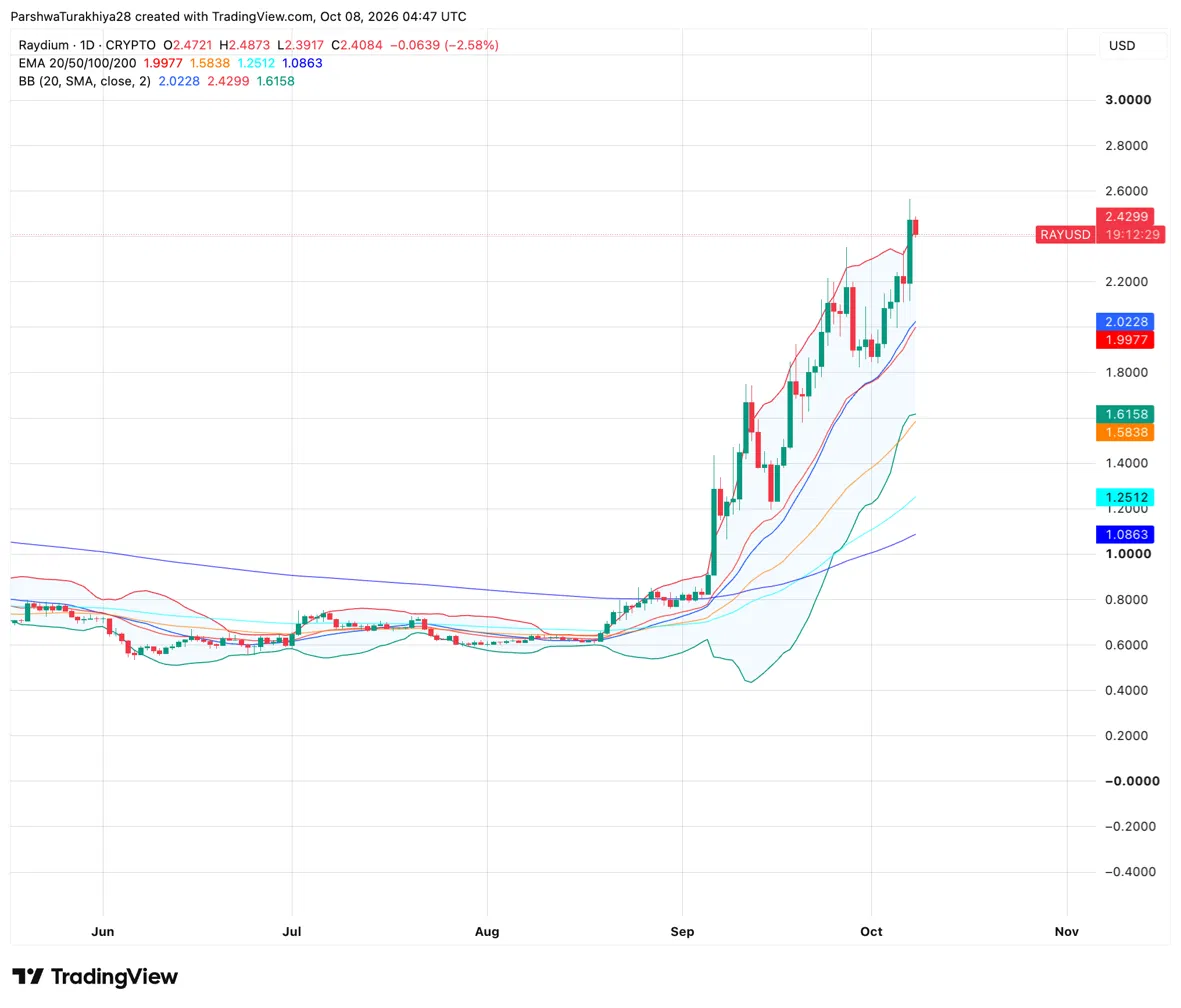
Raydium Price Analysis (Source: TradingView)

$RAY is trading around $2.41, down 2.58% today, after gaining approximately 105% over the month. It could continue rising if it surpasses Wednesday's high around $2.56, which would open the path to $2.80, and then $3. Despite this growth, $RAY remains about 15% below its price from a year ago, so the rally is a recovery that hasn't yet reached new territory.

The moving averages show how stretched the price has become. $RAY is about 21% above its 20-day EMA at $2, while the 50-day at $1.58 and the 100-day at $1.25 are significantly lower. A pullback to $2 would be a normal recharge, while a daily close below it would target $1.58.

Related: Meteora Price Forecast: MET Up 43% After DLMM Pro Launch Sparks Market Interest

$RAY Support and Resistance Levels for October 2026

Price Level
Resistance $2.56
Resistance $2.80
Resistance $3
Support $2.19
Support $2
Support $1.58

How Has Raydium Performed in October? $RAY Posted Gains in Three of Five Years

$RAY has closed October with gains in three of the five completed years since 2021, with an average gain of 12.1% and a median of 9.99%. A 75% gain in 2024 lifts the average, while a 38% decline in 2025 is the worst performance, making the median a better benchmark.

This October, it's already up 24.1%, more than the median, so $RAY is trading above its typical October performance. The 144.1% gain in September compares to a median September loss of 5.57% and follows a 32.3% gain in August.

Year October Performance
2026 (month-to-date) +24.1%
2025 -38%
2024 +75%
2023 +22.5%
2022 -8.92%
2021 +9.99%
Average (2021–2025) +12.1%
Median (2021–2025) +9.99%

$RAY News: Raydium Revenue Soared From $1.4 Million to Over $7 Million in a Month

The Bitcoin Strategy YouTube channel reported that Raydium's revenue increased from approximately $1.4 million in August to over $7 million in September — its best month since the summer of last year. The surge began when Stonk Fun, a platform for tokenized stocks priced new token launches, moved all its launches to Raydium in early September. The host reports that Stonk Fun now accounts for over a quarter of Raydium's revenue.

Metric Figure
Monthly Revenue $1.4M in Aug, over $7M in Sept
Daily Trading Fees Below $500K to ~$2.5M over 24h
Solana DEX Trading Share ~6% to ~12%
Liquidity Pool Deposits ~$1.3B, up ~20% over 30 days
Token Buybacks ~3M $RAY bought in Sept, ~20x new supply

Why Did Raydium Outpace Pump.fun? $RAY Won the Day with $192.2M Volume

Raydium just toppled PumpFun… @Raydium has overtaken @Pumpfun in 24-hour decentralized trading volume.

The protocol recorded $192.2M in total volume, compared to PumpFun's $185.0M.

This increased trading volume helped Raydium move up to eighth place globally in… pic.twitter.com/MVHYIc22IN

— BSCN (@BSCNews) October 7, 2026

BSCN reported on X that Raydium surpassed Pump.fun in 24-hour decentralized exchange volume — $192.2 million versus $185.0 million — moving it up to eighth place among the world's decentralized exchanges from ninth the previous day.

This metric covers a single day, so it shows where trading was concentrated that day, not long-term leadership. Bitcoin Strategy described a similar crossover on September 30th, when it stated Raydium had passed PumpSwap.

Will Raydium's Revenue Hold? Bitcoin Strategy Notes Single-Client Risk

Bitcoin Strategy argues that the revenue surge is heavily dependent on a single client and expects September's level to decline. Its main points:

  • Fees Peaked and Dropped: Daily fees peaked in the third week of September and fell by more than half by the last weekend of the month, two days before $RAY's September high. They remain more than triple the pre-Stonk Fun level.
  • Single Client: The Stonk Fun team is anonymous, and he says it raised roughly four times more than Raydium in a month, so Raydium may need the launchpad more than the reverse.
  • Low Leverage: The open interest on futures, the total value of open bets, is about $16 million, roughly 3% of market cap, and the funding rate is slightly negative, so he doesn't believe the surge is driven by borrowed money.

Raydium Price Forecast for October 2026: Where Could $RAY Trade Each Week?

Expected Range Key Levels
Oct 8 - 12 $2.19 to $2.60 $2.19 must hold on dips, with Wednesday's high at $2.56 as the upside cap.
Oct 13 - 19 $2 to $2.80 A close above $2.56 puts $2.80 in range, while a loss of $2.19 targets the 20-day EMA at $2.
Oct 20 - 26 $2 to $3 $2.80 is the next barrier, with $3 beyond it and $2 as the floor.
Oct 27 - 31 $1.58 to $3 The Fed decision on Oct 28 sets the tone: $3 as resistance, the 50-day EMA at $1.58 as the floor if $2 fails.

Raydium Price Forecast for October: Can $RAY Reach $2.80 or Fall to $2?

Bullish Case, Target: $2.80

$RAY holds $2.19 and the 20-day EMA at $2, then closes a day above Wednesday's $2.56 high. This opens the path to $2.80, with $3 beyond it. Maintaining revenue significantly above August levels would support this rise.

Bearish Risk, Risk Level: $2 (20-day EMA)

$RAY loses $2.19 and then the 20-day EMA at $2, ending September's uptrend. A daily close below this level would target the 50-day EMA at $1.58, and another drop in launchpad fees would fit this path.

FAQ: $RAY Forecast for October 2026

What is the Raydium price forecast for October 2026?

$RAY could rise to $2.56 and then $2.80 in October if it holds above $2 and closes above $2.56. A daily close below $2 would put the 50-day EMA at $1.58 in play.

Will Raydium reach $5 or $10 in October?

This is unlikely. $5 would require a gain of about 108% from $2.41, which is larger than any completed October on CryptoRank's data, where the best was 75% in 2024 at the monthly close. $10 would require about 315%.

Can Raydium fall below $2 in October?

Yes, if it loses $2.19 and the 20-day EMA at $2. This drop of about 17% would be exceeded only by October 2025's 38% decline over the five completed years.

Why is Raydium rising?

Analysts link the rise to revenue growing from ~$1.4M in August to over $7M in September after the Stonk Fun launchpad moved its launches to Raydium. BSCN also reports Raydium surpassed Pump.fun in 24-hour volume. The same channel warns that launchpad revenues are cyclical and may decline.
Trending Cryptos

Related Questions

QWhat is the price forecast for Raydium (RAY) in October 2026 according to the article?

AThe article forecasts that RAY's price may remain bullish above $2. It could increase to $2.56, then $2.80 if it holds above $2 and closes above $2.56. However, a daily close below $2 could target the 50-day EMA at $1.58.

QWhat key factor is cited as driving Raydium's recent revenue growth in September?

AThe recent revenue growth is attributed to Stonk Fun, a platform for new tokens, moving all its launches to Raydium in early September. This helped boost Raydium's revenue from about $1.4 million in August to over $7 million in September, with Stonk Fun reportedly accounting for over a quarter of Raydium's revenue.

QWhat historical performance data for Raydium in October is provided in the article?

AFor the five completed years from 2021 to 2025, RAY closed October with gains in three of those years. The average gain was 12.1%, with a median gain of 9.99%. The best October was 2024 with a 75% gain, and the worst was 2025 with a 38% decline. As of the article's writing, RAY was already up 24.1% in October 2026.

QWhat potential risk to Raydium's sustained growth does the Bitcoin Strategy channel highlight?

ABitcoin Strategy highlights the risk that the revenue surge is heavily dependent on a single client (Stonk Fun). It notes that daily fees peaked in the third week of September and more than halved by the month's end. The channel expects September's revenue level to decline and warns that the anonymous Stonk Fun team may be more important to Raydium than vice versa.

QAccording to the article, what trading volume milestone did Raydium achieve compared to Pump.fun?

AAccording to a report by BSCN cited in the article, Raydium surpassed Pump.fun in 24-hour decentralized trading volume, recording $192.2 million compared to Pump.fun's $185.0 million. This moved Raydium up to eighth place globally among decentralized exchanges.

Related Reads

Research Report Interpretation | Space Fund Scale Grew to $18 Billion in One Year, but In-Orbit Direct Investment Accounts for Only 3%

Barclays analysts Katherine Ogundiya and team published a 61-page report on November 16 introducing an "in-S.P.A.C.E." framework for the in-orbit economy, screening 37 commercial space activities down to 15 priority areas and 3 wildcard sectors. Global space-themed fund assets grew from $1.24 billion in Q2 2024 to over $18 billion by Q2 2026, yet only 3% is directly invested in in-orbit operations, while 47% sits in semiconductors, components, and software. Private markets are more direct: of 33 space unicorns worth about $92 billion, 9 in-orbit operators account for roughly $26 billion, or 28%. Global government space spending reached $141 billion in 2025, up 7.4%. The report identifies five physical bottlenecks—launch concentration, spectrum and network routing, orbital congestion, in-orbit servicing standards, and regulatory approval—noting China and the U.S. accounted for over 82% of orbital launch attempts from 2024 to July 2026, with SpaceX and CASC together near 71%, and Starlink performed over 207,000 collision-avoidance maneuvers between December 2025 and May 2026. Among the highest-scoring priority tracks, GEO satellite life extension offers clear economics: about 85% of GEO satellites retire from fuel depletion, and extending life five years costs roughly $65 million versus $150–300 million for a replacement. Orbital AI computing and data centers scored only 8, ranking as a wildcard due to unresolved thermal, power, and economic challenges. Barclays maps over 350 companies across four investment paths: integrated launch and space systems players like Rocket Lab (RKLB) and Firefly (FLY), bottleneck-breaking specialists such as Astroscale, MDA Space, Mynaric, and Thales, "picks and shovels" suppliers including Linde (LIN) and Air Liquide, and downstream applications like Planet Labs (PL) and AST SpaceMobile (ASTS). A heavy-lift rocket launch now consumes about 8,000 tonnes of liquid oxygen, five times a traditional large rocket's 1,600 tonnes, with Linde projecting about $1 billion in annual space revenue by 2030.

marsbit1h ago

Research Report Interpretation | Space Fund Scale Grew to $18 Billion in One Year, but In-Orbit Direct Investment Accounts for Only 3%

marsbit1h ago

The AI Bubble Has Already Burst, Yet Retail Investors Are Still Frantically Buying the Dip: A Hedge Fund Veteran Warns Nvidia's Risks Are Far From Over

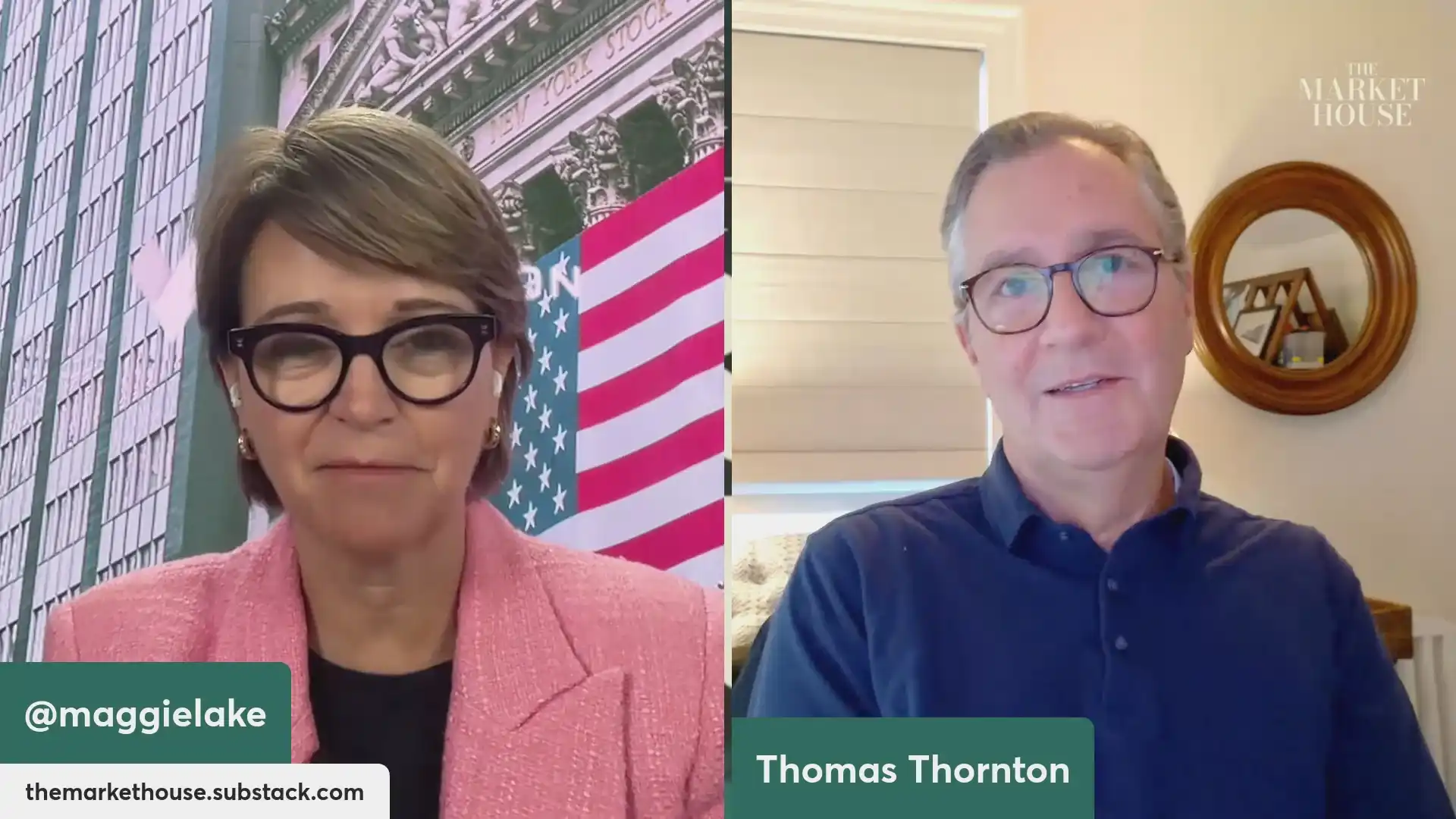
Former hedge fund trader Tom Thornton warns that the AI bubble has already burst, yet retail investors remain trapped in "buy the dip" muscle memory while institutions steadily reduce tech exposure. He points to record single-week inflows into QQQ (~$13.4 billion) even as prices fell—a classic topping pattern where dip-buying eventually fails and confidence collapses. Thornton argues AI's boom rests on a fragile chain of circular financing deals that must unfold perfectly; several links are already cracking. On Nvidia, he stresses that DOJ and congressional investigations aren't short-term noise—any evidence of knowingly bypassing export controls could trigger criminal, not just civil, liability and hammer the business model and valuation. He expects management to spin earnings positively, but even a slight guidance cut could crush the stock and wash out retail dip-buyers, making 2027 a tougher year for markets. Thornton is watching DeMark indicators on the Nasdaq 100 and Mag 7 for true capitulation, noting defensive sectors like staples and utilities are now flashing sell signals. He remains long gold, has started buying silver and gold miners (GDX), is baffled by Anthropic IPO valuations, exited Alibaba on Nvidia-related news, would short a SpaceX-Tesla merger on antitrust grounds, and says the ultimate contrarian buy signal is a front-page photo of a floor trader with his head in his hands.

marsbit1h ago

The AI Bubble Has Already Burst, Yet Retail Investors Are Still Frantically Buying the Dip: A Hedge Fund Veteran Warns Nvidia's Risks Are Far From Over

marsbit1h ago

World Bank Joins Forces with Citi and Circle: Global Aid Funds Poised for On-Chain Settlement via USDC

On November 18, the World Bank Group announced a strategic collaboration with Citi and Circle to explore using the regulated USD stablecoin USDC and blockchain networks to supplement existing cross-border official development assistance (ODA) disbursement systems. The pilot aims to reduce correspondent banking fees, shorten cross-border settlement times, and enhance transparency, starting with borrower countries where digital asset use is legally permitted. Under the division of roles, Circle provides compliant stablecoin infrastructure, minting and clearing USDC on designated blockchains with each token backed 100% by USD cash and short-term Treasuries. Citi leverages its global treasury and trade finance network to bridge traditional fiat payment rails and blockchain networks, validating settlement models interoperable with central banks and local banking systems while ensuring sovereign funds remain fully regulated. Traditional ODA flows rely heavily on SWIFT and多层 correspondent banks, with infrastructure projects in developing countries often routed through three to four intermediary banks, taking three to five business days per transfer, incurring high fees, FX spread losses, and delays from time-zone mismatches and manual reviews. Regulated stablecoin settlement enables near-real-time peer-to-peer on-chain delivery after compliance approval, cutting intermediary layers and sending funds directly to licensed institutions in borrower countries. The initiative builds on the World Bank's FundsChain consortium blockchain, which as of November 18 has connected over 350 sovereign and multilateral development projects across 96 countries, averaging about 3.6 on-chain projects per recipient country. Every transaction—from initial disbursement to treasury receipt to supplier settlement—is recorded on-chain in real time, allowing donors and auditors to verify usage and prevent fund diversion. This marks the first time a core multilateral development institution has formally introduced a regulated stablecoin in sovereign development aid disbursement alongside a major international bank, setting a benchmark for institutional RWA settlement and cross-border payment infrastructure. Next steps include joint testing on central bank FX and digital asset regulatory exemptions, technical standards for commercial bank clearing node access, and automated reconciliation between on-chain stablecoin flows and the FundsChain ledger.

marsbit1h ago

World Bank Joins Forces with Citi and Circle: Global Aid Funds Poised for On-Chain Settlement via USDC

marsbit1h ago

Licenses Are in Hand—So Why Is Crypto Payment Still Not Working?

Why do crypto payment businesses still stall even after obtaining licenses? The core problem is not the number of licenses but whether customers, assets, fiat money, and liability are aligned on a single executable business chain. A license only answers whether a given entity may conduct a regulated activity; it does not resolve who onboards the customer, who controls the stablecoin, who pays out euros, why the bank accepts the funds, or who handles refunds and freezes. Projects often list all group licenses together, assuming they cover the whole business, yet a US MSB registration is not a nationwide money transmission license, and an EU CASP passport under MiCA does not automatically grant payment or e-money institution permissions. Three paths must be reconstructed for any transaction: the customer relationship path (which group company contracts with the client), the crypto asset control path (whose address, whose keys, who decides execution), and the fiat funds path (whose account receives converted funds, whether the bank permits such use, and who pays the merchant). Banks may refuse accounts not because they reject crypto generally but because the proposed account use is unacceptable—licensing does not guarantee banking. With many partners (wallets, KYC providers, liquidity, payment institutions), responsibility easily fragments; MiCA Article 73 makes clear that outsourcing does not transfer regulatory responsibility. Compliance must be continuous—ongoing KYC, transaction monitoring, Travel Rule compliance, sanctions and fraud controls—and must cover before, during, and after a failed transaction. Before launch, projects should stress-test one representative transaction end-to-end, answering who contracts, who controls assets, whose account receives funds, why the bank accepts them, and who is liable when things go wrong. Planning should proceed in three stages: design the business then choose the regulatory path; design licenses, accounts, and fund flows together; and validate the structure through real transactions. The goal is not the most licenses but a complete operating structure in which every payment follows a lawful, clear, sustainable path.

marsbit1h ago

Licenses Are in Hand—So Why Is Crypto Payment Still Not Working?

marsbit1h ago

The Real Reason Jensen Huang Was Brought Down: Rubio's Political Springboard

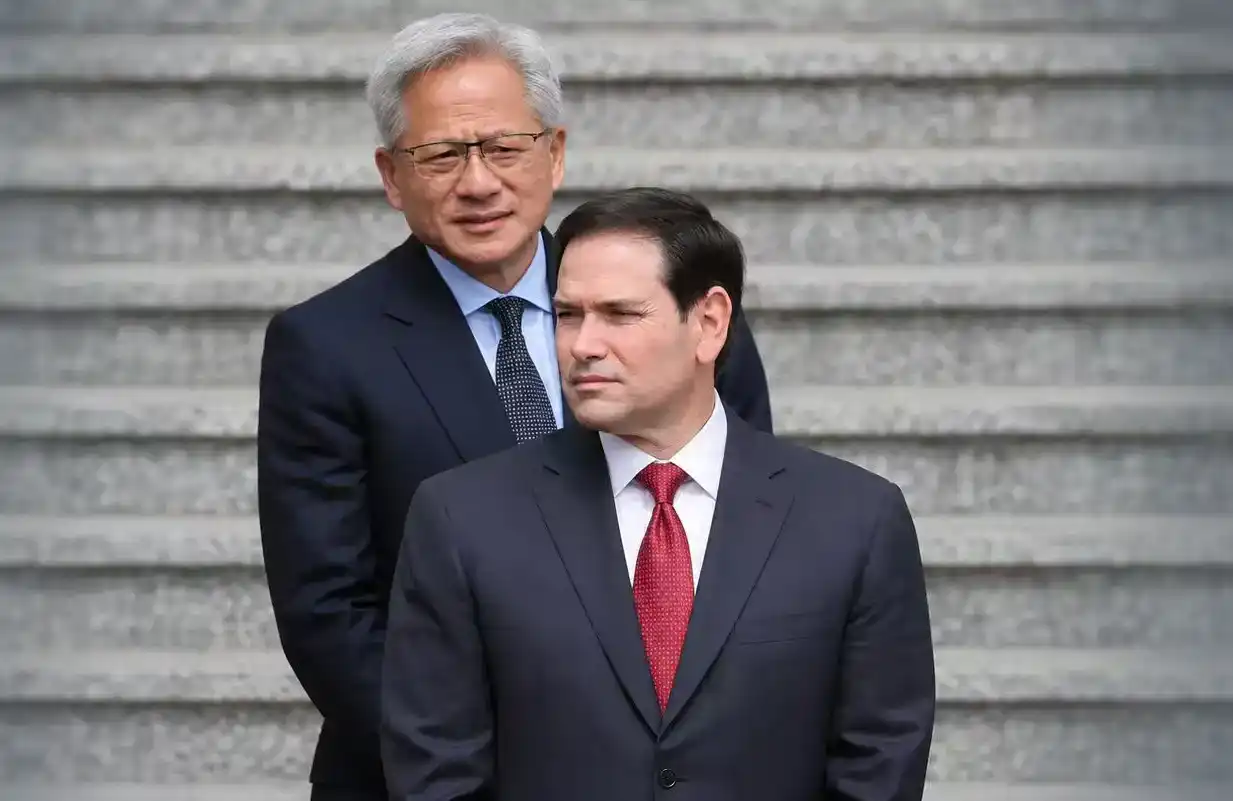
This article analyzes the 2026 ousting of Nvidia CEO Jensen Huang as a window into the internal power struggle within the American right. The author argues Huang's downfall was not primarily about insufficient political donations but about betting entirely on Trump's "expansionist" faction while alienating the party's hawks and populists. Timeline: Huang cultivated Trump through 2025 with donations and lobbying for chip exports, but reports emerged linking him to Megaspeed and a figure named Huang Le suspected of collecting information for a rival state. Secretary of State Rubio wrote a memo warning of the risk, which was ignored by Trump, then leaked to media after Democrats won Congress in the November midterms. Huang admitted an extramarital affair, and the board forced him out, tanking Nvidia's stock. The deeper cause: Trump's MAGA brand is losing influence, and the midterm defeat signals his lame-duck status. Rubio, only 55, is positioning himself for the post-Trump era by proving he can rein in the president's AI agenda—the memo served as a political springboard. Treasury Secretary Bessent, a hawk, consistently pushed to blacklist Megaspeed and now calls for major change at Nvidia's board. Trump's stubborn pro-AI expansion stance (despite 70% public opposition to local data centers) is attributed to donor money and family enrichment: his sons' ventures secured billions in federal contracts and loans, with presidential pardon power as a potential safety net. The article also raises a more conspiratorial theory that AI is becoming a价值观 (value) transmission tool replacing traditional media, and notes the ethnic background of tech leaders—while observing that Claude refused to engage with that framing. Finally, it asks whether Musk is next: unlike others who donated to both parties, Musk bet $474 million entirely on Republicans and lost badly, and Democratic-led Texas now threatens his data center and SpaceX projects. Democrats are expected to tighten AI policy, reclaim projects from Trump's family, and target Musk via Starshield and DOGE contract investigations.

marsbit1h ago

The Real Reason Jensen Huang Was Brought Down: Rubio's Political Springboard

marsbit1h ago

Trading

Spot

Hot Articles

How to Buy GAIN

Welcome to HTX.com! We've made purchasing GriffinAI (GAIN) simple and convenient. Follow our step-by-step guide to embark on your crypto journey.Step 1: Create Your HTX AccountUse your email or phone number to sign up for a free account on HTX. Experience a hassle-free registration journey and unlock all features.Get My AccountStep 2: Go to Buy Crypto and Choose Your Payment MethodCredit/Debit Card: Use your Visa or Mastercard to buy GriffinAI (GAIN) instantly.Balance: Use funds from your HTX account balance to trade seamlessly.Third Parties: We've added popular payment methods such as Google Pay and Apple Pay to enhance convenience.P2P: Trade directly with other users on HTX.Over-the-Counter (OTC): We offer tailor-made services and competitive exchange rates for traders.Step 3: Store Your GriffinAI (GAIN)After purchasing your GriffinAI (GAIN), store it in your HTX account. Alternatively, you can send it elsewhere via blockchain transfer or use it to trade other cryptocurrencies.Step 4: Trade GriffinAI (GAIN)Easily trade GriffinAI (GAIN) on HTX's spot market. Simply access your account, select your trading pair, execute your trades, and monitor in real-time. We offer a user-friendly experience for both beginners and seasoned traders.

8.5k Total ViewsPublished 2025.09.24Updated 2026.06.02

How to Buy GAIN

Discussions

Welcome to the HTX Community. Here, you can stay informed about the latest platform developments and gain access to professional market insights. Users' opinions on the price of GAIN (GAIN) are presented below.

活动图片