$RAVE TGE Countdown: When Clubbing Becomes On-Chain Economic Behavior, Web3's Breakout Moment Truly Arrives

深潮Publicado em 2025-12-11Última atualização em 2025-12-11

Resumo

RaveDAO, a leading Web3 electronic music event organizer, is emerging as a decentralized global entertainment ecosystem. Having successfully hosted over 20 events worldwide with more than 100,000 participants and 80 million online impressions, it has generated $3 million in revenue in 2025 through diverse streams including ticket sales, sponsorships, and NFT memberships. The project is launching its ecosystem token, $RAVE, to deepen connections among participants, artists, brands, and fans. The token will serve as the economic backbone for a participatory economy, enabling functions such as staking for licensing rights, event payments, governance voting, and community rewards. With a total supply of 1 billion tokens, its distribution is heavily community-focused, and a deflationary mechanism is supported by using a portion of event profits to buy back and burn tokens. RaveDAO distinguishes itself by lowering the barrier to Web3 through seamless user experiences, like effortless NFT ticket minting and fiat payment options, and by building a culturally-driven, open ecosystem. Its expansion plan includes 50 global chapters by 2027. The recent sold-out Genesis NFT membership mint further highlights strong community support as RaveDAO positions itself at the intersection of culture, entertainment, and Web3 adoption.

Author: Deep Tide TechFlow

Introduction

When I say "Web3 has its own Tomorrowland," you surely know I'm talking about RaveDAO.

Tomorrowland spent 20 years, leveraging immersive stages, artistic narratives, and top-tier electronic music, attracting over 400,000 fans annually for offline participation, with its YouTube channel accumulating over 2.2 billion views, and its revenue consistently remaining at the billion-dollar level, making it the pinnacle sample of the traditional entertainment industry.

As the Web3 event with the highest scale, largest participation, best atmosphere, and widest reach, RaveDAO is still in its early stages, yet has already successfully hosted 20+ high-quality events globally, attracting over 100,000 on-site participants, distributing over 70,000 on-chain NFT tickets, achieving 800 million total online exposures, and reporting public revenue of $3 million USD in 2025, including ticket sales, brand and public chain sponsorships, IP licensing and cooperation revenue sharing, as well as NFT and membership systems, demonstrating diversified revenue sources.

Faced with these impressive figures, many exclaim: RaveDAO has achieved the positive revenue that most Web3 projects desperately pursue, solely by organizing events, proving the sustainability of its business model.

But it doesn't stop there.

On November 10, 2025, RaveDAO announced the upcoming launch of its ecosystem token $RAVE, to more closely connect participants, producers, artists, brands, sponsors, fans, and other roles within the ecosystem, and on November 11th, initiated the minting of the Genesis Membership NFT membership card, starting the construction of a verifiable on-chain membership identity system to better reward and empower early participants.

A series of major announcements attracted attention and discussion from industry leaders and KOLs who have participated in its events, while RaveDAO's ambitions and direction for the future have also become clearer:

Music is never just an accelerant for atmosphere, but an efficient medium for quickly establishing deep connections between people;

Web3 is not just technological innovation, but the underlying driving force for achieving a positive ecosystem cycle under the model of incentivized participation and community co-construction;

And RaveDAO is not an event company, but is rapidly growing into an open cultural ecosystem built with entertainment as the driving force, leading the key infrastructure for Web3 to truly move towards implementation and breaking into the mainstream.
Why Are Web3 People All Scrambling for RaveDAO Tickets?

For Web3 folks, getting to know RaveDAO probably happened very naturally.

From 2025 to now, RaveDAO has left its mark in almost every "city where crypto people gather": tickets for each event sell out upon release, venues are packed, social media buzzes with organic posts afterwards, and it was described by the Wall Street Journal as a "typical case of bringing Web3 into reality through entertainment".

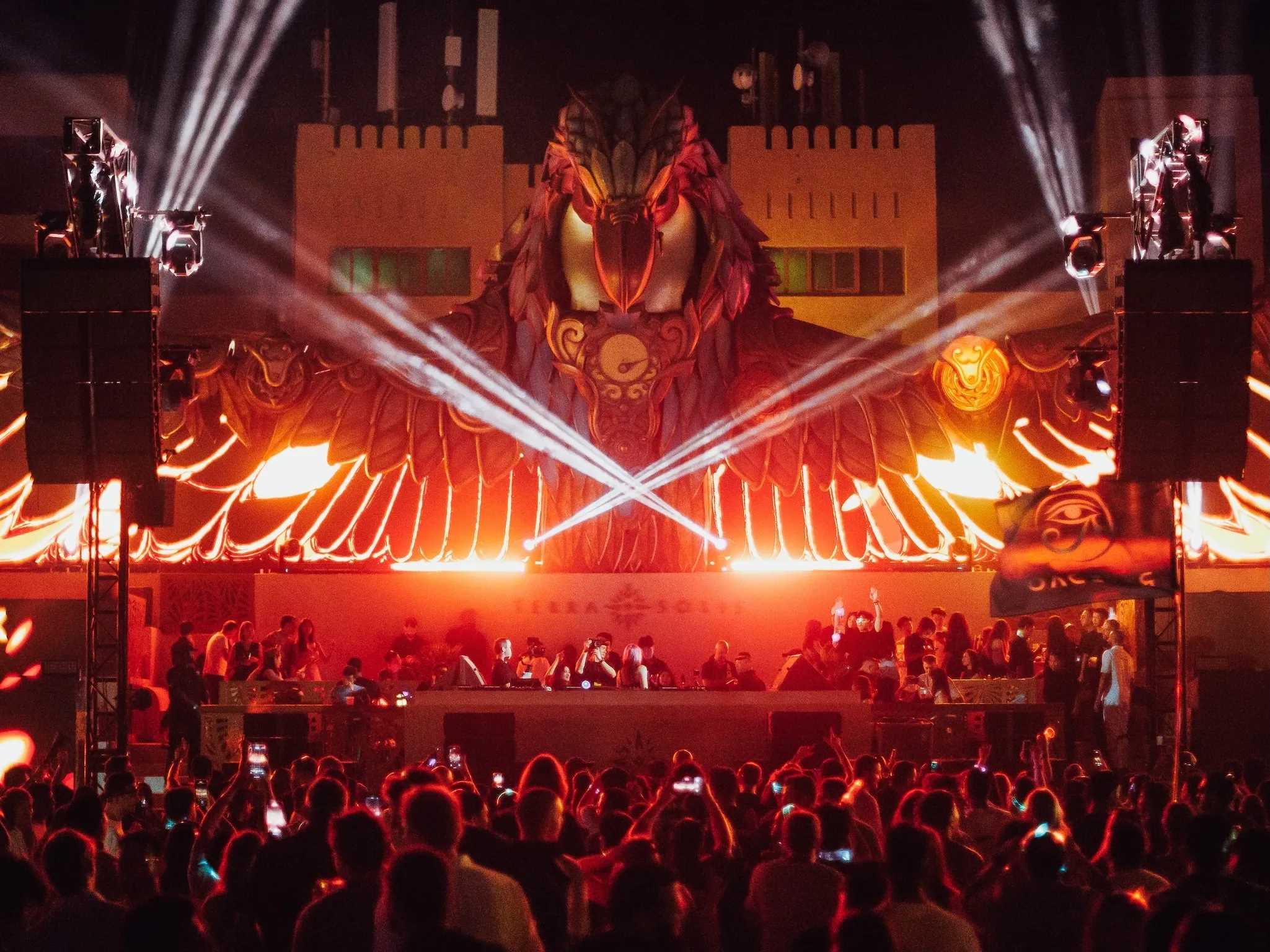
In Dubai, RaveDAO partnered with Tomorrowland's desert branch Terra Solis to set up a Techno night venue in the dreamy complex amidst the sea of sand. The event theme "Female Empowerment and Inclusion" was decided by DAO community voting, with world-class female DJs like Lilly Palmer, Pretty Pink, and Jiayu taking turns on stage, attracting over 4,000 Web3 pioneers and music lovers from around the globe, with related content achieving over 30 million online exposures.

In Korea, RaveDAO joined hands with WLFI to host a grand party blending EDM, K-Pop, and Web3 payments, attracting over 2,000 participants on-site. This event was not only WLFI's first offline event but also the world's first offline application case for USD1, where participants could use USD1 to purchase tickets, book tables, pay for drinks, etc., truly pulling crypto payments from the wallet interface into real-world scenarios.

And in Singapore, many still have fresh memories of the recently concluded ENL1GHT Festival, inviting world-class DJs including Chris Avantgarde, Morten, Doozie, Vintage Culture to collectively take the stage. Over 5,000+ people flooded into the venue, a converted old power plant, that night, with over 200 million online exposures, becoming the most unforgettable night for many during the F1 & TOKEN2049 itinerary.

Beyond this, in Miami, Amsterdam, Brussels, Bangkok, Hong Kong... RaveDAO's event footprint spans major global cities.
Behind the breakout success lies RaveDAO team's极致把控 (ultimate control) over event execution:

From Dubai's desert utopia to Singapore's abandoned power plant, every RaveDAO event location strives to match the event theme, each stage setup is uniquely crafted, presenting a visual feast through art installations, light shows, and极致 stage effects;

From professional sound systems and world-class DJ lineups to carefully curated music libraries, RaveDAO ensures every note has the power to penetrate the heart, providing an极致 auditory experience where every participant quickly gets into the state, embodying "music as an emotional engine";

In the utopia created by lights, music, fine drinks, and food, participants fully immerse themselves, moving their bodies, releasing emotions, expressing views, achieving deeper emotional connections between people through emotional resonance.

Behind the most successful Web3 music festival lies the Web3 team that knows how to "play" the best.

The RaveDAO team is known for being "small but elite," gathering a group of key figures including Crypto OGs, top Web3 investors, and long-time executives from the entertainment industry, which has brought RaveDAO a series of advantages:
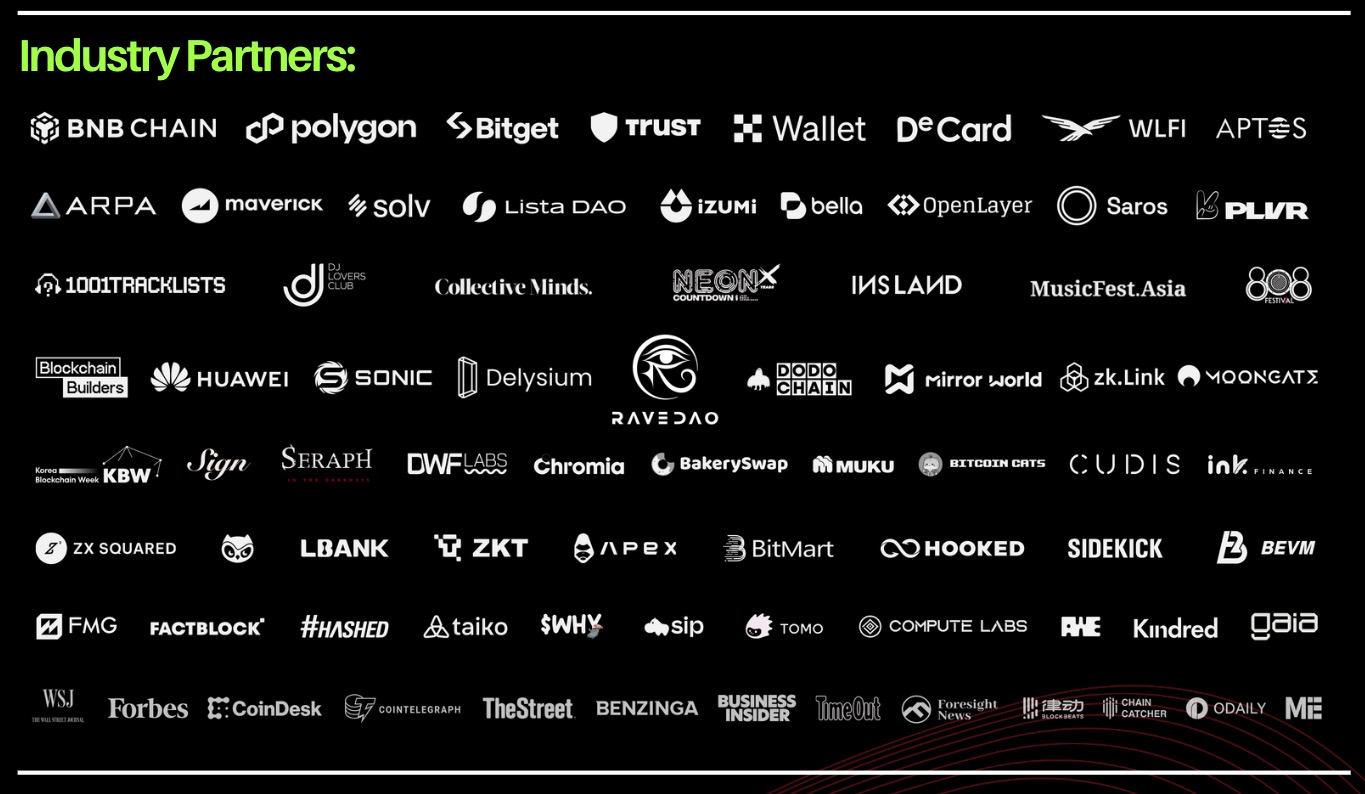
Powerful resource mobilization capability: Partners cover 30+ mainstream entertainment brands, including Tomorrowland Terra Solis, 1001Tracklists, Amsterdam Music Festival, INS Land, etc.; collaborating with over 50 artists, including Vintage Culture, Don Diablo, Chris Avantgarde, Lilly Palmer, MORTEN, Bassjackers, GENESI, and other global DJs; while deeply cooperating with Web3 projects like BNB Chain, WLFI, OKX, Bybit, Bitget, Polygon, Aptos, Base.

Execution capability: Complex venues, international artists, sponsorship systems, multi-chain technical integration, all while ensuring participant experience—this is a hard battle for any execution team. RaveDAO has proven itself with one "flawless event" after another.

Broad and profound industry influence: Project teams, KOLs, and creators are all willing to appear as "participants" at RaveDAO events. This kind of organic spread is far more effective than any marketing campaign.

Simultaneously, the敏锐目光 (keen insight) honed over years in the industry has made the team deeply aware from the very beginning of RaveDAO's birth:

What RaveDAO can do is absolutely not limited to just events.

Culture-Driven Open Ecosystem, Letting Users Experience Web3 Barrier-Free

For a long time, there has been a mismatch in expression between the Web2 and Web3 worlds:

The technological and mechanism advantages of Web3 are often packaged in cold code, obscure whitepapers, and products lacking a sense of scene;

This leads to, for most users, especially Web2 users, Web3 seeming to always remain at the "conceptual" level, not only with high comprehension barriers and difficult interaction operations, but also almost no scenarios in real life to help us truly build a vivid perception of Web3.

This is what we often call Web3's lack of positive externality, i.e., the lack of ability and scenarios for mass adoption.

However, the entertainment and cultural industry, represented by music, is an excellent entry point to help Web2 users better perceive Web3.

On one hand, unlike the cold and obscure nature of technology, the感染力 (infectious power) of culture is immediate, intuitive, and emotional, possessing the power to resonate across regions, countries, languages, and races,更能调动 (more able to mobilize) users' sense of participation, belonging, and enthusiasm for value sharing.

On the other hand, in an era increasingly focused on spiritual world development, people's willingness to pay for culture is becoming more apparent. From music festival tickets to peripheral purchases to art collection, cultural consumption has long become an indispensable part of modern life and is a rapidly developing multi-billion dollar赛道 (sector) in recent years.

Most importantly, under the centralized model, the definition and distribution rights of culture are monopolized by platforms, and people are already tired of passively accepting platform cultural output, while creators are increasingly dissatisfied with profits being monopolized by platforms. The future form of the cultural industry should be more in line with collective will, more encouraging of co-creation, and more focused on fair value distribution, which aligns perfectly with the decentralized spirit of Web3.
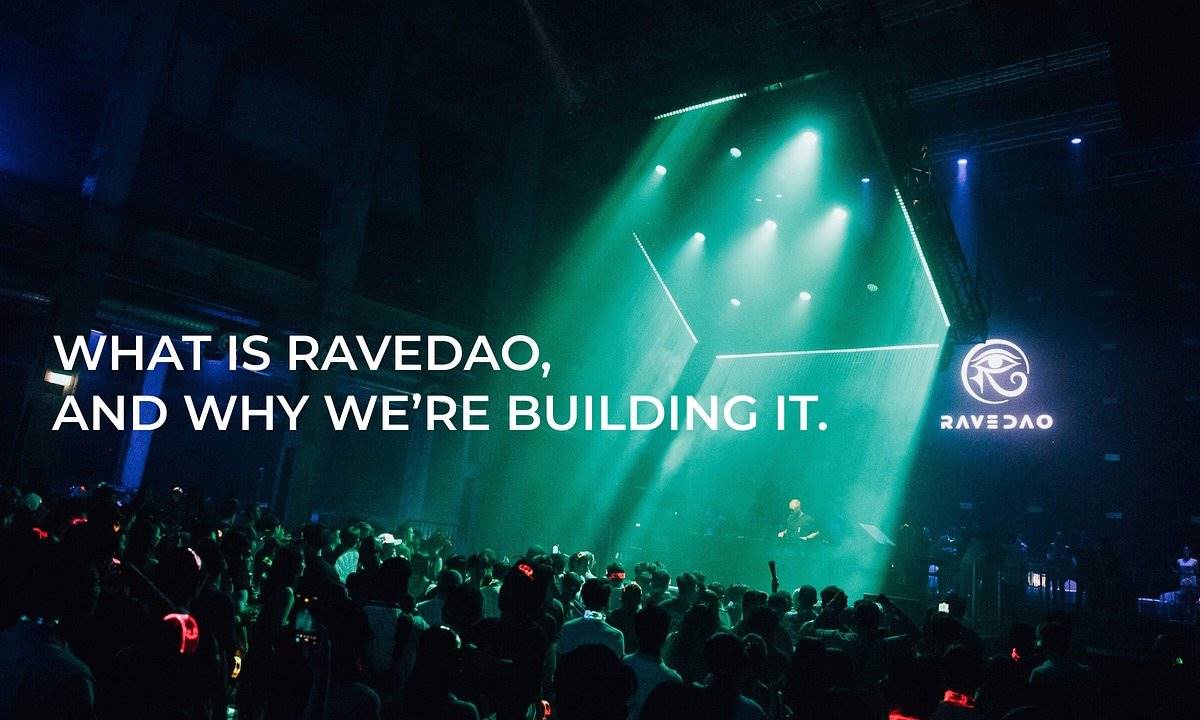
Therefore, when we observe carefully, we can see that RaveDAO has never operated with the mindset of "hosting events," but rather with the logic of "building an ecosystem":

Using culture as the core carrier, decentralization as the main operational form, and Web3 technology to empower products, attracting all relevant parties including audiences, artists, brands, production teams, public chains, wallet projects, payment systems, etc., to co-build an open ecosystem of "real scenarios + culture-driven + incentivized contributions".

As summarized in the RaveDAO whitepaper, RaveDAO integrates three key modules: "a decentralized global entertainment brand, a community-driven cultural network, and an open sandbox for a participation economy," truly merging real-world entertainment with Web3 technology, allowing everyone to participate.

Even when hosting events, RaveDAO adopts a "community governance-driven decentralized brand co-construction" model.

Drawing inspiration from the "TED and TEDx global expansion model," RaveDAO events are divided into two types: RaveDAO flagship events and RaveDAOx community events:

RaveDAO flagship events are planned by the core team, ensuring content and production standards, setting a benchmark for event quality, but the community can participate in decisions regarding event themes, host cities, and charitable distribution of event income through governance voting;

RaveDAOx events are initiated by communities around the world. Each community can apply to use RaveDAO's IP, independently deciding on the venue, lineup, thematic style, and charitable direction, during which the RaveDAO team provides brand standards, promotional resources, and technical support.

It is worth mentioning that RaveDAO event profits have already, through DAO governance decisions, empowered multiple public welfare projects, including funding for 400+ Nepalese cataract patients to regain sight, and supporting 150 meditation and psychological healing projects in Seattle, USA.

Through the linkage between flagship and community events, each event acts like a node, not only achieving brand exposure with higher quality and lower cost but also rapidly building a distributed global entertainment network during global expansion.

Even with ticketing, RaveDAO completes the transition from a "one-time entry pass" to a "continuously enriched Web3 identity system" by introducing an NFT system.

When a user purchases an event ticket, the system immediately mints it into an NFT, permanently existing on the chain. We can think of the NFT as a kind of "on-chain passport," an identity system that can record the owner's entire entertainment journey: every time the user participates in a RaveDAO event, a new stamp is added to the passport, containing information about which city they were in, what event they attended, and in what capacity. As more "visa stamps" are added to the passport, the user's on-chain identity becomes richer and more valuable.

In this way, as more "visa stamps" are added, the user's on-chain identity gradually takes shape, and the user profile becomes clearer. Based on this identity system, RaveDAO's open cultural ecosystem has more space to "do something," such as social connections, precise airdrops of benefits, membership system construction, etc.

Even in letting users enjoy the advantages brought by Web3 technology, RaveDAO pursues "making being on-chain as simple as breathing":

For example, as the first consumer-level scenario case integrating the x402 protocol, RaveDAO is committed to making the entire process of users experiencing x402 payments "seamless": through cooperation with ticketing and data system partner PLVR, users only need to register with an email to automatically generate their first wallet in their life, and besides cryptocurrency payments, it also supports direct payment using Alipay, WeChat, credit cards, or Apple Pay.

After payment is completed, the system automatically mints the NFT ticket, and the wallet address is automatically verified for entry. All the technology is completed in the background, and the front-end experience is as simple as ordinary ticket purchasing. At RaveDAO, technology is no longer a barrier but is hidden within the product, allowing users to enjoy the advantages of Web3 without feeling like they are "going on-chain."
Even with participation, RaveDAO is not "participation ends here," but is building an entertainment-driven "participation economy" cycle.

RaveDAO is open, welcoming anyone to join, and has already attracted over 70,000 users to gather in the ecosystem through breakout events, cultural resonance, lowering barriers, and other initiatives;

Simultaneously, RaveDAO clearly states that "participation" itself has value, it is the basic action of co-building the ecosystem, and RaveDAO is committed to ensuring that every action of participants in the ecosystem, including buying tickets, creating, cooperating, sharing, voting, etc., can be honestly recorded and rewarded. Fair and transparent distribution is not only an important factor in maintaining the healthy operation of the ecosystem but will also further attract participation.

And this is the core mission of the $RAVE token, born as a "proof of participation."

$RAVE: A Key Step in Closing the "Participation Economy" Loop

On November 10, 2025, RaveDAO announced the upcoming launch of its ecosystem token $RAVE, aiming to connect artists, organizers, and fans through token economics, promoting a decentralized entertainment ecosystem of "culture as protocol."

The $RAVE token connects every branch, event, creator, and participant in the ecosystem and provides rewards for every contribution, serving as the basic economic unit of RaveDAO's open cultural ecosystem.

As proof of participation, the $RAVE token naturally has rich utility in multiple scenarios within the RaveDAO ecosystem.

In terms of B2B functionality, the $RAVE token can:

  • Staking Authorization: Event organizers stake $RAVE tokens to obtain a franchise for RaveDAO's intellectual property, with operations following global standards inspired by the Ultra Music model.

  • Chapter Launch: Launch new "Road to RaveDAO" chapters through DAO-approved grants.

  • Supplier Qualification Certification: Partners stake $RAVE tokens to become RaveDAO-certified suppliers.

  • Artist and Label Collaboration: Artists stake $RAVE tokens to launch digital collectibles or Web3 collaboration projects under the RaveDAO brand.

In terms of B2C functionality, the $RAVE token can:

  • Stake $RAVE to Unlock Exclusive Benefits: Including VIP levels, artist meet-and-greets, and priority event entry.

  • Digital Collectibles: Participate in limited edition artist releases, collaboration projects, and NFT issuances.

  • Payment: Use $RAVE to purchase tickets, book tables, and for on-site consumption at flagship and chapter events.

  • Community Rewards: Earn $RAVE by participating in content creation, referrals, and interactions.

In terms of DAO governance functionality, the $RAVE token can:

  • Voting Rights: Decide on locations, artist lineups, venue selections, and charitable donation allocations.

  • Chapter Proposals: Submit and vote on proposals for new "Road to RaveDAO" chapter launches.

  • Ecosystem Grants: Directly fund artists, community builders, and partner projects.

Diverse demand from the ecosystem赋予 (endows) the $RAVE token with its underlying value logic, and the "community first" principle in token economic distribution further attracts more users to join the ecosystem, creating more on-chain interactions and continuously empowering the value of the $RAVE token.

According to the introduction, the total supply of $RAVE is 1 billion tokens, adopting a pure community-driven model, emphasizing sustainability and community benefits. The specific allocation rules are as follows:

  • Community 30%: Includes governance grants, incentives, rewards, etc., with a 12-month lock-up period and 36-month linear vesting.

  • Ecosystem 31%: Dedicated to promoting ecosystem construction, partner activities, and infrastructure improvement. 15.03% unlocked at TGE, the remaining 15.97% follows a 12-month lock-up period and 36-month linear vesting.

  • Initial Airdrop 3%: Aims to reward early participants and contributors, 100% unlocked at TGE.

  • Foundation / Grants / Impact Fund 6%: Includes charitable causes and long-term reserve funds, etc., with a 12-month lock-up period and 36-month linear vesting.

  • Team 20%: Aims to reward the founding team, core contributors, strategic advisors, and long-term partners, with a 12-month lock-up period and 36-month linear vesting.

  • Early Supporters 5%: Aims to reward early supporters and partners, with a 12-month lock-up period and 36-month linear vesting.

  • Liquidity Allocation 5%: Aims to ensure smooth market trading, 100% unlocked at TGE.
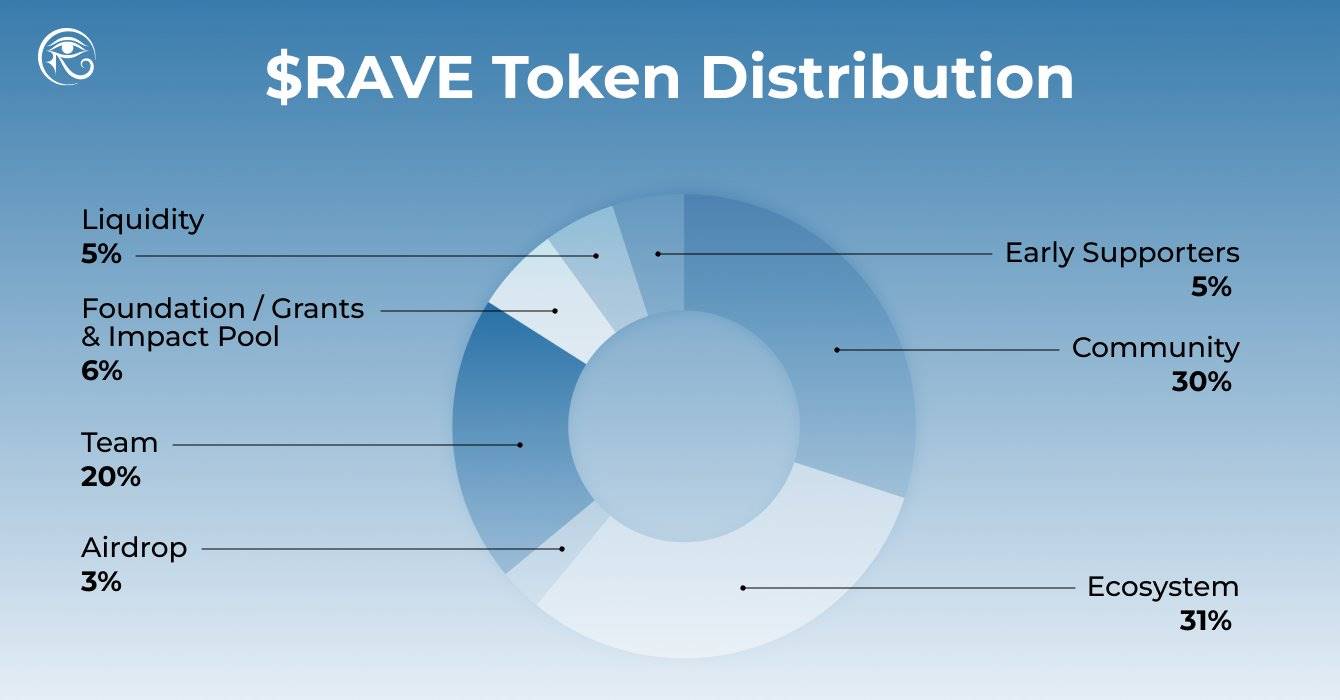
We can see that the 3% airdrop will be 100% unlocked at TGE, while stakeholders like the team and early supporters have a 12-month lock-up period and 36-month linear vesting mechanism, further reflecting the project's determination for long-term construction.

Additionally, we can see that the $RAVE token follows a deflationary model: A portion of event profits will be used to buy back and burn $RAVE.

We know that, based on real scenarios, real demand, and real users, RaveDAO has impressive revenue performance, with公开收入 (public revenue) reaching $3 million USD in 2025, sourced from:

  • Event and Ticketing Revenue: Ticket and beverage sales from global flagship events and various RaveDAOx events;

  • Brand and Ecosystem Cooperation: Strategic sponsorships from partners including BNB Chain, Polygon, Bitget, OKX, Base, Aptos, and DeCard;

  • Derivative Products and IP Licensing: Including brand collaborations, top artist partnerships, and the upcoming Genesis Membership Pass (NFT membership pass).

Based on existing event and cooperation schedules, RaveDAO expects revenue to reach $6 million USD in 2026 and break through $12 million USD in 2027. Positive revenue赋予 (endows) greater token buyback and burn capability, which will further enhance the community's recognition of the $RAVE token's value.

TGE Countdown: Accelerating Global Layout and Ecosystem Implementation

In the moment无限接近 (infinitely close to) TGE, the Genesis Membership NFT minting launched by RaveDAO on November 11th appears particularly noteworthy. The官方 (official) also clearly stated that the RAVE积分 (points) contained in the NFT will be convertible into $RAVE tokens in the future, and holding the NFT automatically enters the holder into the Genesis Rewards global lottery program, with prizes including RAVE airdrop rewards, a Tomorrowland double flight and ticket package (worth $5,000 USD), and a RaveDAO lifetime VIP pass, among others.

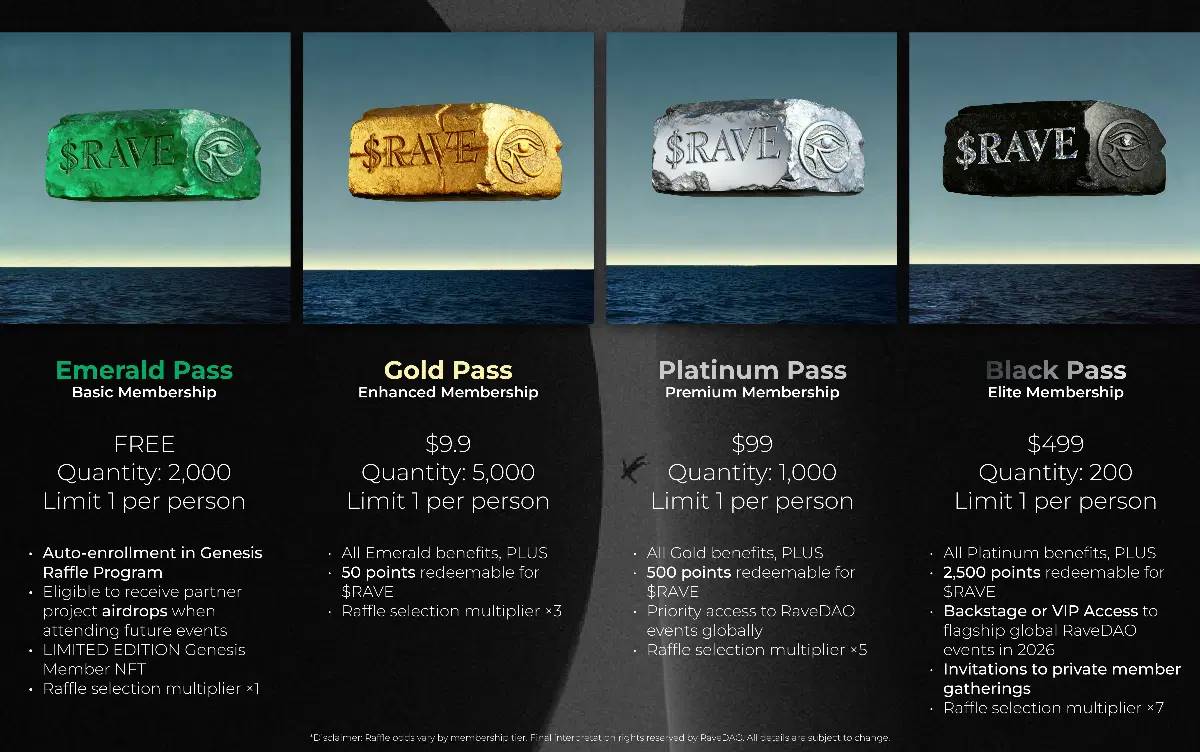
This issuance features four membership tiers:

  • Emerald Pass: Free entry, connect with the global community and participate in the lottery;

  • Gold Pass: Minting price 9.9 U, additionally获得 (obtains) 50 RAVE points, 3x lottery weight, and other benefits;

  • Platinum Pass: Minting price 99 U, additionally获得 (obtains) priority event access, 500 RAVE point reward, 5x lottery weight, and other benefits;

  • Black Pass: Minting price 499 U, additionally获得 (obtains) exclusive backstage/VIP access, invitation to private gatherings, 2500 RAVE point reward, and 7x lottery weight, among other benefits.

The minting activity received热烈反响 (enthusiastic response) upon launch. The Emerald Pass sold out within 11 minutes of release, and currently, all tiers of NFTs are completely sold out.
In addition to NFT minting, early supporters who participated in past RaveDAO events are also highly likely to receive TGE airdrop allocations.

While TGE preparations are in full swing, RaveDAO's ecosystem expansion步伐 (pace) has never stopped. For the upcoming 2026, RaveDAO has defined it as a year moving towards "Globalization × Communityization × Mainstreamization".

For the internal ecosystem: On one hand, RaveDAO will continue to host the RaveDAO flagship event series in multiple cities, continuously accumulating brand reputation and influence, bringing different global cultures on-chain under RaveDAO's lead; on the other hand, it will continue to promote the mature operation of the RaveDAOx model, supporting more community-driven events, attracting more communities, labels, DJs, and creators to become co-builders of RaveDAO. According to the official roadmap, RaveDAO plans to establish 50 chapters globally by 2027, serve over 300,000 participants, and donate a portion of the proceeds to public welfare projects.

Facing the core proposition of "stepping out of Web3," RaveDAO will engage in deeper cooperation with the mainstream entertainment industry: Previously, RaveDAO has successfully co-hosted multiple events with traditional entertainment giants like Tomorrowland, 1001Tracklists, 808 Festival, Collective Minds, INS Land, etc. In the future, RaveDAO will continue and upgrade this cooperation model, allowing RaveDAO to move from the Web3 stage into the core circle of mainstream entertainment. According to official透露 (revelations), RaveDAO will soon announce重磅合作消息 (heavyweight cooperation news) with a global top-tier entertainment group.

As more events are held, RaveDAO's cultural ecosystem influence broadens, and more Web2/Web3 users join the co-construction, the value supported by the $RAVE token will truly achieve efficient operation in a meaningful way:

Consumption generates revenue → Revenue feeds back to the community → Community creates more content → Content drives more consumption

From the desert utopia of Dubai to the abandoned power plant in Singapore, RaveDAO uses the power of culture to prove: Web3 doesn't have to stay in whitepapers and code; it can be震撼人心的音乐 (heart-stirring music),自由的舞步 (free dance steps), and the deep connections established between strangers through emotional resonance.

As TGE approaches, RaveDAO is also about to complete the闭环建设 (closed-loop construction) of its "open cultural ecosystem + participation economy." In this round of community-led Web3 cultural狂欢 (carnival), how $RAVE will change the way value flows and reshape the landscape of the cultural industry is worth持续观察 (continuous observation) by everyone who关注 (cares about) Web3 and the future of culture.

The Web3 cultural party initiated by RaveDAO has opened its doors. Amidst the interweaving of music and lights, the community has already嗅到 (scented) the decentralized spirit within, the free atmosphere, open participation, and fair distribution... The narrative logic is captivating, the implementation and revenue performance are impressive, and the future development space is thought-provoking.

The music is already playing, the story is happening. If you are already attracted by this, why not Rave together with RaveDAO in the next city.


Perguntas relacionadas

QWhat is the total supply of the $RAVE token and what is its core purpose within the RaveDAO ecosystem?

AThe total supply of the $RAVE token is 1 billion. Its core purpose is to serve as the fundamental economic unit of the RaveDAO open cultural ecosystem, connecting artists, organizers, brands, and fans. It is designed to reward participation, enable governance, and facilitate various utilities like staking for exclusive benefits, payments, and access to digital collectibles.

QHow does RaveDAO's NFT ticketing system transform a simple entry pass into a valuable Web3 identity system?

ARaveDAO's NFT ticketing system transforms a ticket from a one-time entry pass into a persistent and enriching Web3 identity system, often referred to as an 'on-chain passport.' Each event attended adds a new 'visa stamp' to this passport, permanently recording details like the city, event type, and participation role. This creates a rich, verifiable on-chain identity that grows in value and utility, enabling features like social connections, targeted airdrops, and membership perks.

QWhat are the three key modules that RaveDAO combines, according to its whitepaper, to merge real-world entertainment with Web3 technology?

AAccording to its whitepaper, RaveDAO combines three key modules: a decentralized global entertainment brand, a community-driven cultural network, and an open sandbox for a participation-based economy. This fusion integrates real-world entertainment with Web3 technology, allowing everyone to participate.

QWhat is the publicly stated revenue of RaveDAO for 2025, and what are its primary sources of income?

ARaveDAO's publicly stated revenue for 2025 is $3 million. Its primary sources of income include ticket and beverage sales from global flagship and RaveDAOx events, strategic sponsorships from brands and ecosystems (like BNB Chain, Polygon, OKX), and revenue from derivative products and IP licensing, including brand collaborations and NFT membership passes.

QHow does RaveDAO plan to use a portion of its event profits to create a deflationary mechanism for the $RAVE token?

ARaveDAO plans to use a portion of its event profits to buy back $RAVE tokens from the open market and subsequently burn them. This process reduces the total circulating supply of the token, creating a deflationary pressure that can potentially increase the token's value over time, assuming demand remains constant or grows.

Leituras Relacionadas

How Many Tokens Away Is Yang Zhilin from the 'Moon Chasing the Light'?

The article explores the intense competition between two leading Chinese AI companies, DeepSeek and Kimi (Moon Dark Side), and the mounting pressure on Yang Zhilin, the founder of Kimi. While DeepSeek re-emerged after 15 months of silence with its powerful V4 model—boasting 1.6 trillion parameters and low-cost, long-context capabilities—Kimi has been focusing on long-context processing and multi-agent systems with its K2.6 model. Yang faces a threefold challenge: technological rivalry, commercialization pressure, and investor expectations. Despite Kimi’s high valuation (reaching $18 billion), its revenue heavily relies on a single product with low paid conversion rates, while DeepSeek’s strategic silence and open-source influence have strengthened its market position and valuation prospects, now targeting over $20 billion. Both companies reflect broader trends in China’s AI ecosystem: Kimi aims for global influence through open-source contributions and agent-based advancements, while DeepSeek prioritizes foundational innovation and hardware independence, notably shifting to Huawei’s chips. Their competition is seen as vital for China’s AI progress, with the gap between top Chinese and U.S. models narrowing to just 2.7% on the Elo rating scale. Ultimately, the article argues that this rivalry, though anxiety-inducing for leaders like Zhilin, is essential for driving innovation and solidifying China’s role in the global AI landscape.

marsbitHá 4h

How Many Tokens Away Is Yang Zhilin from the 'Moon Chasing the Light'?

marsbitHá 4h

TechFlow Intelligence Bureau: ChatGPT Helps Amateur Mathematician Crack 60-Year-Old Problem, CFTC Sues New York Regulator Over Coinbase and Gemini

An amateur mathematician, with the assistance of ChatGPT, has solved a combinatorial mathematics puzzle originally proposed by Hungarian mathematician Paul Erdős in the 1960s. This marks another milestone in AI-aided mathematical research, demonstrating the evolving capabilities of large language models in formal reasoning. In other AI developments, OpenAI introduced a new privacy filter tool for enterprise API usage, automatically screening sensitive data. Meanwhile, the Qwen3.6-27B model achieved 100 tokens per second on a single RTX 5090 GPU using quantization, significantly lowering the cost barrier for local AI deployment. In crypto and Web3, the U.S. CFTC sued New York’s financial regulator, challenging its oversight of Coinbase and Gemini—a first-of-its-kind federal-state regulatory clash. Following a vulnerability, KelpDAO and major DeFi protocols established a recovery fund. Tether froze $344 million in assets linked to Iran’s central bank upon U.S. Treasury request, highlighting the centralized control risks in stablecoins. Separately, Litecoin underwent a 3-hour chain reorganization to undo a privacy-layer exploit. In the U.S., former President Trump invoked the Defense Production Act to address power grid bottlenecks affecting AI data centers and dismissed the entire National Science Board, raising concerns over research independence. A retail trader gained 250% on a $600k Intel options bet amid AI-related speculation. Xiaomi announced its first performance electric vehicle, targeting rivals like Tesla. Meanwhile, iPhone users reported devices automatically reinstalling a hidden app daily, suspected to be MDM-related. A Chinese securities report noted that A-share institutional crowding has reached its second-longest streak since 2007, signaling high valuations and potential style rotation. The day’s developments reflect a dual narrative: AI is enabling unprecedented individual breakthroughs, while centralized power structures—whether governmental or corporate—are becoming more assertive, underscoring that decentralization is as much a political-economic challenge as a technical one.

marsbitHá 4h

TechFlow Intelligence Bureau: ChatGPT Helps Amateur Mathematician Crack 60-Year-Old Problem, CFTC Sues New York Regulator Over Coinbase and Gemini

marsbitHá 4h

Trading

Spot
Futuros

Artigos em Destaque

O que é $S$

Compreender o SPERO: Uma Visão Abrangente Introdução ao SPERO À medida que o panorama da inovação continua a evoluir, o surgimento de tecnologias web3 e projetos de criptomoeda desempenha um papel fundamental na formação do futuro digital. Um projeto que tem atraído atenção neste campo dinâmico é o SPERO, denotado como SPERO,$$s$. Este artigo tem como objetivo reunir e apresentar informações detalhadas sobre o SPERO, para ajudar entusiastas e investidores a compreender as suas bases, objetivos e inovações nos domínios web3 e cripto. O que é o SPERO,$$s$? O SPERO,$$s$ é um projeto único dentro do espaço cripto que procura aproveitar os princípios da descentralização e da tecnologia blockchain para criar um ecossistema que promove o envolvimento, a utilidade e a inclusão financeira. O projeto é concebido para facilitar interações peer-to-peer de novas maneiras, proporcionando aos utilizadores soluções e serviços financeiros inovadores. No seu núcleo, o SPERO,$$s$ visa capacitar indivíduos ao fornecer ferramentas e plataformas que melhoram a experiência do utilizador no espaço das criptomoedas. Isso inclui a possibilidade de métodos de transação mais flexíveis, a promoção de iniciativas impulsionadas pela comunidade e a criação de caminhos para oportunidades financeiras através de aplicações descentralizadas (dApps). A visão subjacente do SPERO,$$s$ gira em torno da inclusão, visando fechar lacunas dentro das finanças tradicionais enquanto aproveita os benefícios da tecnologia blockchain. Quem é o Criador do SPERO,$$s$? A identidade do criador do SPERO,$$s$ permanece algo obscura, uma vez que existem recursos publicamente disponíveis limitados que fornecem informações detalhadas sobre o(s) seu(s) fundador(es). Esta falta de transparência pode resultar do compromisso do projeto com a descentralização—uma ética que muitos projetos web3 partilham, priorizando contribuições coletivas em vez de reconhecimento individual. Ao centrar as discussões em torno da comunidade e dos seus objetivos coletivos, o SPERO,$$s$ incorpora a essência do empoderamento sem destacar indivíduos específicos. Assim, compreender a ética e a missão do SPERO é mais importante do que identificar um criador singular. Quem são os Investidores do SPERO,$$s$? O SPERO,$$s$ é apoiado por uma diversidade de investidores que vão desde capitalistas de risco a investidores-anjo dedicados a promover a inovação no setor cripto. O foco desses investidores geralmente alinha-se com a missão do SPERO—priorizando projetos que prometem avanço tecnológico social, inclusão financeira e governança descentralizada. Essas fundações de investidores estão tipicamente interessadas em projetos que não apenas oferecem produtos inovadores, mas que também contribuem positivamente para a comunidade blockchain e os seus ecossistemas. O apoio desses investidores reforça o SPERO,$$s$ como um concorrente notável no domínio em rápida evolução dos projetos cripto. Como Funciona o SPERO,$$s$? O SPERO,$$s$ emprega uma estrutura multifacetada que o distingue de projetos de criptomoeda convencionais. Aqui estão algumas das características-chave que sublinham a sua singularidade e inovação: Governança Descentralizada: O SPERO,$$s$ integra modelos de governança descentralizada, capacitando os utilizadores a participar ativamente nos processos de tomada de decisão sobre o futuro do projeto. Esta abordagem promove um sentido de propriedade e responsabilidade entre os membros da comunidade. Utilidade do Token: O SPERO,$$s$ utiliza o seu próprio token de criptomoeda, concebido para servir várias funções dentro do ecossistema. Esses tokens permitem transações, recompensas e a facilitação de serviços oferecidos na plataforma, melhorando o envolvimento e a utilidade gerais. Arquitetura em Camadas: A arquitetura técnica do SPERO,$$s$ suporta modularidade e escalabilidade, permitindo a integração contínua de funcionalidades e aplicações adicionais à medida que o projeto evolui. Esta adaptabilidade é fundamental para manter a relevância no panorama cripto em constante mudança. Envolvimento da Comunidade: O projeto enfatiza iniciativas impulsionadas pela comunidade, empregando mecanismos que incentivam a colaboração e o feedback. Ao nutrir uma comunidade forte, o SPERO,$$s$ pode melhor atender às necessidades dos utilizadores e adaptar-se às tendências do mercado. Foco na Inclusão: Ao oferecer taxas de transação baixas e interfaces amigáveis, o SPERO,$$s$ visa atrair uma base de utilizadores diversificada, incluindo indivíduos que anteriormente podem não ter participado no espaço cripto. Este compromisso com a inclusão alinha-se com a sua missão abrangente de empoderamento através da acessibilidade. Cronologia do SPERO,$$s$ Compreender a história de um projeto fornece insights cruciais sobre a sua trajetória de desenvolvimento e marcos. Abaixo está uma cronologia sugerida que mapeia eventos significativos na evolução do SPERO,$$s$: Fase de Conceituação e Ideação: As ideias iniciais que formam a base do SPERO,$$s$ foram concebidas, alinhando-se de perto com os princípios de descentralização e foco na comunidade dentro da indústria blockchain. Lançamento do Whitepaper do Projeto: Após a fase conceitual, um whitepaper abrangente detalhando a visão, os objetivos e a infraestrutura tecnológica do SPERO,$$s$ foi lançado para atrair o interesse e o feedback da comunidade. Construção da Comunidade e Primeiros Envolvimentos: Esforços ativos de divulgação foram feitos para construir uma comunidade de primeiros adotantes e investidores potenciais, facilitando discussões em torno dos objetivos do projeto e angariando apoio. Evento de Geração de Tokens: O SPERO,$$s$ realizou um evento de geração de tokens (TGE) para distribuir os seus tokens nativos a apoiantes iniciais e estabelecer liquidez inicial dentro do ecossistema. Lançamento da dApp Inicial: A primeira aplicação descentralizada (dApp) associada ao SPERO,$$s$ foi lançada, permitindo que os utilizadores interagissem com as funcionalidades principais da plataforma. Desenvolvimento Contínuo e Parcerias: Atualizações e melhorias contínuas nas ofertas do projeto, incluindo parcerias estratégicas com outros players no espaço blockchain, moldaram o SPERO,$$s$ em um jogador competitivo e em evolução no mercado cripto. Conclusão O SPERO,$$s$ é um testemunho do potencial do web3 e das criptomoedas para revolucionar os sistemas financeiros e capacitar indivíduos. Com um compromisso com a governança descentralizada, o envolvimento da comunidade e funcionalidades inovadoras, abre caminho para um panorama financeiro mais inclusivo. Como em qualquer investimento no espaço cripto em rápida evolução, potenciais investidores e utilizadores são incentivados a pesquisar minuciosamente e a envolver-se de forma ponderada com os desenvolvimentos em curso dentro do SPERO,$$s$. O projeto demonstra o espírito inovador da indústria cripto, convidando a uma exploração mais aprofundada das suas inúmeras possibilidades. Embora a jornada do SPERO,$$s$ ainda esteja a desenrolar-se, os seus princípios fundamentais podem, de facto, influenciar o futuro de como interagimos com a tecnologia, as finanças e uns com os outros em ecossistemas digitais interconectados.

69 Visualizações TotaisPublicado em {updateTime}Atualizado em 2024.12.17

O que é $S$

O que é AGENT S

Agent S: O Futuro da Interação Autónoma no Web3 Introdução No panorama em constante evolução do Web3 e das criptomoedas, as inovações estão constantemente a redefinir a forma como os indivíduos interagem com plataformas digitais. Um projeto pioneiro, o Agent S, promete revolucionar a interação humano-computador através do seu framework aberto e agente. Ao abrir caminho para interações autónomas, o Agent S visa simplificar tarefas complexas, oferecendo aplicações transformadoras em inteligência artificial (IA). Esta exploração detalhada irá aprofundar-se nas complexidades do projeto, nas suas características únicas e nas implicações para o domínio das criptomoedas. O que é o Agent S? O Agent S é um framework aberto e agente, especificamente concebido para abordar três desafios fundamentais na automação de tarefas computacionais: Aquisição de Conhecimento Específico de Domínio: O framework aprende inteligentemente a partir de várias fontes de conhecimento externas e experiências internas. Esta abordagem dupla capacita-o a construir um rico repositório de conhecimento específico de domínio, melhorando o seu desempenho na execução de tarefas. Planeamento ao Longo de Longos Horizontes de Tarefas: O Agent S emprega planeamento hierárquico aumentado por experiência, uma abordagem estratégica que facilita a decomposição e execução eficientes de tarefas intrincadas. Esta característica melhora significativamente a sua capacidade de gerir múltiplas subtarefas de forma eficiente e eficaz. Gestão de Interfaces Dinâmicas e Não Uniformes: O projeto introduz a Interface Agente-Computador (ACI), uma solução inovadora que melhora a interação entre agentes e utilizadores. Utilizando Modelos de Linguagem Multimodais de Grande Escala (MLLMs), o Agent S pode navegar e manipular diversas interfaces gráficas de utilizador de forma fluida. Através destas características pioneiras, o Agent S fornece um framework robusto que aborda as complexidades envolvidas na automação da interação humana com máquinas, preparando o terreno para uma infinidade de aplicações em IA e além. Quem é o Criador do Agent S? Embora o conceito de Agent S seja fundamentalmente inovador, informações específicas sobre o seu criador permanecem elusivas. O criador é atualmente desconhecido, o que destaca ou o estágio nascente do projeto ou a escolha estratégica de manter os membros fundadores em anonimato. Independentemente da anonimidade, o foco permanece nas capacidades e no potencial do framework. Quem são os Investidores do Agent S? Como o Agent S é relativamente novo no ecossistema criptográfico, informações detalhadas sobre os seus investidores e financiadores não estão explicitamente documentadas. A falta de informações disponíveis publicamente sobre as fundações de investimento ou organizações que apoiam o projeto levanta questões sobre a sua estrutura de financiamento e roteiro de desenvolvimento. Compreender o apoio é crucial para avaliar a sustentabilidade do projeto e o seu impacto potencial no mercado. Como Funciona o Agent S? No núcleo do Agent S reside uma tecnologia de ponta que lhe permite funcionar eficazmente em diversos ambientes. O seu modelo operacional é construído em torno de várias características-chave: Interação Humano-Computador Semelhante: O framework oferece planeamento avançado em IA, esforçando-se para tornar as interações com computadores mais intuitivas. Ao imitar o comportamento humano na execução de tarefas, promete elevar as experiências dos utilizadores. Memória Narrativa: Utilizada para aproveitar experiências de alto nível, o Agent S utiliza memória narrativa para acompanhar os históricos de tarefas, melhorando assim os seus processos de tomada de decisão. Memória Episódica: Esta característica fornece aos utilizadores orientações passo a passo, permitindo que o framework ofereça suporte contextual à medida que as tarefas se desenrolam. Suporte para OpenACI: Com a capacidade de funcionar localmente, o Agent S permite que os utilizadores mantenham o controlo sobre as suas interações e fluxos de trabalho, alinhando-se com a ética descentralizada do Web3. Fácil Integração com APIs Externas: A sua versatilidade e compatibilidade com várias plataformas de IA garantem que o Agent S possa integrar-se perfeitamente em ecossistemas tecnológicos existentes, tornando-o uma escolha apelativa para desenvolvedores e organizações. Estas funcionalidades contribuem coletivamente para a posição única do Agent S no espaço cripto, à medida que automatiza tarefas complexas e em múltiplos passos com mínima intervenção humana. À medida que o projeto evolui, as suas potenciais aplicações no Web3 podem redefinir a forma como as interações digitais se desenrolam. Cronologia do Agent S O desenvolvimento e os marcos do Agent S podem ser encapsulados numa cronologia que destaca os seus eventos significativos: 27 de Setembro de 2024: O conceito de Agent S foi lançado num artigo de pesquisa abrangente intitulado “Um Framework Agente Aberto que Usa Computadores como um Humano”, mostrando a base para o projeto. 10 de Outubro de 2024: O artigo de pesquisa foi disponibilizado publicamente no arXiv, oferecendo uma exploração aprofundada do framework e da sua avaliação de desempenho com base no benchmark OSWorld. 12 de Outubro de 2024: Uma apresentação em vídeo foi lançada, proporcionando uma visão visual das capacidades e características do Agent S, envolvendo ainda mais potenciais utilizadores e investidores. Estes marcos na cronologia não apenas ilustram o progresso do Agent S, mas também indicam o seu compromisso com a transparência e o envolvimento da comunidade. Pontos-Chave Sobre o Agent S À medida que o framework Agent S continua a evoluir, várias características-chave destacam-se, sublinhando a sua natureza inovadora e potencial: Framework Inovador: Concebido para proporcionar um uso intuitivo de computadores semelhante à interação humana, o Agent S traz uma abordagem nova à automação de tarefas. Interação Autónoma: A capacidade de interagir autonomamente com computadores através de GUI significa um avanço em direção a soluções computacionais mais inteligentes e eficientes. Automação de Tarefas Complexas: Com a sua metodologia robusta, pode automatizar tarefas complexas e em múltiplos passos, tornando os processos mais rápidos e menos propensos a erros. Melhoria Contínua: Os mecanismos de aprendizagem permitem que o Agent S melhore a partir de experiências passadas, aprimorando continuamente o seu desempenho e eficácia. Versatilidade: A sua adaptabilidade em diferentes ambientes operacionais, como OSWorld e WindowsAgentArena, garante que pode servir uma ampla gama de aplicações. À medida que o Agent S se posiciona no panorama do Web3 e das criptomoedas, o seu potencial para melhorar as capacidades de interação e automatizar processos significa um avanço significativo nas tecnologias de IA. Através do seu framework inovador, o Agent S exemplifica o futuro das interações digitais, prometendo uma experiência mais fluida e eficiente para os utilizadores em diversas indústrias. Conclusão O Agent S representa um ousado avanço na união da IA e do Web3, com a capacidade de redefinir a forma como interagimos com a tecnologia. Embora ainda esteja nas suas fases iniciais, as possibilidades para a sua aplicação são vastas e cativantes. Através do seu framework abrangente que aborda desafios críticos, o Agent S visa trazer interações autónomas para o primeiro plano da experiência digital. À medida que avançamos mais profundamente nos domínios das criptomoedas e da descentralização, projetos como o Agent S desempenharão, sem dúvida, um papel crucial na formação do futuro da tecnologia e da colaboração humano-computador.

533 Visualizações TotaisPublicado em {updateTime}Atualizado em 2025.01.14

O que é AGENT S

Como comprar S

Bem-vindo à HTX.com!Tornámos a compra de Sonic (S) simples e conveniente.Segue o nosso guia passo a passo para iniciar a tua jornada no mundo das criptos.Passo 1: cria a tua conta HTXUtiliza o teu e-mail ou número de telefone para te inscreveres numa conta gratuita na HTX.Desfruta de um processo de inscrição sem complicações e desbloqueia todas as funcionalidades.Obter a minha contaPasso 2: vai para Comprar Cripto e escolhe o teu método de pagamentoCartão de crédito/débito: usa o teu visa ou mastercard para comprar Sonic (S) instantaneamente.Saldo: usa os fundos da tua conta HTX para transacionar sem problemas.Terceiros: adicionamos métodos de pagamento populares, como Google Pay e Apple Pay, para aumentar a conveniência.P2P: transaciona diretamente com outros utilizadores na HTX.Mercado de balcão (OTC): oferecemos serviços personalizados e taxas de câmbio competitivas para os traders.Passo 3: armazena teu Sonic (S)Depois de comprar o teu Sonic (S), armazena-o na tua conta HTX.Alternativamente, podes enviá-lo para outro lugar através de transferência blockchain ou usá-lo para transacionar outras criptomoedas.Passo 4: transaciona Sonic (S)Transaciona facilmente Sonic (S) no mercado à vista da HTX.Acede simplesmente à tua conta, seleciona o teu par de trading, executa as tuas transações e monitoriza em tempo real.Oferecemos uma experiência de fácil utilização tanto para principiantes como para traders experientes.

1.0k Visualizações TotaisPublicado em {updateTime}Atualizado em 2025.03.21

Como comprar S

Discussões

Bem-vindo à Comunidade HTX. Aqui, pode manter-se informado sobre os mais recentes desenvolvimentos da plataforma e obter acesso a análises profissionais de mercado. As opiniões dos utilizadores sobre o preço de S (S) são apresentadas abaixo.

活动图片