QuFi Launches Post-Quantum Verification Platform with Proof on Bitcoin Testnet

cryptonews.ruPublicado em 2026-09-04Última atualização em 2026-09-04

Resumo

QuFi Network, a post-quantum infrastructure company, has launched a verification platform designed to protect digital assets from future quantum computing threats without modifying existing blockchain networks. The platform separates verification from settlement, using a decentralized node network and post-quantum cryptography to validate transactions before they are processed on established blockchains. As a proof of concept, QuFi introduced uBTC, which applies this system to Bitcoin and operates on Bitcoin's Testnet4. It verifies BTC collateral and generates cryptographic proofs for value transfers, with final settlement occurring as standard Bitcoin transactions. The platform utilizes three post-quantum cryptographic standards—ML-DSA-65, SLH-DSA, and ML-KEM-1024—for digital signatures and key exchange. The external verification layer aims to avoid the increased storage, bandwidth, and computational demands that could come from directly integrating larger post-quantum signatures into individual blockchains. This launch aligns with growing industry efforts to enhance quantum resistance, including recent initiatives from StarkWare, a European pilot project testing similar standards, and ongoing protocol-level research by Bitcoin developers exploring options like the SHRINCS signature scheme.

Post-quantum infrastructure company QuFi Network has launched a verification platform designed to protect digital assets from future quantum computing threats without the need to modify existing blockchain settlement networks.

The platform separates verification from settlement, using a decentralized node network to verify transactions with post-quantum cryptography before they are executed on existing blockchain networks.

QuFi also launched uBTC—a proof-of-concept applying the verification system to Bitcoin ($BTC) and operating on Bitcoin Testnet4. The uBTC system verifies collateral in $BTC and generates cryptographic proofs governing the movement of value between settlement environments, while final redemption is executed as a standard Bitcoin transaction.

The platform utilizes three post-quantum cryptographic standards—ML-DSA-65, SLH-DSA, and ML-KEM-1024—for digital signatures and secure key exchange.

QuFi stated that the external verification layer aims to avoid the additional storage, bandwidth, and computational resource requirements that could arise from directly integrating larger post-quantum signatures into individual blockchains.

Related: The First Quantum Attack on Crypto Will Look Like an Unexplained Security Breach: Quantus Founder

Crypto Industry Ramps Up Quantum Defense

The platform launch comes amid a series of recent initiatives preparing blockchain networks for potential threats from quantum computing.

In August, StarkWare tested a quantum-resistant Bitcoin transaction on the mainnet without requiring a fork. However, the computation took several hours and cost roughly $150–$200, and the non-standard transaction format required direct submission to a miner.
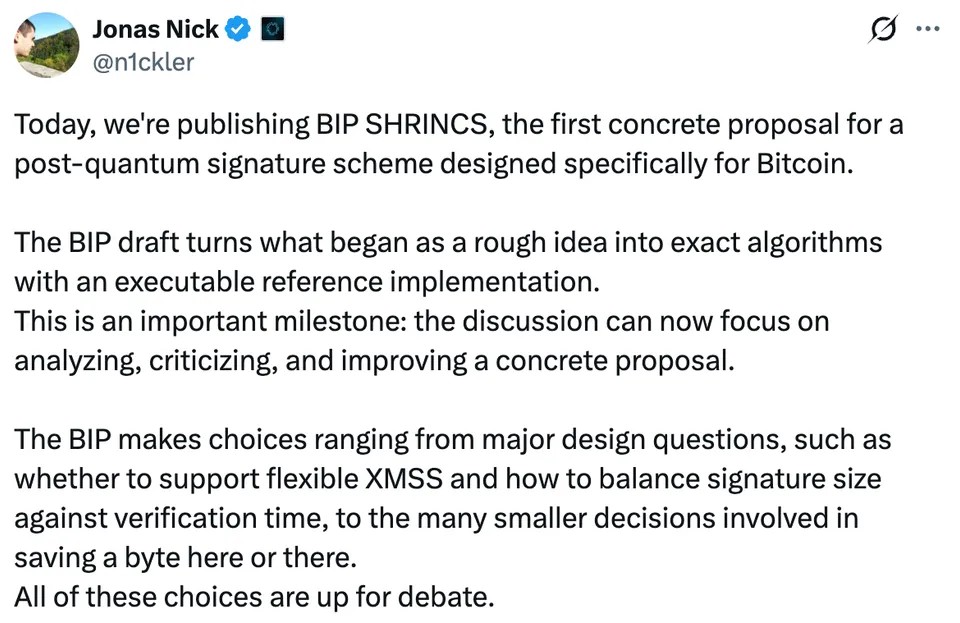
Jonas Nick presenting the BIP SHRINCS proposal on August 26. Source: Jonas Nick

That same month, banks and regulators across Europe, the Middle East, and Asia joined a pilot project testing post-quantum wallets and on-chain transfers using ML-DSA-65—one of the same cryptographic standards included in QuFi's platform. Meanwhile, the Ethereum Foundation removed the Poseidon hash function from its planned post-quantum architecture in favor of proven alternatives like SHA or BLAKE.

Bitcoin developers are also exploring protocol-level defenses. In August, Blockstream researchers published a Bitcoin Improvement Proposal for SHRINCS—an experimental post-quantum signature scheme designed to reduce the size and computational costs associated with quantum-resistant signatures.

This approach has trade-offs. SHRINCS uses stateful signatures to reduce their size, requiring wallets to track previously used signing keys. The scheme remains early-stage, lacking a complete security proof, and its design increases system complexity and creates additional potential user error scenarios.

Magazine: Bitcoin's New Quantum Defense, 18.9M SOL Destroyed: Hodler's Digest

end-content

Perguntas relacionadas

QWhat is the core function of the verification platform launched by QuFi Network?

AIts core function is to separate verification from settlement, using a decentralized network of nodes to verify transactions with post-quantum cryptography before they are executed on existing blockchain networks.

QWhat is uBTC and what network does it currently operate on?

AuBTC is a proof-of-concept from QuFi that applies its verification system to Bitcoin. It currently operates on the Bitcoin Testnet4 network.

QWhich three post-quantum cryptographic standards does the QuFi platform utilize?

AThe QuFi platform utilizes the ML-DSA-65, SLH-DSA, and ML-KEM-1024 standards for digital signatures and secure key exchange.

QWhat is one main advantage claimed by QuFi for its external verification layer?

AIt aims to avoid the increased data storage, bandwidth, and computational resource requirements that could arise from directly implementing larger post-quantum signatures into individual blockchains.

QAccording to the article, what are some potential drawbacks or trade-offs of the SHRINCS post-quantum signature scheme being researched for Bitcoin?

ASHRINCS uses stateful signatures, requiring wallets to track previously used signing keys. It is still at an early stage without a completed security proof, and its design adds system complexity and creates additional potential for user error scenarios.

Leituras Relacionadas

ICP Cloud Engine Heats Up: "20% of Revenue Used for Burn", How Far is it From Token Revaluation?

The ICP community is discussing Cloud Engines, a product enabling enterprises to run private subnets on the Internet Computer. It is linked to the "Mission 70" deflationary plan, where node providers allocate 20% of Cloud Engines revenue to buy and burn ICP tokens, aiming to reduce ICP's inflation rate from 9.72% to 2.92%. This narrative connects enterprise adoption to token scarcity and potential price appreciation for ICP, which is down 99.6% from its peak. Cloud Engines functions as a "custom data center," offering businesses dedicated, sovereign infrastructure without vendor lock-in, using the same underlying protocol as the public ICP network. Key selling points include data sovereignty and hardware choice. However, critical features like SEV-encrypted nodes (for enhanced security) and operator-controlled upgrades are still on the roadmap, not yet live. Early adopters include Pakistan's national cloud engine and a UNDP pilot. The "Mission 70" goal relies on two pillars: supply-side reductions (like cutting node rewards) and demand-side increases in token burns from Cloud Engines revenue. While supply-side changes can be enacted via governance, the demand-side depends entirely on market adoption. Current daily burn rates are far below the levels needed to achieve the 26% deflation target attributed to increased burns. Analysts remain cautious, viewing the 20% burn mechanism as a forward-looking narrative. The product is in early access, and significant, scalable enterprise adoption is unproven. Near-term price catalysts are more likely to come from implementable supply-side governance proposals. The Cloud Engines story represents a longer-term bet on ICP capturing a segment of the enterprise cloud market, with token revaluation contingent on the product generating substantial, quantifiable burn data.

marsbitHá 5m

ICP Cloud Engine Heats Up: "20% of Revenue Used for Burn", How Far is it From Token Revaluation?

marsbitHá 5m

Bank of America's Hartnett: Interest Rate Hikes Become the Biggest Positive, Bond-Ending Bubble Logic Is Spreading

In a recent note, Bank of America strategist Michael Hartnett argues that aggressive central bank tightening, including a potential Fed hike in October, could paradoxically be the most bullish near-term catalyst for risk assets. His core thesis is "the bond bubble is bursting." While stocks remain resilient due to strong US data, solid earnings expectations, and robust AI-related capital expenditure plans, bonds are already showing severe stress, with government bonds down 4.4% year-to-date. The logic is that a proactive Fed hike could help anchor runaway long-end yields (the 10-year recently touched 5.36%), preventing a disorderly surge toward 6%. Without such action, the pressure from rising term premiums could continue unabated. The damage from higher rates is already visible in the most rate-sensitive areas: South Korean retail brokers, French government bonds (with the France-Germany spread hitting 140 bps, reminiscent of the 2012 crisis), and CCC-rated credit. Hartnett highlights that the $8 trillion in money market funds is unlikely to flow into equities without a clear shift to monetary easing. Furthermore, the upcoming US midterm elections pose a key risk; a Democratic sweep (currently a 64% probability) could trigger a >10% equity sell-off due to fears of higher taxes and regulation. Near-term strategy involves positioning for a peak in yields (e.g., long 30-year Treasuries) and risk contraction ahead of the elections, while maintaining exposure to commodities and EM assets. Key levels to watch include 10-year yields at 6%, the France-Germany spread at 150 bps, and a Bull & Bear Indicator below 8 for a potential risk rebound.

marsbitHá 9m

Bank of America's Hartnett: Interest Rate Hikes Become the Biggest Positive, Bond-Ending Bubble Logic Is Spreading

marsbitHá 9m

Silicon Valley AI Status: Whoever Has the Compute is the Boss

The Silicon Valley AI Power Crunch: Compute is King Silicon Valley's race for AI dominance has devolved into a desperate scramble for computing power. The situation has become so extreme that even top executives are resorting to unusual measures. Anthropic's CEO Dario Amodei was reportedly turned down by Meta's Mark Zuckerberg when seeking additional GPU resources, leading to a deal where SpaceX acts as a broker, reselling Nvidia GPUs to Anthropic. This venture reportedly generated $2.561 billion in quarterly AI revenue for SpaceX. The shortage is reshaping the industry's dynamics, creating a new "compute economy" where GPU access is the ultimate currency. This scarcity is causing internal strife at major firms and altering competitive landscapes. A high-profile example is Noam Shazeer, a key AI scientist whom Google re-hired for $2.7 billion, only for him to leave for OpenAI reportedly due to insufficient compute resources for his team. Similar frustrations over resource allocation have been cited within Google and DeepMind. For AI startups, the challenge is existential. Cloud providers are now demanding multi-year contracts with large upfront payments, making flexible, on-demand access nearly impossible. This has spurred innovative workarounds, including a new market for "global compute prospecting"—companies scavenging for underutilized server capacity worldwide—and venture capital firms like Y Combinator and Radical Ventures directly acquiring and allocating GPU clusters for their portfolio companies. The root causes are complex: explosive growth in AI model complexity and the shift from simple chatbots to persistent "Agent" systems dramatically increase compute demands. While tech giants are building new data centers, supply cannot keep pace with immediate needs. Rental prices for critical chips like the Nvidia H100 have surged nearly 40% in months. The consequence is a consolidation of power. Compute access is becoming the definitive barrier to entry, significantly strengthening large companies with their own infrastructure and creating a lucrative "picks and shovels" market for those who control the hardware supply. In today's Silicon Valley, compute isn't just a resource—it's the foundation of survival and competitive advantage.

marsbitHá 35m

Silicon Valley AI Status: Whoever Has the Compute is the Boss

marsbitHá 35m

Even Losing Money Requires Waiting in Line, How Far Can PaperTrade's 1000x Leverage Experiment Go?

PaperTrade, a synthetic perpetual contract platform built on HyperEVM, launched on October 10th. Its defining feature is offering up to 1000x leverage and rewarding users with its native token, PAPER, for trading losses or liquidations—a mechanism dubbed "losing money to mine." This sparked initial frenzy, with users queuing to execute trades and generate losses for PAPER rewards. Within 24 hours, nominal trading volume exceeded $678 billion. The platform operates without traditional order books; users trade directly against a shared USDC liquidity pool. Profits are paid from this pool, but if insufficient funds exist, payments queue on a first-in, first-out basis. PAPER has zero initial supply, minted solely from qualifying user losses, and can be staked for a share of protocol revenue. However, controversies emerged quickly. Smaller orders faced longer execution queues compared to larger ones. More critically, PaperTrade's reliance on Hyperliquid's mid-price for asset pricing made it vulnerable to market manipulation. Reports indicated that actors potentially moved prices on Hyperliquid to profit from large, highly leveraged positions on PaperTrade. The team acknowledged this as a known risk, exacerbated by high initial position limits, and has since tightened limits to reduce the attack surface. After the initial surge, open interest and margin deposited have significantly declined. The platform's long-term viability hinges on whether the value and revenue share from PAPER can justify the initial "loss-mining" strategy for users, moving beyond speculative hype to sustainable returns.

marsbitHá 1h

Even Losing Money Requires Waiting in Line, How Far Can PaperTrade's 1000x Leverage Experiment Go?

marsbitHá 1h

Trading

Spot
活动图片