Pump.fun Launches Direct Investment, Spending $3 Million to Buy 12 New Memes

marsbitPublicado em 2026-01-20Última atualização em 2026-01-20

Resumo

Pump.fun, a leading Meme token launch platform, has announced the creation of its investment arm, Pump Fund. The fund will launch its first initiative, the Build in Public (BiP) hackathon, this month. With a total allocation of $3 million, it plans to invest $250,000 into each of 12 new tokens launched on its platform, valuing each project at $10 million. Beyond funding, selected projects will receive mentorship from Pump.fun’s founders and additional resources. This marks Pump.fun’s first direct financial endorsement of specific Meme tokens, signaling strong support for promising new projects. The platform, known for its substantial revenue—reportedly over $954.8 million historically—aims to reinvest in the ecosystem beyond token buybacks. The BiP hackathon encourages founders to publicly build products after launching a token on Pump.fun. Key requirements include retaining at least 10% of the token supply and maintaining active communication with supporters via social media and live streams. Project selection will prioritize organic user growth, genuine market appeal, and long-term sustainability over hype. Applications opened on January 19 and will run for 30 days. The first winning projects will be announced on February 18, though the program will continue indefinitely. For those tracking potential opportunities, new tokens on Pump.fun—especially those tagged with Pump Fund or BiP—are worth monitoring closely in the coming weeks.

Original | Odaily Planet Daily (@OdailyChina)

Author | Azuma (@azuma_eth)

On the morning of January 20, Pump.fun officially announced the launch of its investment division, Pump Fund. Pump Fund will initiate its first project, the Build in Public (BiP) hackathon, this month, investing $3 million in 12 new tokens issued through the platform, with $250,000 allocated to each token, corresponding to a valuation of $10 million. In addition to financial support, Pump.fun will also provide professional guidance from its founders and other substantial resources.

As the project with the strongest revenue-generating capability in the entire Meme sector, this is the first time Pump.fun has openly expressed its support for specific Meme tokens through official channels with real money (the attitude may be more important than the funding scale). Therefore, the selected tokens are highly likely to become the seed candidates in the Meme sector in the coming period.

Pump.fun's Revenue-Generating Capability

Pump.fun's staggering revenue capability is no secret. Data compiled by analyst Adam (@Adam_Tehc) on Dune shows that Pump.fun's historical total revenue has reached $954.8 million. Although daily revenue has significantly declined as the Meme hype cooled, it still amounts to hundreds of thousands of dollars per day.
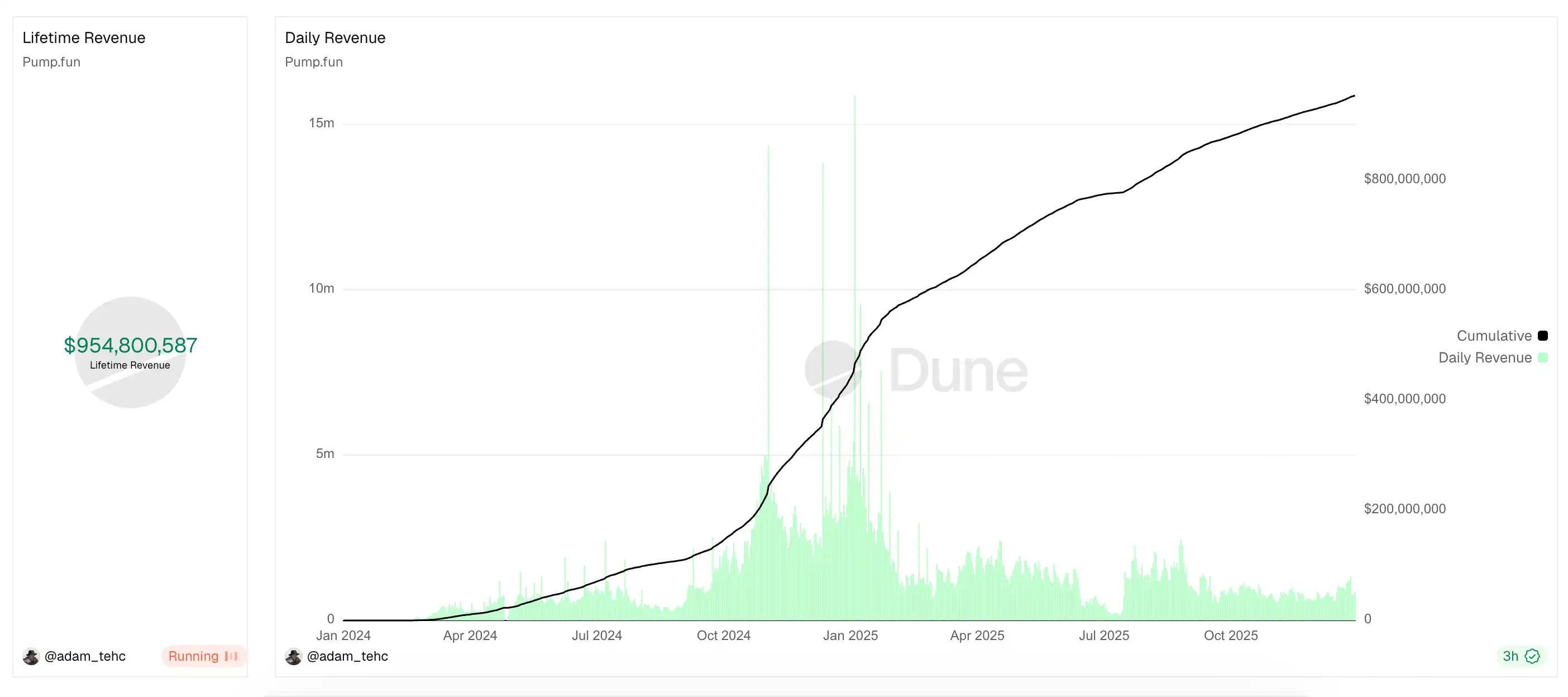
Holding massive real funds, Pump.fun is exploring other paths for ecosystem feedback beyond PUMP token buybacks. Pump Fund and its affiliated BiP hackathon are Pump.fun's latest attempts.

BiP Hackathon Details

According to the description on the BiP hackathon's dedicated page, the project aims to support founders who issue tokens on Pump.fun and publicly build products. Unlike traditional hackathons where participants rely on VCs or judges for evaluation to compete for prizes, the BiP hackathon intends to introduce token performance as a variable, allowing the market to determine whether a project is worth advancing and enabling users to become the earliest investors.

When discussing this key difference, Pump.fun founder Alon stated in an X post: "Before Pump.fun, my co-founder and I tried many different ideas. Consumer finance, DeFi, SocialFi, NFTs—but all failed. One of the biggest problems we encountered was that we found it extremely difficult to get our products in front of users. Trying to reach the right user base was an incredibly tedious task..."

Specifically, the BiP hackathon requires:

  • Participants must issue a token on Pump.fun and then publicly build a product;
  • Participants must also hold at least 10% of the token supply to align interests;
  • Finally, the event strongly encourages founders to speak publicly on social media like X or livestream on Pump.fun to maintain effective communication with the community.

As for the types of participating projects, Pump.fun imposes no restrictions; they are not even limited to cryptocurrency-related products. Projects from different market stages and various verticals can participate.

Regarding how the 12 winning projects will ultimately be selected, Pump.fun did not provide specific rules but pointed out two main principles: First, organic user growth and genuine appeal are preferred over connections and flashy promotions; second, in addition to the appeal of the product itself/social media, the long-term sustainability of the project will also be evaluated.

Key Timelines to Note

According to the BiP hackathon's schedule, applications opened on January 19. Participants are required to launch their tokens at the time of application and begin public building (including livestreaming development progress, regularly sharing updates, and maintaining community interaction). The application window will be open for 30 days. On February 18, Pump.fun will announce the first batch of winning projects and provide funding (at least one will be announced). Considering that some projects may need more time to gain market attention and demonstrate appeal, the program will continue to run long-term.

So the timeline is clear: if you want to spot potential opportunities among this batch of Meme tokens, you need to start paying attention to newly issued tokens on Pump.fun from now on, especially those with the Pump Fund or BiP labels. Although the first batch of winning tokens won't be announced until 30 days later, tokens likely to be selected by Pump.fun will inevitably show competitiveness before then.

Overall, while Pump.fun's event may not drive a collective sentiment recovery in the Meme market, it can at least contribute some new tokens with clearer evaluation dimensions.


Perguntas relacionadas

QWhat is the purpose of Pump Fund's first project, the Build in Public (BiP) hackathon?

AThe BiP hackathon aims to support founders who launch tokens on Pump.fun and publicly build products. It will invest $3 million in 12 new tokens, with $250,000 per token at a $10 million valuation, and provide professional guidance and resources.

QHow much total revenue has Pump.fun generated historically according to data analyst Adam?

APump.fun's historical total revenue has reached $954.8 million.

QWhat are the key requirements for participants in the BiP hackathon?

AParticipants must issue a token on Pump.fun, publicly build a product, hold at least 10% of the token supply to align interests, and are strongly encouraged to communicate publicly on social media like X or via live streams on Pump.fun.

QWhen will Pump.fun announce the first batch of winning projects for the BiP hackathon?

APump.fun will announce the first batch of winning projects on February 18, after the 30-day application window that started on January 19.

QWhat principles will Pump.fun use to select the 12 winning projects in the BiP hackathon?

ASelection will prioritize organic growth and genuine user attraction over relationships and flashy marketing, and will evaluate projects based on long-term sustainability alongside product and social media appeal.

Leituras Relacionadas

$292 Million KelpDAO Cross-Chain Bridge Hack: Who Should Foot the Bill?

On April 18, 2026, an attacker stole 116,500 rsETH (worth ~$292M) from KelpDAO’s cross-chain bridge in 46 minutes—the largest DeFi exploit of 2026. The stolen assets were deposited into Aave V3 as collateral, causing $177–200M in bad debt and triggering a cascade of losses across nine DeFi protocols. Aave’s TVL dropped by ~$6B overnight. This legal analysis argues that KelpDAO and LayerZero Labs share concurrent liability, with fault apportioned 60%/40%. KelpDAO negligently configured its bridge with a 1-of-1 decentralized verifier network (DVN)—a single point of failure—despite LayerZero’s explicit recommendation of a 2-of-3 setup. LayerZero, which operated the compromised DVN, failed to secure its RPC infrastructure against a known poisoning attack vector. Both protocols’ terms of service cap liability at $200 (KelpDAO) or $50 (LayerZero), but these limits are likely unenforceable due to unconscionability, gross negligence exceptions, and potential securities law invalidation (if rsETH is deemed a security under the Howey test). Aave’s governance also faces fiduciary duty claims for raising rsETH’s loan-to-value ratio to 93%—far above competitors’ 72–75%—without adequately assessing bridge risks, amplifying the systemic fallout. Practical recovery targets include LayerZero Labs (a registered Canadian entity), KelpDAO’s founders, auditors, and identifiable Aave governance delegates. The incident underscores escalating legal risks for DeFi protocols, infrastructure providers, and governance participants.

marsbitHá 3m

$292 Million KelpDAO Cross-Chain Bridge Hack: Who Should Foot the Bill?

marsbitHá 3m

Insider Trading in War: 5 People Involved, the Highest Earner Was Arrested

On April 24, the U.S. Department of Justice arrested U.S. Army Special Forces Staff Sergeant Gannon Ken Van Dyke for insider trading related to the capture of Venezuelan President Nicolás Maduro on January 3. Van Dyke allegedly profited over $400,000 by placing bets on a prediction market, Polymarket, using insider knowledge of the covert operation. According to the indictment, Van Dyke registered an account (0x31a5) on December 26 and made a series of bets predicting Maduro’s capture and U.S. military involvement in Venezuela. He withdrew most of his funds on the day of the operation and attempted to obscure his tracks by transferring assets through crypto and brokerage accounts. This case marks the first time the DOJ has prosecuted insider trading on Polymarket. PolyBeats had previously identified five suspicious accounts, including Van Dyke’s—the highest earner—in January. The other accounts, with profits ranging from $34,000 to $145,000, remain under unofficial scrutiny but have not been charged. Their lower profits, indirect access to information, and unclear legal boundaries may complicate prosecution. Polymarket has since strengthened its market integrity rules, explicitly prohibiting trading based on confidential or insider information. Van Dyke’s arrest, nearly four months after his trades, signals increased regulatory attention and the persistent traceability of blockchain-based transactions.

marsbitHá 5m

Insider Trading in War: 5 People Involved, the Highest Earner Was Arrested

marsbitHá 5m

Bitwise: Bullish on Bitcoin's Performance in the Second Half of the Year, AI and Regulation Will Spark a New Altcoin Season

Bitwise CIO Matt Hougan and Research Lead Ryan Rasmussen express strong bullish sentiment on Bitcoin's long-term prospects, suggesting that its $1 million price target may be too conservative. They argue Bitcoin serves a dual role: as digital gold and a potential global settlement asset, especially amid declining trust in traditional monetary systems. Despite a weak Q1 2026 where nearly all crypto assets and prices saw double-digit declines, the analysts remain optimistic due to strong forward-looking catalysts, including institutional adoption via Bitcoin ETFs from major firms like Morgan Stanley and Goldman Sachs. Geopolitical instability, such as Iran’s mention of using Bitcoin for international payments, increases the value of Bitcoin’s “out-of-the-money call option” as a non-political, global settlement currency. This enhances its appeal beyond a mere store of value. . Additionally, Hougan highlights that a clearer regulatory token framework under current SEC leadership, combined with AI efficiency gains and high-performance blockchains, could fuel a new “altseason” by late 2026. This may lead to a wave of legitimate, value-capturing token projects, unlike the earlier ICO boom. . Bitwise also announced an Avalanche ETF, citing its unique architecture and rapid growth in real-world asset (RWA) tokenization, which has surged 10x to nearly $30 billion in two years. The firm believes Layer 1 blockchains are still early in their growth cycle, with significant potential ahead.

marsbitHá 50m

Bitwise: Bullish on Bitcoin's Performance in the Second Half of the Year, AI and Regulation Will Spark a New Altcoin Season

marsbitHá 50m

Trading

Spot
Futuros
活动图片




