Public Version of Mythos Officially Launched: Analyzing the Advantages and Limitations of AI Smart Contract Auditing

marsbitPublicado em 2026-06-11Última atualização em 2026-06-11

Resumo

Publicly available Mythos, Anthropic's AI model, has officially launched, demonstrating both significant potential and limitations in smart contract security auditing. The article analyzes its capabilities through real-world cases. AI excels in identifying subtle, low-level vulnerabilities through pattern recognition and large-scale code screening. A key example is detecting a storage slot collision between a custom rewards mapping and a third-party library's ReentrancyGuard, a vulnerability easily missed in manual audits. In the recent Zcash incident, AI also rapidly discovered a critical soundness bug that had remained hidden for years. However, AI currently struggles with complex, interconnected scenarios. When tested on the Curve LlamaLend sDOLA exploit, which involved manipulating prices across multiple protocols (Curve pools, lending markets) to trigger liquidations, Fable 5 failed to identify the core cross-protocol attack vector. These scenarios require a deep understanding of DeFi economic models and multi-contract interactions. In conclusion, while AI tools like Mythos significantly boost efficiency in finding standardized, syntactic vulnerabilities, they cannot yet replace expert analysis for complex, business-logic, and cross-protocol attacks. An effective audit workflow combines AI's speed for initial screening with human expertise for in-depth, holistic analysis.

Original Source: Beosin

On June 9th, Anthropic officially launched the public version of Mythos, Claude Fable 5. Previously, Mythos demonstrated outstanding capabilities in security vulnerability discovery, rapidly identifying hidden vulnerabilities within systems, which garnered significant attention in the cybersecurity field.

The recent Zcash incident is a typical example of AI uncovering blockchain vulnerabilities. Security researcher Taylor Hornby, using the Anthropic Claude Opus 4.8 model, discovered a latent Orchard privacy pool soundness vulnerability within just a few hours. This vulnerability, which had gone unnoticed in multiple previous manual audits over four years, theoretically allowed the minting of unlimited undetected fake ZEC, directly causing the price of ZEC to plummet by nearly 40%.

Currently, AI has demonstrated astonishing efficiency in areas such as code pattern matching and batch preliminary screening. Integrating AI into the blockchain and smart contract security audit process is becoming a trend in the Web3 security industry. This article will analyze the strengths and weaknesses of AI in smart contract auditing based on real vulnerability cases and the actual performance of Fable 5.

Advantageous Scenarios for AI Auditing

Case Analysis: Storage Slot Collision

A certain contract used the following two components simultaneously:

1. A custom rewards mapping (used to record user claimable rewards)

2. The Solady library's ReentrancyGuard (to prevent reentrancy attacks)

However, the storage layouts of these two components conflicted.

Among them, Solady's ReentrancyGuard, for ultimate gas optimization, uses a fixed, low-numbered storage slot (typically a slot near constant obtained through specific calculations). The typical logic of the nonReentrant modifier is:

// A simplified versionmodifier nonReentrant() {    // when entering, write guard slot as 0xff...ff(Sentinel Value)    assembly {        if eq(sload(REENTRANCY_GUARD_SLOT), 2) { revert(...) }  // 2 represents locked        sstore(REENTRANCY_GUARD_SLOT, 2)  // locked    }    _;    // recover when function finishes    assembly { sstore(REENTRANCY_GUARD_SLOT, 1) }}

Custom rewards mapping:

mapping(address => uint256) public rewards;

According to Solidity storage layout rules (the first slot of a mapping is calculated from its declaration position), the first slot of the rewards mapping was exactly the same as the fixed guard slot of the ReentrancyGuard.

Attack process (detailed steps):

1. The attacker calls the getReward() function.

2. The nonReentrant modifier triggers, writing the guard slot as 0xffffffffffffffffffffffffffffffffffffffffffffffffffffffffffffffff (all 1s).

3. The contract code subsequently reads rewards[attacker's address] — but due to the slot collision, it actually reads the large value of 0xff...ff from the guard slot.

4. The contract assumes "there is a huge reward," thus transfers that amount of ETH to the attacker, while attempting to zero out rewards[attacker] (but writes back to the same guard slot).

5. Because the modifier restores the slot when the function ends, when the attacker calls getReward() again, the process repeats.

6. The attacker cyclically calls 200 times, successfully extracting a fixed amount of ETH each time, until the contract's available ETH is drained.

It's important to note that this is not a traditional "reentrancy attack" but rather the ReentrancyGuard's own protection mechanism being reverse-engineered by storage collision, turning into a vulnerability for infinite reward claims. Manual audits rarely dig line-by-line into the storage layout of third-party libraries, while AI can instantly perform library version comparison + precise storage slot mapping, directly hitting such "hidden collision" vulnerabilities.

Disadvantageous Scenarios for AI Auditing

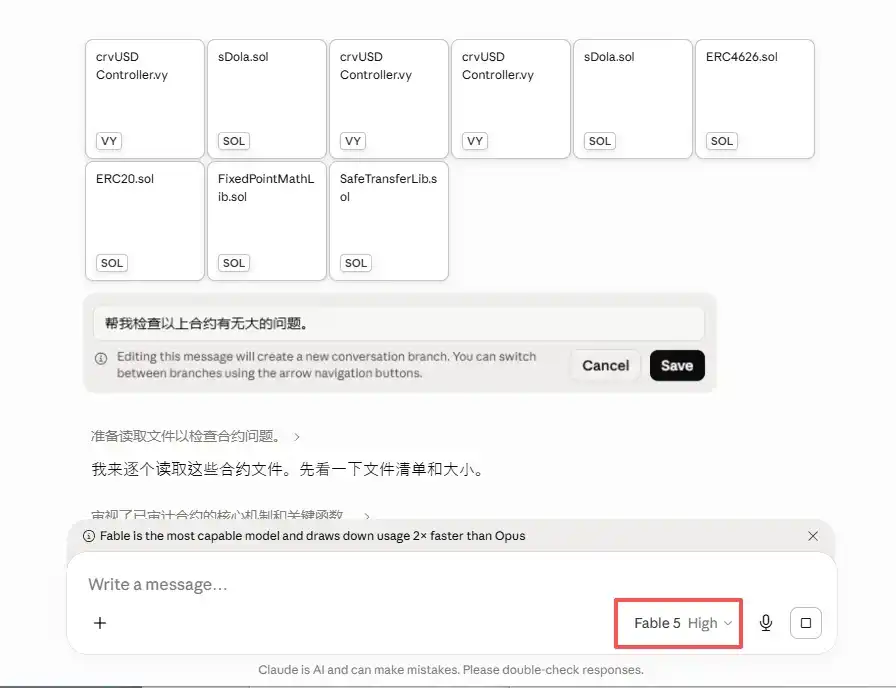
Fable 5 performs excellently in detecting single-contract, pure-code-syntax, low-level storage-class vulnerabilities. However, it still shows obvious limitations when facing cross-protocol combined semantics and multi-contract composite attacks. We used the latest public version Fable 5 to retest contracts related to the Curve LlamaLend sDOLA attack incident. The results confirmed this issue.

This audit involved the following contract list: crvUSD Controller.vy, sDOLA.sol, ERC4626.sol, and other series contracts. Fable 5 failed to identify the core risks corresponding to this attack:
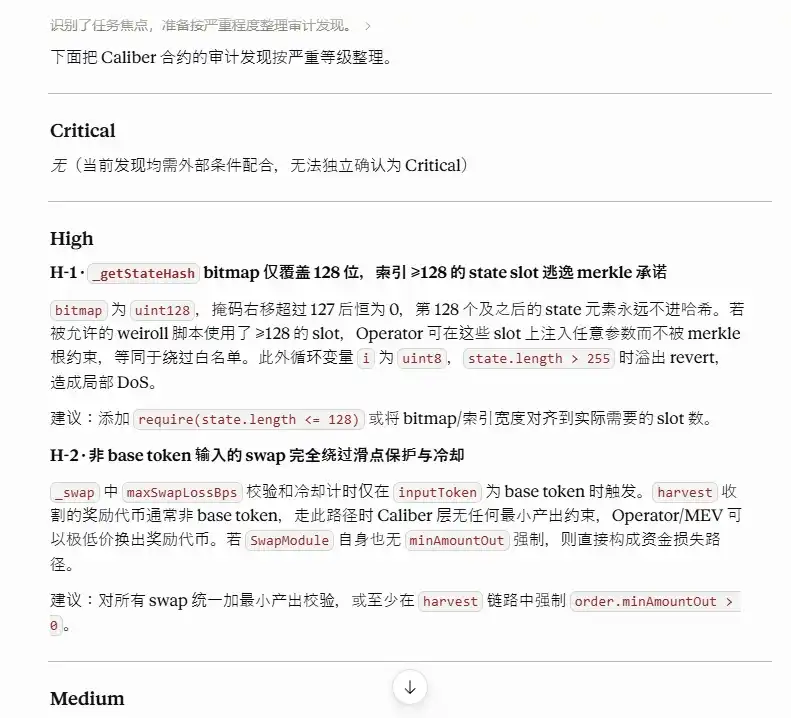
This incident belongs to a typical cross-protocol composite vulnerability. The syntax and logic of a single contract's code are flawless, but the attacker exploits multi-protocol linkage to construct an attack chain:

1. Utilizing flash loan tools to manipulate the price of the Curve liquidity pool, maliciously suppressing the asset price of sDOLA (an ERC-4626 vault share).

2. A large number of lending positions using sDOLA as collateral trigger the liquidation threshold.

3. The attacker executes liquidation operations in batches, profiting from them.

Such vulnerabilities are formed based on DeFi multi-protocol combinations, testing the comprehensive analysis capabilities of AI/audit experts regarding the overall business and protocol economic models. Currently, AI auditing still has shortcomings in cross-protocol combined semantics.

Conclusion

Through actual case testing, it can be seen that Fable 5 effectively uncovers hidden vulnerabilities that are easily missed in manual audits in standardized, detail-oriented scenarios such as storage slot conflicts, code pattern vulnerabilities, single-contract logic flaws, and batch code preliminary screening. However, when dealing with cross-protocol combined semantics, DeFi economic models, multi-contract linkage attacks, and complex business logic vulnerabilities, it struggles to understand the business nature of the on-chain ecosystem and discover composite attack paths. This part still requires analysis led by professional security auditors.

In daily audit work, Beosin has established a mature collaborative audit process combining AI and security audit experts. This not only significantly improves audit efficiency but also better identifies potential detailed risks and complex business logic vulnerabilities, making audit work more efficient, comprehensive, and in-depth.


Perguntas relacionadas

QWhat major AI model was released for public use, and what specific capability in cybersecurity has it demonstrated?

AAnthropic officially released the public version of Mythos, specifically the Claude Fable 5 model. It has demonstrated a strong capability in proactively discovering hidden security vulnerabilities within systems, particularly in areas like storage slot collisions within smart contracts.

QWhat is the key limitation of AI like Claude Fable 5 in smart contract auditing, according to the article's analysis of the Curve LlamaLend sDOLA attack?

AThe key limitation is its difficulty in handling cross-protocol combinatorial semantics and multi-contract interaction attacks. While effective for single-contract, syntax-level vulnerabilities, it struggles to understand the overall business logic and economic models of DeFi protocols that involve interactions between multiple smart contracts.

QDescribe the storage slot collision vulnerability example given in the article. How did AI auditing help discover it?

AThe vulnerability involved a collision between a custom `rewards` mapping and the fixed storage slot used by the Solady library's `ReentrancyGuard`. This allowed an attacker to repeatedly drain ETH by tricking the contract into reading the guard's sentinel value as a massive reward balance. AI auditing excelled here by instantly comparing library versions and precisely mapping storage layouts, pinpointing this 'hidden collision' that manual audits often miss.

QWhat was the outcome of using Anthropic Claude Opus to analyze Zcash, as mentioned in the article?

ASecurity researcher Taylor Hornby used the Anthropic Claude Opus 4.8 model and discovered a critical 'soundness' vulnerability in Zcash's Orchard privacy pool within a few hours. This bug, which had gone undetected through multiple manual audits for four years, could theoretically allow the unlimited minting of undetectable fake ZEC, causing ZEC's price to drop nearly 40%.

QWhat workflow does Beosin advocate for in smart contract security auditing based on the article's conclusion?

ABeosin advocates for a mature, collaborative workflow that combines AI tools with human security audit experts. This synergy leverages AI for efficiency in standardized tasks and detail-oriented vulnerability detection (like pattern matching and initial screening) while relying on human experts to lead the analysis of complex business logic, cross-protocol interactions, and DeFi economic models, resulting in a more efficient, comprehensive, and in-depth audit process.

Leituras Relacionadas

The Clarity Act's Journey Through Congress: The Thorny Path of Bipartisan Compromise in the U.S.

The U.S. Congress is struggling to advance the crypto market structure bill known as the Clarity Act, with bipartisan compromise proving difficult. Key hurdles include unresolved disputes over "yield" products and, more critically, the inclusion of strong ethics provisions for elected officials—a non-negotiable demand for many Democrats. While a compromise on yield was reached in May, securing only limited Democratic support in committee, the separate Senate Agriculture Committee version later passed with no Democratic votes due to the ethics impasse. As Republicans push for a full Senate vote in July, demands for ethics rules have expanded, and other contentious issues like developer protections and concerns from law enforcement and large banks further complicate negotiations. Despite consensus on the need for legislation, the path forward is unclear. Recent discussions between senators and White House officials aim to find acceptable ethics language. Some lawmakers question whether a compromise text can garner enough bipartisan support, with one Democrat stating the current proposal lacks the strong ethics provisions required for their vote. Potential short-term goals for the crypto community include symbolic Senate action before the August recess, a longer-term aim for passage by 2026, or establishing a detailed framework that addresses ethics and other compromises. The process remains arduous, relying on the traditional, vote-by-vote effort to build bipartisan support.

marsbitHá 12m

The Clarity Act's Journey Through Congress: The Thorny Path of Bipartisan Compromise in the U.S.

marsbitHá 12m

Are Kalshi and Polymarket Founders at Odds? This Business Rivalry Is More Brutal Than You Think

"The Rivalry Between Kalshi and Polymarket Founders Turns Bitter and Litigious" The intense feud between Tarek Mansour, CEO of Kalshi, and Shayne Coplan, founder of Polymarket, has escalated far beyond typical business competition into personal animosity and regulatory battles. Both lead billion-dollar prediction market platforms, but their approaches differ sharply. Kalshi positions itself as the compliant operator, securing U.S. regulatory approval before launching. In contrast, Polymarket initially operated offshore, allowing U.S. users to access its platform via VPN, which drew regulatory scrutiny. The conflict reached a peak in November 2024 when FBI agents raided Coplan's New York apartment. While Coplan publicly blamed political motives, his team privately suspected Kalshi was involved. According to sources, Kalshi's lawyers had previously reported Polymarket's operations to federal prosecutors, highlighting its accessibility to U.S. users despite a ban. This incident fueled mutual accusations and underhanded tactics, including social media smear campaigns and attempts to sabotage each other's major business deals. Their rivalry also played out in Washington, influencing regulatory debates. Kalshi actively lobbied against Polymarket's practices, framing them as illegal and unethical. Polymarket, after facing a CFTC fine and investigation, later acquired a licensed U.S. firm to launch a domestic app, regaining a foothold. Despite the hostility, both companies have seen massive growth, with combined trading volumes soaring. However, increased regulatory scrutiny, particularly around insider trading on Polymarket's platform, continues to pose challenges. The founders' deep-seated mutual disdain ensures their battle for market dominance remains as much a personal vendetta as a commercial one.

marsbitHá 21m

Are Kalshi and Polymarket Founders at Odds? This Business Rivalry Is More Brutal Than You Think

marsbitHá 21m

Bank of America Quietly Positions: Could $6 Trillion in Bank Deposits Flow into Stablecoins?

Bank of America (BofA) is making strategic moves in digital assets, appointing senior leaders to advance a platform covering stablecoins, tokenized deposits, custody, and crypto settlement. This comes amid a broader discussion about the potential migration of trillions in bank deposits to stablecoins. A cited TBAC report estimated up to $6.6 trillion in transactional deposits could be at risk of moving to stablecoins long-term, a point BofA's CEO previously conditioned on stablecoins being allowed to pay interest. The regulatory landscape is evolving, with the GENIUS Act setting a final implementation deadline for January 2027. Major banks, however, are not waiting; JPMorgan, Citi, BofA, and others are already developing tokenized deposit networks and services. Industry observers note that while retail crypto trading is sluggish, institutional adoption of stablecoins for real-world use cases is driving growth. Despite the activity, some analysts remain cautious, noting banks have a long history of blockchain announcements and that true structural change is slow. The stablecoin market itself has seen a recent dip from its peak. Optimistic projections, however, foresee significant growth, with stablecoin settlement volume already reaching $33 trillion in 2025. The race is on for the post-January 2027 landscape, where regulatory clarity is expected to accelerate the fusion of traditional finance and crypto.

marsbitHá 26m

Bank of America Quietly Positions: Could $6 Trillion in Bank Deposits Flow into Stablecoins?

marsbitHá 26m

Trading

Spot
活动图片