Prompt Engineering Paper Accepted at ICML 2026 Sparks Heated Debate Among Netizens

marsbitPublicado em 2026-07-15Última atualização em 2026-07-15

Resumo

A paper on prompt engineering, titled "Verbalized Sampling (VS)," has been accepted by the prestigious machine learning conference ICML 2026, sparking significant debate online. The paper addresses the problem of "mode collapse" in large language models (LLMs), where models tend to produce repetitive, safe, and homogeneous outputs. Instead of proposing new training algorithms or model architectures, the authors introduce a simple yet effective prompt-based method. The core technique, Verbalized Sampling, instructs the model to generate multiple responses (e.g., five jokes) while also outputting a possible probability value for each. This prompt adjustment alone was shown to significantly increase output diversity by 1.6x to 2.1x in creative writing tasks, without compromising factual accuracy or safety. The authors argue that the root cause of mode collapse lies not in optimization algorithms but in the "typicality bias" present in human preference data used for alignment. Human annotators naturally favor familiar and fluent text, which steers models toward conservative outputs. The VS method aims to counteract this by leveraging the model's inherent pre-training distribution during inference. The paper's acceptance has led to polarized reactions. Critics argue that prompt engineering lacks the theoretical depth and algorithmic innovation expected from top-tier conferences like ICML, questioning its novelty, generalizability across models, and experimental scale. Some draw...

Prompt engineering can get a paper published in ICML these days???

Recently, a guy shared a paper just accepted by ICML 2026 on Reddit, and the post instantly went viral, with the number of comments skyrocketing.

However, everyone was left scratching their heads: Is this for real?
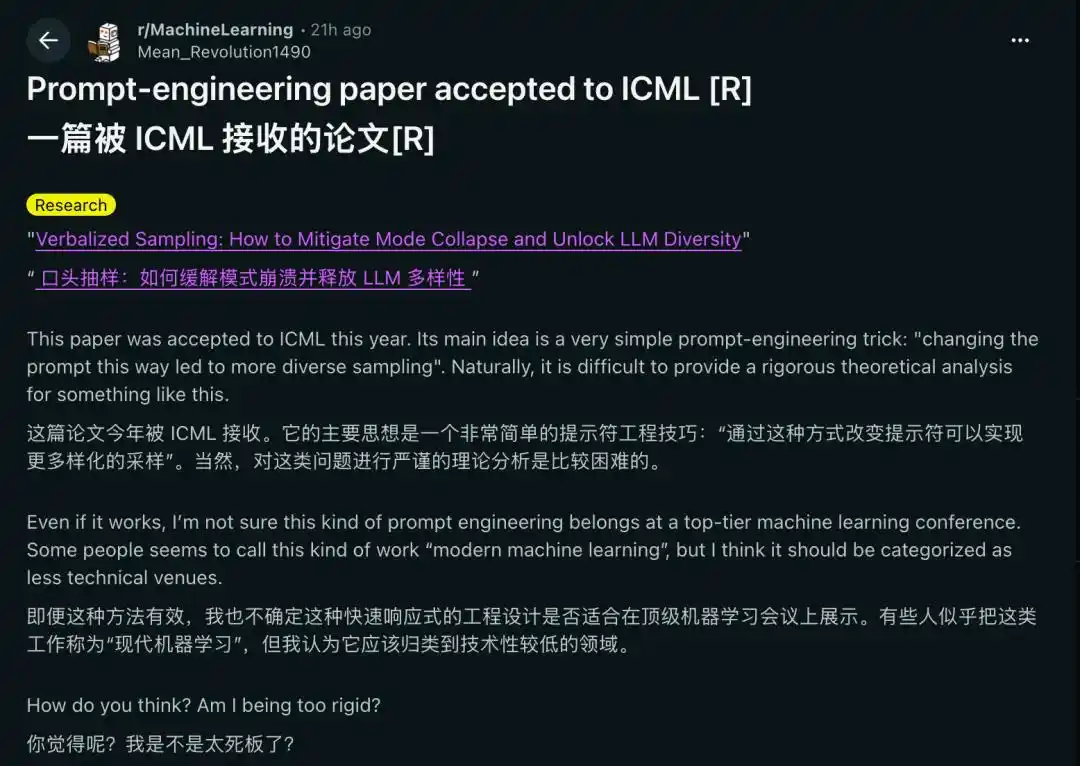
The authors didn't propose any new optimization algorithms or train any new large models. They simply did one thing—

Modified the Prompt.

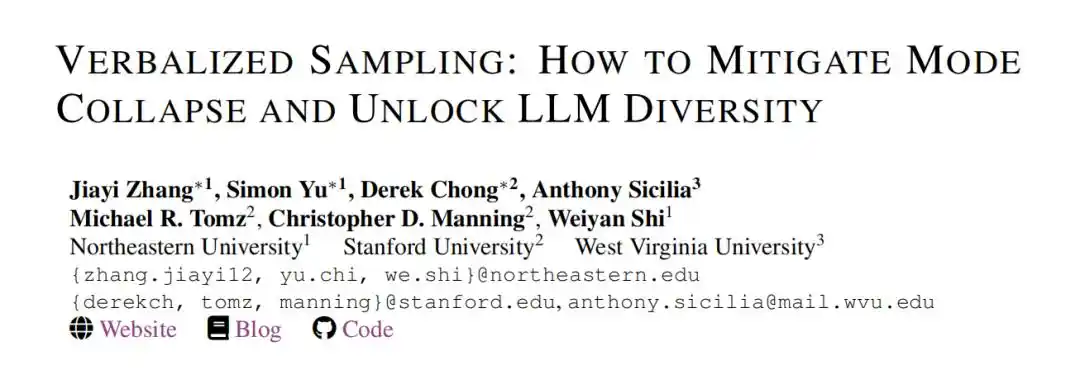
The paper proposes a method called Verbalized Sampling (VS), which significantly enhances the diversity of large language model outputs and alleviates the long-standing issue of Mode Collapse in LLMs, solely by adjusting the prompt.

It sounds quite practical, but is it right for a mere prompt trick to get into a top-tier conference?

Let's take a look at the paper first before passing judgment.

A Highly Controversial ICML Paper
Have you ever felt that AI is becoming increasingly homogeneous?

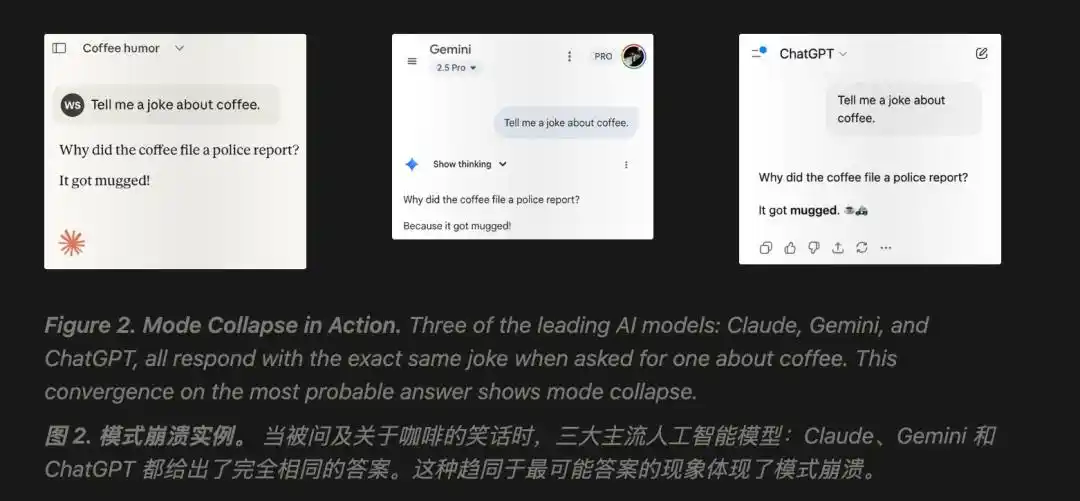
Ask it ten times to "Tell me a joke," and the answers you get are often highly similar. This is not only true for creative tasks but also for Q&A, code generation...

This phenomenon is collectively referred to as mode collapse in academia.

Simply put, models increasingly prefer to output the highest probability, safest, and most classic answers, while rejecting alternative creative ideas.
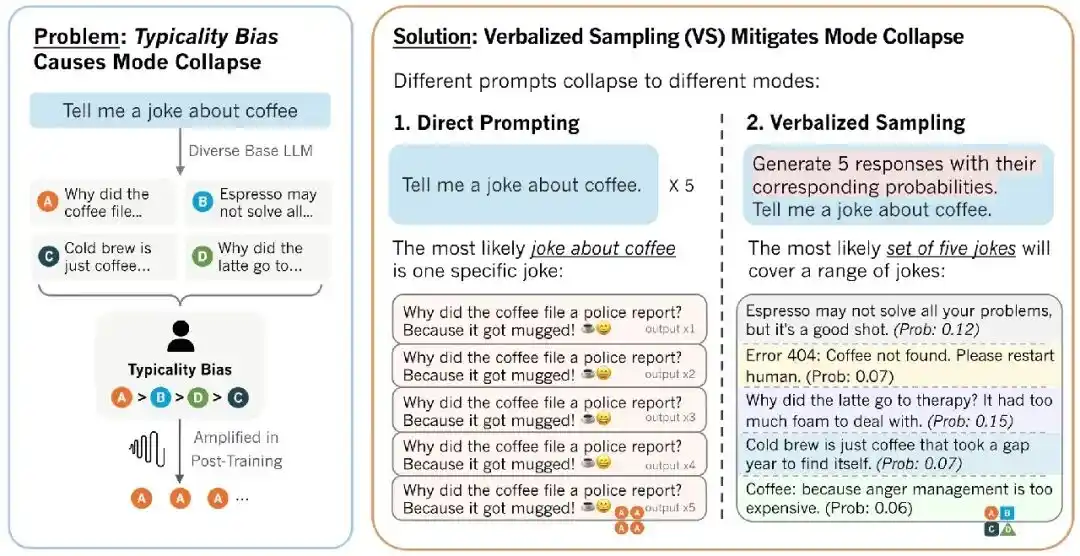
In the past, to solve this model problem, most researchers would first think of adjusting sampling parameters, modifying decoding algorithms, retraining, etc. However, this paper takes a different approach: directly asking the model to output its own sampling process along with the answer.

For example, using the earlier joke-telling scenario, the authors would modify the prompt, requiring the model to:

Generate 5 jokes, while also assigning a possible probability value to each joke.

Then the model can produce more varied and less repetitive answers.

It sounds very simple, doesn't it? In fact, this is the core contribution of the paper—the Verbalized Probability Sampling method. No fine-tuning is needed; just by changing the way of asking, content diversity can be significantly improved.
In the paper, however, the authors provide a rigorous argumentation process for this.

First, they address the root cause of the model's uniformity.

Past academia attributed this problem to algorithmic aspects, such as insufficient reward models or improperly set KL penalty terms. This paper delves deeper, suggesting the real root lies in the preference data itself.

They propose a concept called prototypical bias. From a cognitive psychology perspective, human annotators naturally prefer familiar, fluent, conventional text, and instinctively give higher scores to stereotypical, mainstream answers.
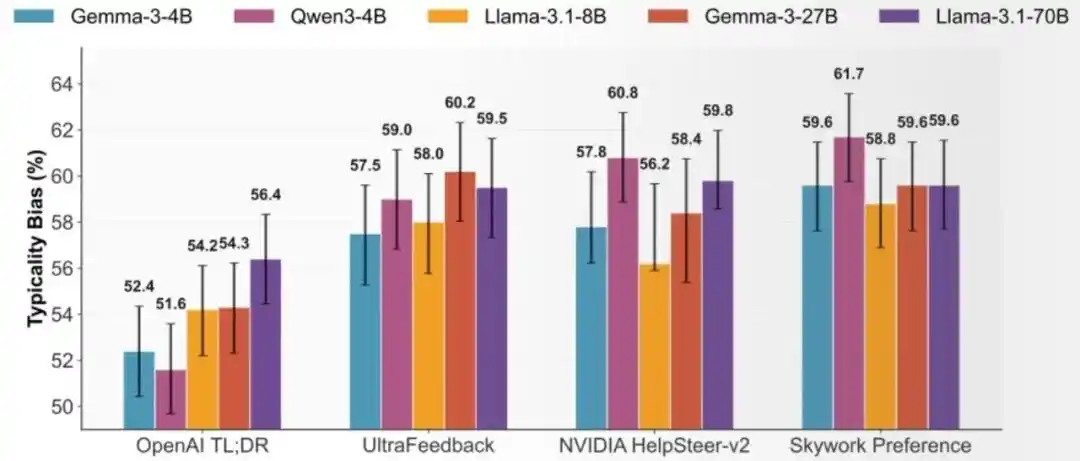
Therefore, even if reward models and optimization algorithms are perfected, as long as the human preference data used for training inherently contains prototypical bias, post-alignment models will still suffer from mode collapse.

The authors tested this repeatedly on five preference datasets and different base models, and the conclusion remained consistent.

After realizing this, the authors argue that since the problem is rooted in the training data, one only needs to consider designing a prompt-based correction scheme during the inference stage. That is, by making the model output the complete probability distribution in the prompt, the model's inherent diverse output distribution from the pre-training phase can be awakened, restoring diversity.

The rest involved running experiments with this method in various scenarios. The results show that in creative writing tasks, diversity was 1.6~2.1 times that of ordinary prompts, without reducing factual accuracy or compromising model safety.

Furthermore, the stronger the model's capabilities and the larger the parameter count, the more pronounced the diversity improvement brought by VS.
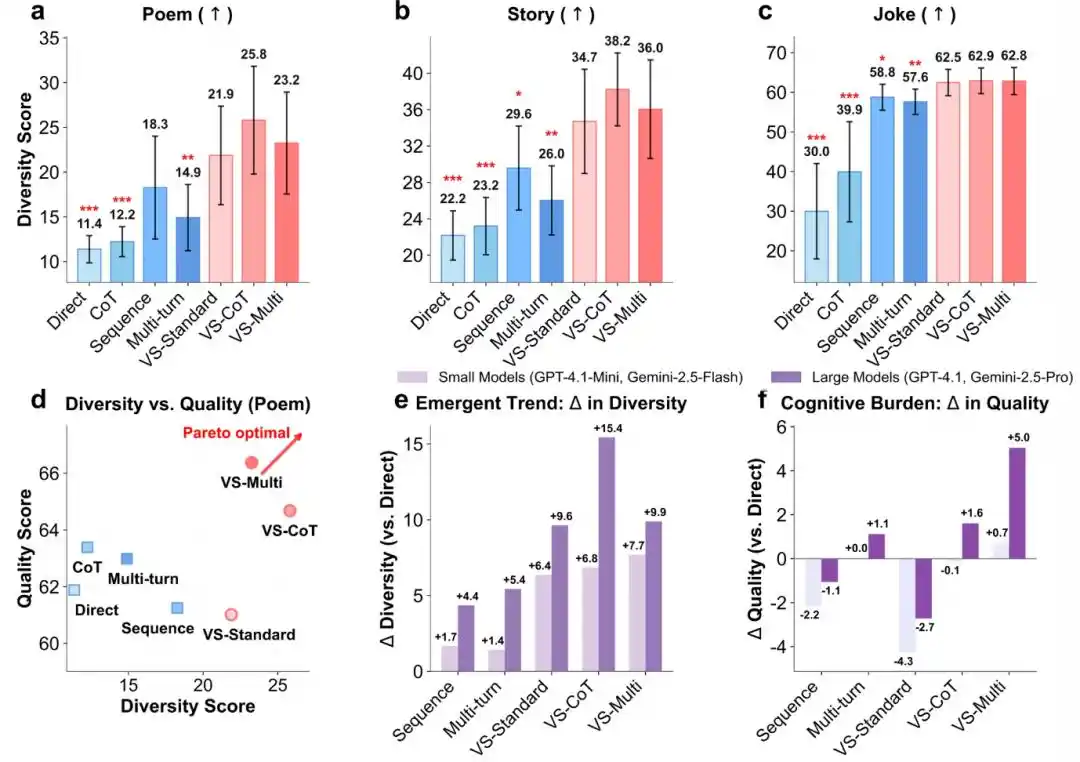
So, while the final method presented in the paper is simple, ICML still passed it.

Reddit Users in a Heated Debate

Under the original post, however, opinions on this paper are polarized.

Many netizens expressed that in the past, ICML featured hardcore innovations like new models, new algorithms, and new theories. Merely optimizing prompts or inference processes doesn't qualify as serious machine learning research.

In comparison, the innovation of this work seems somewhat thin, and several issues exist:

First, similar instruction-writing methods are not unique; some even claimed they were writing prompts like this just yesterday. Second, the theory is difficult to verify because prompts might fail when models are changed, unlike algorithms which are more stable. Third, the experimental scale is limited, insufficient to prove this is a universal law.
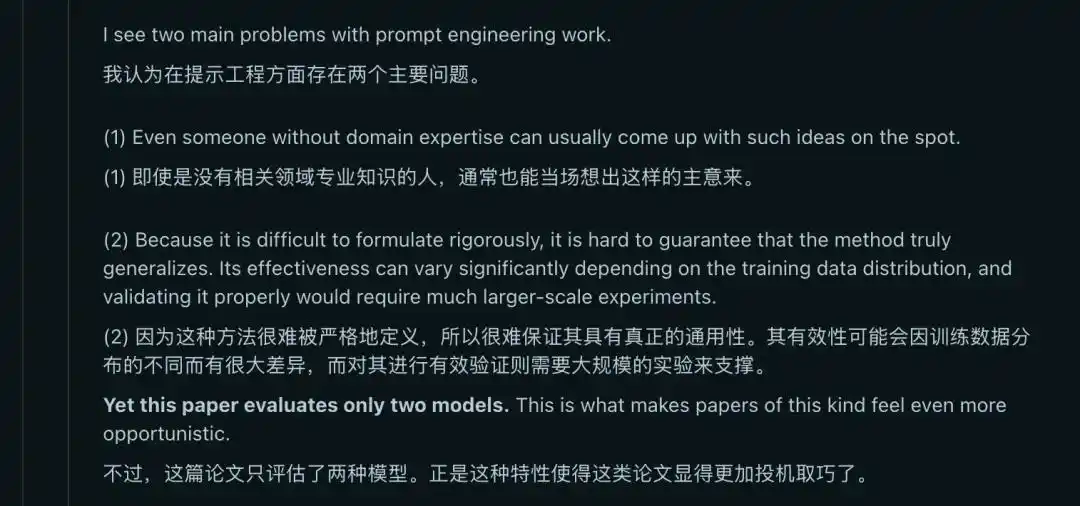
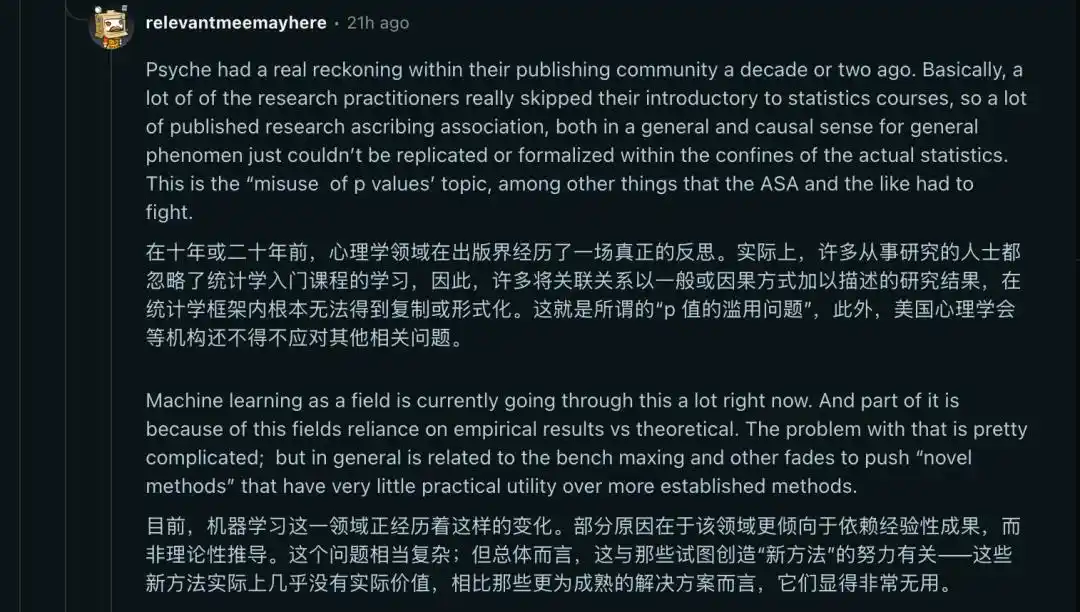
Some netizens directly compared the current state of the machine learning field to the academic crisis in psychology over a decade ago.

Back then, many researchers had weak statistical foundations and misused statistical tools, leading to many papers with unreproducible conclusions and a severe trust crisis in the field. Similarly, the machine learning industry now heavily relies on empirical experiments and undervalues rigorous theoretical support.

The industry is internally competitive, chasing new methods, but there's a widespread atmosphere of excessive hyperparameter tuning and benchmark score chasing. Many so-called innovative algorithms offer little practical value compared to mature baseline models, being packaged as innovative achievements based on tiny metric improvements.

Essentially, these are issues in paper publishing caused by unclear professional standards following the rapid expansion of the discipline.
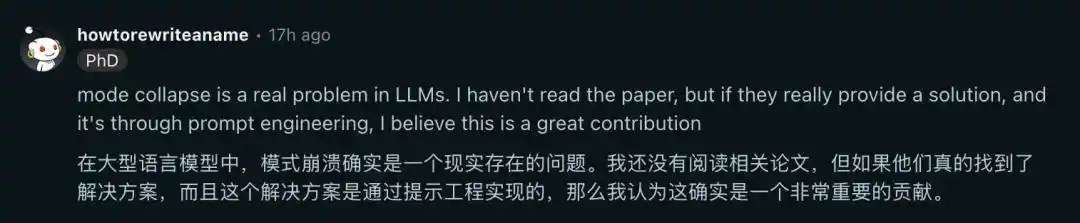
But supporters argue that scientific research is not about whose method is more complex. As long as the hypothesis is clear, experiments are sufficient, and results are stable and reproducible, it can still be excellent research.

For example, this paper thoroughly explains what mode collapse is and proposes that the real problem lies in prototypical bias—a viewpoint more important than the prompt itself.
One of the authors also replied in the comments, stating that while the paper appears simple, it actually involves a great deal of complex processing.

The entire work includes complete problem tracing, new theoretical attribution, mathematical derivation, and multi-dimensional quantitative experiments—it's not a shallow, trivial prompt-tuning effort.
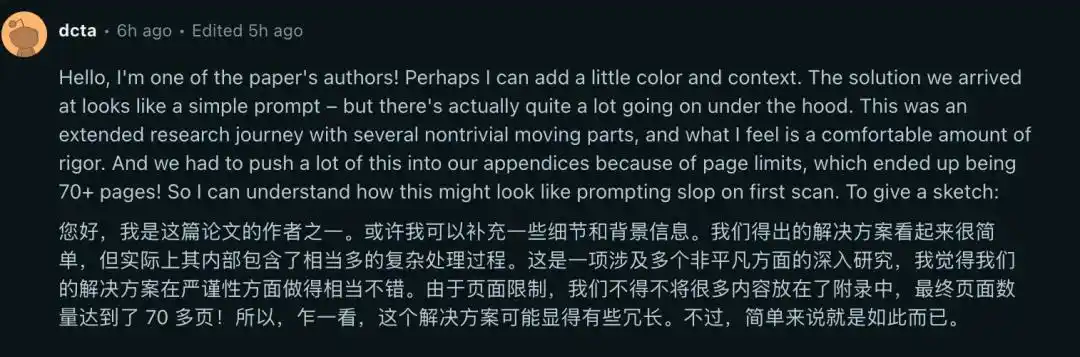
Many also mentioned Chain-of-Thought (CoT). When CoT first appeared, it was essentially a one-line prompt:

Let’s think step by step.

But now, almost all reasoning methods can be traced back to CoT. This precisely indicates that prompt engineering is no longer just about writing prompts; it is becoming a new method for studying model behavior.

Over the past decade, machine learning research has almost revolved around training. But now, some usage techniques during the inference stage are gradually moving toward the core of machine learning research.

Perhaps in the coming years, we will see more and more papers like this. They don't add a single line of training code or an extra model parameter, yet they can still change the capability boundaries of large models.

Research Team Introduction

Finally, let's take a look at the research team.

This work was completed by Weiyan Shi's team at Northeastern University (USA) in collaboration with Stanford's Manning Lab and West Virginia University. Jiayi Zhang, Simon Yu, and Derek Chong are listed as co-first authors.

Jiayi Zhang completed her undergraduate studies at the University of Michigan, earning triple bachelor's degrees in Computer Science, Mathematics, and Linguistics. She then pursued a Master's in Computer Science at Northeastern University (USA).

Another paper of hers, "Analyzing the Role of Semantic Representations in the Era of Large Language Models," accepted by the NLP top conference NAACL 2024, also revolves around semantic representation and large models.

Simon Yu is currently pursuing a Ph.D. at Northeastern University (USA), with his main research direction focusing on alignment and reinforcement learning mechanisms in large models. He completed both his bachelor's and master's degrees at the University of Edinburgh and has published several top conference papers.

Besides this paper, another one of his papers, "Unsafer in Many Turns: Benchmarking and Defending Multi-Turn Safety Risks in Tool-Using Agents," was also accepted by ICML 2026.

Derek Chong earned his Master's from Stanford University and is currently a researcher at the Stanford Artificial Intelligence Laboratory. His research primarily focuses on large language models in NLP.

He previously had three years of experience as a founder-entrepreneur and worked at Ello as an Applied Scientist, participating in industry-end AI implementation R&D. He possesses both solid theoretical research skills and rich hands-on practical experience.

References:[1]https://www.reddit.com/r/MachineLearning/comments/1uv1xb3/promptengineering_paper_accepted_to_icml_r/

[2]https://www.linkedin.com/in/jiayizx/[3]https://simonucl.github.io/[4]https://www.linkedin.com/in/derekch/

This article is from the WeChat public account "Qubit" (量子位), author: Focus on Frontier Technology


Criptomoedas em alta

Perguntas relacionadas

QWhat is the main contribution of the 'Verbalized Sampling' paper accepted at ICML 2026?

AThe main contribution is a method called 'Verbalized Sampling' (VS), which involves adjusting prompts to ask language models to output their sampling process (e.g., assign probabilities to multiple generated answers). This simple intervention significantly increases the diversity of LLM outputs and mitigates the 'mode collapse' problem without requiring model retraining or new algorithms.

QAccording to the paper, what is identified as the root cause of the mode collapse problem in LLMs?

AThe paper identifies the root cause as 'typicality bias' in the human preference data used for training. This cognitive bias leads human annotators to consistently favor familiar, fluent, and conventional text. Consequently, the reward models trained on this data steer aligned models towards safe, high-probability answers, causing mode collapse.

QWhat are some of the key criticisms from Reddit users regarding this paper's acceptance at ICML?

ACritics argue that the innovation is thin, noting similar prompt techniques are already in use and questioning the method's stability across different models. They also contend that the experimental scale is insufficient to prove a universal law and express concern that the field is drifting towards an over-reliance on empirical results and 'benchmark hacking' rather than rigorous theoretical contributions.

QHow do the paper's supporters defend its value and acceptance at a top-tier conference?

ASupporters argue that good research is defined by clear hypotheses, rigorous experimentation, and reproducible results, not just complexity. They highlight that the paper's core contribution is the novel theoretical insight into the cause of mode collapse (typicality bias). They also compare it to foundational techniques like Chain-of-Thought, suggesting prompt engineering is evolving into a legitimate method for studying model behavior.

QWhat was the observed impact of the Verbalized Sampling method on creative writing tasks?

AIn creative writing tasks, the Verbalized Sampling method increased output diversity by 1.6 to 2.1 times compared to standard prompting, without compromising factual accuracy or model safety. The effectiveness of the method was also shown to be more pronounced in larger, more capable models.

Leituras Relacionadas

From Being Ignored to the Venture Capital Queen Investing: Has AI Revived This Ultra-Niche Sector?

From obscurity to receiving investment from the "queen of venture capital," AI has revitalized the ultra-niche social networking track. In recent years, the social networking sector experienced a deep freeze in venture capital, with high-profile projects like the video social app "Huayin" (founded by a former WeChat core team member) and the offline-online dating app "Single's Tavern" ultimately failing. These failures underscored the immense difficulty of challenging WeChat's dominance in熟人社交 (close-contact social networking) and the general lack of scalable monetization paths for niche concepts like metaverse, female-only, or Muslim community apps. However, a shift emerged in 2025. "Liangpei," an AI-powered matchmaking company, secured a $2 million angel round from Today Capital, led by renowned investor Xu Xin. Its approach uses AI conversational profiling to create detailed user matches and charges only upon successful connections. Similarly, projects like "Pixel Rhythm" (reportedly focused on AI-assisted content creation for Gen Z overseas) and "Moobius" (AI-native group chat) signal a new trend. The investment logic has fundamentally changed. Instead of pursuing broad, traffic-driven "platform dreams" to compete with giants like WeChat, Douyin, or Soul, the new wave focuses on using AI as a tool to solve specific, high-pain-point problems for targeted, niche user segments. The path to viability now lies in achieving healthy cash flow by solving a concrete problem rather than chasing massive scale.

marsbitHá 18m

From Being Ignored to the Venture Capital Queen Investing: Has AI Revived This Ultra-Niche Sector?

marsbitHá 18m

From TrueFi to Elara: Why the Next Stop for On-Chain Finance is Liquidity Infrastructure?

From TrueFi to Elara: Why On-Chain Finance's Next Stage is Liquidity Infrastructure? The article analyzes the evolving focus in decentralized finance, shifting from narrative-driven expansion to robust, operationally sound infrastructure. The author, drawing from experience at TrueFi and building Elara, argues that early DeFi incorrectly assumed technological superiority alone would force adoption. Instead, financial systems evolve through workflow compatibility. Traditional finance prioritizes stability and predictability, creating intentional "viscosity" (friction) through controls, which slows execution but ensures durability. Crypto-native systems minimized friction for rapid experimentation and iteration but often lacked operational safeguards, leading to reflexive liquidity that can disintegrate under stress. The core insight is that sustainable on-chain finance cannot rely solely on isolated products like RWA lending or token incentives. The real opportunity lies in a coordinated financial architecture for liquidity management, collateral coordination, and capital deployment. Elara is presented as an example of this next-generation "programmable treasury infrastructure"—a yield-bearing, dollar-pegged collateral asset designed for capital efficiency and operational flexibility within fragmented digital markets. A key architectural decision separates liquidity from yield generation, allowing the collateral to remain liquid and programmable while accruing value. The funding environment has also shifted. Investors now prioritize operational proof—working systems, integrations, and controls—over visionary narratives. Competitive advantage comes from building systems that endure under real market conditions, not just launching quickly. Ultimately, the path forward is not a sudden replacement of traditional finance but a selective hybridization. Lasting infrastructure will combine the iterative speed of digital assets with the control architecture of traditional finance. Systems like Elara are built to operate efficiently in today's low-viscosity crypto markets while embedding the operational discipline—compliance, reporting, risk management—required to eventually support institutional capital as it gradually integrates with on-chain settlement rails. The focus is not on who launches first, but on who can build infrastructure capable of managing both high-speed digital-native liquidity and the slower, more deliberate flow of institutional capital.

marsbitHá 28m

From TrueFi to Elara: Why the Next Stop for On-Chain Finance is Liquidity Infrastructure?

marsbitHá 28m

Understanding the Q2 Crypto Market in 5 Charts: RWA Explosion, Fundamentals Continue to Recover

Summary of Q2 Crypto Market: RWA Boom and Continued Fundamental Recovery The second quarter of 2026 presented a mixed picture for the crypto market. While major crypto asset prices declined by 36% in H1 2026, the fundamentals of the industry showed significant strength. Key highlights from Bitwise's market review include: 1. **Divergence Between Crypto Stocks and Tokens:** Crypto-related public equities, tracked by the Bitwise Crypto Innovators 30 Index, rose 23% in H1, outperforming most major asset classes. This signals robust investment opportunities within the crypto ecosystem, such as Bitcoin miners benefiting from AI and traditional finance firms deepening crypto integration, even during a bear market for tokens. 2. **Substantial Crypto Application Revenue:** Leading decentralized applications generated a combined $5.9 billion in revenue over the past 12 months, with top protocols like PancakeSwap, Hyperliquid, and Aave each nearing $1 billion. This demonstrates the existence of real, revenue-generating businesses within the sector. 3. **Breakout Growth in Real-World Asset (RWA) Tokenization:** The total value of tokenized real-world assets reached a record $33 billion in Q2, up 12% quarterly and 45% year-to-date. Growth is driven by tokenized U.S. Treasuries, corporate credit, equities, and venture capital shares, indicating accelerating institutional adoption. 4. **Expanding Prediction Markets:** Prediction market open interest hit a new high of $1.8 billion in Q2, with sports being a key category. Quarterly trading volume also reached a record $43 billion. Platforms like Polymarket represent a form of mainstream, albeit often unaware, adoption of crypto infrastructure for event betting, with further growth expected around the U.S. midterm elections. 5. **Attractive Profile of Crypto Equities:** The Bitwise Crypto Innovators 30 Index exhibited low 90-day rolling correlations with most major assets (developed market stocks, EM stocks, REITs, bonds, gold) and negative correlation with commodities. This combination of high returns and portfolio diversification is highly attractive to institutional investors. In conclusion, despite weak token prices, core industry fundamentals—including user activity, business revenues, and institutional adoption—continue to advance, building a strong foundation for the next market cycle.

Foresight NewsHá 57m

Understanding the Q2 Crypto Market in 5 Charts: RWA Explosion, Fundamentals Continue to Recover

Foresight NewsHá 57m

GPT-5.6 Cracks a 50-Year-Old Math Problem in 1 Hour, 64 AIs Claim the Crown Jewel of Graph Theory

OpenAI announced that its AI model, GPT-5.6 Sol Ultra, has successfully proved the 50-year-old Cycle Double Cover (CDC) conjecture in graph theory in under an hour. This long-standing problem, posed independently by several prominent mathematicians, states that every bridgeless finite undirected graph contains a set of cycles where each edge is covered exactly twice. The breakthrough was achieved using a novel "parallel test-time computation" (TTC) approach. Instead of a single AI working sequentially, the system deployed 64 concurrent AI agents, each exploring distinct proof strategies—from algebraic perspectives to structural induction. The process included strict protocols to avoid common research pitfalls: initial exploration of fundamentally different paths, preventing herd mentality by not revealing the most promising direction, and employing a "critic squad" of agents to rigorously attack and verify every proposed proof step. The system forbade vague assertions, demanding concrete lemmas and constructions. The resulting proof, generated by GPT-5.6 and formatted with Codex, employed a sophisticated multi-step strategy. It first reduced the general case to cubic graphs, then leveraged Tutte's group-flow theorem to establish the existence of a nowhere-zero 8-flow on the graph. A key inventive step was introducing a "two-element set" labeling scheme (Lemma 2.1), which, if satisfied, guarantees a cycle double cover. The AI then transformed this combinatorial condition into a large system of linear equations (Lemma 2.2), using linear algebra over finite fields to conclusively demonstrate that a solution always exists. Researchers highlighted that parallel TTC dramatically compressed the reasoning time, making deep, extended AI problem-solving practically feasible. While some observers marveled at the implications for mathematics and science, others questioned whether parallel breadth can fully substitute for deep, continuous logical chains. Nonetheless, this achievement marks a significant advance in AI's autonomous capacity for high-level abstract reasoning and complex proof generation.

marsbitHá 1h

GPT-5.6 Cracks a 50-Year-Old Math Problem in 1 Hour, 64 AIs Claim the Crown Jewel of Graph Theory

marsbitHá 1h

Trading

Spot

Artigos em Destaque

O que é G$

Compreender o GoodDollar ($G$): Um Plano para um Rendimento Básico Universal Descentralizado Introdução No panorama em constante evolução das criptomoedas e da tecnologia blockchain, iniciativas que procuram abordar questões sociais prementes têm ganhado uma atenção crescente. Um desses projetos é o GoodDollar ($G$), uma solução de rendimento básico universal (UBI) baseada na Web3. O GoodDollar esforça-se para enfrentar a desigualdade e reduzir a disparidade de riqueza, criando e distribuindo recursos econômicos acessíveis aos que mais precisam. Através da sua utilização inovadora das finanças descentralizadas (DeFi), o GoodDollar apresenta um modelo único que poderia potencialmente reconfigurar a forma como a assistência financeira é percebida e entregue globalmente. O que é o GoodDollar ($G$)? O GoodDollar é um protocolo de criptomoeda que facilita a emissão e distribuição de tokens digitais, referidos como $G$, aos seus utilizadores registados diariamente. Esses tokens funcionam como uma forma de rendimento básico universal, promovendo o empoderamento financeiro de indivíduos de diversas origens, especialmente aqueles tradicionalmente excluídos do sistema financeiro. Operando na blockchain, o GoodDollar utiliza múltiplas cadeias, incluindo Ethereum, Celo e Fuse, assegurando acesso amplo e usabilidade. O objetivo fundamental do GoodDollar é tornar as criptomoedas acessíveis e benéficas para todos, independentemente do seu ponto de partida econômico. O Criador do GoodDollar ($G$) Os detalhes sobre o criador do GoodDollar permanecem um pouco obscuros. No entanto, é notavelmente destacado que o projeto tem um forte apoio da eToro, uma plataforma de investimento amplamente reconhecida que forneceu o financiamento inicial e o suporte fundamental para o desenvolvimento do GoodDollar. A visão por trás do projeto não é apenas orientada para o lucro, mas inclina-se fortemente para o empreendedorismo social, visando uma mudança sistémica na acessibilidade econômica. Investidores do GoodDollar ($G$) O GoodDollar goza do apoio financeiro e operacional da eToro. Esta parceria desempenhou um papel significativo no lançamento do protocolo e nos seus desenvolvimentos subsequentes. Enquanto a eToro foi instrumental na estabelecer a fundação do projeto, o GoodDollar visiona uma transição para um modelo financiado pela sua comunidade a longo prazo. Esta mudança para o financiamento comunitário está em linha com o compromisso do GoodDollar com a descentralização, permitindo que os seus utilizadores tenham uma participação direta no futuro do projeto. Como Funciona o GoodDollar ($G$)? O framework operacional do GoodDollar baseia-se fortemente nos princípios de DeFi para gerar juros a partir de criptomoedas em stake. Este mecanismo permite ao projeto cunhar e distribuir tokens $G$ como um rendimento básico digital para utilizadores em todo o mundo. Várias características-chave contribuem para a singularidade e inovação do GoodDollar: Rendimento Básico Universal (UBI): Todos os dias, os utilizadores registados recebem tokens gratuitos, estabelecendo um fluxo de rendimento automático destinado a aliviar as pressões financeiras. Modelo Económico Sustentável: A tokenómica do projeto visa equilibrar a oferta e a procura de tokens $G$, garantindo que o valor permaneça estável ao longo do tempo. Tokens Garantidos por Reservas: Cada token $G$ é garantido por uma reserva de criptomoedas, conferindo-lhe um valor inerente e fiabilidade, um aspecto crucial para manter a confiança dos utilizadores. Governança Descentralizada: O GoodDollar incorpora uma abordagem democrática à tomada de decisões através de governança descentralizada com poder de tokens. Isso permite que os membros da comunidade participem ativamente na definição da trajetória do projeto, tornando-o verdadeiramente orientado pela comunidade. Acessibilidade Global: O GoodDollar estabeleceu uma considerável pegada comunitária, com mais de 640.000 membros espalhados por 181 países. Tal alcance generalizado é instrumental na facilitação do UBI em escala global. Cronologia do GoodDollar ($G$) A evolução do GoodDollar é marcada por vários marcos significativos ao longo da sua história: 2019: O lançamento da carteira GoodDollar marcou o primeiro passo para operacionalizar a sua visão de entregar UBI através de criptomoeda. 2020: Após o bem-sucedido lançamento da carteira, o protocolo GoodDollar fez a sua estreia oficial. Isso marcou uma fase crucial na sua missão de fornecer rendimento diário distribuído. 2021: O projeto avançou ainda mais com a introdução da sua Organização Autónoma Descentralizada (DAO), promovendo um maior nível de envolvimento e governança comunitária. 2022: O GoodDollar revelou a sua versão 2 (V2) amiga das DeFi, esforçando-se por um maior envolvimento dos utilizadores e eficiência operacional. O mesmo ano também viu a transição para uma estrutura de governança descentralizada através do GoodDAO. 2022: Um novo roteiro foi conceptualizado, focando em iniciativas como um programa de subsídios destinado a promover empreendimentos relacionados com $G$ e um Mercado GoodDollar atualizado. Características Principais do GoodDollar ($G$) O projeto GoodDollar introduz inúmeras características críticas destinadas a redefinir o cenário do rendimento básico: Rendimento Básico Universal: A entrega diária de tokens gratuitos aos seus utilizadores sublinha fundamentalmente a sua missão de eliminar a precariedade económica. Operação Multi-Cadeia: A utilização de múltiplas redes de blockchain melhora a acessibilidade e escalabilidade, assegurando uma participação mais ampla. Envolvimento com Finanças Descentralizadas: O uso de DeFi permite o financiamento sustentável do modelo UBI, reforçando a sua viabilidade como uma solução económica. Envolvimento e Governança Comunitária: O GoodDollar imagina um modelo onde a comunidade influencia as operações através da participação democrática, promovendo transparência e responsabilidade. Comunidade Global: Com uma comunidade global diversificada, o projeto pode implementar soluções de UBI adaptadas a vários contextos culturais e económicos. Conclusão O GoodDollar representa um salto transformador para a incorporação dos princípios de rendimento básico universal através da lente inovadora da tecnologia blockchain. Ao aproveitar as finanças descentralizadas, o projeto não apenas fornece uma solução para a desigualdade financeira, mas também envolve ativamente os utilizadores na sua governança e operações. Com uma comunidade em crescimento e um roteiro em evolução, o GoodDollar destaca-se como um jogador significativo na interseção entre criptomoeda e bem social, abrindo caminho para um futuro financeiro mais equitativo. À medida que continua a evoluir, a jornada do GoodDollar poderá, em última análise, inspirar outras iniciativas a considerar modelos semelhantes, promovendo ainda mais a causa do empoderamento económico para todos.

60 Visualizações TotaisPublicado em {updateTime}Atualizado em 2024.12.03

O que é G$

Como comprar G

Bem-vindo à HTX.com!Tornámos a compra de Gravity (G) simples e conveniente.Segue o nosso guia passo a passo para iniciar a tua jornada no mundo das criptos.Passo 1: cria a tua conta HTXUtiliza o teu e-mail ou número de telefone para te inscreveres numa conta gratuita na HTX.Desfruta de um processo de inscrição sem complicações e desbloqueia todas as funcionalidades.Obter a minha contaPasso 2: vai para Comprar Cripto e escolhe o teu método de pagamentoCartão de crédito/débito: usa o teu visa ou mastercard para comprar Gravity (G) instantaneamente.Saldo: usa os fundos da tua conta HTX para transacionar sem problemas.Terceiros: adicionamos métodos de pagamento populares, como Google Pay e Apple Pay, para aumentar a conveniência.P2P: transaciona diretamente com outros utilizadores na HTX.Mercado de balcão (OTC): oferecemos serviços personalizados e taxas de câmbio competitivas para os traders.Passo 3: armazena teu Gravity (G)Depois de comprar o teu Gravity (G), armazena-o na tua conta HTX.Alternativamente, podes enviá-lo para outro lugar através de transferência blockchain ou usá-lo para transacionar outras criptomoedas.Passo 4: transaciona Gravity (G)Transaciona facilmente Gravity (G) no mercado à vista da HTX.Acede simplesmente à tua conta, seleciona o teu par de trading, executa as tuas transações e monitoriza em tempo real.Oferecemos uma experiência de fácil utilização tanto para principiantes como para traders experientes.

513 Visualizações TotaisPublicado em {updateTime}Atualizado em 2026.06.02

Como comprar G

O que é @G

Graphite Network, $@G: A Conexão entre TradFi e Web3 Introdução ao Graphite Network, $@G No vibrante mundo das criptomoedas e projetos web3, o Graphite Network emerge como um farol de inovação. Com o seu token nativo, $@G, esta blockchain de Camada 1, Proof-of-Authority (PoA) é projetada para preencher a lacuna entre as finanças tradicionais (TradFi) e o ecossistema Web3 em rápida evolução. À medida que as moedas digitais ganham tração, o Graphite Network esforça-se por oferecer uma plataforma blockchain que prioriza a segurança, conformidade e velocidade, apresentando-se como um facilitador de confiança e responsabilidade. O que é o Graphite Network, $@G? O Graphite Network não é apenas mais um projeto de blockchain; visa redefinir como a descentralização, segurança e responsabilidade do utilizador são percebidas no domínio das finanças digitais. O projeto possui uma série de características distintas: Blockchain Baseada em Reputação: No seu núcleo, o Graphite Network implementa uma política de um utilizador, uma conta, reforçada com mecanismos integrados de Know Your Customer (KYC) e de pontuação. Este design assegura um equilíbrio entre a privacidade do utilizador e a transparência—um aspecto crítico das operações financeiras no mundo digital de hoje. Rendimento de Nós de Ponto de Entrada: A rede incentiva os utilizadores a configurar nós de ponto de entrada, permitindo que os operadores ganhem recompensas a partir das transações da rede. Este modelo de geração de rendimento não só aumenta o envolvimento dos utilizadores, mas também reforça a saúde e descentralização da rede. Compatibilidade com EVM: Com uma máquina virtual (VM) compatível com Ethereum, o Graphite Network permite a integração sem costura de aplicações descentralizadas (dApps) e contratos inteligentes existentes em Solidity, convidando assim os desenvolvedores a aproveitar as suas capacidades sem modificações extensivas. Integração de KYC: Numa era em que a conformidade é primordial, o quadro KYC integrado com múltiplos níveis de verificação melhora o controlo sobre as operações financeiras sem participação obrigatória, estabelecendo um precedente para a autonomia do utilizador. Quem é o Criador do Graphite Network, $@G? O Graphite Network nasce dos esforços da Graphite Foundation, uma organização sem fins lucrativos dedicada ao desenvolvimento, manutenção e evolução do Graphite Network. O compromisso da fundação sublinha a visão do projeto de criar um ambiente blockchain seguro e sustentável, focado no envolvimento genuíno dos utilizadores e na conformidade. Quem são os Investidores do Graphite Network, $@G? Atualmente, há informações limitadas disponíveis sobre os investidores específicos que apoiam a iniciativa Graphite Network. A organização fundadora, a Graphite Foundation, funciona de forma independente na promoção do crescimento do projeto, enquanto procura parcerias que ressoem com a sua visão de uma plataforma blockchain acessível e em conformidade. Como Funciona o Graphite Network, $@G? A operação do Graphite Network está fundamentada no seu mecanismo de consenso único Proof-of-Authority, que encontra um impressionante equilíbrio entre alta capacidade de processamento e descentralização. Vamos explorar os vários componentes que definem a sua operação: Nós de Transporte: Servindo como nós de ponto de entrada, estes são críticos para o ecossistema. Os operadores podem ganhar receita a partir das transações que atravessam a rede, o que não só empodera os utilizadores individuais, mas também reforça a descentralização da rede. Nós Autorizados: No coração do Graphite Network estão os validadores principais que passam por rigorosos testes de conformidade, abrangendo uma verificação KYC robusta juntamente com avaliações técnicas. Este nível de confiança é essencial para garantir que as transações dentro da rede mantenham um alto nível de integridade. Sistema de Tickers: O Graphite Network utiliza um sistema de ticker distinto para os seus tokens embrulhados, denotados como @G. Esta característica melhora a clareza na integração de ativos, tornando as transações dos utilizadores compreensíveis e diretas. A abordagem inovadora do Graphite Network reflete um passo significativo na resolução das questões cruciais das finanças digitais, posicionando-se favoravelmente para o futuro à medida que mais utilizadores transitam de formas tradicionais de finanças para o mundo das aplicações descentralizadas. Cronologia do Graphite Network, $@G Para entender a progressão e os marcos do Graphite Network, é benéfico rever eventos-chave na sua cronologia: 2021: A incepção do Graphite Network pela Graphite Foundation marca o início de um novo capítulo no desenvolvimento de blockchain, focando na conformidade e no empoderamento do utilizador. Desenvolvimentos Chave: Após o seu lançamento, a introdução do rendimento de nós de ponto de entrada, o estabelecimento de um modelo baseado em reputação, a verificação KYC integrada e a provisão de compatibilidade EVM representam avanços significativos no projeto. Atividades Recentes: O contínuo desenvolvimento e esforços de nutrição da Graphite Foundation têm-se concentrado em aumentar as características da rede enquanto fomentam o crescimento do ecossistema, demonstrando um compromisso a longo prazo com a sustentabilidade e inovação. Pontos Adicionais Além dos seus componentes fundamentais, o Graphite Network abrange várias ferramentas e características que reforçam a sua usabilidade: Graphite Wallet: Uma extensão do Chrome fácil de usar que facilita o acesso a várias características e aplicações da rede em cadeias compatíveis com Ethereum, melhorando a conveniência do utilizador. Graphite Bridge: Esta utilidade permite transferências sem costura de ativos Graphite entre diferentes redes, promovendo um ecossistema integrado e interoperável. Graphite Explorer: Servindo como uma ferramenta essencial dentro do ecossistema, esta característica permite aos utilizadores visualizar e verificar o código-fonte dos contratos inteligentes, rastrear transações e explorar outras informações vitais em tempo real. Graphite Testnet: O projeto fornece um ambiente de teste robusto para desenvolvedores, permitindo-lhes garantir estabilidade e escalabilidade antes da implementação na mainnet. Esta iniciativa não só empodera os desenvolvedores, mas também melhora a fiabilidade de toda a rede. Conclusão O Graphite Network, com o seu token nativo $@G, representa um avanço significativo na conexão entre as finanças tradicionais e a tecnologia blockchain de ponta. Ao focar na segurança, conformidade e descentralização, esta plataforma inovadora está pronta para liderar a transição para a era Web3. À medida que o envolvimento dos utilizadores cresce e mais projetos aproveitam as suas capacidades, o Graphite Network está posicionado para fazer contribuições duradouras para o panorama digital em rápida evolução. Em conclusão, o Graphite Network é um testemunho do que pode ser alcançado quando o pensamento inovador encontra as crescentes demandas das finanças e tecnologia modernas. À medida que o mundo explora o potencial das finanças descentralizadas, o Graphite Network sem dúvida continuará a ser um jogador notável nesta arena.

25 Visualizações TotaisPublicado em {updateTime}Atualizado em 2025.01.06

O que é @G

Discussões

Bem-vindo à Comunidade HTX. Aqui, pode manter-se informado sobre os mais recentes desenvolvimentos da plataforma e obter acesso a análises profissionais de mercado. As opiniões dos utilizadores sobre o preço de G (G) são apresentadas abaixo.

活动图片