Promised Year of Crypto IPOs? Only One Went Public in Six Months, Down 70%

marsbitPublicado em 2026-06-11Última atualização em 2026-06-11

Resumo

The much-anticipated wave of crypto IPOs in 2026 has failed to materialize, with market conditions worsening dramatically. While SpaceX prepares for the largest IPO in history, raising $75 billion at a $1.75 trillion valuation, the crypto sector faces a frozen pipeline. The sole crypto IPO success this year, BitGo, serves as a cautionary tale. After launching on the NYSE in January at $18, its stock has plummeted approximately 70%. Other major contenders have stalled or delayed. Kraken, which secretly filed in late 2025, has put its plans on ice, seeing its valuation drop 33% to $13.3 billion. Consensys has postponed its filing until autumn at the earliest, and Bitpanda is poised to miss its self-imposed H1 deadline for a Frankfurt listing. This widespread retreat is driven by a severe liquidity crunch. Bitcoin has fallen below $60,000, with capital being diverted to AI stocks and the massive SpaceX offering. The poor performance of earlier crypto listings like Gemini and the stagnant price of Coinbase further dampen investor appetite. A key underlying pressure is the impending US midterm elections in November, which could alter the currently favorable regulatory landscape. Companies had hoped to go public during this window of policy certainty, but challenging market dynamics have overridden those plans. The transparency that comes with being a public company is now seen as a potential liability rather than a benefit in a down market. The industry's fate now hinges on a ...

Author: Claude, Deep Tide TechFlow

Deep Tide Introduction: SpaceX will price its offering tonight and list on Nasdaq tomorrow, aiming to raise $75 billion with a valuation of $1.75 trillion, marking the largest IPO ever. Meanwhile, the crypto IPO pipeline has frozen solid: the only company to list this year, BitGo, is down about 70% from its issue price; Kraken's valuation has shrunk 33% in five months; Consensys has been pushed back to autumn; Bitpanda is on the verge of missing its deadline. With just five months left until the midterm elections in November, the window for crypto companies to go public is narrowing.

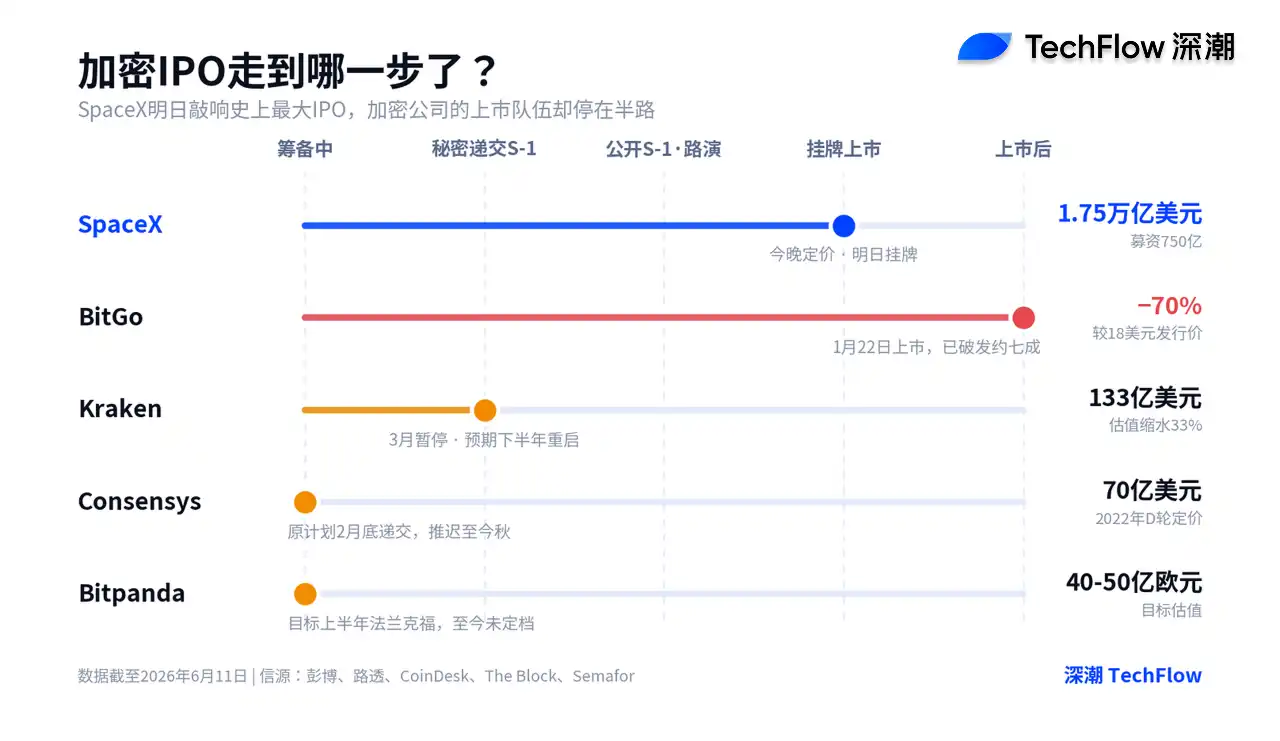
After the U.S. stock market closes tonight, SpaceX will finalize its issue price. Tomorrow, the ticker SPCX will debut on Nasdaq. According to Reuters, the company plans to issue approximately 557 million shares at $135 per share, raising $75 billion at a valuation of $1.75 trillion. This will be the largest IPO in history by both fundraising size and valuation, with the fundraising amount more than double that of the previous record holder, Saudi Aramco.

Outside this grand feast, the queue of crypto companies waiting to go public is falling apart.
SpaceX Siphons Liquidity, Bitcoin Falls Below $60k Concurrently

SpaceX's listing pace is unusually fast. It confidentially filed its registration on April 1, publicly released its S-1 prospectus on May 20, and kicked off its roadshow on June 4, several days ahead of schedule due to an unexpectedly swift SEC review process. It took just over two months from confidential filing to bell-ringing.

The crypto market trended in the exact opposite direction during the same window. According to CoinDesk data, Bitcoin traded around $61,500 on June 10, down about 17% for the week and briefly falling below $60,000 for the first time in 2024. The Fear and Greed Index registered a reading of 9, indicating "Extreme Fear." The total crypto market cap shrank to around $2.21 trillion. The explanation for the capital flows isn't complicated: continuous outflows from Bitcoin ETFs, coupled with funds rotating towards the AI sector and SpaceX's subscription, have seen risk appetite sucked dry by this $1.75 trillion behemoth.

For any company wanting to go public, liquidity is oxygen. $75 billion in subscription demand is locked up by SpaceX alone. Filing a prospectus at this point is like flying a kite in a typhoon.

BitGo: The Year's Only Listing Sample, Stock Down About 70%

The crypto industry hasn't been without attempts. BitGo listed on the NYSE on January 22 with an issue price of $18, above the indicated range of $15 to $17, raising $213 million. It was the first and, so far, only crypto-native company to complete an IPO in 2026.

The start didn't look bad. It opened at $22.43 on its first day, up 24.6% from the issue price, and briefly surged to $24.5 intraday. But those gains were wiped out by the close, ending the day with just a 2.7% gain, followed by a steady decline. According to Benzinga data, BTGO closed at $5.61 on June 3, down about 69% from its issue price. Goldman Sachs cut its price target from $10.5 to $9 on June 4, and even this slashed target is 60% higher than the current price.

BitGo was once hoped to be the bellwether for 2026 crypto IPOs. Now it indeed serves as a bellwether, just pointing in the opposite direction. When Kraken paused its listing plans in March this year, multiple media reports cited BitGo's post-listing slump as a cautionary tale for management. If an infrastructure company with over $100 billion in assets under custody and a defensive business model fares this poorly, what valuation would a pure exchange story receive in the secondary market? The companies in line are well aware.

Kraken: Valuation Evaporates 33% in Five Months, Deutsche Börse Seizes Opportunity

Kraken is the company that progressed the furthest in the queue. On November 19, 2025, its parent company Payward confidentially submitted a draft S-1 to the SEC, shortly after completing an $800 million funding round with investors including Jane Street and Citadel Securities, valuing the company at $20 billion. Reuters reported at the time that its target was to go public in Q1 2026.

Then the market soured. In March this year, multiple media reports stated Kraken had frozen its listing plans. On April 14, co-CEO Arjun Sethi confirmed at the Semafor World Economy Summit in Washington that the confidential filing remained active but declined to provide a timeline, offering size, or valuation range. According to Semafor, Kraken was valued at $13.3 billion in a funding round in April, a 33% contraction from its peak last November.

This funding round contains a noteworthy subplot: Deutsche Börse Group invested $200 million for approximately 1.5% of Kraken's fully diluted shares, with the transaction expected to close in Q2. The operator of the Frankfurt Stock Exchange is buying in at a time when a U.S. exchange's valuation is at its lowest ebb. Considering Bitpanda's choice discussed below, the Germans' intent to snatch business as the U.S. window tightens is quite evident.

Media consensus currently expects Kraken's listing restart to wait until the second half of the year.

Consensys Pushed to Autumn, Bitpanda on the Verge of Missing Deadline

Consensys, the parent company of MetaMask, has a more straightforward script. According to a CoinDesk report on May 13, the company led by Ethereum co-founder Joe Lubin originally planned to confidentially file its S-1 with the SEC by the end of February, with JPMorgan and Goldman Sachs leading the underwriting. However, due to persistently weak market conditions, the IPO has been postponed until at least this autumn. Consensys' last valuation was from its Series D in 2022, a $450 million funding round at a $7 billion valuation. How much of this number can be preserved in the current market environment will only be known when the prospectus is unveiled.

Bitpanda's problem is the calendar. According to a Bloomberg report in January, this Vienna-based company, backed by Peter Thiel, plans to list in Frankfurt with a target valuation of €4-5 billion, with Goldman Sachs, Citigroup, and Deutsche Bank acting as underwriters. The schedule was set for the first half of the year, potentially Q1. Today is June 11, with less than three weeks left in H1, and the company has yet to officially announce a date. Unless it launches suddenly in the coming days, missing its own deadline is almost certain.

Looking at the four together: one listed but is down 70%, one filed but paused, one pushed to autumn, and one on the verge of missing its self-imposed deadline. The original Reddit post described these four as "sprinting to go public within 12 months." The wording isn't wrong, but the sense of direction is. This team isn't sprinting; they're each looking for an exit ramp.

Five Months Until the Midterm Elections

The clustering of crypto companies targeting 2026 for listings has a common, invisible deadline.

This year's regulatory climate has been relatively favorable for the crypto industry, but the U.S. midterm elections in early November could rewrite the congressional power balance. Many companies' timelines were originally compressed before the election, betting on five months of policy certainty.

Precedents aren't encouraging. Among the crypto companies that went public in 2025, Gemini's stock price had fallen over 60% from its issue price (data as of end-January), Bullish hovered around its issue price, and Coinbase, which listed in 2021, remains below its opening price from that year. Circle is a rare exception that has significantly outperformed its issue price. The pricing given by the secondary market with real money is more honest than any roadshow PowerPoint.

Returning to that Reddit post, the poster actually had a valid point: once an exchange goes public, its financials are no longer a black box. Quarterly audited reports will reveal whether revenue truly comes from trading fees, custody fees, or idle fund interest. Retail investors get their first chance to judge an exchange by numbers rather than "withdrawal smoothness."
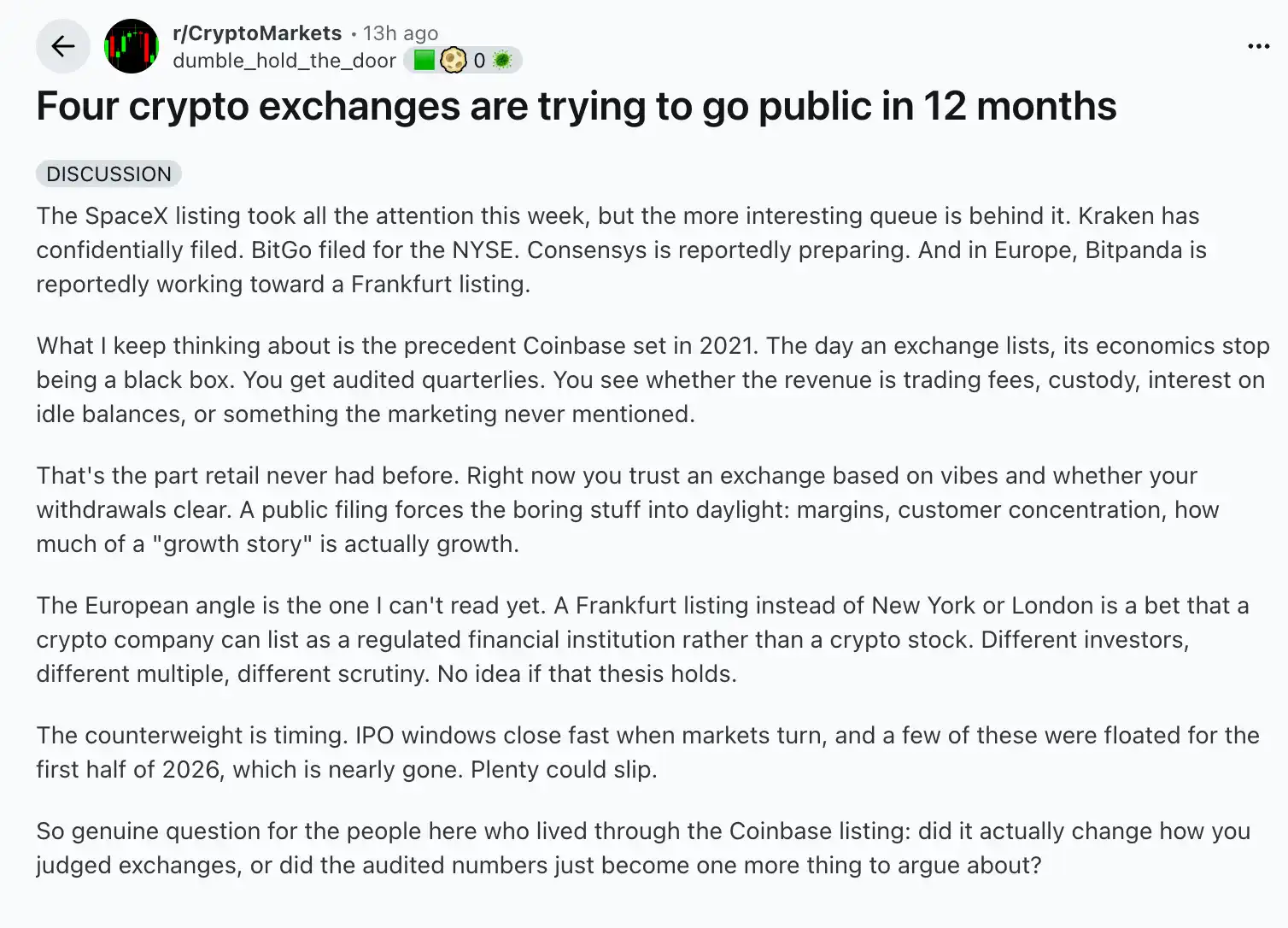
The problem is the sequence. Transparency is a consequence of going public, not the motivation for it. In a market with Bitcoin at $61,500 and the only listing sample down 70%, no company is in a hurry to lay its cards on the table.

Over the next five months, three specific milestones are worth watching: whether Kraken restarts in H2, whether Consensys actually files its S-1 in autumn, and when Bitpanda officially admits to missing its deadline.

There's another variable to be revealed tomorrow. If funds absorbed by SpaceX's listing flow back and market liquidity recovers, this window might crack open again. If even the largest IPO in history performs tepidly, this year's crypto listing wave will likely have to wait until after the elections.


Criptomoedas em alta

Perguntas relacionadas

QWhat major event is described as diverting liquidity from the crypto market, coinciding with Bitcoin's price drop?

AThe article describes the upcoming IPO of SpaceX as the major event. SpaceX's planned $75 billion offering, with a $1.75 trillion valuation, was reportedly locking up significant investor capital and risk appetite, creating a 'liquidity drain' that contributed to Bitcoin falling below $60,000.

QAccording to the article, which crypto company is the only one to have completed an IPO in 2026, and how has its stock performed?

AThe only crypto-native company to have completed an IPO in 2026 is BitGo (ticker: BTGO). Its stock has performed poorly, falling approximately 70% from its initial offering price of $18 to around $5.61 by early June.

QWhy did the article suggest several crypto companies originally aimed to go public before November 2026?

AThe article suggests these companies aimed for a pre-November 2026 timeline due to the U.S. midterm elections. They were betting on the current, relatively friendly regulatory environment for crypto, which could change depending on the election outcome, making the five months before the election a window of perceived policy certainty.

QWhat evidence does the article provide that the public listing pipeline for crypto companies is effectively frozen?

AThe article provides several pieces of evidence: BitGo's poor post-IPO performance (-70%), Kraken's paused plans and 33% valuation drop, Consensys's delay to autumn, and Bitpanda's likely missed self-imposed deadline for a first-half listing. It describes the situation as companies 'finding their own excuses' rather than sprinting to go public.

QWhat is one potential positive outcome for crypto companies if SpaceX's IPO goes well, according to the article's conclusion?

AThe article concludes that if SpaceX's IPO performs well and the massive capital it absorbed begins to flow back into the market, improving overall liquidity, the window for crypto IPOs might 'reopen a crack.' However, if even the largest IPO ever performs poorly, any significant crypto listing wave would likely be postponed until after the midterm elections.

Leituras Relacionadas

Must-Watch Events Next Week|CLARITY Act Could Face Senate Vote; SpaceX, Circle to Report Earnings (8.3-8.9)

**Summary: Key Events and Developments to Watch (August 3-9)** The upcoming week is marked by significant financial disclosures, key legislative deadlines, and notable product updates. **Major Financial Events:** Several companies are scheduled to release their Q2 2026 earnings. American Bitcoin (ABTC) will report on August 3, followed by SpaceX and Hut 8 Mining Corp. on August 4, and Circle on August 5. Notably, a significant portion of SpaceX shares (up to 12% of total shares) will be unlocked on August 6 following their earnings release. **Key Legislative Deadline:** The U.S. Senate faces an August 7 deadline to secure 60 votes for the CLARITY Act, a bipartisan bill aiming to establish a federal regulatory framework for cryptocurrencies. The Senate may hold a full vote on the bill during the week. **Economic Data:** The U.S. July Non-Farm Payrolls report will be released on August 7, providing crucial labor market data. **Technology & Product Updates:** * **Shutdowns:** DeFi portfolio tracker Zapper and wallet app Ctrl Wallet will cease operations on August 3. * **Upgrades:** LayerZero will deprecate its v1 relayers on August 3. XRP Ledger's new version 3.3.0, featuring five new functions, is expected next week. * **AI:** Elon Musk announced that the advanced Grok 4.6 AI model is set for release around August 7. * **Bitcoin:** The BIP-110 forced signaling for a potential Bitcoin network change is scheduled to begin around August 8. **Other Notable Events:** Chinese robotics firm Unitree Tech has set its preliminary price inquiry for its IPO for August 5. South Korean exchange Upbit will delist AQT and AERGO tokens on August 3.

marsbitHá 55m

Must-Watch Events Next Week|CLARITY Act Could Face Senate Vote; SpaceX, Circle to Report Earnings (8.3-8.9)

marsbitHá 55m

Stocks Are Plummeting More Sharply Than Cryptocurrencies. Where Has the Money Gone?

Stock Markets Plunge Deeper Than Cryptocurrencies: Where Did the Money Go? In late July, Seoul's Kospi index triggered circuit breakers for two consecutive days, plummeting over 40% from its June high. The collapse was led by heavyweight stocks like SK Hynix, whose record profits still disappointed investors, and devastating leveraged ETFs, with one major product losing over 83% of its value. This signaled a global, forced deleveraging targeting the most crowded trades. Interestingly, while stocks exhibited extreme volatility akin to crypto markets, Bitcoin rose nearly 15% in July after a prior steep drop. Analysis shows the money fleeing equities did not flow into Bitcoin. Instead, Bitcoin had already absorbed its sell-off in May-June, when U.S. spot Bitcoin ETFs saw historic outflows. The true safe-haven beneficiary was gold, whose price rose over 20% year-on-year, highlighting a decoupling between Bitcoin and gold as "digital gold." The sell-off was a targeted unwinding of leveraged positions in tech and semiconductors, accelerated by broker-dealer risk management and shifts in the AI narrative, including new competition from Chinese memory chipmakers. The retreat path was clear: from high-valuation tech stocks to cash and U.S. Treasuries, then to gold. For Bitcoin to attract sustained institutional inflows, conditions like eased global liquidity pressure, a "soft-landing" Fed rate cut, and U.S. regulatory clarity via legislation like the stalled CLARITY Act are needed. Currently, Bitcoin is not a safe haven but an already-cleared asset. Its low correlation with tech stocks, however, makes it a potential diversification play for institutional portfolios once the storm passes. The money isn't here yet, but the positioning is underway.

marsbitHá 55m

Stocks Are Plummeting More Sharply Than Cryptocurrencies. Where Has the Money Gone?

marsbitHá 55m

In Conversation with Ray Dalio: We Are Currently in an AI Bubble, with 1% of My Portfolio in Bitcoin

Ray Dalio, founder of Bridgewater Associates, warns in an interview that the current AI boom shows classic bubble characteristics, which could lead to significant economic downturns as seen in past cycles like 1929 or 2000. He explains that speculative enthusiasm, fueled by debt and overvaluation, often precedes a crash when rising rates or taxation force asset sales, causing widespread losses and recession. Dalio also outlines his "Big Cycle" theory, describing an approximate 80-year pattern where widening wealth gaps, massive government deficits, and shifting geopolitical power (like China's rise) create internal conflict and global instability. He emphasizes that we are in a late-cycle, transitional phase where traditional powers like the US and UK face decline. For personal wealth protection, Dalio advises diversification beyond cash into assets like stocks, bonds, real estate, and particularly gold, which he prefers over Bitcoin. While he holds about 1% of his portfolio in Bitcoin as a non-printable hard asset, he views gold as more secure from technological or governmental threats. Regarding AI's impact, Dalio believes it will disproportionately benefit capital owners, worsening inequality by replacing both physical and cognitive labor. He suggests that human intuition and emotional intelligence, combined with AI, will be key for future workers. On taxation, Dalio argues that wealth taxes are impractical and risk triggering asset sell-offs, reducing productive investment. He points to the UK as a cautionary example of debt, low productivity, and political strife. Geopolitically, Dalio foresees a more regionalized world, with the US showing weakness in prolonged conflicts like with Iran, akin to past imperial declines. The ideal outcome, he suggests, is coexisting powerful blocs (e.g., Americas, China-Asia Pacific) without major war.

marsbitHá 4h

In Conversation with Ray Dalio: We Are Currently in an AI Bubble, with 1% of My Portfolio in Bitcoin

marsbitHá 4h

Daily 7.2 Trillion KRW: Foreign Capital's Record Net Buying on Friday! Wall Street Says Headwinds for Korean Stock Fund Flows Have Subsided

South Korean stock market sees a dramatic shift in fund flows. On July 31, foreign investors made a record net purchase of approximately KRW 7.2 trillion in KOSPI stocks, marking a fundamental reversal from the persistent large-scale net outflows seen in previous months. This contributed to a significant narrowing of foreign net selling in July to KRW 9.8 trillion, down sharply from KRW 48.4 trillion in June and KRW 44.5 trillion in May. Simultaneously, domestic institutional pressure eased. South Korean pension funds and asset managers turned to a net buying position in July, purchasing KRW 1.0 trillion worth of KOSPI shares, contrasting with net sales in May and June. Market volatility is expected to be dampened by new financial regulations. Effective July 31, the Financial Services Commission tightened access for retail investors to single-stock leveraged ETFs by raising the minimum cash deposit requirement. Trading volumes for these products subsequently dropped to about 50% of their monthly average. Citigroup Research maintains its year-end KOSPI target of 10,000 points. The firm cites several supportive factors: the substantial easing of headwinds from capital outflows, a robust fundamental outlook for the semiconductor sector, historically low market valuations, strong economic fundamentals, and the potential for policy support from financial authorities if needed.

marsbitHá 4h

Daily 7.2 Trillion KRW: Foreign Capital's Record Net Buying on Friday! Wall Street Says Headwinds for Korean Stock Fund Flows Have Subsided

marsbitHá 4h

Trading

Spot

Artigos em Destaque

Como comprar ONE

Bem-vindo à HTX.com!Tornámos a compra de Harmony (ONE) simples e conveniente.Segue o nosso guia passo a passo para iniciar a tua jornada no mundo das criptos.Passo 1: cria a tua conta HTXUtiliza o teu e-mail ou número de telefone para te inscreveres numa conta gratuita na HTX.Desfruta de um processo de inscrição sem complicações e desbloqueia todas as funcionalidades.Obter a minha contaPasso 2: vai para Comprar Cripto e escolhe o teu método de pagamentoCartão de crédito/débito: usa o teu visa ou mastercard para comprar Harmony (ONE) instantaneamente.Saldo: usa os fundos da tua conta HTX para transacionar sem problemas.Terceiros: adicionamos métodos de pagamento populares, como Google Pay e Apple Pay, para aumentar a conveniência.P2P: transaciona diretamente com outros utilizadores na HTX.Mercado de balcão (OTC): oferecemos serviços personalizados e taxas de câmbio competitivas para os traders.Passo 3: armazena teu Harmony (ONE)Depois de comprar o teu Harmony (ONE), armazena-o na tua conta HTX.Alternativamente, podes enviá-lo para outro lugar através de transferência blockchain ou usá-lo para transacionar outras criptomoedas.Passo 4: transaciona Harmony (ONE)Transaciona facilmente Harmony (ONE) no mercado à vista da HTX.Acede simplesmente à tua conta, seleciona o teu par de trading, executa as tuas transações e monitoriza em tempo real.Oferecemos uma experiência de fácil utilização tanto para principiantes como para traders experientes.

405 Visualizações TotaisPublicado em {updateTime}Atualizado em 2026.06.02

Como comprar ONE

Discussões

Bem-vindo à Comunidade HTX. Aqui, pode manter-se informado sobre os mais recentes desenvolvimentos da plataforma e obter acesso a análises profissionais de mercado. As opiniões dos utilizadores sobre o preço de ONE (ONE) são apresentadas abaixo.

活动图片












