Probability of Shutdown Plummets: Why Was the U.S. Government Shutdown Crisis Suddenly 'Resolved'?

比推Publicado em 2026-01-29Última atualização em 2026-01-29

Resumo

The risk of a U.S. government shutdown at the end of January has significantly decreased, with prediction markets showing the probability dropping from 80% to 42%. The potential shutdown stemmed from a partisan dispute over funding for the Department of Homeland Security (DHS), particularly related to the Immigration and Customs Enforcement (ICE) agency. Democrats sought to limit funding after a controversial ICE operation in Minnesota resulted in fatalities, while Republicans defended ICE's role in immigration enforcement. The shift in shutdown probability reflects a likely political compromise, as both parties recognize that a shutdown could harm their prospects in the upcoming midterm elections. Control of Congress is at stake, and neither side wants to be blamed for economic and operational disruptions. Democrats have proposed separating the DHS funding bill from other appropriations to avoid a full shutdown, and reports indicate negotiations are underway between the White House and Senate leaders to reach a short-term funding extension. The focus is on avoiding a repeat of the 43-day shutdown from late last year.

Author: Golem

Original Title: U.S. Government Shutdown Is Difficult Because Both Parties Have Already Calculated the Cost


A major macroeconomic event this month is whether the U.S. government will shut down at the end of January. Last October, the U.S. government shut down for 43 days, and it has been operating since then only after the passage of a temporary funding bill. January 30 is the expiration date of the temporary funding bill. If Congress fails to pass a formal funding bill or if there is no new temporary bill to extend it, the U.S. government will shut down again.

This time, the dispute between the two U.S. parties is mainly over funding for the Department of Homeland Security (DHS). Democrats believe that ICE (Immigration and Customs Enforcement) has problems with law enforcement in Minnesota, resulting in two deaths, and they want to strictly restrict funding and related operations. However, Republicans disagree, arguing that ICE is a key force in combating illegal immigration and welfare fraud. As a result, the two sides are at a stalemate. (For details on the dispute between the two U.S. parties, please read: "U.S. Government Shutdown Storm Is Brewing Again, Will the Crypto Circle Repeat the Crash Script?")

It is this confrontational state and the approaching expiration date of the temporary funding bill that caused the probability of a U.S. government shutdown at the end of January to rise sharply on prediction markets. However, this morning, Polymarket data showed that the probability of the U.S. government shutting down at the end of January has continued to decline and currently stands at 42%, down from a previous high of 80%.
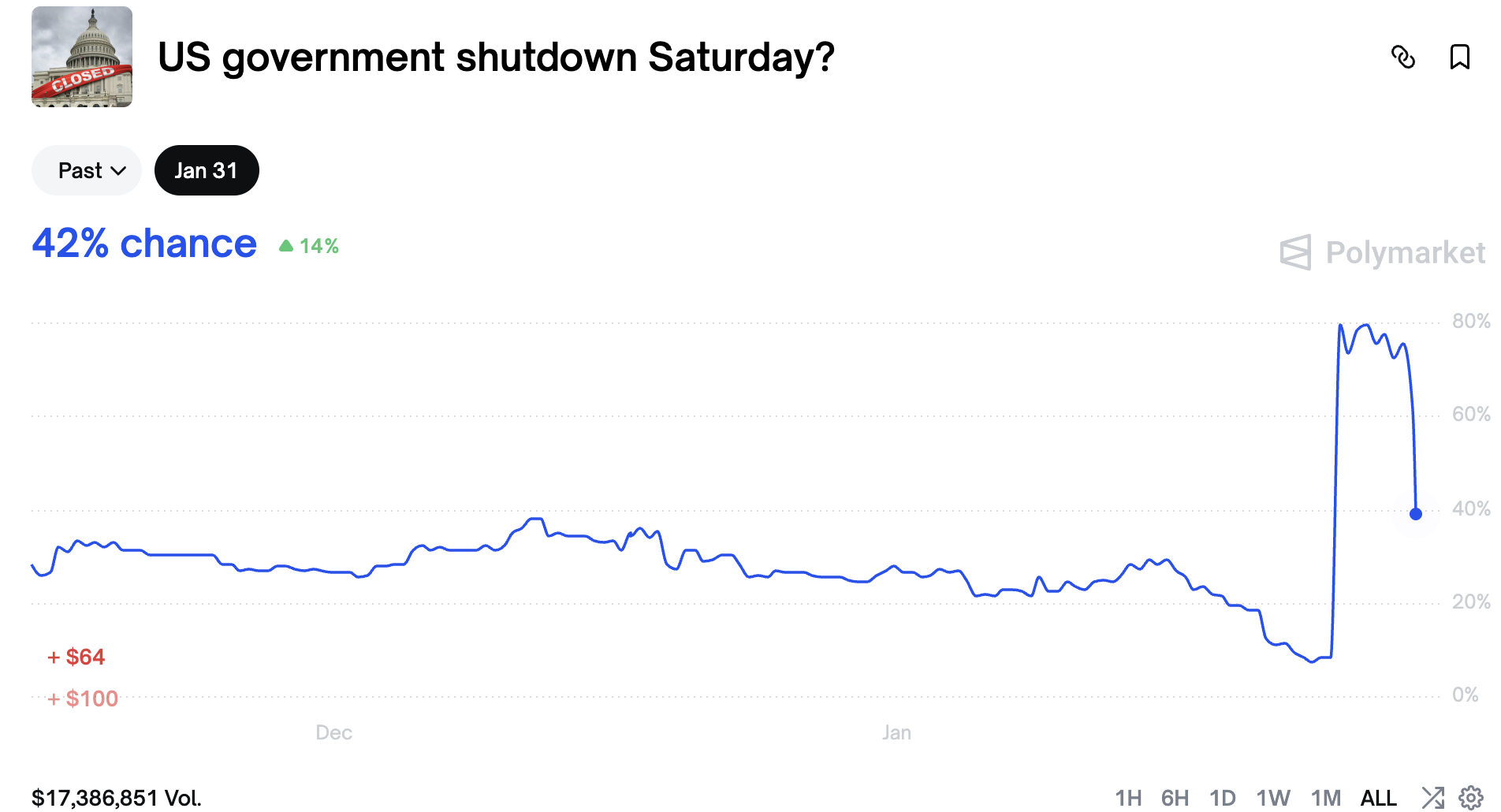
Price changes in prediction markets reflect the results of collective wisdom and博弈. The rising probability that the U.S. government will not shut down at the end of January indicates that people believe the high certainty of a government shutdown suggested by the prediction market probability no longer exists under the current U.S. political situation.

Midterm Elections Are the Key Focus for Both U.S. Parties

On January 28, regarding the risk of another possible U.S. government shutdown, U.S. Treasury Secretary Besant said the situation is still unclear but emphasized that President Trump has urged the Democratic side to avoid this outcome.

This government shutdown crisis is essentially because the Republicans were caught by the Democrats with a political counterattack handle. The shooting death of a U.S. citizen by ICE law enforcement officers in Minnesota on January 24 was essentially a result of the Trump administration's increased immigration enforcement efforts, which also led to large-scale public protests expressing dissatisfaction with the Trump administration. The Democrats reasonably seized this opportunity and used it as an excuse to block the passage of the funding bill in the Senate. Because it reflects the demands of voters, the Democrats' counterattack has taken the political initiative.

The Republicans have thus been put in a passive position. If the U.S. government does shut down as a result, the Democrats could blame all subsequent economic and livelihood problems caused by the shutdown (delayed release of economic data, large-scale flight delays at airports, etc.) on the incompetence of the Republican government.

And this series of possible chain reactions will also affect the issue that both U.S. parties truly care about this year: the U.S. midterm elections.

The U.S. "midterm elections" are held in the second year of a presidential term. All 435 seats in the House of Representatives will be re-elected, and approximately one-third of the seats in the Senate are usually re-elected. Currently, the Republicans hold a majority in both the House (218 seats) and the Senate (53 seats). For the Republicans to maintain their seat advantage after the midterm elections at the end of the year and reduce governance difficulties, they cannot accumulate too many "stains" politically this year.

At the same time, although the midterm elections do not involve the U.S. presidential election, they are also regarded as a "midterm referendum" on the incumbent president, which will affect the president's policy orientation in the latter two years and also reshape the intra-party power structure and the candidate landscape for the next presidential election. Therefore, it is extremely important for Trump as well.

From the above analysis, it can be seen that this government shutdown is no longer a simple funding issue but a political battlefield set up in advance by both U.S. parties for the midterm elections at the end of the year. The Republicans, who are in a passive position, are highly likely to compromise to resolve the crisis and矛盾.

For the Democrats, if the Republicans compromise, it would also be a political victory.

Compromise Is Already Underway

This U.S. government shutdown crisis will not be a "full shutdown" like last October (when all 12 funding bills expired). The scale of the shutdown may be much smaller. Funding for the Commerce Department (responsible for releasing GDP and other data) and the Agriculture Department (responsible for food benefits) has already been secured, but about 78% of federal government functions—involving the remaining 6 funding bills—may face funding cuts.

The Democrats have actually already given the Republicans a way out. Senate Minority Leader Chuck Schumer (D-N.Y.) said on January 28 that Senate Democrats are "prepared to quickly advance five funding bills by the January 30 deadline, separate from the Department of Homeland Security funding bill," which could be a way to avoid a large-scale government shutdown. However, Senate Republicans have not yet agreed to separate the DHS bill from the overall funding package.

On the other hand, it is unrealistic to demand changes to the DHS funding before January 30, as any changes to the remaining six funding bills must be submitted to the House of Representatives for approval, and the House will not reconvene until February 2.

For the Democrats, forcing the U.S. government into a shutdown state by being too rigid about amending the funding bill would not be of much benefit, and the "offensive and defensive态势" with the Republicans could even reverse. Therefore, the current consensus between the two U.S. parties may be to pass a temporary funding bill to first solve the potential government shutdown problem and postpone the矛盾 between the two parties.

And just as Odaily was writing this article speculating that the two parties might compromise to avoid a government shutdown, The New York Times also reported that Trump is reaching a possible agreement with Chuck Schumer to avoid a U.S. government shutdown.

According to two informed officials, under the plan being developed, the Senate would separate one bill from the six spending bills, which is intended to fund the Department of Homeland Security to maintain funding for the military, medical programs, and other federal agencies for the remainder of the fiscal year. The Senate will pass these bills by the Friday midnight deadline, and Congress will also consider a short-term extension of homeland security operations to prevent service disruptions at the TSA, Coast Guard, and Federal Emergency Management Agency.

It is still unclear how this potential agreement will affect this week's funding bill vote, but it at least indicates that the White House and the Senate are working towards resolving the crisis.


Twitter:https://twitter.com/BitpushNewsCN

Bitpush TG Discussion Group:https://t.me/BitPushCommunity

Bitpush TG Subscription: https://t.me/bitpush

Original link:https://www.bitpush.news/articles/7607037

Perguntas relacionadas

QWhy did the probability of a US government shutdown at the end of January drop significantly?

AThe probability dropped because both political parties recognized that a shutdown could negatively impact the midterm elections. The Republican party, in particular, was in a politically vulnerable position and was likely to compromise to avoid the economic and public backlash associated with a shutdown.

QWhat was the main point of contention between Democrats and Republicans that threatened a government shutdown?

AThe main contention was over funding for the Department of Homeland Security (DHS), specifically related to the Immigration and Customs Enforcement (ICE) agency. Democrats wanted to restrict funding and actions for ICE following a fatal incident in Minnesota, while Republicans defended ICE's role in combating illegal immigration.

QHow are the upcoming US midterm elections connected to the government shutdown crisis?

AThe midterm elections are the key political priority for both parties. A government shutdown would create economic and logistical problems that could be used as political ammunition. Republicans, who control both chambers of Congress, want to avoid any 'stains' on their record to maintain their majority, making them more willing to compromise.

QWhat specific compromise was proposed by Democrats to avoid a full government shutdown?

ASenate Democratic Leader Chuck Schumer proposed separating the Homeland Security funding bill from the other five remaining appropriations bills. This would allow the non-controversial bills to pass quickly before the deadline, avoiding a full shutdown, while negotiations on DHS funding continued.

QWhat was reported that indicated a deal was being made to prevent the shutdown?

AThe New York Times reported that President Trump and Senator Chuck Schumer were working on a potential deal. The plan involved separating the Homeland Security appropriations bill from the others and passing a short-term extension for DHS to prevent service disruptions while a longer-term solution was negotiated.

Leituras Relacionadas

Must-Watch Events Next Week|CLARITY Act Could Face Senate Vote; SpaceX, Circle to Report Earnings (8.3-8.9)

**Summary: Key Events and Developments to Watch (August 3-9)** The upcoming week is marked by significant financial disclosures, key legislative deadlines, and notable product updates. **Major Financial Events:** Several companies are scheduled to release their Q2 2026 earnings. American Bitcoin (ABTC) will report on August 3, followed by SpaceX and Hut 8 Mining Corp. on August 4, and Circle on August 5. Notably, a significant portion of SpaceX shares (up to 12% of total shares) will be unlocked on August 6 following their earnings release. **Key Legislative Deadline:** The U.S. Senate faces an August 7 deadline to secure 60 votes for the CLARITY Act, a bipartisan bill aiming to establish a federal regulatory framework for cryptocurrencies. The Senate may hold a full vote on the bill during the week. **Economic Data:** The U.S. July Non-Farm Payrolls report will be released on August 7, providing crucial labor market data. **Technology & Product Updates:** * **Shutdowns:** DeFi portfolio tracker Zapper and wallet app Ctrl Wallet will cease operations on August 3. * **Upgrades:** LayerZero will deprecate its v1 relayers on August 3. XRP Ledger's new version 3.3.0, featuring five new functions, is expected next week. * **AI:** Elon Musk announced that the advanced Grok 4.6 AI model is set for release around August 7. * **Bitcoin:** The BIP-110 forced signaling for a potential Bitcoin network change is scheduled to begin around August 8. **Other Notable Events:** Chinese robotics firm Unitree Tech has set its preliminary price inquiry for its IPO for August 5. South Korean exchange Upbit will delist AQT and AERGO tokens on August 3.

marsbitHá 1h

Must-Watch Events Next Week|CLARITY Act Could Face Senate Vote; SpaceX, Circle to Report Earnings (8.3-8.9)

marsbitHá 1h

Stocks Are Plummeting More Sharply Than Cryptocurrencies. Where Has the Money Gone?

Stock Markets Plunge Deeper Than Cryptocurrencies: Where Did the Money Go? In late July, Seoul's Kospi index triggered circuit breakers for two consecutive days, plummeting over 40% from its June high. The collapse was led by heavyweight stocks like SK Hynix, whose record profits still disappointed investors, and devastating leveraged ETFs, with one major product losing over 83% of its value. This signaled a global, forced deleveraging targeting the most crowded trades. Interestingly, while stocks exhibited extreme volatility akin to crypto markets, Bitcoin rose nearly 15% in July after a prior steep drop. Analysis shows the money fleeing equities did not flow into Bitcoin. Instead, Bitcoin had already absorbed its sell-off in May-June, when U.S. spot Bitcoin ETFs saw historic outflows. The true safe-haven beneficiary was gold, whose price rose over 20% year-on-year, highlighting a decoupling between Bitcoin and gold as "digital gold." The sell-off was a targeted unwinding of leveraged positions in tech and semiconductors, accelerated by broker-dealer risk management and shifts in the AI narrative, including new competition from Chinese memory chipmakers. The retreat path was clear: from high-valuation tech stocks to cash and U.S. Treasuries, then to gold. For Bitcoin to attract sustained institutional inflows, conditions like eased global liquidity pressure, a "soft-landing" Fed rate cut, and U.S. regulatory clarity via legislation like the stalled CLARITY Act are needed. Currently, Bitcoin is not a safe haven but an already-cleared asset. Its low correlation with tech stocks, however, makes it a potential diversification play for institutional portfolios once the storm passes. The money isn't here yet, but the positioning is underway.

marsbitHá 1h

Stocks Are Plummeting More Sharply Than Cryptocurrencies. Where Has the Money Gone?

marsbitHá 1h

In Conversation with Ray Dalio: We Are Currently in an AI Bubble, with 1% of My Portfolio in Bitcoin

Ray Dalio, founder of Bridgewater Associates, warns in an interview that the current AI boom shows classic bubble characteristics, which could lead to significant economic downturns as seen in past cycles like 1929 or 2000. He explains that speculative enthusiasm, fueled by debt and overvaluation, often precedes a crash when rising rates or taxation force asset sales, causing widespread losses and recession. Dalio also outlines his "Big Cycle" theory, describing an approximate 80-year pattern where widening wealth gaps, massive government deficits, and shifting geopolitical power (like China's rise) create internal conflict and global instability. He emphasizes that we are in a late-cycle, transitional phase where traditional powers like the US and UK face decline. For personal wealth protection, Dalio advises diversification beyond cash into assets like stocks, bonds, real estate, and particularly gold, which he prefers over Bitcoin. While he holds about 1% of his portfolio in Bitcoin as a non-printable hard asset, he views gold as more secure from technological or governmental threats. Regarding AI's impact, Dalio believes it will disproportionately benefit capital owners, worsening inequality by replacing both physical and cognitive labor. He suggests that human intuition and emotional intelligence, combined with AI, will be key for future workers. On taxation, Dalio argues that wealth taxes are impractical and risk triggering asset sell-offs, reducing productive investment. He points to the UK as a cautionary example of debt, low productivity, and political strife. Geopolitically, Dalio foresees a more regionalized world, with the US showing weakness in prolonged conflicts like with Iran, akin to past imperial declines. The ideal outcome, he suggests, is coexisting powerful blocs (e.g., Americas, China-Asia Pacific) without major war.

marsbitHá 5h

In Conversation with Ray Dalio: We Are Currently in an AI Bubble, with 1% of My Portfolio in Bitcoin

marsbitHá 5h

Trading

Spot
活动图片





