Privacy and RWA Tokens Dominate MEXC December Trading as Meme Trading Cools

TheNewsCryptoPublicado em 2026-01-15Última atualização em 2026-01-15

Resumo

MEXC, a leading cryptocurrency exchange, reported a significant shift in trading activity during December, with infrastructure projects capturing 50% of top-performing positions. Privacy computing and real-world asset (RWA) tokenization led capital allocation among 110 new listings, reflecting a move toward utility-driven investments. Meme tokens declined to just 10% of top spots. Notable performers included privacy tokens like ZKP, NIGHT, and RLS, each achieving gains nearing 2,000%, while DeFi and Web3 entertainment also showed strength. The month featured strong institutional participation, with projects backed by established teams like Charles Hoskinson’s NIGHT and Bitfinex-incubated STABLE. MEXC’s user-focused initiatives, including Launchpad and Airdrop+, saw substantial growth in engagement.

MEXC, the fastest-growing global cryptocurrency exchange, redefining a user-first approach to digital assets through true zero-fee trading, reported a significant shift in December trading activity as infrastructure projects captured 50% of top-performing positions, with privacy computing and real-world asset (RWA) tokenization leading capital allocation across the platform’s 110 new token listings.

December trading patterns reflected concentrated capital flow toward utility-driven narratives. Infrastructure projects accounted for half of the top 10 tokens by spot trading volume, including NIGHT, RLS, ZKP, STABLE, and US. DeFi and Web3 Entertainment each represented 20% of top performers, while meme tokens declined to 10% of positions.
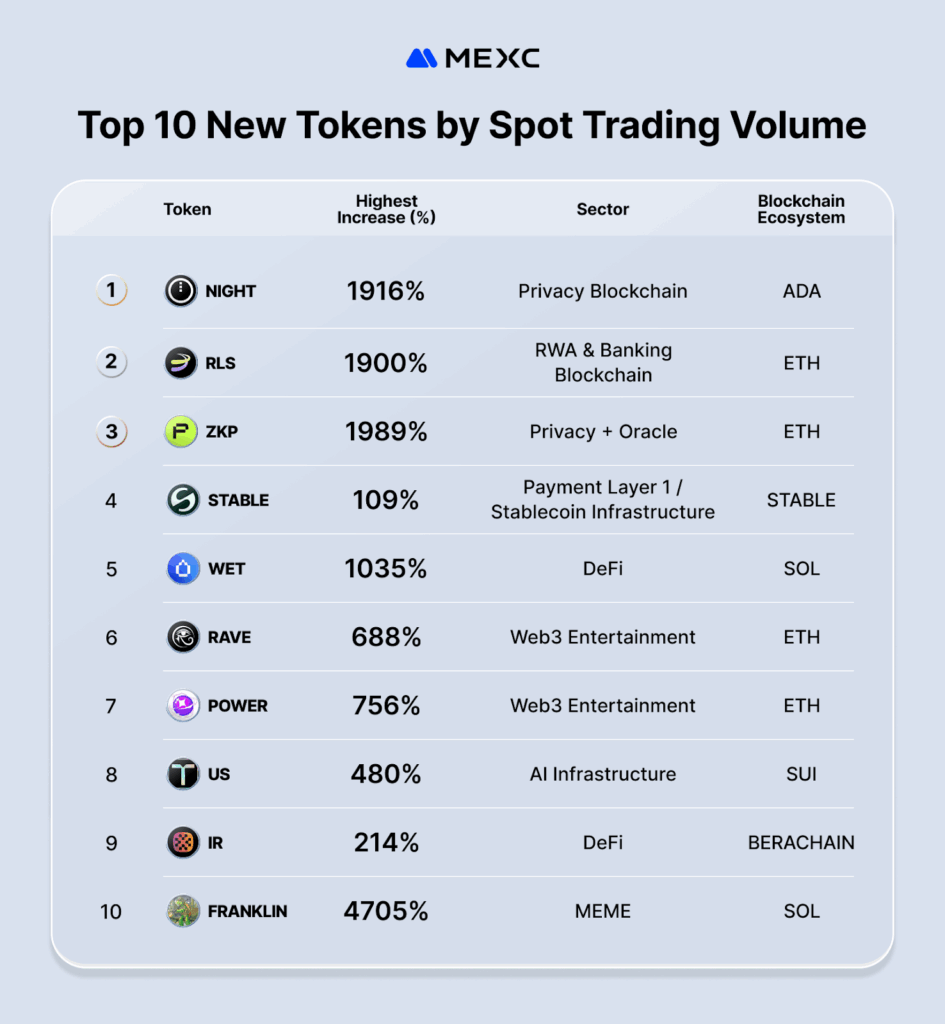
Notable institutional participation characterized the month’s listings. NIGHT, led by Ethereum and Cardano co-founder Charles Hoskinson, focuses on zero-knowledge proof technology for privacy infrastructure. STABLE, incubated by Bitfinex and Tether, utilizes USDT as gas for compliant payment solutions. The presence of established teams and technical foundations distinguished December’s top performers from previous months.

Privacy-focused and real-world asset projects delivered substantial returns. ZKP, NIGHT, and RLS each achieved gains approaching 2,000%, while the DeFAI sector showed strength with SEEK and THQ posting approximately 900% gains across Ethereum and BASE ecosystems.
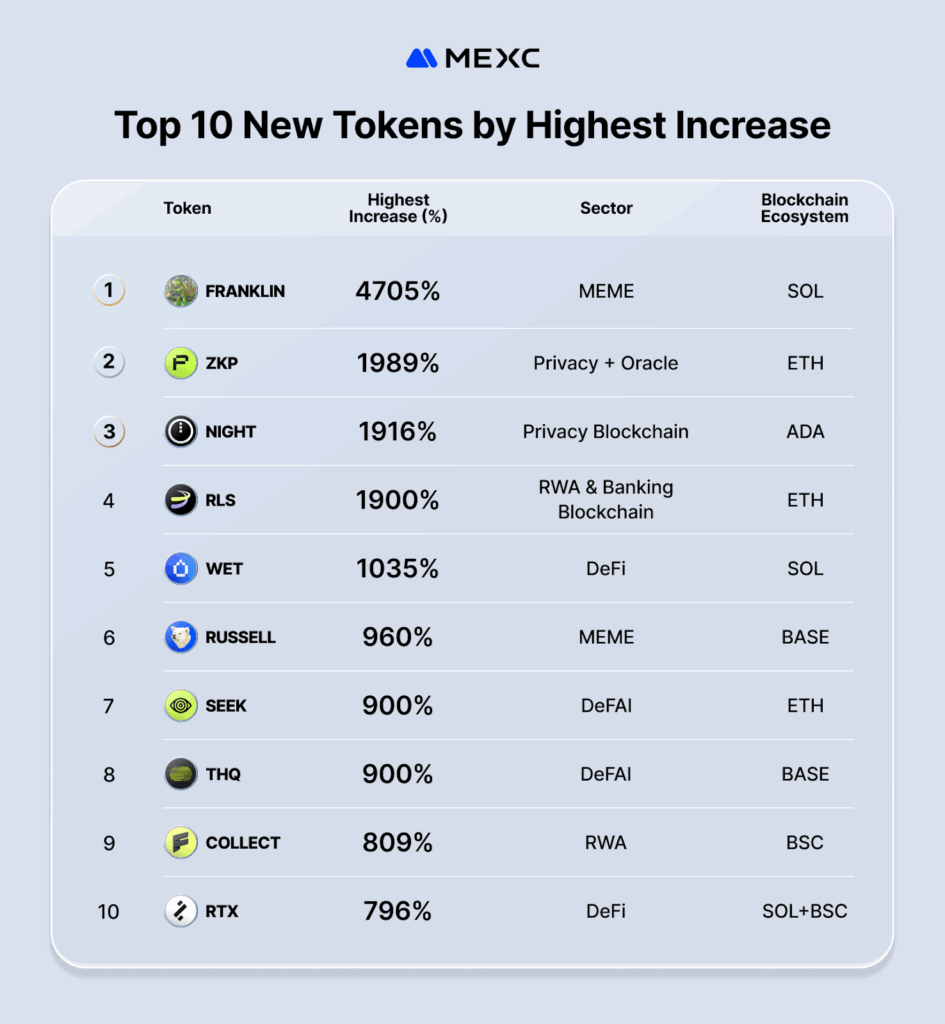
Top-performing assets spanned multiple blockchain ecosystems. Ethereum led with four positions across RWA, privacy, and entertainment sectors. Solana secured two positions, while emerging chains including Berachain, SUI, and StableChain demonstrated strong performance, reflecting broad ecosystem representation.

MEXC’s user-first approach translated into measurable participation growth across key initiatives. The Launchpad’s “Quality First” strategy delivered approximately 70% peak returns on Lighter (LIT), validating the platform’s asset selection framework for early-stage access.

Airdrop+ maintained high-frequency momentum with 30 events across DePIN, Privacy Computing, and RWA sectors. Participation surged 142% month-over-month with an 80% win rate, combining probability with meaningful upside.

The platform’s Spin & Win format integrated gamification directly into trading activity, allowing users to earn rewards through standard execution—reinforcing MEXC’s commitment to aligning user success with platform growth.

MEXC’s December performance reflects evolving market dynamics as capital allocation increasingly prioritizes utility-driven projects with institutional backing and technical fundamentals.

About MEXC

Founded in 2018, MEXC is committed to being “Your Easiest Way to Crypto”. Serving over 40 million users across 170+ countries, MEXC is known for its broad selection of trending tokens, frequent airdrop opportunities, and low trading fees. Our user-friendly platform is designed to support both new traders and experienced investors, offering secure and efficient access to digital assets. MEXC prioritizes simplicity and innovation, making crypto trading more accessible and rewarding.

MEXC Official Website| X | Telegram |How to Sign Up on MEXC

For media inquiries, please contact MEXC PR team:

Disclaimer: TheNewsCrypto does not endorse any content on this page. The content depicted in this Press Release does not represent any investment advice. TheNewsCrypto recommends our readers to make decisions based on their own research. TheNewsCrypto is not accountable for any damage or loss related to content, products, or services stated in this Press Release.


TagsMEXCPrivacyRWA

Perguntas relacionadas

QWhat were the two dominant themes in MEXC's December trading activity, according to the article?

APrivacy computing and real-world asset (RWA) tokenization were the two dominant themes.

QWhat percentage of the top 10 tokens by spot trading volume were infrastructure projects?

AInfrastructure projects accounted for 50% of the top 10 tokens by spot trading volume.

QWhich two specific tokens, backed by notable institutions, were highlighted for their focus on privacy and compliant payments?

ANIGHT, led by Charles Hoskinson, focused on privacy infrastructure, and STABLE, incubated by Bitfinex and Tether, focused on compliant payment solutions.

QWhat was the approximate percentage gain achieved by top privacy and RWA tokens like ZKP, NIGHT, and RLS?

ATokens like ZKP, NIGHT, and RLS each achieved gains approaching 2,000%.

QHow did user participation in the Airdrop+ events change from the previous month, and what was the win rate?

AParticipation in Airdrop+ events surged 142% month-over-month with an 80% win rate.

Leituras Relacionadas

Wall Street's 'Compliance Hunt': The Great Stablecoin Reserve Migration

In a concentrated move over the past week, several Wall Street giants have advanced their tokenized money market fund initiatives, signaling a strategic shift driven by impending U.S. stablecoin regulations. JPMorgan Chase launched its second such fund, JLTXX, on Ethereum, explicitly targeting future stablecoin issuer reserve needs. Concurrently, Franklin Templeton partnered with Kraken to integrate its BENJI tokenized funds onto the exchange platform for use as collateral and cash management tools. BlackRock further solidified its position by filing for two new tokenized funds with the SEC, aiming to convert its massive traditional stablecoin custody business into a tokenized model. These parallel developments represent a multi-pronged institutional "compliance hunt" to capture future crypto liquidity. BlackRock and JPMorgan are focusing on the backend, preparing to serve as the core reserve and settlement infrastructure for compliant stablecoins as outlined by the GENIUS Act. This act defines strict "qualified reserve asset" requirements for stablecoin backing while prohibiting interest payments to holders. Franklin Templeton and Kraken, however, are exploiting a potential regulatory gap. By offering a tokenized fund (BENJI) that is not a stablecoin, they aim to provide yield-bearing, collateralizable digital cash instruments, circumventing GENIUS Act's ban on stablecoin yield. The impending CLARITY Act, which will delineate digital asset market structure, is seen as a complementary piece to GENIUS. Its treatment of passive income could solidify the niche for instruments like BENJI. With conservative market size estimates for tokenized money market funds reaching hundreds of billions by 2030, Wall Street institutions are positioning themselves early, using on-chain settlement as a key competitive differentiator to offer superior liquidity and composability for the next generation of dollar reserves.

marsbitHá 37m

Wall Street's 'Compliance Hunt': The Great Stablecoin Reserve Migration

marsbitHá 37m

Altman Drops Bombshell While Musk is Away: He Once Wanted His Children to Inherit OpenAI

In a California court, Sam Altman testified for the first time in the ongoing legal battle between Elon Musk and OpenAI. Altman made a striking claim: Musk once suggested that control of OpenAI could one day be passed down to his children. This statement reframes the long-standing conflict not as a simple governance dispute but as a foundational power struggle. Altman sought to counter the narrative that OpenAI betrayed its original non-profit, idealistic mission. He argued that from the beginning, it was Musk who sought increasing control over the organization, including a larger equity stake and ultimate decision-making authority. Altman opposed this, citing OpenAI's core principle that AGI should not be controlled by any single individual. He also addressed the key point of contention about OpenAI's shift to a for-profit structure, claiming Musk was aware of and initially supportive of exploring such a model to secure the massive funding needed for advanced AI research. Altman framed the change as a practical necessity, not a betrayal. Further testimony revealed internal concerns after Musk left OpenAI's board, with worries he might take retaliatory action. Altman critiqued Musk's management style as unsuitable for a research lab, damaging morale and culture. Throughout his testimony, Altman's focus appeared to shift from technological idealism to the realities of organizational governance and resource requirements. Regarding his brief ouster in 2023, Altman stated he seriously considered joining Microsoft but ultimately returned because OpenAI was too important to abandon.

marsbitHá 1h

Altman Drops Bombshell While Musk is Away: He Once Wanted His Children to Inherit OpenAI

marsbitHá 1h

Trading

Spot
Futuros
活动图片




