
Primitive Ventures: Why Are We Bullish On On-Chain Perpetual U.S. Stocks?

marsbitPublicado em 2026-01-30Última atualização em 2026-01-30

Resumo

Primitive Ventures argues that on-chain perpetual contracts for US equities represent a pivotal convergence point for crypto and traditional finance, poised to absorb global liquidity. The trend is driven by crypto's innate preference for volatility and key infrastructure upgrades: crypto in-kind margin acceptance by CBOE/CME, DTCC's potential on-chain settlement integration, and the emergence of tokenized equities as collateral enabling systematic basis farming. The dynamic involves "onshore issuance, offshore distribution." While entities like Ondo focus on compliant tokenized stock issuance, demand flows to platforms with superior distribution and trading interfaces, predominantly on BNB Chain. On-chain perps attract global professional traders seeking 24/7 access, high leverage, cross-margin efficiency, and DeFi composability, bypassing traditional broker limitations. The stack is maturing with infrastructure (HIP-3/HyperCore, Orderly, Chainlink), trading platforms (Trade.xyz, Ostium), and terminal frontends (Based, Phantom). The future is a unified global "margin network" where diverse assets serve as interoperable collateral. However, the window is narrowing. The primary threat is not demand but regulatory approval of onshore products, which could rapidly shift activity back to established brokers (e.g., Robinhood with 0DTE options). With the SEC/CFTC actively studying perps and compliant entrants like Bitnomial emerging, offshore/on-chain players must quickly captur...

Author: YettaS, Investment Partner at Primitive Ventures

As gold and silver continue to hit new highs, Trade.xyz's daily trading volume approaches $2 billion, and Binance lists TSLA perpetual contracts with little hesitation, the trend is hard to ignore: Traditional financial assets are becoming the new gateway for the crypto market to absorb global liquidity.

Just a year ago, most CEX operators probably couldn't accept this fact: An on-chain trading venue is actually using TradFi assets as a wedge to begin eroding and reshaping the core territory of centralized exchanges.
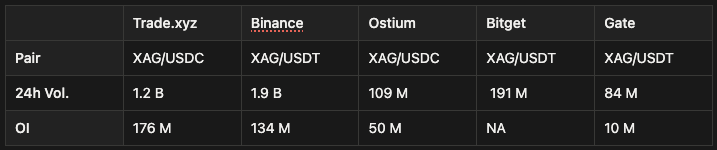
We all know that crypto capital inherently prefers volatility; from a product structure perspective, equity perps are precisely at the convergence point of several key upgrades, which is the fundamental reason they stand out in this cycle:

  • As CBOE / CME gradually accept crypto in-kind margin this year, the liquidity and availability of crypto assets as collateral will significantly improve.

  • Once the DTCC establishes a direct on-chain connection, the settlement layer will begin to permeate on-chain, and stock assets will gain a native on-chain settlement channel from the source.

  • The truly interesting part then emerges: Tokenized stocks as collateral → Perpetual contract exchanges accept them → Institutions begin systematic basis farming.

Onshore Issuance, Offshore Distribution

The U.S. exports finance not by exporting financial institutions themselves, but by exporting "access." The petrodollar system distributed dollars globally, externalizing inflationary pressure; stablecoins replicated this logic by wholesale purchasing of U.S. Treasuries, turning the whole world into new dollar holders without the need for banks or brokers. On-chain stocks are the next step in this logic. From unbanked to unbrokered, dollar assets will once again complete their global倾销 (dumping).
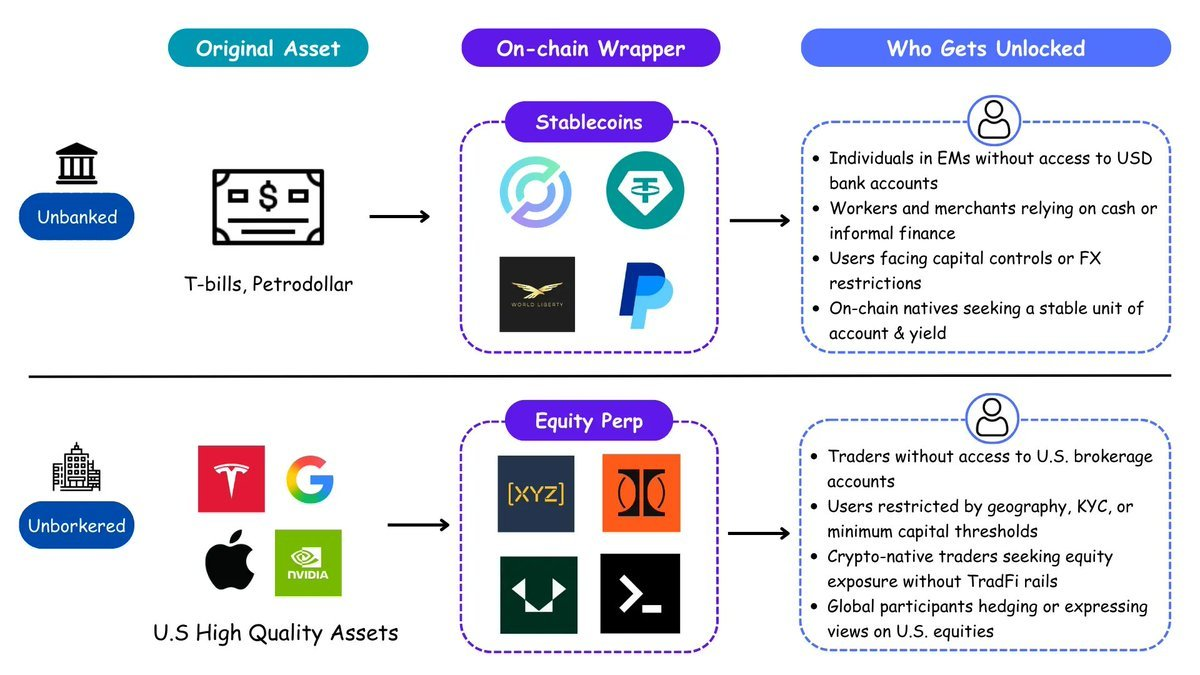
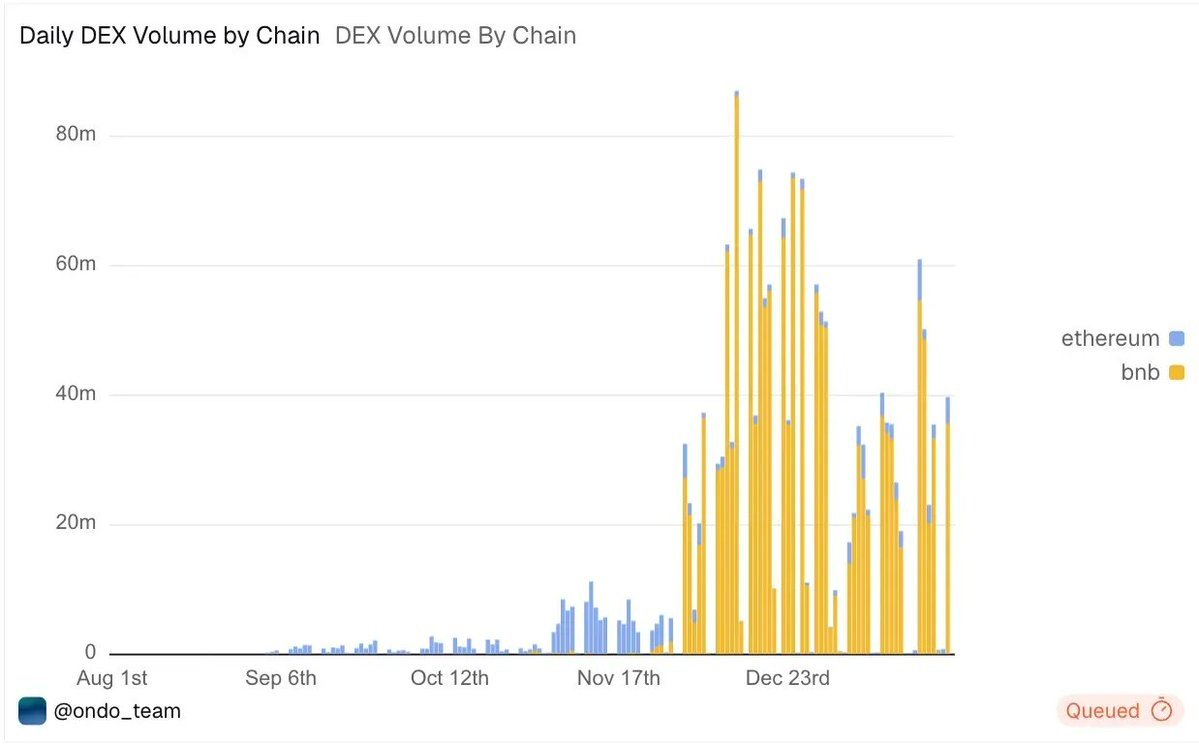
CEXs saw the opportunity and potential threat early on, so they chose to expand first. Ondo and xStocks focused on the issuance side—connecting with brokers, custodying real stocks, minting 1:1 tokenized stocks on multiple chains—but it turned out that issuance itself doesn't automatically create a market.

The first wave of real demand came from traders unable to access the U.S. brokerage system and crypto-native users seeking exposure to U.S. stocks without relying on TradFi infrastructure. The issuers handled the heaviest compliance and custody work, but the flow of funds went to the side that truly controls trading attention and distribution capabilities. Offshore platforms embedded the products directly into their trading interfaces, and trading volume naturally aggregated there. Ultimately, we see the vast majority of tokenized stock trading volume concentrated on BNB Chain, accounting for over 80%.
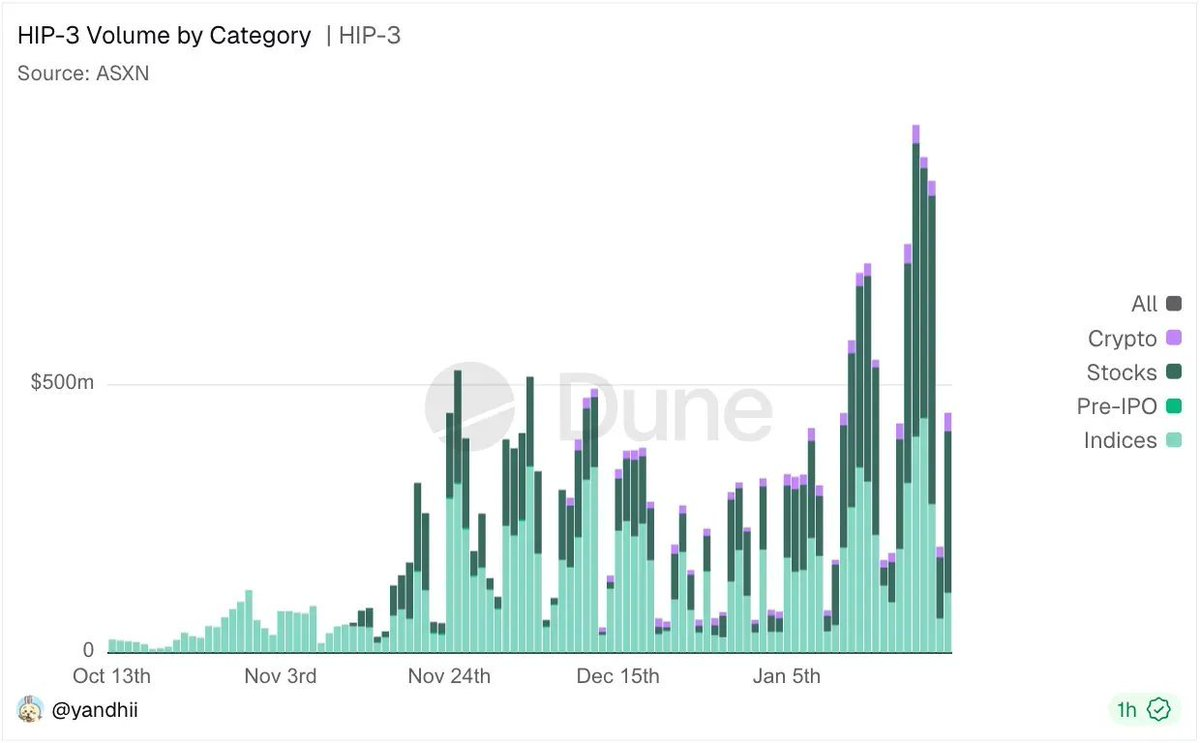
If offshore spot unlocked retail demand, on-chain equity perps further attracted the flow of professional traders. These users are global trading participants who want to trade or hedge U.S. stocks without being constrained by broker access, trading hours, or jurisdictional limits.

Take HIP-3 as an example; it provides professional traders with a trading interface to systematically conduct basis trading, capture cross-market dislocations, and cover stocks, crypto assets, and indices simultaneously. With the叠加 (overlay) of potential airdrop incentives, trading volume continues to刷新 (refresh) new highs.
The Golden Window for On-Chain Stock Perpetuals

Once a现货锚点 (spot anchor) exists, perpetual contracts almost always become the most efficient trading tool, for reasons that are as direct as ever:

  • 7×24 hour trading,不受 (not subject to) market hour restrictions

  • Cross-margin with all assets, extremely capital efficient

  • High leverage allows true risk appetite to be释放 (released)

  • Composable into DeFi strategies

  • Provides a clear collateral path for RWA / tokenized assets

The entire tech stack is rapidly taking shape:
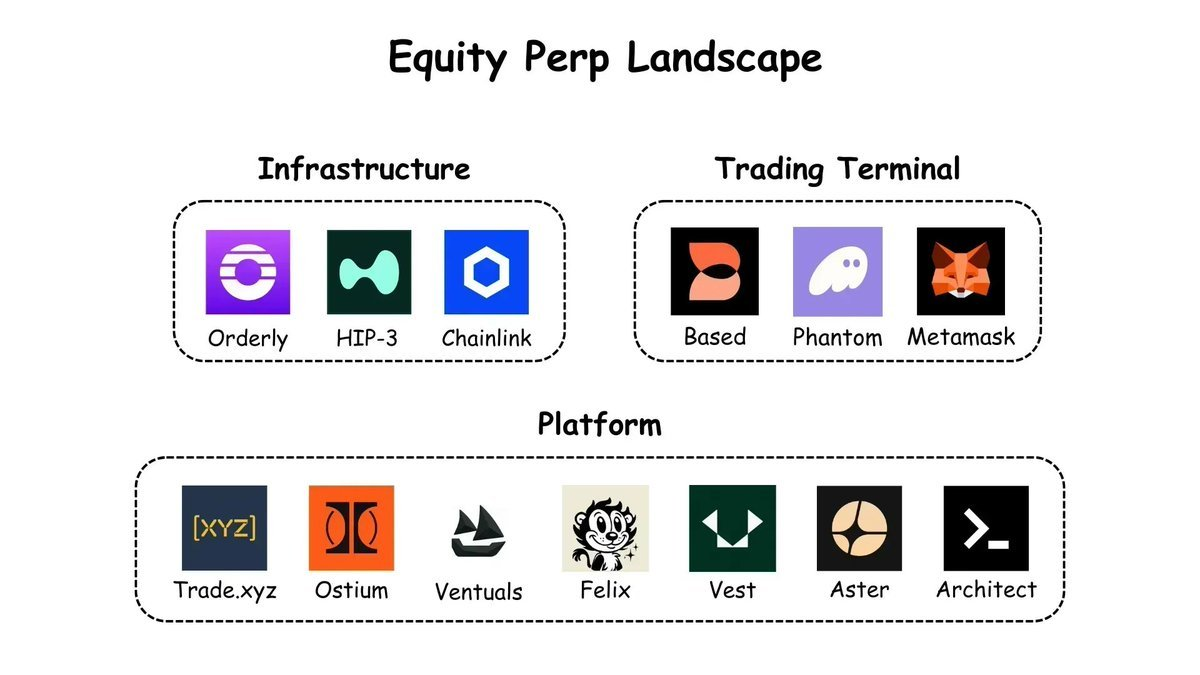
Infrastructure

  • HIP-3 / HyperCore: High-performance orderbook engine, supports any perp market

  • Orderly: Unified omnichain orderbook, anyone can launch a perp with no code

  • Chainlink: Stock price oracle (core data layer)

Platforms (Where trading happens)

  • Trade.xyz: Based on HIP-3, currently the largest equity perp DEX

  • Ostium: FX / Commodities / Stocks,偏向 (leaning towards) CFD structure

  • Ventuals: pre-IPO market (HIP-3)

  • Felix / Vest / Aster / Architect: Each has its focus on settlement, coverage, and distribution

Terminals (Current upstream traffic entry points)

  • Based: Multi-asset interface aggregating Hyperliquid, HIP-3, and prediction markets

  • Phantom / Metamask-like frontends: Convert wallet traffic into trading behavior

Looking forward, the focus is shifting from "tokenization" to "monetary velocity." The real on-chain GDP will be generated here. The ultimate winners won't just be players who can mint on-chain wrapped assets, but those trading venues that, at scale, can convert any asset into usable collateral and provide the deepest liquidity and the cleanest matching / risk engine.

Imagine the future as a globally unified "collateral network": Bitcoin, U.S. stocks, gold, U.S. Treasuries are no longer locked in their respective systems but can be used as collateral like building blocks at any time; perpetual contracts become the most universal risk expression tool; stablecoins play the role of cash; various trading and arbitrage strategies run automatically 7×24 on-chain, constantly combining. Assets are no longer "held" but are continuously called upon.

Racing Against Time

The window is open, but time is not on the side of on-chain equity perps. The biggest threat is not demand, but the formal approval of onshore products. History has repeatedly shown that once regulators nod, distribution回流 (flows back) to the existing brokerage system in an extremely short time. 0DTE options are the most direct example: after approval, they were quickly absorbed and dominated by Robinhood.

More importantly, the countdown has begun. The SEC and CFTC are systematically studying perpetual derivatives and their market structure and risks, which usually means regulatory boundaries are being actively defined. Meanwhile,

  • Bitnomial became the first CFTC-compliant perp

  • Coinbase also launched 5-year futures with a funding mechanism,几乎 (almost) indistinguishable in trading behavior from perps.

The reason offshore and on-chain players can still lead is simply that the products haven't been standardized yet. Once the rules take shape, the advantage will quickly disappear. Those who truly have a chance are not those waiting for certainty, but those who, while the window is still open, quickly lock in users and liquidity, and shape the rules while running and coordinating with regulators. Time is not a background variable but the core constraint determining victory or defeat, and the countdown has already begun.

Just as Tether used crypto's distribution power to quietly push the dollar globally back in the day, today's on-chain economy is essentially doing the same thing—leveraging the liquidity and trading tools of the crypto market to deliver U.S. stocks and American assets in a form with higher frequency, higher leverage, and higher liquidity to a broader set of participants. On-chain is not对抗 (fighting against) off-chain; it is rewriting the operating methods of the existing system with faster speed and stronger capital efficiency. The real watershed lies in whether one can timely capture this mechanism and complete the cognition and layout of the new continent on-chain.


Perguntas relacionadas

QWhy does Primitive Ventures believe on-chain perpetuals for US stocks are gaining traction in the crypto market?

APrimitive Ventures attributes the rise of on-chain perpetuals for stocks to crypto's inherent preference for volatility, key infrastructure upgrades like CBOE/CME accepting crypto in-kind margin, and the potential for DTCC to establish direct on-chain connections. These factors enable tokenized stocks to be used as collateral, attracting institutional basis farming and global liquidity.

QWhat is the significance of the 'offshore distribution' model for tokenized stocks mentioned in the article?

AThe 'offshore distribution' model refers to platforms outside strict US jurisdiction that focus on distributing and trading tokenized stocks, capturing demand from users unable to access US brokerages or seeking crypto-native exposure. This model has concentrated over 80% of trading volume on BNB Chain, demonstrating that distribution, not just issuance, drives market growth.

QWhat advantages do on-chain equity perpetuals offer over traditional trading methods?

AOn-chain equity perpetuals offer 24/7 trading unrestricted by market hours, high capital efficiency with cross-margin across all assets, high leverage to match risk appetite, composability into DeFi strategies, and a clear path for using RWA/tokenized assets as collateral.

QWhat are the main threats to the growth of on-chain equity perpetuals according to the article?

AThe primary threat is the potential approval and rapid adoption of onshore regulated products by established brokers, as seen with 0DTE options on Robinhood. Regulatory bodies like the SEC and CFTC are already studying perpetual derivatives, and once rules are standardized, the current advantage could quickly diminish.

QHow does the article describe the future vision of a 'global margin network'?

AThe future is envisioned as a globally unified 'margin network' where assets like Bitcoin, US stocks, gold, and US Treasuries are not siloed but can be used interchangeably as collateral. Perpetual contracts serve as the universal tool for risk expression, stablecoins act as cash, and various trading/arbitrage strategies operate 24/7, continuously composing and utilizing assets rather than just holding them.

Leituras Relacionadas

As Consensus Accelerates, What Are Young Investors Betting On?

Title: As Consensus Forms Faster, What Are Young Investors Betting On? In the rapid evolution of tech investment, a new generation of young investors is navigating a landscape where AI, robotics, commercial aerospace, and quantum computing are advancing simultaneously. Traditional investment logic based on financial models is giving way to a need for deep technical understanding and the ability to act before industry consensus forms. An analysis of trends from the "WAIC FUTURE TECH" list of young investment leaders reveals key shifts in focus. The first major trend is the movement of AI from the digital screen into the physical world. Investment is shifting from large language models and chatbots towards embodied AI, robotics, AI hardware, and edge computing. While demonstrations generate excitement, the real challenge lies in achieving scalable, reliable, and cost-effective delivery in complex real-world environments like factories and logistics. Success depends not just on algorithms but on the integration of sensors, actuators, and control systems. Second, the competitive focus for large models is moving beyond raw capability toward building an "intelligence flywheel." The goal is to create self-reinforcing systems where user interaction generates data, improving the model, which in turn enhances the user experience and attracts more engagement. Companies that successfully embed AI into workflows to create these closed-loop systems can build lasting value that isn't easily erased by the next model upgrade. Third, facing a potential bottleneck in high-quality human-generated data, investors are looking at new underlying technologies. Reinforcement learning and self-play, as demonstrated by AlphaGo Zero, offer paths for AI to generate its own experience. Scientific foundation models, which aim to build general AI capabilities for fields like life sciences and materials discovery, represent a non-consensus direction that could unlock new frontiers of knowledge and data. Finally, in deep-tech areas like quantum computing, commercial aerospace, and space-based infrastructure, patient capital is essential. These fields have long, uncertain development and validation cycles involving complex engineering, supply chains, and regulations. Investment here requires a long-term view, focusing on foundational team capabilities and the eventual emergence of market demand, even if commercial returns are distant. Collectively, these trends illustrate how young investors are adapting to a new era. They are learning to make earlier, technically-informed judgments, balance hype with real-world viability, and provide the patient capital needed to build the deep-tech foundations of the future.

marsbitHá 6m

As Consensus Accelerates, What Are Young Investors Betting On?

marsbitHá 6m

Can Japan Buy Growth with AI? Will the Bond Market Believe It?

Japan's cabinet has introduced the 2026 Basic Policy on Economic and Fiscal Management and Reform, shifting its primary fiscal target. The new framework moves away from the traditional annual primary balance goal and instead prioritizes a stable reduction of the debt-to-GDP ratio. This change is tied to a strategy of increased "responsible proactive fiscal" spending, aiming to boost long-term growth through investments in strategic sectors like AI, semiconductors, energy, and robotics. The government estimates total public and private investment in 62 key technologies could exceed 370 trillion yen by 2040. The market reaction has been mixed and cautious. While equity markets may respond to policy signals, bond markets are focused on fiscal credibility. Concerns center on whether the weakening of the clear primary balance anchor could lead to looser fiscal discipline. If investors doubt that these strategic investments will generate sufficient productivity gains, tax revenue, and nominal growth to outpace rising interest costs, they may demand higher yields on Japanese Government Bonds (JGBs). Recent volatility in the yen and JGB yields, with the 10-year yield briefly reaching 2.9%, reflects this skepticism. The success of this new framework hinges on two factors: whether Japan can achieve a nominal growth rate consistently higher than its long-term interest rates, and whether future budgets demonstrate disciplined control over bond issuance. The government's narrative is that strategic investment is essential to break Japan's cycle of low growth, aging, and labor shortages. However, the bond market will continuously assess the credibility of this plan, pricing the risk that it may represent fiscal expansion rather than a viable growth strategy.

marsbitHá 43m

Can Japan Buy Growth with AI? Will the Bond Market Believe It?

marsbitHá 43m

Misjudged A-Shares: Resilience, Expectations, and Confidence

China's A-share market recently faced selling pressure, especially in tech sectors, initially triggered by a global tech sell-off that began in South Korea. However, the article argues this is a case of "mistaken injury" and highlights the market's underlying resilience. This resilience stems from three main pillars: **1) Tech Sector Fundamentals:** Unlike Korea's market dominated by a few memory chip stocks, China's tech sector is diversified across computing, communications, electronics, and semiconductors, supported by dual narratives of global AI supply chains and domestic substitution. Core areas like optical modules and fiber optics continue to show strong earnings growth. **2) "National Team" Support:** State-backed institutions and large corporations have made significant market purchases and announced buybacks, providing liquidity and signaling confidence. This is seen as a stabilizing policy signal, often associated with market bottoms. **3) Broader Market Pillars:** Other major sectors are showing endogenous recovery momentum. Consumer stocks benefit from stabilizing CPI and signs of sector recovery (e.g., liquor price hikes). Cyclical sectors like aluminum have high earnings, potential price increases due to tight supply, and low valuations. The financial sector offers stable dividends and low valuations. The conclusion is that the sell-off was driven by external contagion, not a collapse in fundamentals. With strong policy support and recovering momentum across key sectors, the A-share market possesses the toughness to regain stability.

marsbitHá 1h

Misjudged A-Shares: Resilience, Expectations, and Confidence

marsbitHá 1h

Trading

Spot
活动图片




