Prediction Markets Plunge into Major Controversy Again: Are You Trading Facts or Rules?

marsbitPublicado em 2026-04-08Última atualização em 2026-04-08

Resumo

The prediction market sector, particularly platforms like Polymarket and Predict.fun, is facing significant controversy over event resolution rules that sometimes conflict with user expectations. Two recent cases highlight the issue. First, on Polymarket, a market asking “Will US forces enter Iran by a certain date?” was resolved as “Yes” after US special forces entered Iranian territory to rescue a downed pilot. While the rules technically defined such an operational entry as a qualifying "invasion," many users argued it contradicted the common-sense understanding of a military invasion, as the action was a limited humanitarian rescue, not a combat operation. Second, on Predict.fun, a market on “Will Polymarket launch a token?” was resolved as “Yes” after the platform announced a new stablecoin, Polymarket USD, pegged 1:1 to USDC. The rules defined a "token" as any fungible asset, but the community debated whether a stablecoin—a collateral tool rather than a governance or equity token—should truly count as the "launch" users were predicting, especially for a subsequent market on the project’s Fully Diluted Valuation (FDV). The core conflict is whether users are betting on real-world events or a platform’s specific, often technical, rules. These cases show that a high-probability bet can quickly become a loss if the rules are misinterpreted. The key takeaway for participants is to prioritize understanding the precise, written rules over their own assumptions to avoid unex...

Author | Asher(@Asher_ 0210)

Prediction markets are currently one of the most discussed sectors in Web3.

Trading around macro events, the crypto industry, and even entertainment topics continues to heat up, with discussion fervor and participation numbers constantly rising. However, as the market develops rapidly, some discordant voices have gradually emerged—some events, upon settlement, deviate from users' expectations based on common sense or "real-world understanding," sparking controversies over rule design, fairness, and even platform credibility.

Recently, two highly controversial events occurred in quick succession in prediction markets. Below, Odaily Planet Daily will sort through and discuss them.

Polymarket: U.S. Rescue of Downed Pilot in Iran Judged as U.S. Invasion of Iran

On April 3, a U.S. F-15E Strike Eagle fighter jet was shot down by Iranian air defense systems in southwestern Iran. The two crew members (one pilot, one Weapon Systems Officer/WSO) ejected; one was quickly rescued, while the other was missing for several days, hiding in the Iranian mountains.

  • The U.S. military subsequently launched a Search and Rescue (SAR) operation involving armed aircraft, helicopters, etc., ultimately successfully rescuing the second severely injured crew member (Trump personally announced "WE GOT HIM").
  • The rescue operation involved U.S. forces entering Iranian territory (mountain search and rescue, possible ground or low-altitude operations), which attracted attention given the current sensitive geopolitical conflict background.

Since U.S. forces entering Iranian territory could, in a way, be considered a U.S. invasion of Iran, this directly affected the prediction event on the Polymarket platform regarding when U.S. forces would enter Iran (US forces enter Iran by?).
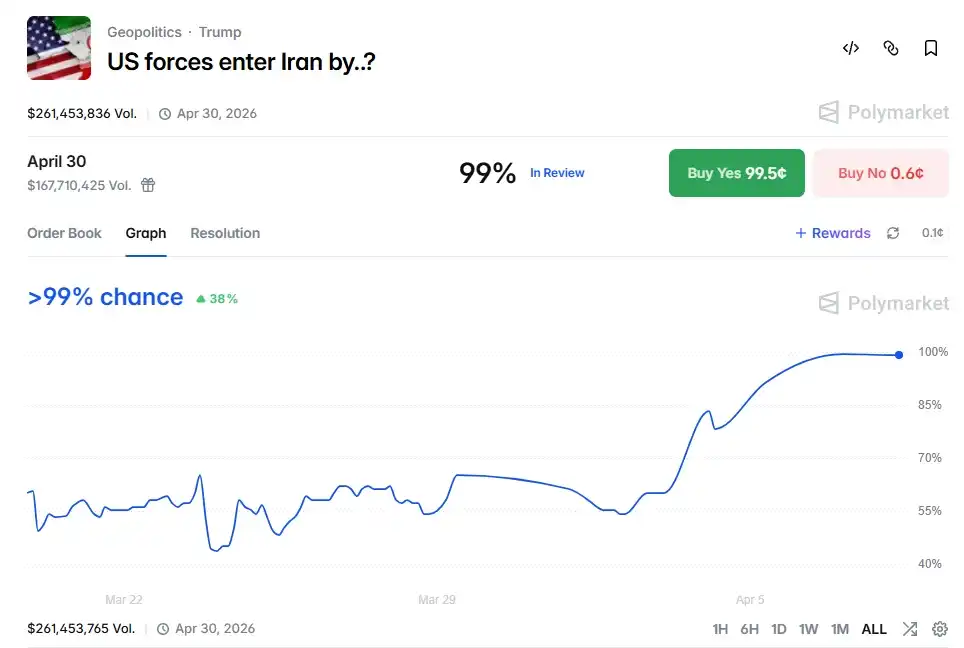
According to the settlement rules, active U.S. military personnel (including special operations forces) entering Iranian land territory before the specified date counts as an invasion. Downed pilots do not count as invasion, but the special forces sent by the U.S. military did indeed enter Iranian territory to rescue the pilot. Therefore, the special forces entering Iran to rescue the pilot met the criteria for judging "Yes" for a U.S. invasion of Iran.
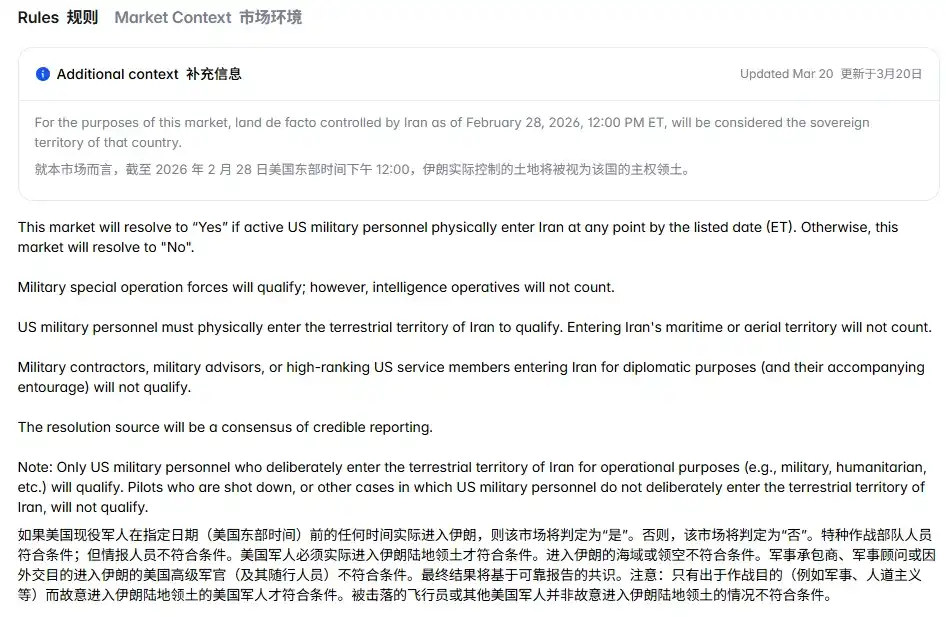
Polymarket's judgment that the "pilot rescue" event constituted a U.S. invasion of Iran has sparked strong controversy in the community.

Those supporting "counts as entry" (Yes side) argue that this operation meets the definition of "entry" in the rules. The U.S. special forces deliberately entered Iranian territory to execute a mission, and the rules explicitly state that "special operation forces will qualify," also covering "for operational purposes (including humanitarian)." Objectively, this is the first confirmed ground infiltration by U.S. forces in the current conflict context; U.S. personnel did set foot on Iranian soil, so it should be considered "entry."

Those opposing "counts as entry" (No side) believe this definition is an overextension. The action was essentially a short-term, limited-scale humanitarian rescue, not a combat invasion (invasion), nor did it have an intent to occupy, which does not align with the public's common-sense understanding of "U.S. forces entering Iran." Furthermore, the rules explicitly exclude "pilots who are shot down... will not qualify," and this operation was precisely about rescuing a downed pilot, possessing a nature of "forced entry" and should logically fall under a similar exception. Referring to past cases (e.g., similar regional actions were not considered invasions), rescue operations should not be equated with military entry; if judged as Yes, it might encourage marginal interpretations of the rules, weakening the market's seriousness and consistency. The Chinese community also generally believes that "entering Iran" should refer more to large-scale ground or amphibious operations, not short-term "rescue and leave" actions.

Predict.fun: Polymarket Issuing Stablecoin Judged as Token Launch

On the evening of April 6, Polymarket officially announced on X a comprehensive exchange upgrade:

  • Rebuilding the trading engine, upgrading smart contracts;
  • Launching a new native collateral token, Polymarket USD (1:1 pegged to USDC, to replace USDC.e and reduce bridging risks).

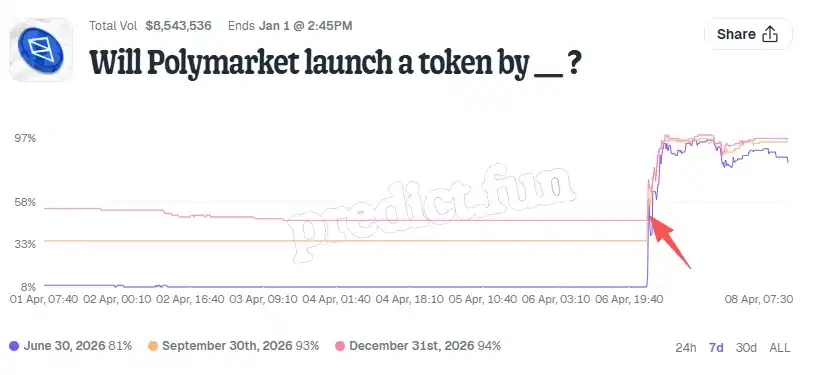
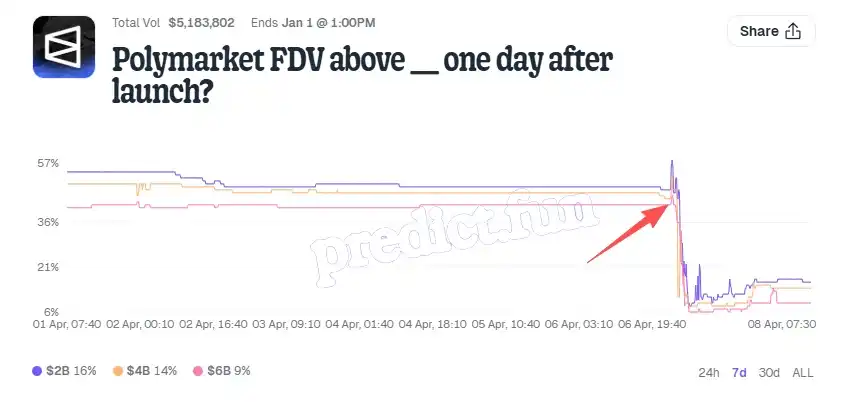
The second point, mentioning the launch of the native collateral token Polymarket USD, directly affected the probability of two related prediction events on the Predict.fun platform: one about token launch; the other about post-launch market cap:

1. When will Polymarket launch a token? (Will Polymarket launch a token by ___ ?)
2. Polymarket's FDV one day after launch (Polymarket FDV above ___ one day after launch?);
According to the settlement rules document, it clearly states that "any fungible token issued by Polymarket counts as a 'token launch' in this event", and stablecoins are of course no exception. Therefore, the Polymarket stablecoin meets the criteria for a Yes judgment.
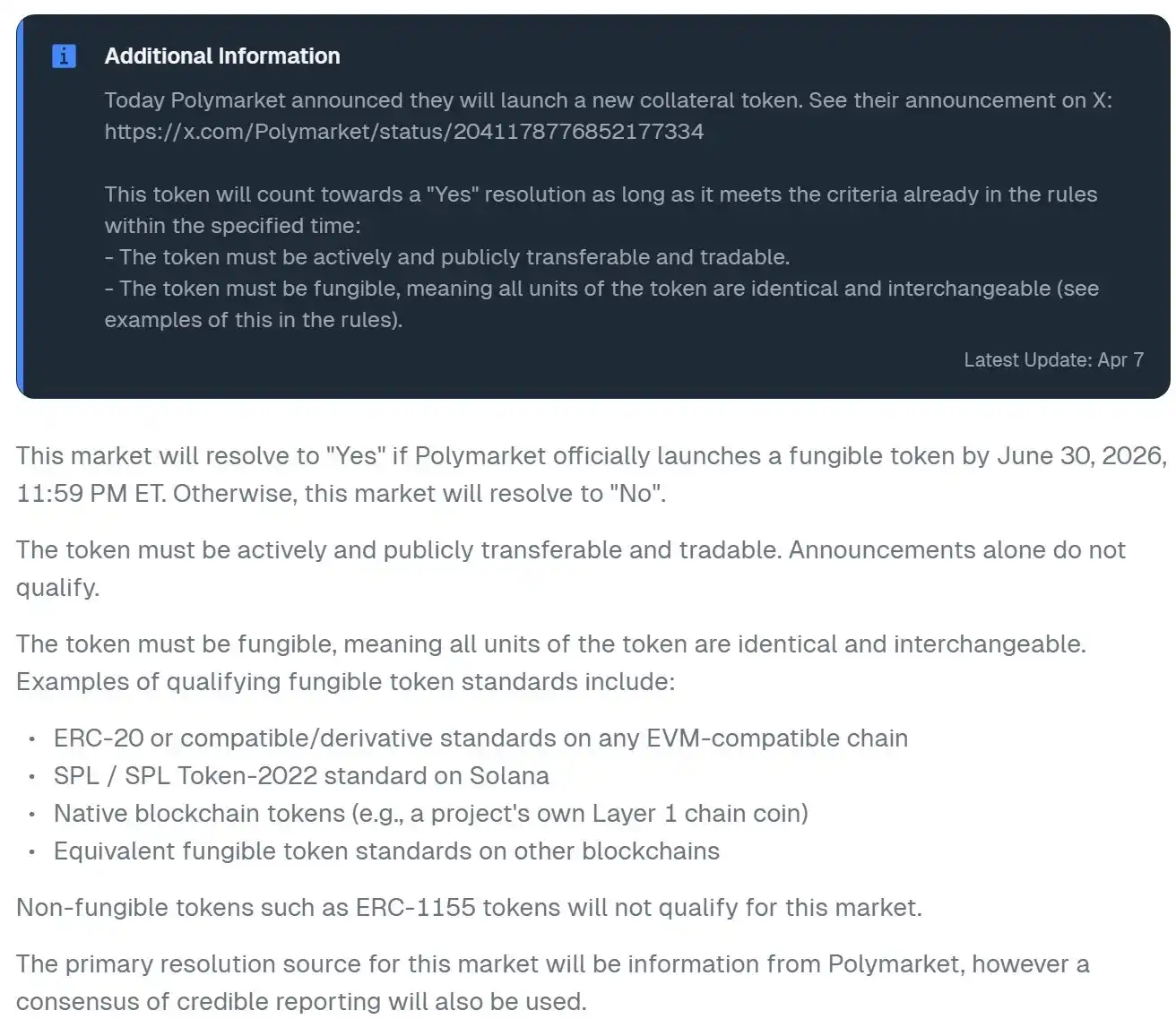
Relevant explanation of settlement rules

The community debated this issue.

Supporters argue that, literally from the rules, "issuing a token" is not limited to must be a "governance token," but is a general term for all tokens. Under this premise, Polymarket USD, as a fungible token (like ERC20/SPL) issued by Polymarket, essentially fits the definition of "token launch." Additionally, the official follow-up clarification was more a reiteration of the existing rules rather than a temporary change, so it has some legitimacy in terms of compliance.

However, skeptics do not accept this interpretation. On one hand, they believe including stablecoins in the "token launch" category is an overinterpretation of the rules, a typical play on words; on the other hand, even if stablecoins are acknowledged as "token launch," the core of this prediction market is "Polymarket FDV," not "Polymarket USD FDV." Stablecoins serve more as collateral or settlement tools; their market cap structure is fundamentally different from that of the project's main token (e.g., a POLY governance token), so they should not be directly equated or substitute for the project's overall valuation logic.

Which Side Are You On?

Overall, looking at these events, the controversies in prediction markets essentially revolve around a core question: are you betting on "reality" or are you betting on "rules"? Often, these two do not completely overlap.

For us participating in prediction markets, understanding the rules themselves might be more important than judging the direction of events. How the information source is defined, whether there are exception clauses, whether there is room for interpretation—these details can decisively determine win or loss at critical moments.

Precisely because of this, some high-probability events that look like "sure-win bets" are not without risk; they might instead be potential "lose-everything bets." Many reversals happen exactly in these overlooked details. Rather than betting blindly, taking an extra look at the rules is more useful than complaining after losing money.

Criptomoedas em alta

Perguntas relacionadas

QWhat is the core issue discussed in the article regarding prediction markets?

AThe core issue is the discrepancy between user expectations based on common sense or 'real-world understanding' and the actual settlement based on predefined rules, leading to controversies about rule design, fairness, and platform credibility.

QWhy was the US rescue operation for a downed pilot in Iran considered an 'invasion' on Polymarket?

ABecause the settlement rules defined 'invasion' as active entry of US military personnel, including special operations forces, into Iranian territory for operational purposes (including humanitarian), which the rescue mission technically fulfilled.

QWhat was the controversy surrounding Polymarket's launch of Polymarket USD on Predict.fun?

AThe controversy was whether launching a stablecoin (Polymarket USD) counted as 'launching a token' under the platform's rules, as the rules broadly defined it as any fungible token, but users argued it misrepresented the intent of the prediction about a governance token and FDV.

QWhat lesson does the article suggest for participants in prediction markets?

AParticipants should prioritize understanding the specific rules and definitions of the market—such as information sources, exceptions, and interpretation space—over relying solely on common sense or real-world expectations to avoid unexpected losses.

QHow did the community react to the settlement of the 'US invasion of Iran' event on Polymarket?

AThe community was divided: supporters argued it met the rule-based definition of 'entry,' while opponents felt it was an overextension that contradicted common sense, as rescue operations shouldn't be equated with military invasion.

Leituras Relacionadas

When the World Cup Collides with Agents: From Web2 to Web3, How Are Wallets Evolving into Agentic Wallets?

World Cup as a Catalyst for Agentic Wallets: From Web2 to Web3 This article explores how the World Cup provides a real-world scenario for observing the evolution of digital wallets from simple asset managers towards "Agentic Wallets"—intelligent, AI-powered interfaces. Using the example of prediction markets like Polymarket, it illustrates how AI Agents can lower the barrier to Web3 interaction. Instead of navigating complex DApps, users can express intent in natural language (e.g., "I think Portugal will win") within platforms like Discord or web pages. The Agent then interprets this intent, finds the relevant market, and seamlessly guides the user through the on-chain transaction via their wallet. The core shift is from wallets as mere "function menus" for signing transactions to "intent interpreters" that understand user goals. The article highlights parallel developments in traditional finance, such as Mastercard's "Agent Pay" and WeChat Pay's AI tests, which focus on granting AI controlled, authorized, and auditable payment capabilities. This underscores a broader trend of AI entering the financial layer. However, the article emphasizes that the primary challenge for Agentic Wallets in Web3 is not automation but establishing clear security boundaries. Unlike traditional systems with chargebacks, on-chain transactions are often irreversible. Therefore, future wallets must ensure users retain ultimate control and comprehension. They need to transparently communicate an Agent's permissions, spending limits, authorized durations, and provide easy ways to pause or revoke access. The World Cup experiments represent early steps toward wallets that are not just applications but ubiquitous, intelligent interfaces that simplify Web3 while keeping users securely in control.

marsbitHá 1h

When the World Cup Collides with Agents: From Web2 to Web3, How Are Wallets Evolving into Agentic Wallets?

marsbitHá 1h

Options Don't Work in DeFi? Vitalik Might Not Agree

For years, the prevailing view has been that options struggle to gain traction in DeFi due to complexity, fragmented liquidity, and lack of natural demand compared to products like perpetual futures. However, a recent algorithmic stablecoin design proposed by Vitalik Buterin presents a different perspective, using options not as a standalone trading product, but as foundational infrastructure for other financial instruments. In this design, one unit of ETH is split into two components: a "stable" side (P) that retains value up to a specified strike price, and an "upside" side (N) that captures all appreciation above that strike. Combined, they always equal one ETH, eliminating debt, margin, and liquidation risks inherent in typical collateralized debt position (CDP) stablecoins. The stable component essentially mimics the payoff of a covered call option. To function as a stablecoin, this structure requires continuously rolling deep in-the-money calls, which introduces challenges like rollover slippage, predictable transaction flow vulnerable to front-running, and persistent liquidity needs. A core hurdle is finding consistent buyers for the leveraged ETH upside exposure (N). While it offers leverage without funding rates or liquidation, it must compete with simpler alternatives like direct call options or perpetuals. The system's scalability depends on a sustained demand for this specific form of leverage. The author draws parallels to their experience with Rysk, where earlier versions of DeFi options protocols struggled. The breakthrough came with Rysk V12, which aligns incentives: asset holders generate yield by selling covered calls against their holdings, while market makers efficiently acquire the desired option exposure. This demonstrates that options can find product-market fit when embedded as a risk distribution and pricing engine within structured products, stablecoins, or yield-generating assets, rather than marketed as a complex direct trading instrument. Vitalik's proposal reinforces this architectural approach—using fully collateralized, non-custodial, and physically settled options as a fundamental building block. The real opportunity for options in DeFi may lie not in becoming the next perpetual swap, but in powering the next generation of on-chain financial products.

marsbitHá 1h

Options Don't Work in DeFi? Vitalik Might Not Agree

marsbitHá 1h

Conversation with Investor Zheng Di: MicroStrategy's Coin Sale Experiment, AI Economy, and Opportunities in US Stocks

Frontier tech investor Zheng "Didier" Di discusses the recent Bitcoin price drop, the financial strategy shift at MicroStrategy, the AI-driven surge in U.S. stocks, and the evolving role of crypto exchanges. Didier posits that the recent BTC decline stems less from macro factors or ETF outflows, and more from market repricing due to MicroStrategy's new financial structure. Following a wave of preferred stock and debt issuance (STRC, STRZ, etc.), MicroStrategy must now manage cash flow to pay dividends, potentially leading to a market expectation of sustained, small-scale BTC sales to maintain its "per-share bitcoin neutral" principle. Didier views this as a financial "experiment" testing market capacity for such recurring sell pressure, which, while creating near-term structural headwinds, likely avoids a true "death spiral" absent major new external shocks. Shifting to AI, Didier argues that tokens are becoming the new form of labor, with AI models and compute (tokenized inputs) increasingly replacing human roles in execution and middle-management. This drives enterprise efficiency and higher margins, fueling the sustained rally in U.S. semiconductor, data center, and infrastructure stocks. He foresees an emerging "machine economy" where automated agents transact and collaborate on-chain. Regarding crypto exchanges offering U.S. equities, Didier sees this as a natural evolution. With few crypto-native assets generating lasting value, exchanges are pivoting towards real-world assets (RWAs) like stocks and bonds. This doesn't necessarily cannibalize crypto but reflects a maturing industry focusing on blockchain's core utilities: decentralized choice and efficient settlement. He notes that trading logic for crypto natives doesn't need to drastically change, as meme-driven and fundamentalist strategies find analogs in U.S. markets. The "1011 event" (likely referring to a major market crash) severely damaged crypto market liquidity, marking a probable end to the altcoin speculative cycle, with capital flowing towards the deeper liquidity of U.S. markets. For the macro outlook, Didier is cautious about near-term market pressure from potential mega-IPOs (e.g., SpaceX) and the U.S. midterm elections, which could bring more regulatory scrutiny. Long-term, he remains bullish on AI's productivity gains and its convergence with blockchain/Web3, predicting a shift from speculative frenzy to a more institutionalized, industrial phase for the crypto sector.

marsbitHá 2h

Conversation with Investor Zheng Di: MicroStrategy's Coin Sale Experiment, AI Economy, and Opportunities in US Stocks

marsbitHá 2h

Playnance’s $GCOIN Lists on KoinBX Amid Rapid Growth in India

Playnance's native token, $GCOIN, has been listed on the cryptocurrency exchange KoinBX as of June 18. This move aims to enhance accessibility for its rapidly growing community, particularly in India, where the blockchain-powered Web3 iGaming ecosystem has gained significant traction. Over 130 partners in Playnance's "Be the Boss" program have built communities engaging thousands of active players in the region. The "Be the Boss" model allows participants to create and manage their own gaming communities, earning rewards tied to community activity. CEO Pini Peter noted India's high engagement, with community leaders successfully building player networks. One partner, Dr. Nicolas, reported earning over $57,000 through the program in recent months, highlighting both the financial rewards and the opportunity to grow an engaged community. $GCOIN serves as the ecosystem's core utility token, incentivizing participation and aligning the interests of players and community leaders ("Bosses"). The listing on KoinBX is part of Playnance's strategy to expand globally, increasing the token's utility and accessibility by combining community ownership, gamified engagement, and blockchain-based incentives. Founded in 2020, Playnance is a Web3 iGaming infrastructure company focused on creating live, non-custodial, on-chain products to onboard mainstream users. It currently processes approximately one million transactions daily, aiming to simplify the user experience while maintaining full on-chain transparency.

TheNewsCryptoHá 3h

Playnance’s $GCOIN Lists on KoinBX Amid Rapid Growth in India

TheNewsCryptoHá 3h

Trading

Spot
Futuros

Artigos em Destaque

Como comprar ONE

Bem-vindo à HTX.com!Tornámos a compra de Harmony (ONE) simples e conveniente.Segue o nosso guia passo a passo para iniciar a tua jornada no mundo das criptos.Passo 1: cria a tua conta HTXUtiliza o teu e-mail ou número de telefone para te inscreveres numa conta gratuita na HTX.Desfruta de um processo de inscrição sem complicações e desbloqueia todas as funcionalidades.Obter a minha contaPasso 2: vai para Comprar Cripto e escolhe o teu método de pagamentoCartão de crédito/débito: usa o teu visa ou mastercard para comprar Harmony (ONE) instantaneamente.Saldo: usa os fundos da tua conta HTX para transacionar sem problemas.Terceiros: adicionamos métodos de pagamento populares, como Google Pay e Apple Pay, para aumentar a conveniência.P2P: transaciona diretamente com outros utilizadores na HTX.Mercado de balcão (OTC): oferecemos serviços personalizados e taxas de câmbio competitivas para os traders.Passo 3: armazena teu Harmony (ONE)Depois de comprar o teu Harmony (ONE), armazena-o na tua conta HTX.Alternativamente, podes enviá-lo para outro lugar através de transferência blockchain ou usá-lo para transacionar outras criptomoedas.Passo 4: transaciona Harmony (ONE)Transaciona facilmente Harmony (ONE) no mercado à vista da HTX.Acede simplesmente à tua conta, seleciona o teu par de trading, executa as tuas transações e monitoriza em tempo real.Oferecemos uma experiência de fácil utilização tanto para principiantes como para traders experientes.

314 Visualizações TotaisPublicado em {updateTime}Atualizado em 2026.06.02

Como comprar ONE

Discussões

Bem-vindo à Comunidade HTX. Aqui, pode manter-se informado sobre os mais recentes desenvolvimentos da plataforma e obter acesso a análises profissionais de mercado. As opiniões dos utilizadores sobre o preço de ONE (ONE) são apresentadas abaixo.

活动图片