Prediction markets emerge as speculative ‘arbitrage arena’ for crypto traders

cointelegraphPublicado em 2025-12-08Última atualização em 2025-12-08

Resumo

Blockchain-based prediction markets are becoming a popular speculative arena for crypto traders seeking higher returns than holding spot cryptocurrencies. According to 10X Research, these markets create significant information asymmetry and arbitrage opportunities, pitting retail traders against data-driven professionals. While sports betting dominates activity, crypto-related outcome markets—like whether BNB will hit $1,500 by December 2025—offer asymmetric payoffs, such as potential 100x returns. However, concerns about insider trading are rising, with accounts like 'AlphaRaccoon' making over $1 million in a day with a near-perfect win rate. Others, such as 'ilovecircle,' are suspected of using AI and machine learning for cross-niche arbitrage, raising questions about market fairness.

Blockchain-based prediction markets are drawing in more speculators as traders hunt for returns that can beat simply holding spot cryptocurrencies, according to a new report.

Prediction markets are emerging as a new speculative arena for traders, pitting casual retail participants against data-driven, professional traders, creating “extreme information asymmetry and meaningful arbitrage windows,” according to a Monday report from crypto research company 10X Research.

While sports bets account for the lion’s share of activity on these platforms, Bitcoin (BTC) and crypto-outcome related events are presenting more niche opportunities that digital asset traders can’t ignore, according to 10X.

“It is a valuable reminder that nearly every major crypto trading venue operated its own market-making or ‘treasury’ desk, not just to provide liquidity, but to stand on the other side of retail flow, and rarely at a loss,” the company wrote.
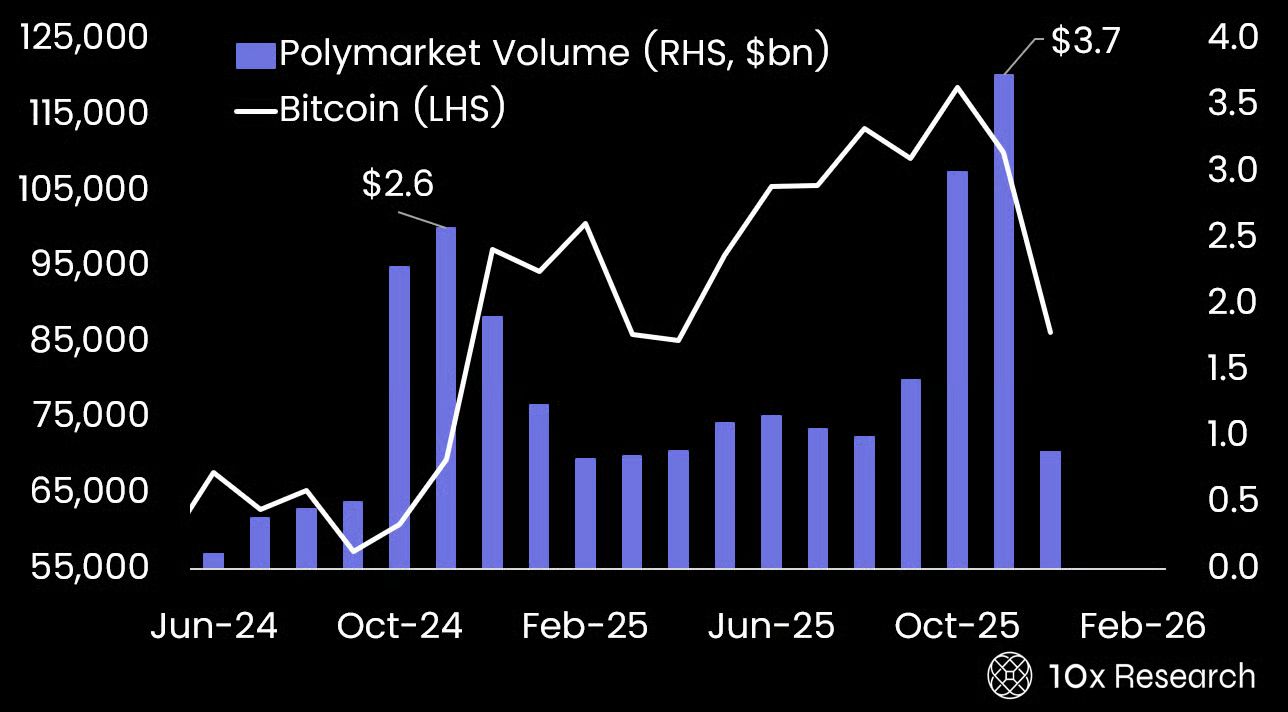
Polymarket volume, right-hand-side price, Bitcoin left-hand-side price. Source: 10x Research

Related: BTC poised for December recovery on ‘macro tailwinds,' Fed rate cut: Coinbase

For quantitative traders, prediction markets can offer asymmetric payoffs that compare favorably with the upside on underlying spot tokens, the report suggested.

For instance, traders on decentralized prediction market Polymarket are betting on whether the BNB (BNB) token will hit $1,500 by Dec. 31, 2025. “Yes” shares on that market recently traded around $0.01, implying a potential 100x payout if the event happens. By comparison, a spot BNB holder would see roughly a 1.65x gain if the token climbed to the same level from current prices.

Related: BitMine buys $199M in Ether as smart money traders bet on ETH decline

High win-rate accounts, AI bots raise Insider trading concerns

However, some prediction market accounts are showing concerning signs of insider trading, particularly a newly emerged account that made over $1 million in a single day by betting on Google search trends.

Polymarket user ‘AlphaRaccoon’ generated $1 million by successfully winning 22 out of 23 placed bets, according to crypto investors Haeju.

“This isn’t a lucky streak. He previously made $150K+ predicting the early release of Gemini 3.0 before results were out,” he wrote in a Thursday X post.
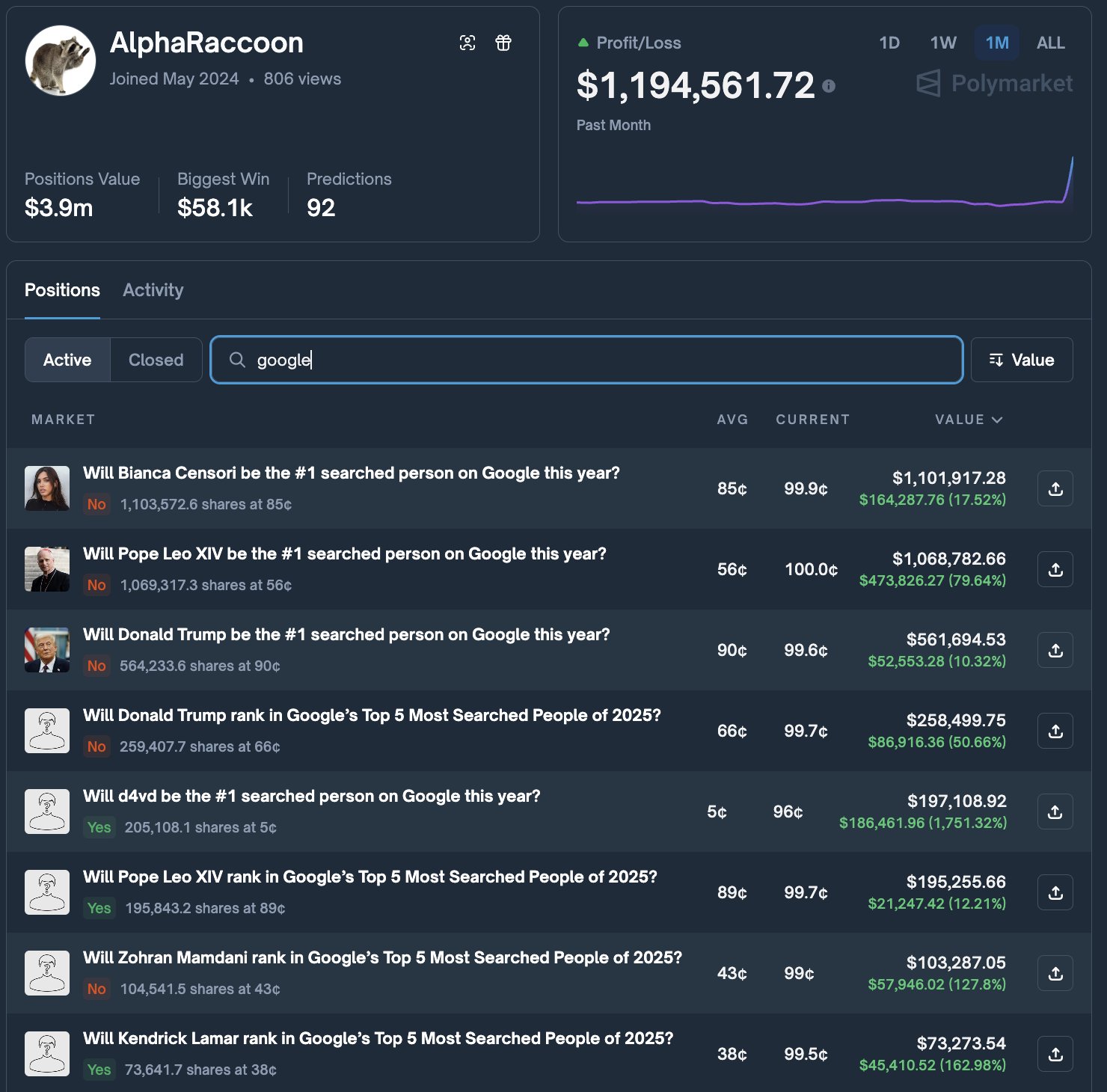
Source: haeju.eth

Others are employing artificial intelligence bots to increase their chances of winning.

Polymarkt user “ilovecircle” earned over $2.2 million during the past two months, boasting a 74% win rate through bets encompassing politics, sports and cryptocurrency.

The user’s volume and winning consistency “almost guarantees” that it is employing a machine learning (ML) model for “cross-niche arbitrage and auto trading,” wrote prediction market trader Archive, in a Sunday X post.

Magazine: Train AI agents to make better predictions... for token rewards
Leituras Relacionadas

Will the Fed Still Cut Interest Rates? Tonight's Data Is Crucial

The core debate surrounding the Federal Reserve's potential interest rate cuts is intensifying amid geopolitical conflict and rebounding inflation. The key question is whether high energy prices will cause persistent inflation or weaken consumer demand enough to force the Fed to cut rates. Citigroup presents a bullish case for cuts, arguing that oil supply disruptions from the Strait of Hormuz are temporary and will not lead to lasting inflationary pressure. They point to receding bond yields and oil prices as evidence the market is pricing in a short-lived shock. Citi's data also shows tightening financial conditions, a stabilizing labor market, and healthy tax returns, supporting their view that the path to lower rates remains open. Conversely, Deutsche Bank offers a starkly contrasting, more hawkish outlook. They argue the Fed's current policy is already neutral and expect rates to remain unchanged indefinitely. Their view is based on stalled disinflation progress and a shift toward more hawkish rhetoric from key Fed officials like Waller, who cited risks from prolonged Middle East conflict and tariffs. Other officials, including Williams and Hammack, signaled rates would likely stay on hold for a "considerable time." The market pricing has shifted dramatically, now forecasting zero cuts in 2026. The imminent release of the March retail sales "control group" data is highlighted as a critical test. This metric, which excludes gas station sales, will reveal if high gasoline prices are eroding consumer spending in other areas. A weak reading could support the case for imminent rate cuts, while a strong one would bolster the argument for the Fed to hold steady. This data is pivotal for determining the near-term policy path.

marsbitHá 14m

Will the Fed Still Cut Interest Rates? Tonight's Data Is Crucial

marsbitHá 14m

The Second Half of Macro Influencer Fu Peng's Career

Fu Peng, a prominent Chinese macroeconomist and former chief economist of Northeast Securities, has joined Hong Kong-based digital asset management firm Bitfire Group (formerly New Huo Group) as its chief economist. This move, announced in April 2026, triggered an 11% surge in Bitfire's stock price. Fu, known for his accessible macroeconomic commentary and large social media following, will focus on integrating digital assets into global asset allocation frameworks, particularly combining FICC (fixed income, currencies, and commodities) with cryptocurrencies for institutional clients. His career includes roles at Lehman Brothers and Solomon International, with significant influence gained through public communication. However, in late 2024, Fu faced temporary social media bans after a controversial private speech at HSBC on China's economic challenges, though he denied regulatory sanctions. He later left Northeast Securities citing health reasons. Bitfire, a licensed virtual asset manager serving high-net-worth clients, seeks to build trust and attract traditional capital through Fu’s expertise and credibility. The partnership represents a strategic shift for both: Fu enters the crypto sector after a traditional finance peak, while Bitfire aims to leverage his macro framework for institutional adoption. Outcomes remain uncertain regarding capital inflows and compatibility within corporate structure.

marsbitHá 1h

The Second Half of Macro Influencer Fu Peng's Career

marsbitHá 1h

Trading

Spot
Futuros
活动图片