Prediction Markets Cannot Exist Without Insider Trading, But Insider Trading Is Killing Them

marsbitPublicado em 2026-04-27Última atualização em 2026-04-27

Resumo

Prediction markets face a fundamental contradiction: they rely on insider trading to generate accurate prices, yet this same activity erodes public trust and threatens their survival. Recent scandals, such as a U.S. special forces member making $400,000 on Polymarket using classified information about a raid, highlight the severity of the issue. While platforms like Polymarket and Kalshi market themselves as venues where "everyone is an expert" and encourage informed trading, they also enforce policies against illegal insider trading. The core dilemma is that these markets depend on informed insiders for price efficiency but require uninformed retail participants to provide liquidity. If insider trading is too rampant, retail traders leave, perceiving the market as unfair. If restrictions are too strict, valuable information flow dries up, reducing the market’s predictive utility. The challenge is finding a balance that maintains both accuracy and perceived fairness—a task complicated by regulatory pressures and recurring scandals.

Author: Nic Carter

Compiled by: Deep Tide TechFlow

Deep Tide Introduction: A U.S. Special Forces soldier made $400,000 on Polymarket using classified information, and this is just the latest scandal. Nic Carter points out that prediction markets are stuck in a vicious cycle: they rely on insider trading to generate accurate prices, but this makes retail investors feel the market is manipulated and leave. This contradiction determines whether prediction markets can survive in the long term.

As I wrote in February of this year, prediction markets have a serious insider trading problem, and this is no accident. This leads to a major failure mode:

The social value of prediction markets comes from using monetary incentives to get insiders to leak confidential information, but this destroys retail investor confidence in the market over time.

Two days ago, the biggest scandal to date broke. The U.S. Department of Justice charged Special Forces Sergeant Major Gannon Ken Van Dyke with improper trading using classified information. Before the Maduro raid mission, he made $400,000 on Polymarket. He was not an ordinary soldier but a senior Green Beret member responsible for special operations planning and execution.

To be clear, although many people are calling for leniency for him because (legal) insider trading is widespread among members of Congress, he should still go to jail. His actions potentially leaked raid information to Venezuelans through trading activities, which is morally and legally problematic. Although the Venezuelans don't seem to have noticed, the government cannot set a precedent where elite operatives leak details of upcoming operations through market activities for personal gain. I sympathize with Van Dyke, but he did break the law and the confidentiality he swore to uphold.

This is just the latest in a series of real or suspected insider trading scandals on prediction markets. Previously, Israel arrested two reservists for using military intelligence to trade on Polymarket. Markets concerning the start time of the Iran war, ceasefire agreements, the killing of Khamenei, and Biden's pardon order have also been under suspicion, but no arrests have been made yet. Kalshi and Polymarket have also flagged and suspended accounts trading in markets where they had a vested interest, such as three congressional candidates betting on their own election markets.

You might think that as more people realize that trading with confidential information is illegal not only in securities markets but also in prediction markets, these problems would disappear. But I think the issue is deeper.

The premise of prediction markets is that they are informationally efficient because they reward informed insiders.

In other words, prediction markets are "good" because they aggregate a large number of uninformed retail investors, who create economic incentives for insiders to reveal private information. (This concept—that retail investors create incentives for informed insiders to participate—is well-documented in financial literature, and a recent paper further extends it to prediction markets.) Prediction markets can then reliably promote themselves as having social utility because they indeed provide better, more timely signals than other platforms (experts, polls, etc.). Kalshi and Polymarket both know this but are reluctant to explicitly admit it. But they do hint at it in their marketing!

Kalshi's CEO Tarek Mansour explicitly stated on the Sourcery podcast that "There is no such thing as insider trading in commodity markets. It's all insider trading actually," which is... an extremely creative interpretation of the law. He added:

I think there is a subset of non-public information that (traders) cannot trade on, but I think we are restricting it a bit too much right now.

Kalshi has used slogans like "Trade Anything" and "Everyone is an Expert at Something," both of which imply that ordinary people can monetize any privileged information they happen to have on the platform.

Polymarket's CEO Shayne Coplan had this exchange with CBS last year:

Anderson Cooper: But prediction markets do rely on some people having inside information.

Shayne Coplan: Mhmm. Yes. I think it's a good thing that people have an edge in the market. Obviously, you need to manage them, need to be very clear and strict about drawing the lines, like on the ethics side, we spend a lot of time on that. But it's somewhat inevitable, and there's a lot of good that comes from it. You know, people will adapt.

Shayne has also said that prediction markets are "the most accurate thing that we have as humans right now, until someone creates some sort of super crystal ball." Some of that accuracy comes from insiders.

Robinhood's CEO Vlad Tenev (partnering with Kalshi) said:

Prediction markets actually allow you to get news faster, in some cases even before it happens. I think it does have tremendous economic value.

Economist Robin Hanson, considered by many to be the godfather of prediction markets, directly accepts this view and has written extensive defenses of insider trading in prediction markets. In 2024 he said:

If the purpose of the (prediction) market is to get accurate information in the price, then you definitely want to allow insiders to trade, even if that makes other people less willing to bet because they think it's unfair, because it makes the price more accurate. That's the priority.

I must point out that both Kalshi and Polymarket have anti-insider trading policies. Kalshi is regulated by the CFTC and has been explicit about prohibiting trading based on Material Non-Public Information (MNPI) and conducts market surveillance. When I wrote my last blog in February, I noted that Polymarket did not explicitly sanction insider trading, but in March they updated their rulebook, adding detailed prohibitions against trading of the following types:

  • Trading based on stolen confidential information (if you are a soldier, the battle plan does not belong to you, it belongs to the government)
  • Trading based on information illegally passed to you by an insider
  • Trading on any contract where you can influence the outcome

The point of this section is not to blame Kalshi or Polymarket or their leadership for implying that traders have an informational advantage. I think their policies (updated in March 2026) are clear enough. Instead, I want to point out the fundamental contradiction plaguing these markets:

Prediction markets rely on informed traders to generate accurate prices, but they also rely on uninformed traders to create the economic incentive to attract informed order flow. This creates a tension:

  • If they are too permissive towards insider trading, uninformed traders may exit due to a perceived lack of fairness
  • If they are too restrictive towards insider trading, the markets may exclude their most valuable source of information

Thus, there is a trade-off between informational efficiency and perceived fairness. Here is a visual version of the same idea:
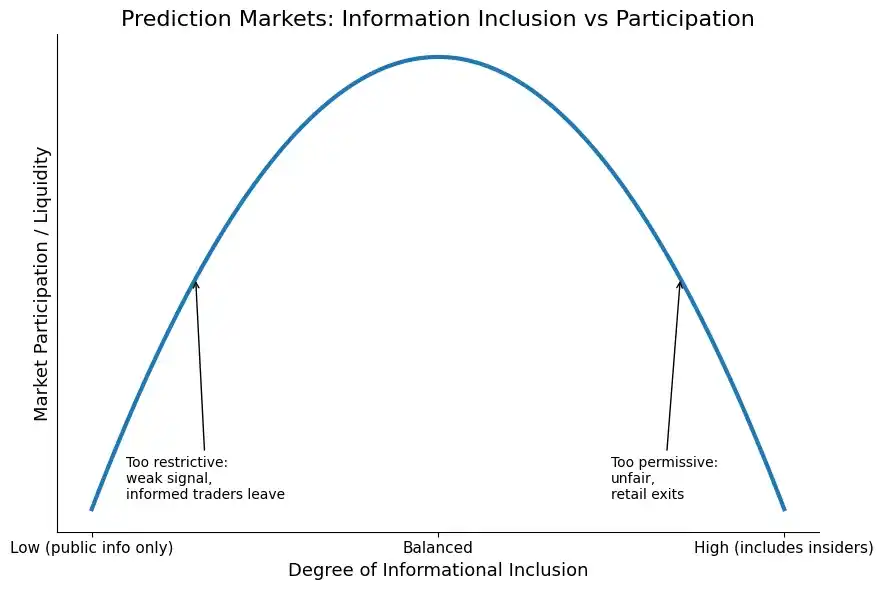
Chart: The Trade-off Curve Between Informational Efficiency and Perceived Fairness

So we end up with a few different failure modes:

Too Many Sharks, They Eat All the Fish

Insider trading standards are too loose, the market becomes very informationally efficient, but retail investors clearly feel the market is "rigged," that they are always betting against insiders. Therefore, retail leaves, and market liquidity decreases. This is the failure mode I talked about before. This is where we are now, but I think we will rebound in the other direction.

No Sharks, No Edge

This is the other end of the spectrum. Insider trading is strictly policed on the platform, with real-time market surveillance and strong regulatory reporting, so informed order flow stays away. The markets thus produce less socially valuable information, becoming mere sentiment aggregators rather than generating "news before the news." Therefore, the platform cannot market itself effectively.

The existential question is whether there is a golden mean: where liquidity is maximized, retail feels the market is "fair enough," and informed order flow is still compensated for its information gathering. The chart suggests it might exist, but reality is messier.

My prediction from February still holds. As I said then:

A serious risk remains that insider trading scandals will make retail traders feel the market is manipulated, causing them to abandon the platform. I predict a string of insider trading events this year that will convince platforms to significantly strengthen market surveillance and lead Polymarket in particular to move away from anonymous modes.

I expect Polymarket will remove the ability to trade without KYC entirely (this is currently the case for the non-US platform) and strengthen the flagging of suspicious trading on the platform. There will be a slew of criminal cases regarding stolen insider information, but the temptation will remain. While platforms won't admit it, there is a "socially optimal" amount of insider trading. But can they calibrate it optimally? Will regulators allow them to?

It's worth noting that not all informed traders are insiders. You can become informed by collecting public information and trading on it. But a subset of informed traders are indeed insiders misappropriating information.


Perguntas relacionadas

QWhat is the core contradiction that prediction markets face according to the article?

APrediction markets rely on informed traders (insiders) to generate accurate prices, but they also depend on uninformed traders to create the economic incentive that attracts that informed flow. This creates a tension: if insider trading is too tolerated, uninformed traders may leave feeling the market is unfair; if it is too restricted, the market loses its most valuable source of information.

QWhat are the two main failure modes for prediction markets described in the text?

AThe two failure modes are: 1. Too many sharks (insiders), which scares away the fish (retail traders) because the market feels manipulated. 2. No sharks, no edge, where strict regulation of insider trading drives away informed traders, reducing the market's social value and making it merely an aggregator of sentiment.

QHow did the recent case involving Gannon Ken Van Dyke illustrate the problem with prediction markets?

AThe case illustrated the problem as Van Dyke, a senior Green Beret, used classified information about an impending raid on Maduro to trade on Polymarket, making $400,000. This is a clear example of how the markets incentivize the leakage of confidential information, which can damage operational security and public trust.

QWhat is the proposed 'social value' of prediction markets, and what is the mechanism that enables it?

AThe proposed social value is that prediction markets provide a better, more accurate, and timely signal than other platforms like experts or polls. The mechanism that enables this is the aggregation of uninformed retail traders, which creates a financial incentive for informed insiders to reveal their private information, thus making the market informationally efficient.

QWhat specific policy change did Polymarket make in March 2026 in response to insider trading concerns?

AIn March 2026, Polymarket updated its rulebook to include a detailed ban on trading based on: 1. stolen confidential information, 2. information illegally passed to you from an insider, and 3. any contract where you can influence the outcome.

Leituras Relacionadas

SpaceX, OpenAI, Anthropic: The Three AI Giants Racing for IPO, Which One Is Worth Betting On?

SpaceX, OpenAI, and Anthropic are poised for historic IPOs within weeks, potentially raising a combined $180 billion—a sum exceeding the entire internet bubble's fundraising. The hosts of the Limitless Podcast argue this isn't just individual company financing but an unprecedented capital concentration for AI infrastructure, driven by an insatiable need for compute, data centers, power, and chips. SpaceX's IPO is notable for reportedly changing market index rules to allow faster inclusion, potentially funneling trillions in passive retirement funds into its stock, despite its unproven space-based data center business model. In contrast, Anthropic demonstrates explosive growth, with ARR reportedly hitting $45 billion and approaching profitability, fueled by strong enterprise adoption of products like Claude Code. Google's separate $80 billion raise highlights the immense capital pressure, even for giants. The discussion acknowledges bubble risks but leans optimistic. The hosts contend the massive spending is building essential physical infrastructure for the next technological era. A key bottleneck isn't capital but the real-world limits of chip manufacturing and construction speed. As long as demand for AI compute outstrips supply, this investment cycle represents a foundational build-out rather than a purely financial bubble. All three companies are seen as foundational bets on the future, with Anthropic often cited as the most immediately compelling due to its proven revenue trajectory.

marsbitHá 17m

SpaceX, OpenAI, Anthropic: The Three AI Giants Racing for IPO, Which One Is Worth Betting On?

marsbitHá 17m

From 'Old Guys' to 'New Favorites': How AI Is Revaluing Old Infrastructure from Dell to Nokia?

From "Vintage Tech" to "New AI Darlings": How AI Revalues Old Infrastructure One year ago, tech giants like Dell, Nokia, Cisco, and Western Data were seen as slow-growth, low-valuation stories, far from the AI spotlight dominated by players like Nvidia. Now, these legacy tech stocks are gaining market attention, sparking debate on whether this is genuine industry revaluation or a temporary narrative. As AI moves from model parameters to real-world data centers, the market is recognizing companies with proven delivery and infrastructure capabilities. This shift marks a change in the AI investment thesis: from pure model and GPU focus to the complex systems engineering required for deployment. Companies like Dell, HPE, and Corning are being revalued not for being "sexy" AI innovators, but for their decades of accumulated expertise in supply chains, enterprise delivery, and infrastructure—assets that have become critical in the AI buildout phase. The revaluation is unfolding across three key infrastructure lines: 1. **Servers & System Integration:** Dell and HPE are emerging as crucial system integrators or "general contractors" for AI data centers, translating GPU orders into complete, deployable server racks integrated with power, cooling, and networking. 2. **Networking & Connectivity:** AI's scale demands robust high-speed connections. Corning (fiber optics), Nokia (AI-RAN, 6G), and Cisco (data center switches) are gaining importance for enabling efficient data transfer within and between AI clusters. 3. **Storage:** Beyond high-speed memory (HBM/DRAM), the AI data explosion is driving demand for high-capacity hard drives (HDDs) from companies like Western Digital and Seagate to handle training data, logs, and cold storage cost-effectively. For this revaluation to be substantive and not just a narrative, three criteria are key: 1) Concrete AI-related order and revenue growth (e.g., Dell's AI server sales), 2) Upward revisions to company financial guidance, and 3) Sustainable improvements in profit quality, not just top-line revenue spikes. In essence, AI's transition to a real construction phase is re-pricing "old assets" against "new demand." The opportunity, however, is selective. Only those legacy firms that are demonstrably integrated into the capital expenditure chains of data center and enterprise AI deployment are likely to experience a true "logic re-rating" rather than just a temporary valuation bounce.

marsbitHá 23m

From 'Old Guys' to 'New Favorites': How AI Is Revaluing Old Infrastructure from Dell to Nokia?

marsbitHá 23m

The Merger of Codex and ChatGPT Marks the Beginning of a Major Reshuffle in Programming Tools

OpenAI is shifting its strategic focus from ChatGPT to Codex, merging them along with the browser tool Atlas into a unified desktop super-app. This move signals an internal belief that Codex, originally a programming tool, represents the next evolution of AI more than conversational models like ChatGPT. Over the past year, Codex's weekly active users have surged past 5 million. The key distinction is that while ChatGPT answers questions, Codex executes tasks. Enterprises increasingly value this ability to get work done over simply receiving advice. Consequently, Codex is attracting professionals beyond developers, including analysts, bankers, marketers, and product managers. OpenAI's reorganization and increased investment in Codex stem from recognizing that the future of AI competition lies in execution capabilities, not just conversation. The company is launching role-specific plugins (e.g., for data analysis, sales, design) to transform Codex into a broad knowledge work platform that automates and redefines white-collar workflows. Beyond being a tool, Codex reflects OpenAI's ambition to redefine software. New features like "Sites"—which generates interactive websites from documents—and collaborative "Annotations" aim to create a paradigm where the AI understands the goal and handles the tools and steps, functioning more like a digital colleague than traditional software. The ultimate goal is a unified experience where the user cares only about the completed task.

marsbitHá 32m

The Merger of Codex and ChatGPT Marks the Beginning of a Major Reshuffle in Programming Tools

marsbitHá 32m

Interpreting Investment Opportunities in the Age of Great Navigation, Invesco Great Wall Fund Releases '2026 Report on Chinese Enterprises Going Global'

Invesco Great Wall Fund has released its "2026 China Corporate Globalization Report," titled "The 'Great Navigation Era' of Chinese Enterprises." The report analyzes the new trends and investment opportunities as Chinese companies expand globally, moving from simple product exports to comprehensive overseas operations involving services, branding, and local production. Driven by factors like trade friction, the pursuit of higher profit margins abroad, and policy support, globalization is becoming essential for Chinese companies. The report outlines an evolution: from early product export ("Globalization 1.0") to the current "Globalization 2.0," characterized by overseas capacity, capital goods investment, consumer brand expansion, and service exports. Chinese firms' competitive advantages are highlighted, including a vast engineer talent pool, low-cost and robust infrastructure, and complete industrial clusters. Specific sectors with significant出海 potential are identified: * **Capital Goods** (e.g., engineering machinery, power equipment): Benefiting from global demand, especially in Belt & Road markets and the AI-driven power grid upgrade cycle. * **Consumer Brands**: Transitioning from cost to brand advantage, leveraging供应链 efficiency. * **Technology & Innovation**: Including AI applications, optical modules within global tech supply chains, and new energy vehicles focusing on local production. * **Pharmaceuticals**: Chinese biotech firms are becoming preferred partners for global pharma, with potential for breakthrough drugs in areas like oncology and weight loss. The report concludes that corporate globalization represents a sustained, core theme for China's capital markets, though companies must navigate challenges like geopolitics and localization.

marsbitHá 45m

Interpreting Investment Opportunities in the Age of Great Navigation, Invesco Great Wall Fund Releases '2026 Report on Chinese Enterprises Going Global'

marsbitHá 45m

Trading

Spot
Futuros
活动图片




