Predicting the 'Side Hustles' of Market Giants: From Online Betting to Offline Store Openings

比推Publicado em 2026-02-04Última atualização em 2026-02-04

Resumo

The competition between leading prediction market platforms Kalshi and Polymarket has expanded from online to offline. On February 4, Kalshi distributed free groceries (up to $50 per person) at a market in New York City, promoting its event-based trading platform with the slogan “We believe in free markets.” The campaign targeted economic concerns like inflation and aimed to attract users by lowering entry barriers. On the same day, Polymarket announced plans to open a permanent free grocery store in New York, supported by a $1 million donation to address food security. The store, set to open on February 12, aligns with Polymarket’s mission to make prediction markets accessible and socially impactful. This offline move reflects intensifying competition. Kalshi, compliant in the U.S., has partnered with platforms like Coinbase and reported annualized trading volume exceeding $100 billion. Polymarket faces regulatory challenges, including bans in Ukraine and Portugal, and restrictions in Nevada. It also competes with new entrants like Opinion, which raised millions and gained rapid traction. Other players, including Crypto.com, Kraken, Robinhood, and Hyperliquid, are also entering the prediction market space, driven by growing user interest in event-based trading. As global events like elections and sports continue to attract attention, prediction markets are poised for further growth, keeping platforms like Kalshi and Polymarket in a fierce battle for users.

Author: Ma He, Foresight News

Original Title: Behind the 'Side Hustles' of Prediction Market Giants: Opening Offline Grocery Stores Out of Anxiety?


Who would have thought that the competition between the two online prediction market giants, Kalshi and Polymarket, has already extended from purely online to offline.

At 12:00 PM on February 4th, Kalshi gave away free groceries to residents at the West Side Market on 84 Third Avenue in New York City, with a limit of up to $50 per person.

Kalshi CEO Tarek Mansour stated, "We believe in free markets," making it clear that this move aims to promote the concept of prediction markets through tangible benefits to the public.
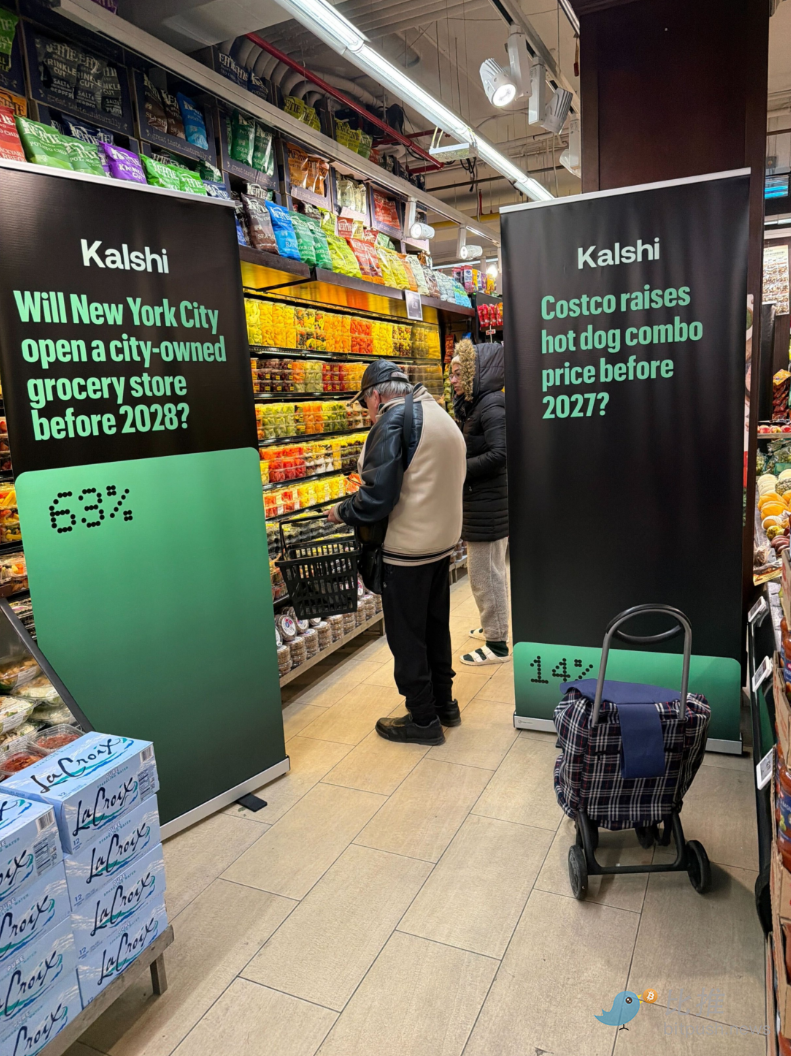
The highlight of the event lies in its clever marketing strategy. First, it directly ties into current economic hot topics—inflation and rising living costs have become pain points for the American public. By offering free groceries, Kalshi not only provides immediate value but also positions itself as an "event contract exchange," allowing users to trade on events such as politics, economics, and sports.

For example, users can predict fluctuations in grocery prices or changes in economic indicators on the platform, thereby transforming the offline experience into online participation. Second, the event’s location in a high-density, high-consumption city like New York maximizes exposure. Official videos show crowds rushing in at the opening moment, likened to "Christmas revisited."

The event had a low barrier to entry: no app download was required to participate; one only needed to shop in-store, and Kalshi would cover the bill. This not only lowered the entry barrier for users but also reinforced the platform’s approachable image.

Unlike Kalshi’s short-term promotion, Polymarket’s offline activity is more long-term and ambitious.

On February 4th, Polymarket announced it would open a "free grocery store" in New York, located at 7 Madison Avenue, scheduled to officially open on February 12th. The store is supported by the Food Bank for New York City, with the project breaking ground in late 2025 and a lease agreement already signed. Additionally, Polymarket donated $1 million to address security concerns.

Polymarket’s announcement coincidentally came on the same day as Kalshi’s event, even with overlapping opening times, which is seen as a direct response.
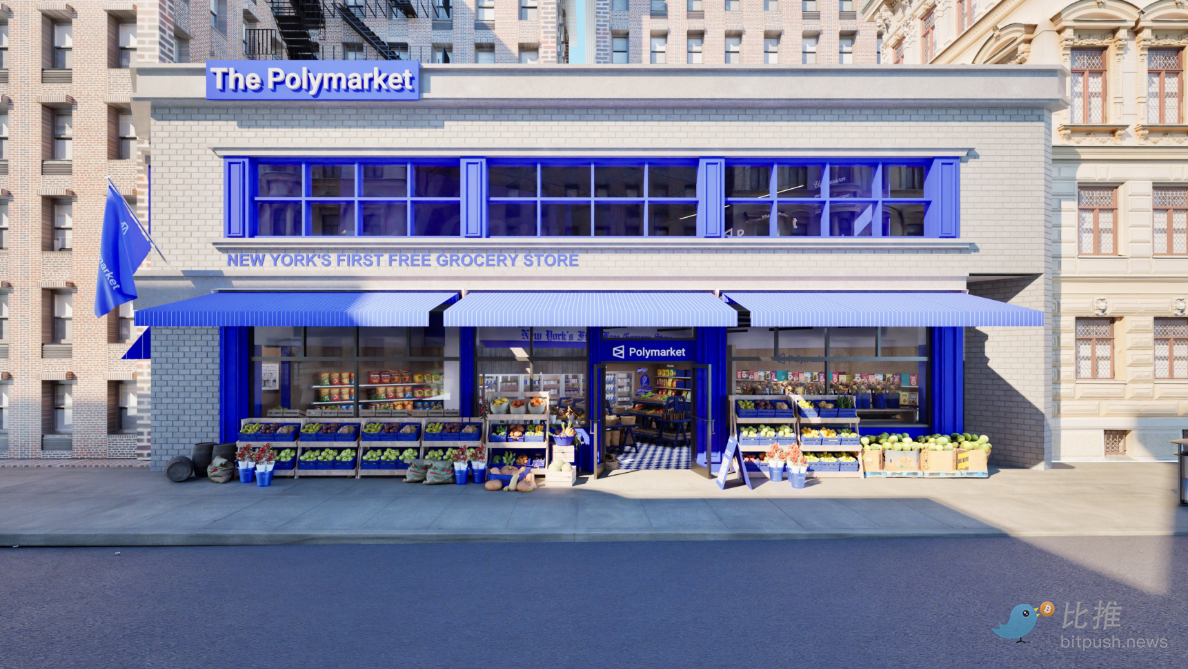
The highlight of Polymarket’s activity lies in its innovation and emphasis on social responsibility. First, this is not a one-time promotion but a permanent store where users can obtain groceries for free, addressing food security issues in New York. Second, this aligns closely with the platform’s core philosophy of revealing truth and allocating resources through prediction markets.

Polymarket founder Shayne Coplan stated that this move is an expansion of the platform from online to offline, aiming to "make prediction markets accessible."
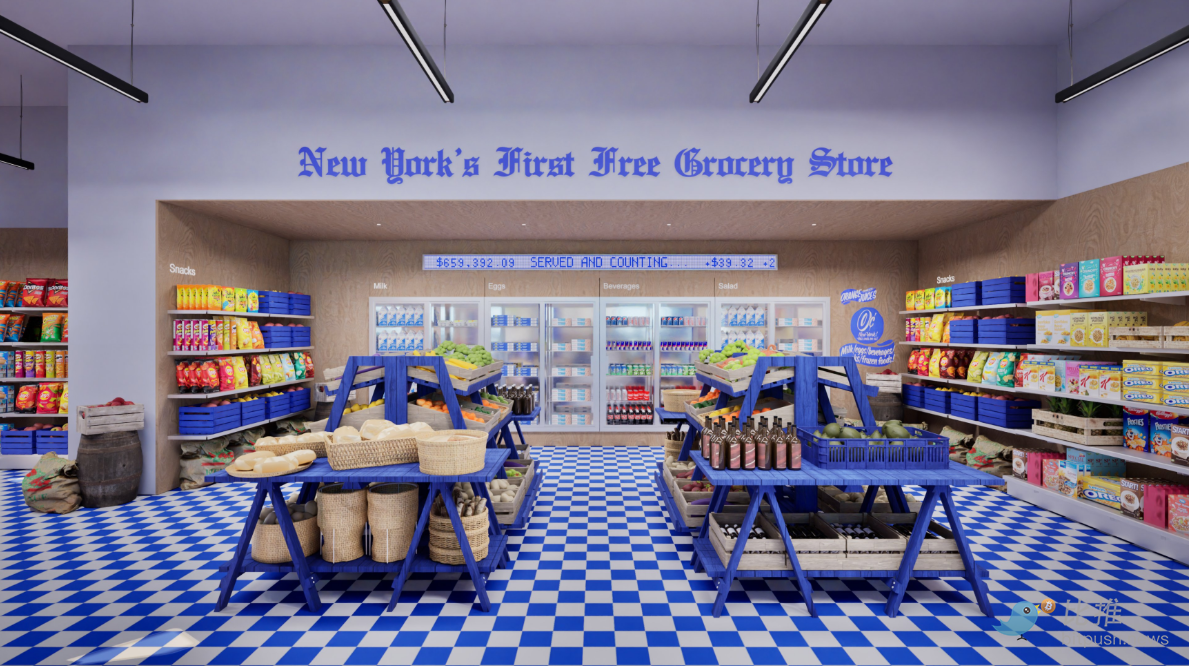
Polymarket incorporates its signature blue logo into the store, with a simple and stylish interior design. Compared to Kalshi’s $50 cap, Polymarket’s free model is more attractive and is expected to reach more low-income groups.

Intensified Rivalry Between the Two Platforms

The offline activities of Kalshi and Polymarket are a microcosm of the fierce competition in the prediction market.

Kalshi uses U.S. compliance as its moat, rapidly expanding its territory. It has not only integrated with various Web3 wallets like Phantom but also partnered with Coinbase to extend its services to all 50 U.S. states. Coinbase users can trade prediction market contracts with as little as $1. In January of this year, Kalshi officially announced that its annualized trading volume exceeded $100 billion.

Polymarket has not only strengthened collaborations with crypto-native players like Jupiter and Phantom but has also expanded its traffic channels by sponsoring events such as the Hollywood Golden Globe Awards.

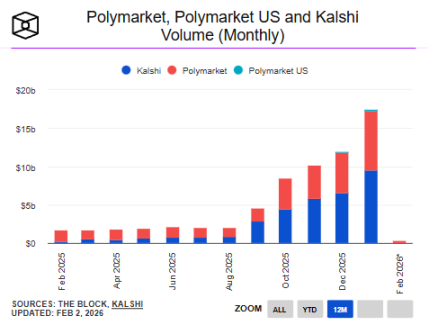
However, the latest data shows that its market share is still being eroded by Kalshi.
To make matters worse, Polymarket faces troubling regulatory issues.

In January of this year, Ukraine banned Polymarket, as the country’s current legal framework does not recognize prediction markets. Portuguese regulators have also ordered Polymarket to cease operations in the country.

In February, a Nevada court issued a temporary restraining order, prohibiting Polymarket from offering event contract services to Nevada residents before a preliminary hearing on February 11th.

Additionally, many regions in Asia view Polymarket as a gambling platform and have blocked its IP address.

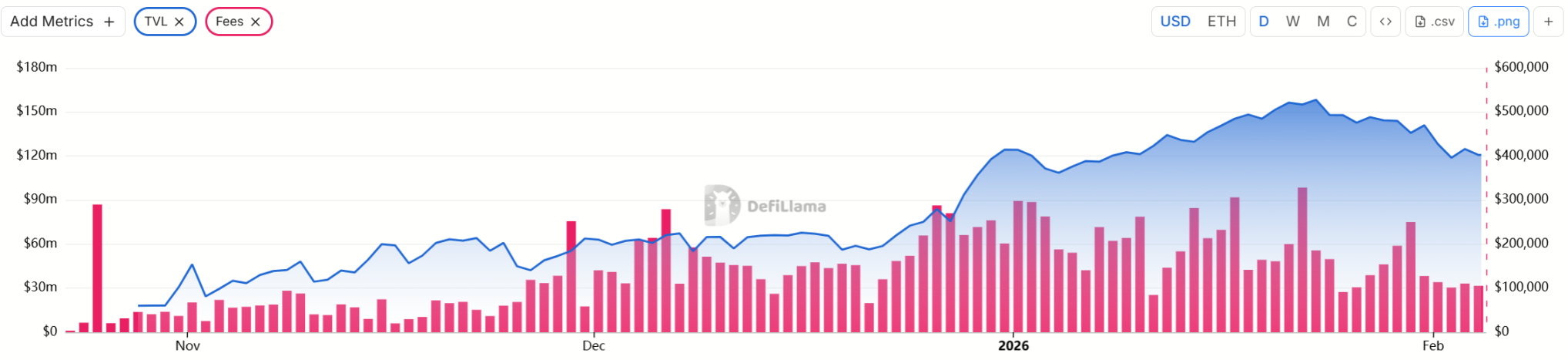
Another competitor backed by Binance is also eyeing the market. Opinion completed a tens of millions of dollars funding round in December 2025. Driven by airdrop expectations, the platform’s trading volume exceeded $5 billion in just one month, with daily fee revenue consistently surpassing $100,000.
Meanwhile, various exchanges, DEXs, and traditional financial institutions are also entering the prediction market.

Bloomberg reported that Crypto.com announced on Tuesday that it would launch a dedicated prediction market platform, OG, just days before the Super Bowl. Its co-founder and CEO, Kris Marszalek, stated that its event contract business has grown 40 times week-over-week in the past six months, making the launch of an independent product necessary. Another crypto trading platform, Kraken, plans to launch prediction market services in 2026, as revealed by its Global Consumer Business Head, Mark Greenberg, on the Crypto World show.

Robinhood had already launched a prediction market before Trump’s election and plans to introduce more new event contracts. In October 2025, Robinhood CEO Vlad Tenev stated in an interview with Bloomberg that its prediction market segment is one of the fastest-growing sectors and one of its nine business lines with annual revenue exceeding $100 million.

Derivatives DEX leader Hyperliquid is also testing a native prediction market on its testnet. Hyperliquid announced that HyperCore will support Outcome Trading (HIP-4). Outcome Trading involves fully collateralized contracts settled within a fixed range. This is a universal foundational trading element applicable to scenarios such as prediction markets and bounded option-like instruments.

It features non-linear, time-bound contracts, offering a form of derivatives trading without leverage or liquidation, and can be combined with portfolio margin and HyperEVM. Currently, this feature is still under development and is only being tested on the testnet. Once technical development is complete, Hyperliquid will deploy standardized markets denominated in USDH.

The store openings by Kalshi and Polymarket are not just marketing but also battles to capture user attention.

Wars, political events, elections, and sports competitions are gathering global users online, enabling 24/7 non-stop global betting. Rule disputes, wealth stories, and insider trading are all unfolding simultaneously, with only money and brains never sleeping. Perhaps future hot events like the World Cup and U.S. elections will continue to drive prediction market trading volumes and recognition to new heights.

Before the final outcome is determined, no participant dares to let their guard down.


Twitter:https://twitter.com/BitpushNewsCN

Bitpush TG Discussion Group:https://t.me/BitPushCommunity

Bitpush TG Subscription: https://t.me/bitpush

Original link:https://www.bitpush.news/articles/7608693

Perguntas relacionadas

QWhat was the main purpose of Kalshi's free grocery giveaway event in New York?

AKalshi's free grocery event aimed to promote the concept of prediction markets by providing immediate value to the public, linking economic concerns like inflation to their platform where users can trade on events such as politics, economics, and sports.

QHow does Polymarket's approach to a physical store differ from Kalshi's event?

APolymarket's store is a permanent establishment in partnership with Food Bank for New York City, focusing on long-term social responsibility and addressing food insecurity, while Kalshi's was a temporary promotional event with a spending limit per person.

QWhat regulatory challenges is Polymarket currently facing?

APolymarket faces bans in Ukraine and Portugal, a temporary restriction order in Nevada, and is blocked in several Asia-Pacific regions where it is viewed as a gambling platform.

QWhich companies are emerging as new competitors in the prediction market space?

ANew competitors include Opinion, which received funding and rapid growth, Crypto.com's OG platform, Kraken's planned service, Robinhood's expanding prediction market, and Hyperliquid's testing of native prediction market features.

QWhat is the significance of the competition between Kalshi and Polymarket expanding to physical locations?

AThe expansion into physical locations represents a strategic move to capture user attention and market share beyond online platforms, using real-world engagement to drive awareness and participation in prediction markets amid growing competition.

Leituras Relacionadas

Stuck Polymarket: The Real Test After Riding the Traffic Boom Has Arrived

Polymarket, a leading prediction market platform, is facing significant technical challenges as its growth outpaces its current infrastructure on Polygon. Users are experiencing laggy transactions, unresponsive orders, and delayed confirmations, severely impacting the trading experience. In response, DeFi Engineering VP Josh Stevens outlined a comprehensive engineering overhaul. The plan includes reducing on-chain data delays, fixing order cancellation issues, rebuilding the central limit order book (CLOB), improving website performance, and developing a unified SDK and API. A major revelation was the ongoing "chain migration," indicating a potential move away from Polygon. The core issue is that Polymarket has evolved from a simple prediction market into a high-frequency trading platform, making Polygon's limitations—such as block space, gas fees, and block time—a ceiling for further growth. The migration is not just a simple chain switch but a fundamental rebuild of its trading system to support more complex products like perpetual contracts (Perps). This announcement has sparked competition among chains like Solana, Sui, and Algorand, all vying to host Polymarket. For Polygon, losing this key application, which contributes significantly to its gas fee revenue, would be a major setback. The real test for Polymarket is no longer attracting users but proving it can provide a stable, reliable trading environment that retains them.

Odaily星球日报Há 3m

Stuck Polymarket: The Real Test After Riding the Traffic Boom Has Arrived

Odaily星球日报Há 3m

Lowering Expectations for BTC's Next Bull Market

The author, Alex Xu, explains his decision to significantly reduce his Bitcoin holdings (from full to ~30% of his portfolio) during the current bull cycle, citing a lowered long-term outlook for BTC's price appreciation in the next cycle. He outlines six key reasons for this reduced expectation: 1. **Diminished Growth Drivers:** The narrative of exponential user adoption has largely played out with institutional ETF adoption. The next major growth phase—adoption by sovereign national reserves or central banks—seems unlikely in the near future. 2. **Personal Opportunity Cost:** More attractive investment opportunities have emerged in other assets, such as undervalued companies. 3. **Industry-Wide Contraction:** The broader crypto industry is struggling, with most Web3 business models (SocialFi, GameFi, DePIN) failing. This overall萧条 (depression) reduces the fundamental demand and consensus for Bitcoin. 4. **Strain on Major Buyer:** MicroStrategy, a major corporate buyer of BTC, faces rising financing expenses for its debt, which could slow its purchasing rate and create significant marginal pressure on the market. 5. **Increased Competition from Gold:** The emergence of "tokenized gold" has closed the functional gap (portability, divisibility) between physical gold and Bitcoin, offering a strong competitor in the non-sovereign store-of-value space. 6. **Security Budget Concerns:** The block reward halving continues to exacerbate the long-standing issue of funding Bitcoin's network security, with new fee source explorations like Ordinals and L2s largely failing. The author's decision to hold a significant (though reduced) position reflects a cautious, not bearish, outlook. He remains open to increasing his exposure if the fundamental reasons for his skepticism change or if new positive catalysts emerge.

marsbitHá 41m

Lowering Expectations for BTC's Next Bull Market

marsbitHá 41m

Can Iran 'Control' the Strait of Hormuz?

Iran has announced a comprehensive plan to assert control over the strategic Strait of Hormuz, a critical global oil shipping chokepoint. The proposed measures include requiring all vessels to obtain Iranian permission for passage, imposing fees for security, environmental protection, and navigation management—preferably paid in Iranian rials—and absolutely banning Israeli ships. Vessels from countries deemed hostile by Iran’s top security bodies may also be barred. Analysts suggest Iran’s motives are multifaceted: increasing pressure on the U.S. and Israel by leveraging control over oil transit to influence global prices and inflation; creating a new revenue stream, potentially exceeding $7.7 billion annually, to counter Western sanctions and support postwar reconstruction; and using transit permissions as bargaining chips in future negotiations, notably with the U.S. However, the plan faces significant practical and diplomatic challenges. Enforcing comprehensive interception and fee collection in the busy waterway, patrolled by international military forces, would be difficult. The U.S. has already countering with a blockade of Iranian ports and threats to intercept any ship paying fees, potentially strangling Iran’s oil exports and fee revenue. Broad international opposition, led by European and Gulf states, and legal controversies further complicate implementation. The proposal may ultimately serve more as a negotiating tactic than a feasible policy, with its execution remaining highly uncertain.

marsbitHá 1h

Can Iran 'Control' the Strait of Hormuz?

marsbitHá 1h

Trading

Spot
Futuros
活动图片





