Predicting the Dormant Period of Market Heat, Polymarket Prepares a Killer Move to Catch Up with Kalshi

marsbitPublicado em 2026-08-12Última atualização em 2026-08-12

Resumo

Following a period of lower trading activity after the World Cup and during a sports offseason, Polymarket is restructuring in preparation for upcoming major sports events and the US midterm elections in November. Key personnel changes include the appointment of Travis VanderZanden, former Bird founder and Uber/Lyft executive, as Chief Growth Officer to oversee marketing. The company has also hired executives from Robinhood, Coinbase, Nasdaq, and the FBI to strengthen compliance, risk management, and regulatory functions. This push supports Polymarket's renewed focus on the US market after its 2022 exit due to regulatory issues. Its US re-entry accelerated with the 2025 acquisition of licensed exchange QCEX, rebranded as Polymarket US. After launching on iOS in May, a web version recently went live. Trading volume on Polymarket US has surged, growing from $1.77 billion in May to approximately $5 billion in July. This represents 62% of the international platform's volume, up from just 25% two months prior. VanderZanden's immediate task involves addressing past marketing controversies, including CFTC investigations into promotional practices that used simulated trades. The company has since reformed its marketing rules and partner vetting. Despite rapid growth, Polymarket US still trails the US prediction market leader, Kalshi, which saw about $37.7 billion in July volume compared to Polymarket's combined ~$13 billion. Kalshi's valuation also significantly outpaces Polymark...

Author | Asher(@Asher_ 0210)
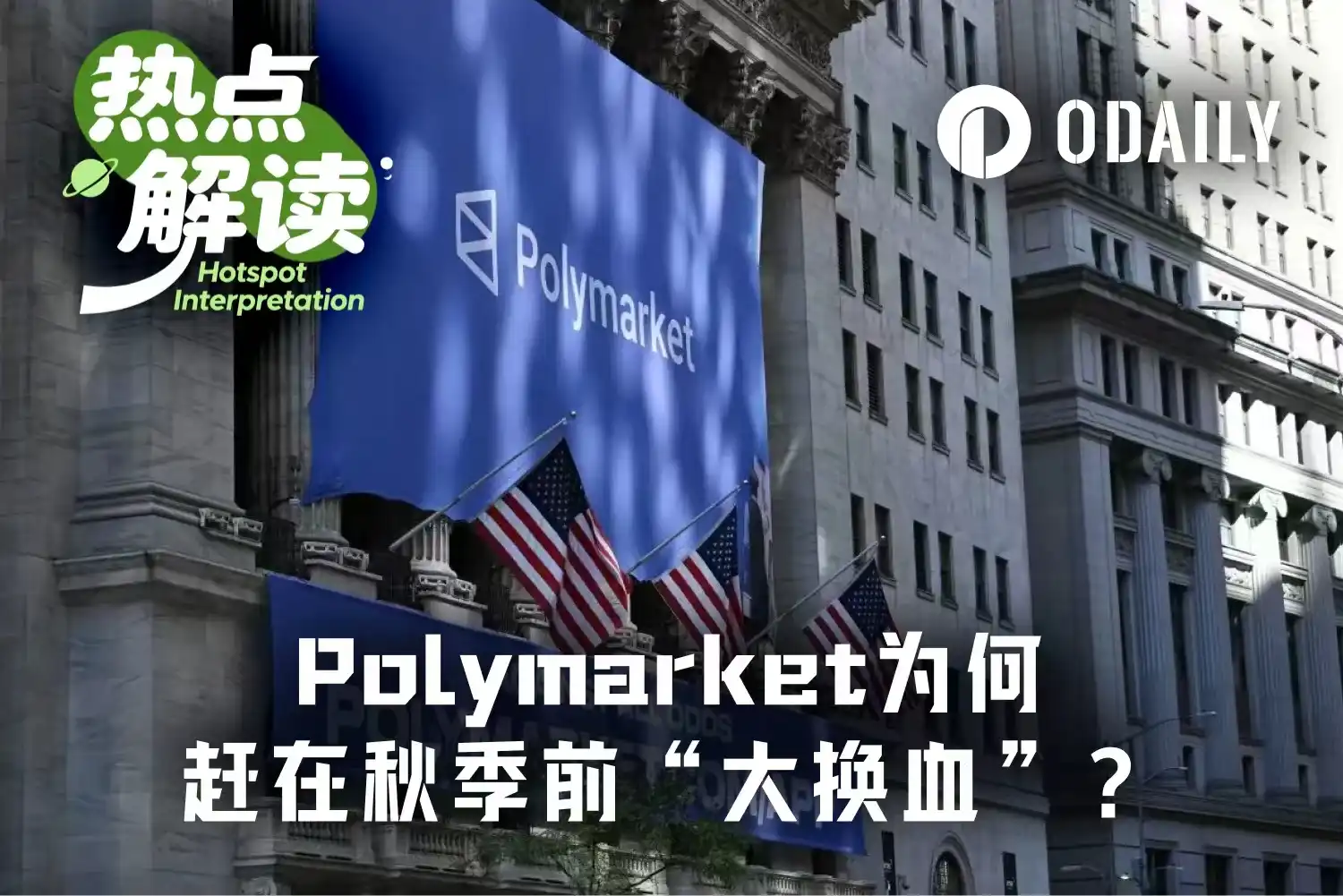
After the World Cup, with most other popular sports events also being in the off-season recently, trading enthusiasm on Polymarket has declined. The platform recently conducted a round of intensive adjustments to management, market direction, and promotion strategies to prepare for upcoming popular sports events and the US midterm elections in November.

In terms of personnel, Travis VanderZanden, founder of shared electric scooter company Bird and former executive at Uber and Lyft, has joined Polymarket as Chief Growth Officer, responsible for the company's marketing system. Additionally, Polymarket has recruited several executives from institutions like Robinhood, Coinbase, Nasdaq, and the FBI, covering compliance, regulation, investigation, and risk management roles.

Furthermore, Polymarket continues to exert efforts in returning to the US market. The series of upcoming sports events and political events are also expected to further boost trading heat for its US business.

One Year After Returning to the US, Polymarket US Enters Growth Phase

From Acquiring a Licensed Exchange to Launching a Web Version, Polymarket US Accelerates Rollout

In 2022, Polymarket reached a settlement with the CFTC for unregistered derivatives trading business and exited the US market.

It wasn't until July 2025 that Polymarket paved the way for its US return by acquiring CFTC-licensed derivatives exchange and clearing agency QCEX for $112 million. Subsequently, QCX LLC operated under the name Polymarket US and, in November of that year, obtained an amended order from the CFTC, further solidifying its foundation for conducting regulated trading in the US.

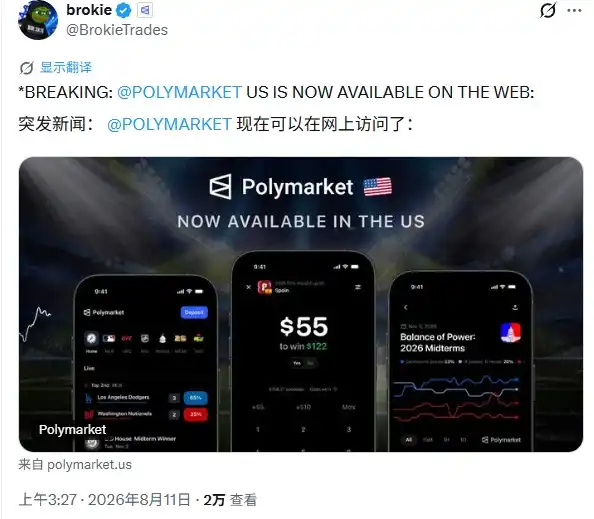
In December of the same year, Polymarket US began opening to users on the waitlist; in May this year, Polymarket US was fully opened to US iOS users. Just yesterday, community members reported that Polymarket US has launched a web version, continuing to expand channels accessible to US users.
Polymarket US Trading Volume Continues to Grow, Gradually Approaching Polymarket International

In May this year, as access for US users gradually opened, Polymarket US trading volume began to show significant growth.

According to Dune data, Polymarket US trading volume in May was $1.769 billion, while Polymarket International's volume was $7.077 billion during the same period, with US volume being about 25% of International's. By June, Polymarket US trading volume rapidly increased to $4.041 billion, more than doubling from May. International volume for the same period was $10.773 billion, bringing the ratio to about 38%.

In July, this gap narrowed further. Polymarket US monthly trading volume reached approximately $5 billion, setting a new high, while International's July volume was only $8.044 billion. US volume was equivalent to 62% of International's, whereas just two months prior this ratio was only 25%.
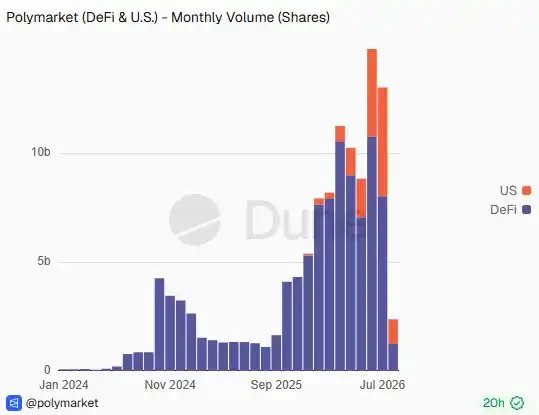
With user access increasing and trading scale continuing to rise, Polymarket now needs not only to further acquire US users but also to face a series of more specific issues like marketing, compliance, and risk management. Therefore, growth, marketing, compliance, and risk control have become the most concentrated areas in this round of team adjustments.

Simultaneously Adding Staff for Growth and Compliance, But First Must Address Previous Marketing Issues

After taking over marketing operations, Travis VanderZanden, founder of Bird and former Uber and Lyft executive, must first deal with the promotional controversies left from earlier actions.

Previously, a Wall Street Journal investigation found that Polymarket had used promotional partners to have content creators display simulated trading. Some videos used website interfaces highly similar to the real Polymarket, leading viewers to believe the creators were conducting real trades and making profits. The related investigation stated that approximately $1.9 million in bets shown across over 1,100 related videos were simulated trades. Subsequently, the CFTC launched an investigation into Polymarket's related marketing practices.

Polymarket then began rectifying its marketing system, including restructuring the marketing department, updating rules for promotion partners, and conducting relevant training for employees. The company also hired consulting firm AlixPartners to review content released by partners, checking for compliance with new promotion guidelines.

Therefore, VanderZanden's task upon joining Polymarket is not merely to continue expanding the user base. He is taking over a marketing system still under adjustment. Polymarket US is currently continuing to expand user access, with trading volume also in a growth phase. With more sports events and political events on the horizon, the platform hopes to further attract US users and increase trading activity. However, previous regulatory investigations also mean that some of the more aggressive promotion methods used in the past can no longer be readily employed.

Autumn is the Real Test, Polymarket Still Needs to Catch Up with Kalshi

In the US prediction market, Kalshi still holds a significant lead over Polymarket US. In July, Kalshi's monthly trading volume was approximately $37.7 billion, Polymarket US about $5 billion, and Polymarket International about $8 billion for the same period—the two platforms combined about $13 billion, less than one-third of Kalshi's. Moreover, Kalshi's business is almost entirely concentrated in the US market.

This gap is also reflected in capital market valuations. At the end of June, Kalshi was negotiating a new round of financing with a target valuation of about $40 billion; just a month earlier, the company had completed a $1 billion funding round with a valuation of $22 billion at that time. In contrast, Polymarket was valued at about $9 billion in October 2025. After completing approximately $1 billion in financing in April this year, its valuation rose to $15 billion. Entering August, it began seeking another round of about $1 billion in financing, targeting a valuation exceeding $20 billion.

After September, a series of popular sports events and the US midterm elections in November will arrive. The US compliant prediction market is Kalshi's foundation and is also becoming Polymarket's most important growth engine. For Polymarket, the next few months will be a critical window for US to further expand trading scale. How effective this round of team adjustments will be will also soon be put to the test.


Criptomoedas em alta

Perguntas relacionadas

QAccording to the article, what was the key reason behind Polymarket's recent management and strategy adjustments?

AThe article states that Polymarket is adjusting its management, market direction, and promotion strategies in preparation for upcoming hot sports events and the US mid-term elections in November.

QWhat steps did Polymarket take to facilitate its return to the US market in 2025?

AIn 2025, Polymarket acquired CFTC-licensed derivatives exchange and clearing agency QCEX for $112 million, paving the way for its US return. The entity QCX LLC then operated as Polymarket US and obtained a revised CFTC Designation Order in November of that year.

QHow did the trading volume of Polymarket US change from May to July, and how did it compare to Polymarket International?

AThe trading volume of Polymarket US grew significantly from $1.769 billion in May to over $5 billion in July. Its proportion compared to Polymarket International's volume increased from 25% in May to 62% in July.

QWhat was the main marketing controversy Polymarket faced, and what actions did the company take in response?

APolymarket faced a controversy where promotional partners used simulated trading on websites that looked very similar to the real Polymarket platform, misleading viewers. Over 1,100 videos showcased about $1.9 million in simulated bets. In response, Polymarket restructured its marketing department, updated partner rules, trained employees, and hired AlixPartners to audit partner content for compliance.

QWhat is the competitive landscape between Polymarket and Kalshi in the US prediction market as described in the article?

AKalshi holds a significant lead over Polymarket in the US. In July, Kalshi's monthly trading volume was about $37.7 billion, while Polymarket US and International combined had about $13 billion, which is less than one-third of Kalshi's volume. Kalshi's valuation was also much higher, targeting around $40 billion in June compared to Polymarket's valuation of over $20 billion in August.

Leituras Relacionadas

What to Expect from Bitcoin's Price After Today's Sharp Surge? Only One Hurdle Left to Overcome!

Bitcoin ($BTC) surged sharply after the U.S. Treasury Department announced expanded liquidity support for the long-term bond market, triggering one of the largest short liquidations since October 2020. According to Michael Nagye, founder of The DeFi Report, the timing of Bitcoin's jump followed the Treasury's announcement of enhanced long-term bond buyback operations starting in September. Nagye views this as a second "moderate quantitative easing" measure implemented recently to alleviate pressure on long-term Treasury yields. He noted that gold reacted first to the macroeconomic shift, followed by Bitcoin. However, a significant portion of Bitcoin's move was attributed to short liquidations and market positioning changes rather than new, sustained spot demand. As Bitcoin approaches the $68,000-$69,000 range, key technical levels are back in focus: $68,500 (short-term holder cost basis), $68,800 (21-week moving average), and $69,100 (200-day moving average). The current price action is seen as crucial in determining whether the uptrend will continue. While the rally is notable given the Treasury's actions, Nagye emphasized it remains largely liquidation-driven at this stage. The key question now is whether sustainable market demand will emerge to support further gains. If Bitcoin can break through and convert the $68,500-$69,100 resistance zone into support, it could pave the way for a new bullish rally.

cryptonews.ruHá 21m

What to Expect from Bitcoin's Price After Today's Sharp Surge? Only One Hurdle Left to Overcome!

cryptonews.ruHá 21m

LATEST NEWS: Long-awaited Fed meeting minutes released! Here's what you absolutely need to read

The Federal Reserve has released the highly anticipated minutes from its Federal Open Market Committee (FOMC) meeting held on July 28-29. The minutes revealed that while most Fed officials supported holding the federal funds rate steady at 3.50-3.75%, a minority advocated for a 25-basis-point increase. A key consensus was that interest rates may need to remain high for longer, and further hikes could be necessary if inflation does not continue to decline. Inflation concerns were central to the discussion. Officials broadly agreed that risks to inflation remain elevated, with some noting that current financial conditions might not be sufficiently restrictive to bring inflation back to the Fed's 2% target. They observed that price increases have been broad-based across many categories of goods and services. The minutes noted that financial conditions had tightened between meetings, partly driven by market expectations of tighter Fed policy. Some officials viewed this market-driven tightening as having already done some of the Fed's work. Staff economic forecasts saw little change in inflation outlook but a slightly downgraded growth forecast. Other points included assessments of financial stability, with some officials flagging a potential sharp correction in AI-related stocks as a risk. The minutes also covered operational topics, such as the effective handling of a payment system glitch and a proposal—though not adopted—to reduce the number of annual policy meetings. The committee affirmed its commitment to maintaining the phrase "will ensure price stability" in its policy statement.

cryptonews.ruHá 1h

LATEST NEWS: Long-awaited Fed meeting minutes released! Here's what you absolutely need to read

cryptonews.ruHá 1h

Trading

Spot

Artigos em Destaque

Como comprar MOVE

Bem-vindo à HTX.com!Tornámos a compra de Movement (MOVE) simples e conveniente.Segue o nosso guia passo a passo para iniciar a tua jornada no mundo das criptos.Passo 1: cria a tua conta HTXUtiliza o teu e-mail ou número de telefone para te inscreveres numa conta gratuita na HTX.Desfruta de um processo de inscrição sem complicações e desbloqueia todas as funcionalidades.Obter a minha contaPasso 2: vai para Comprar Cripto e escolhe o teu método de pagamentoCartão de crédito/débito: usa o teu visa ou mastercard para comprar Movement (MOVE) instantaneamente.Saldo: usa os fundos da tua conta HTX para transacionar sem problemas.Terceiros: adicionamos métodos de pagamento populares, como Google Pay e Apple Pay, para aumentar a conveniência.P2P: transaciona diretamente com outros utilizadores na HTX.Mercado de balcão (OTC): oferecemos serviços personalizados e taxas de câmbio competitivas para os traders.Passo 3: armazena teu Movement (MOVE)Depois de comprar o teu Movement (MOVE), armazena-o na tua conta HTX.Alternativamente, podes enviá-lo para outro lugar através de transferência blockchain ou usá-lo para transacionar outras criptomoedas.Passo 4: transaciona Movement (MOVE)Transaciona facilmente Movement (MOVE) no mercado à vista da HTX.Acede simplesmente à tua conta, seleciona o teu par de trading, executa as tuas transações e monitoriza em tempo real.Oferecemos uma experiência de fácil utilização tanto para principiantes como para traders experientes.

570 Visualizações TotaisPublicado em {updateTime}Atualizado em 2026.06.02

Como comprar MOVE

Discussões

Bem-vindo à Comunidade HTX. Aqui, pode manter-se informado sobre os mais recentes desenvolvimentos da plataforma e obter acesso a análises profissionais de mercado. As opiniões dos utilizadores sobre o preço de MOVE (MOVE) são apresentadas abaixo.

活动图片