Precious Metals Decline Alongside, What Signal is Gold Sending to the Market?

marsbitPublicado em 2026-06-24Última atualização em 2026-06-24

Resumo

Gold and silver prices have declined recently, moving in tandem with a sell-off in risk assets like South Korean semiconductor stocks. This is unusual, as gold typically rises when equities fall due to its safe-haven status. The synchronized drop signals a shift in market focus: it's not about finding safety, but about the rising cost of holding assets that do not yield interest. This cost is the real interest rate. The key driver is a change in Federal Reserve policy expectations under new Chair Kevin Warsh. Despite holding rates steady, the Fed's rhetoric has turned more hawkish, emphasizing persistent inflation risks. This has led markets to price in a "higher for longer" rate environment, increasing the appeal of cash and bonds while pressuring zero-yield assets like gold and tech stocks with high future cash flow valuations. Technically, gold breached the $4,100/oz support level, approaching the critical $4,000 psychological and technical zone. A break below could trigger accelerated selling from momentum traders and ETFs. While long-term supportive factors like central bank buying and geopolitical risks remain, short-term price action is dominated by liquidity and opportunity cost dynamics. The South Korean market meltdown, driven by crowded AI-trade unwinding, is a symptom—not the cause—of this broader macro repricing. Both markets are reacting to the same pressures: higher real rates and a stronger US dollar. In summary, the concurrent decline in equities and prec...

TL;DR

Since June, South Korea's KOSPI index, dragged down by heavyweight semiconductor stocks, has fallen over 8% at one point, triggering a circuit breaker. Gold and silver also declined during the same time window.

The anomaly is that if it were merely a traditional decline in risk appetite, investors would typically sell stocks and buy gold. But this time, both risk assets and precious metals are being sold. The Korean market provides an extreme case: stocks like Samsung Electronics and SK Hynix, core players in the AI supply chain, fell, while gold and silver also faced simultaneous pressure. The market is not currently trading "where is the safest," but rather "the cost of holding uncertain assets has increased."

This cost is the real interest rate. Simply put, the real interest rate is the true price of money after deducting inflation expectations. When it rises, bonds and cash become more attractive, while assets like gold and silver that do not generate interest become less worthwhile; high-valuation tech stocks also see their valuations compressed because a higher discount rate makes future profits less valuable.

Therefore, the Korean circuit breaker is the surface-level shock, while gold's decline alongside is the more crucial signal. The narrative that supported the simultaneous rise of AI semiconductors and precious metals in 2025 is now being tested by the same macro variable. It does not necessarily mean the end of the AI bull market, nor does it prove that gold's safe-haven attribute has failed. However, it at least indicates that, following the hardening tone from the Federal Reserve under Kevin Warsh's leadership, interest rates and the dollar have regained short-term pricing power.

Gold Under Pressure: Opportunity Cost Trumps Safe-Haven Demand

Gold does not always rise during panic. Its greatest fear is not simply a stock market decline, but a strengthening dollar and rising real interest rates.

Following Kevin Warsh's swearing-in as Fed Chairman on May 22, the June 17 FOMC meeting kept the target range for the federal funds rate unchanged at 3.50%-3.75%. On the surface, this was a hold; but the statement continued to emphasize that inflation remains above the 2% target and mentioned that supply shocks, including energy, are pushing up some prices.

For the market, this is more important than an immediate rate hike. Previously, investors were betting on a dovish pivot; now they are once again facing the prospect of high rates persisting longer, with the risk of rate hikes even re-entering the pricing.

The decline in gold and silver occurred after this shift in the macro anchor. By June 24, major data sources showed gold had fallen below $4,100 per ounce, with Trading Economics' intraday quote around $4,069 at one point, leaving only about 2% to the key psychological $4,000 level. This level is significant not only because it's a round number, but also because several technical analyses identify $4,000 as a key support zone for this pullback. After losing $4,100, the market is no longer just trading an ordinary retracement, but whether gold is formally testing the $4,000 support.
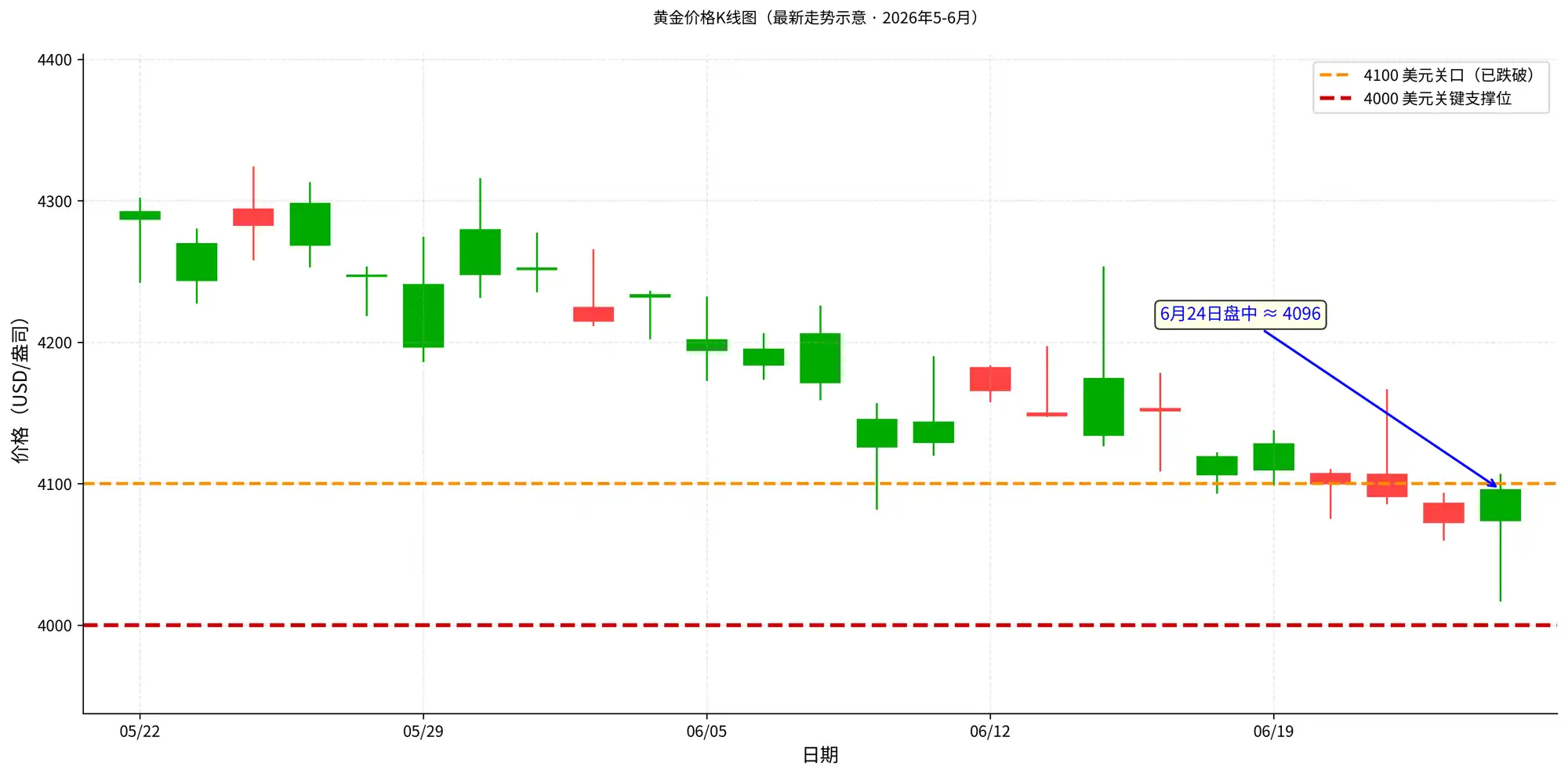
If $4,000 is decisively broken, the issue is not simply how much lower the price might go, but assessing whether the correction could amplify into a sharp sell-off. Gold has seen significant gains and holds substantial profit positions. Once a key integer level is breached, simultaneous selling pressure from short-term stop-losses, trend fund de-risking, ETF outflows, and margin calls could emerge. In such a scenario, gold would still have long-term supports like central bank purchases and safe-haven demand, but the short-term price would first obey liquidity and risk controls. Market confidence in "gold's defensive capability" might be tested anew.
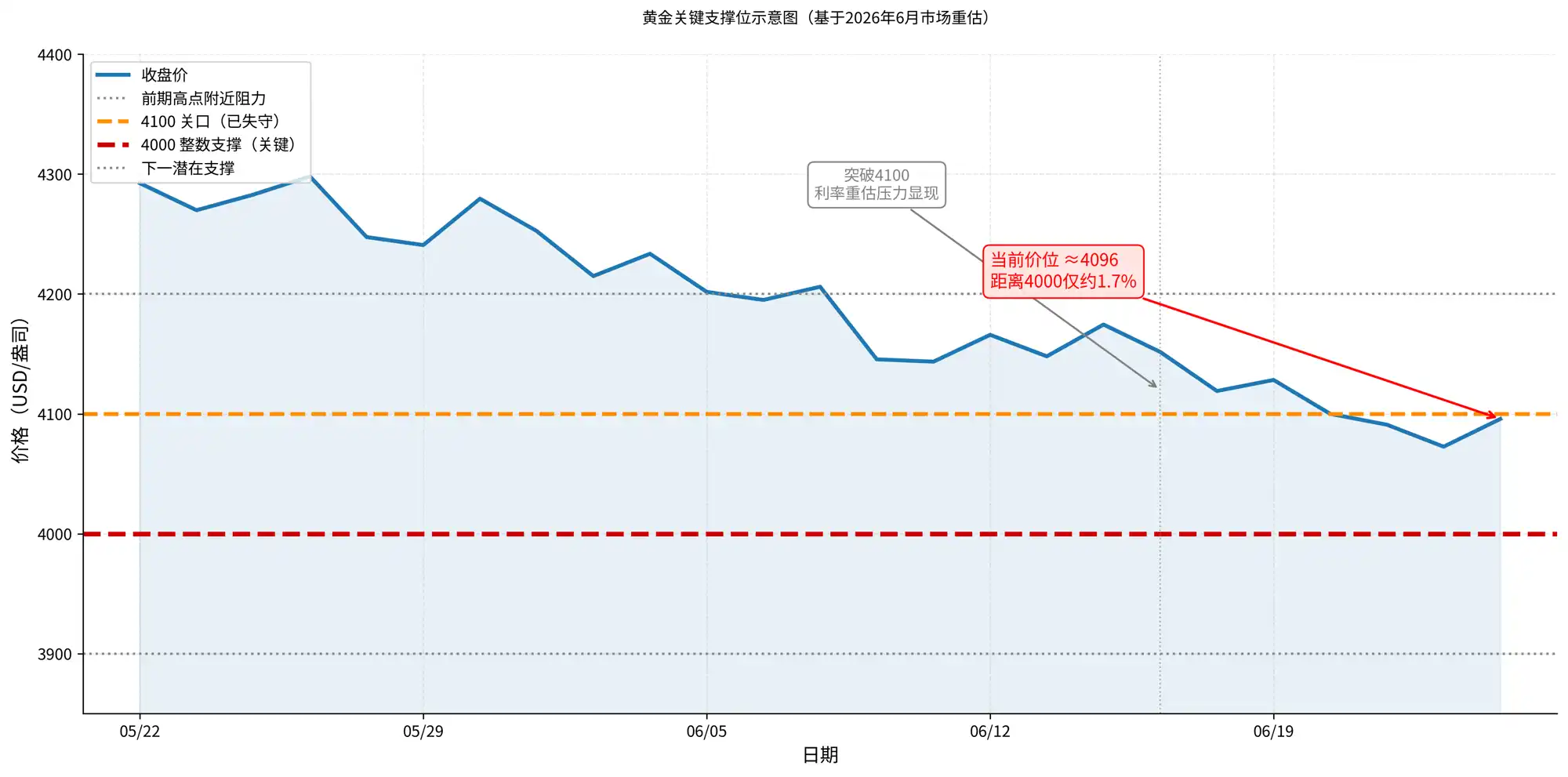
This is not to say that geopolitical risks, central bank buying, or industrial demand are unimportant. Gold's strong rally in 2025 was indeed supported by multiple factors including central bank purchases, a weaker dollar, and safe-haven demand. Silver's even larger gains were also related to its industrial attributes and supply-demand expectations. But when interest rate expectations are suddenly revised upward, precious metals are first revalued as non-yielding assets.

The reasons for holding gold haven't disappeared for investors; they are just being temporarily suppressed in the short term by higher opportunity costs for capital. Risk events will stimulate safe-haven buying, while high interest rates increase the cost of holding gold. When the latter dominates, gold can fall alongside stocks.

Gold and Silver Falling Together Indicate the Market is Selling Liquidity

The simultaneous decline of gold and silver cannot be simplistically interpreted as "safe-haven assets failing." More accurately, the market is repricing liquidity.

When dovish expectations are strong, gold can benefit simultaneously from a weaker dollar, falling real rates, and safe-haven demand. Silver adds industrial attributes and supply-demand expectations on top, giving it greater elasticity. But when the Fed signals a renewed hawkish tilt, the pricing logic reverses: a stronger dollar weighs on dollar-denominated gold and silver, rising real rates increase the opportunity cost of non-yielding assets, and the market actively reduces positions in more volatile assets.

This is also why gold and silver fall alongside stocks. On the surface, they belong to different asset classes, but in short-term trading, they both depend on the same variable: the price of money. If money becomes more expensive, the market will first sell the most crowded, most profitable, and most liquid positions, rather than first distinguishing whether these assets' long-term narratives still hold. Silver is more sensitive because it also carries industrial attributes; once risk assets correct in unison, industrial demand expectations are also discounted.

Therefore, the core of this decline is not "why isn't gold acting as a safe haven," but rather that the direction of market safe-haven flows has changed. In an environment of higher interest rate expectations, the short-term safe-haven assets chosen by capital may be the US dollar, cash, and short-term bonds. Gold remains a long-term safe-haven tool, but during a phase of rapid interest rate repricing, it will first face the impact of opportunity cost.

Korea is a Magnifying Glass, Not the Cause of Precious Metals' Decline

The reason the Korean market's sharp drop is observed alongside gold is not because Korean semiconductors directly determine gold prices, but because it amplifies the pressure from the same macro trade.

The Korean stock market benefited from AI memory demand in 2025, with semiconductor heavyweights like Samsung Electronics and SK Hynix driving a significant index rally. By 2026, the question became: if too much capital is crowded into the same trade, once macro rates rise, who sells first and how much they sell may impact prices more than short-term changes in company fundamentals. The KOSPI falling over 8% and triggering a circuit breaker in June is the result of such a crowded trade being re-examined.

However, the causality needs clarification. Current public evidence does not prove that "Korean deleveraging directly spilled over to global precious metals positions." A more prudent judgment is that Korean semiconductors and precious metals are simultaneously bearing the same macro pressure: rising interest rates, a strengthening dollar, and more expensive liquidity. The Korean market shows a more violent price reaction due to index concentration and crowded AI positioning; gold and silver are directly exposed to interest rate repricing due to their non-yielding and dollar-denominated nature.

In other words, Korea is not the cause of gold's decline, but rather a display screen for market risk appetite and leverage levels. It tells investors: when expectations for higher rates resurface, assets that have seen significant gains and heavy positioning over the past year will be inspected first. Precious metals, while not tech stocks, also face repricing when the cost of capital rises.

AI Volatility Affects Sentiment, But Gold and Silver Still Look to Interest Rates

AI semiconductor volatility affects market sentiment and assets like silver that possess industrial attributes, but it is not the main driver explaining gold and silver price movements.

If the key variable for gold and silver is the real interest rate, then the key variable for AI semiconductors is order fulfillment. Micron's earnings can serve as a window into risk appetite because they influence the market's judgment on "whether high-valuation assets can still withstand high rates." If AI chain earnings remain strong, risk appetite may find support, and silver's industrial attributes could be more easily re-priced. If guidance falls short, the market may further reduce growth asset positions, and contracting risk appetite will continue to pressure high-beta assets.

But the core pricing factor for gold must still return to the Fed, the dollar, and real interest rates. No matter how strong AI earnings are, they can hardly directly offset the pressure from rising real rates on gold. Similarly, weaker AI earnings do not necessarily drive gold higher unless they simultaneously trigger expectations for rate cuts, a weaker dollar, or stronger safe-haven demand.

This is the difference between market repricing and fundamental disproval. Repricing means the discount rate has changed, and investors are willing to assign a lower valuation to the same profits. Disproval means demand itself has a problem, and future profits must also be revised downward. For precious metals, the former is more important now: the market is first revaluing gold and silver based on higher capital costs, not changing the long-term safe-haven logic due to isolated changes in a specific industry chain.

Interest Rates and the Dollar Are Validating This Decline

The easiest overstatement to make now is to equate the synchronous decline directly with the end of a trend. Gold falling does not mean the end of the gold bull market; a Korean circuit breaker does not mean AI demand has already collapsed. A more reasonable assessment is that the market has entered a validation window: interest rate pressure first compresses valuations and non-yielding asset prices, followed by waiting for data to confirm whether this is a correction or a reversal.

The Fed under Warsh's leadership is the first validation line. If subsequent inflation and employment data continue to show strength, and energy prices maintain their pressure, the FOMC's hawkish tone may further translate into more explicit rate hike expectations. Then, gold and silver would face not just a short-term technical correction, but more sustained real rate pressure.

The dollar is the second validation line. Gold and silver are priced in dollars. A stronger dollar directly increases holding costs for non-US dollar investors and weakens short-term demand for precious metals. If dollar strength coincides with rising real rates, precious metals typically find it harder to reverse the pressure relying solely on a single safe-haven narrative.

Silver has an additional validation line: industrial demand expectations. It is more susceptible to risk asset sentiment than gold and more prone to amplified volatility when growth expectations change. If AI, semiconductors, and other high-beta assets remain under pressure, silver may face a double revaluation of both its precious metal and industrial attributes.

The simultaneous decline of gold, silver, and AI stocks sends investors a straightforward reminder: seemingly different assets in a portfolio may be exposed to the same risk from a single macro variable. The winning trades of 2025 will not necessarily lose their fundamentals simultaneously in 2026, but they will simultaneously face more expensive capital costs. The variables that will truly land on precious metals prices going forward are how long the pressure from interest rates and the dollar can persist, and whether safe-haven demand, central bank purchases, and industrial demand can arrive quickly enough to offset this pressure.

Perguntas relacionadas

QWhy have gold and silver prices fallen alongside risk assets like equities, according to the article?

AAccording to the article, the core reason is not a failure of their safe-haven status, but a shift in market focus toward the higher cost of holding uncertain assets. This cost is represented by rising real interest rates. When real rates (the real cost of money after inflation) increase, interest-bearing assets like bonds and cash become more attractive. This makes non-yielding assets like gold and silver less favorable to hold, as their opportunity cost increases. Simultaneously, higher discount rates pressure the valuation of high-growth tech stocks.

QWhat key signal does the article suggest is more critical than the South Korean market's circuit breaker, and what does it indicate?

AThe article suggests that gold falling in tandem with equities is the more critical signal than the South Korean circuit breaker. It indicates that the 2025 narrative supporting both AI semiconductors and precious metals is being tested by the same macro variable—real interest rates. It shows that under new Fed Chair Kevin Warsh's firmer stance, interest rates and the US dollar have regained short-term pricing power in the market.

QWhat is the most significant threat to the price of gold mentioned in the article?

AThe article states that what gold fears most is not simply a stock market decline, but a strengthening US dollar and rising real interest rates. These factors directly increase the holding cost (opportunity cost) for gold, which produces no yield, and can suppress its price even during periods of risk aversion.

QHow does the article differentiate between the primary drivers for gold versus silver during this market phase?

AThe article states that the key variable for both gold and silver is real interest rates. However, silver has an additional layer of sensitivity due to its industrial properties. This means silver is more susceptible to swings in risk asset sentiment and expectations for industrial demand (e.g., from the AI/semiconductor sector), which can amplify its volatility compared to gold during this repricing phase.

QWhat are the main validation lines or factors that will determine the future trajectory for gold and silver, as per the article's conclusion?

AThe article outlines several validation lines: 1) The Federal Reserve's policy path under Chair Warsh, particularly if strong inflation and employment data solidify hawkish expectations. 2) The strength of the US Dollar, which directly impacts dollar-denominated gold and silver. 3) For silver specifically, the expectations for industrial demand, which are tied to the health of risk assets like AI and semiconductors. The interplay between these pressures (rates/dollar) and supporting factors (safe-haven demand, central bank buying, industrial demand) will determine the price path.

Leituras Relacionadas

Stablecoin Salaries: Why Are They Becoming the First Choice for Cross-Border Workers?

Stablecoin Salaries: Why They're Becoming the Top Choice for Global Remote Workers The traditional global salary system carries hidden exchange rate risks for freelancers in countries like India, Argentina, and Turkey who earn in USD but spend in local currencies. When salaries are instantly converted to local currency, workers lose purchasing power if that currency depreciates against the dollar. For instance, an Indian designer converting a $2000 monthly salary to rupees lost over 10% in purchasing power last year due to the rupee's decline. Holding even a portion of income in USD or USD-pegged stablecoins can preserve value. Stablecoins offer a solution by breaking down barriers to holding dollars. Opening foreign USD bank accounts is difficult, and international wire transfers incur high fees (averaging 6.5%) and delays. In contrast, stablecoin transfers are fast and low-cost. Furthermore, many countries with high inflation and depreciating currencies restrict citizens' access to foreign currency. Self-custody stablecoin wallets enable workers to hold dollar-equivalent assets without needing bank approval, bypassing these limits. These wallets integrate multiple functions: they allow users to convert only what's needed for daily expenses into local currency, keep the remainder in stablecoins, connect to on-chain lending or yield products, and even link to payment cards for direct spending. While challenges remain—such as the lack of deposit insurance and evolving regulatory frameworks—the trend is clear. Reports indicate a growing preference for USD or stablecoin payments among freelancers in high-inflation countries. This shift represents a fundamental restructuring of salary functions: payment currency, asset storage, yield generation, spending, and cross-border flow. It offers the freedom and flexibility that are core to money's purpose, signaling a profound change in the global financial landscape.

Foresight NewsHá 6m

Stablecoin Salaries: Why Are They Becoming the First Choice for Cross-Border Workers?

Foresight NewsHá 6m

Don't Just Focus on Layoffs, The New Structure of the Ethereum Foundation is More Worthy of Appreciation

The Ethereum Foundation (EF) has undergone a significant organizational restructuring, with the most notable change being a strategic refocusing of its priorities rather than just a 20% staff reduction (approximately 54 people). The new structure clearly prioritizes the Protocol and Access layers, which now comprise the largest teams (57 and 34 people, respectively). This signals EF's intent to concentrate its core resources on fundamental, hard-to-outsource aspects of Ethereum: protocol evolution, security, privacy, client development, and the foundational access layer. Key areas within the Protocol layer, led by an architecture group including Vitalik Buterin and Justin Drake, receive heightened emphasis. These include post-quantum security, zkEVM, formal verification, and long-term roadmap development ("Strawmap"). This reflects a shift towards tackling complex, interdependent challenges like scalability, privacy, and future-proofing the protocol, potentially moving from a pure "redundant security" multi-client model towards more specialized clients aided by AI-assisted formal verification. Financially, EF's budget is being reduced by approximately 40%. The goal is to transition from spending about 15% of its remaining funds annually to a more sustainable 5% rate, akin to a long-term endowment, ensuring its longevity. Concurrently, the restructuring involves pushing certain responsibilities—such as application development, adoption, and ecosystem coordination—to external organizations like EthLabs, the Ethereum Apps Guild, and others. This "multi-node" model aims to increase ecosystem resilience by decentralizing functions beyond the EF, though it introduces new coordination challenges. In essence, the reorganization represents EF consciously narrowing its scope to focus on the hardest, most critical protocol-level problems while fostering a more distributed and sustainable ecosystem structure for Ethereum's future growth.

Foresight NewsHá 35m

Don't Just Focus on Layoffs, The New Structure of the Ethereum Foundation is More Worthy of Appreciation

Foresight NewsHá 35m

Report Analysis: What Is Coherent Planning as CPO Booms?

Title: Report Interpretation: What Moves Is Coherent Making Amid the CPO Boom? Summary: JP Morgan analyst Samik Chatterjee reiterates an Overweight rating on Coherent (COHR), citing undervalued growth potential across three core areas: data center optical transceivers, co-packaged optics (CPO) chips, and industrial lasers/thermal management. COHR's 1.6T data center transceivers are in high demand, with pricing remaining firm. The rise of CPO is seen not as a threat but as a catalyst, creating higher demand for sophisticated optical components, an area where COHR holds a competitive edge with its comprehensive portfolio (lasers, isolators, VCSELs, thermoelectric coolers). Each CPO chip offers significantly greater revenue potential than traditional transceivers. Furthermore, its Optical Circuit Switch (OCS) technology targets a potential $4B market with reliability and power advantages. The company is expanding its InP (Indium Phosphide) device capacity fourfold within two years, securing substrate supply and transitioning to more cost-effective 6-inch wafers. As one of only two major suppliers of high-quality pump lasers—currently in severe shortage—COHR can now move up the value chain from components to complete line cards/systems, boosting ASP over tenfold. Gross margin targets (>42%) may be revised upward due to high-end product premiums, cost improvements from the wafer transition, and contributions from new high-margin products like CPO and OCS. Its efficient thermadite thermal material also offers long-term growth. Industrial segment revenue grows at a steady 5-10%, supported by semiconductor equipment orders. Changes in Apple's Face ID protocol present a re-competition opportunity for 3D sensing. Overall, Coherent is positioned as a key infrastructure provider, with AI-driven compute demand fueling the need for high-speed optical interconnectivity. Growth from CPO/OCS, stable industrial performance, and margin improvement support the bullish thesis. *Disclaimer: This summary interprets a third-party analyst report from JP Morgan. It does not constitute investment advice.*

marsbitHá 57m

Report Analysis: What Is Coherent Planning as CPO Booms?

marsbitHá 57m

After Laying Off 20% of Staff, What Are the Key Points of EF's New Structure?

Following the completion of a months-long organizational restructuring, the Ethereum Foundation (EF) announced a 20% workforce reduction (approximately 54 employees) on June 23rd. It reorganized its teams into five new core clusters: Protocol, Access, User, Community, and Institutional (plus Operations/Management support units). Officially, this move implements the EF's 2026 Mandate and 2025 Treasury Management Policy, aiming to create a more focused and "self-sovereign" organization. The restructuring prioritizes the CROPS principles—Censorship Resistance, Openness & Freedom, Privacy, and Security—as foundational organizational tenets. The Protocol cluster will focus on core protocol R&D, including MEV reduction and zkEVM. The Access cluster emphasizes preserving user "zero option" for non-custodial, permissionless interaction. The User, Community, and Institutional clusters will manage external engagement, with the latter handling institutional and regulatory matters. While offering enhanced severance and transition support for affected employees, the EF did not disclose budget allocations or specific KPIs for the new clusters. This has led to market uncertainty about the impact on project funding and development priorities. Analysts note the announcement's positive tone of mission focus contrasts with a backdrop of recent EF leadership changes and broader ecosystem pressures. The true impact—whether this signifies strategic realignment or reactive contraction—will become clearer as the new structure's resource allocation and project prioritization are revealed in the coming months.

marsbitHá 1h

After Laying Off 20% of Staff, What Are the Key Points of EF's New Structure?

marsbitHá 1h

Trading

Spot
Futuros
活动图片