Post-World Cup, HIP-4 Awaits Its ‘Election Day’

marsbitPublicado em 2026-08-05Última atualização em 2026-08-05

Resumo

Following its significant success driven by World Cup trading, Hyperliquid's HIP-4 prediction market is now looking toward the upcoming US midterm elections as its next major opportunity. Initially viewed as an extension for hedging crypto positions, HIP-4 unexpectedly saw nearly 48% of its total volume come from sports markets, primarily the World Cup. However, activity plummeted over 90% after the tournament, highlighting the platform's heavy reliance on major real-world events. To address this dependency and enable continuous market creation, Hyperliquid launched a permissionless deployment feature for HIP-4 on its testnet on July 31. This new system allows approved third-party deployers to create markets using pre-approved templates, requiring a 500,000 HYPE stake and offering up to 50% of trading fees. The goal is to decentralize the sourcing of timely, high-interest markets. The imminent US midterm elections present a critical test case. While competitors like Polymarket and Kalshi already offer extensive political markets, HIP-4 currently has none. If the permissionless system launches on mainnet in time, deployers could build a comprehensive election trading suite. Missing this window would mean relying on manual validator creation again, forfeiting a chance to prove that external deployers can sustainably supply popular markets. The coming weeks will be crucial for HIP-4's evolution beyond sporadic event-driven spikes.

The biggest success of the Hyperliquid HIP-4 prediction market so far came from World Cup-related trading.

I did not anticipate this outcome initially. When HIP-4 first launched, I suggested the viewpoint that Hyperliquid was not actually aiming to compete head-on with Polymarket or Kalshi. These types of outcome prediction markets seemed more like an extension of its trading ecosystem: providing daily crypto binary contracts to hedge perpetual positions, build option-like exposures, and allow traders to keep all their positions unified within the Hyperliquid platform.

But subsequent developments were unexpected. Hyperliquid successively launched trading markets for the NBA Finals, individual World Cup matches, and the tournament champion. These three categories (with the latter two contributing the vast majority of trading volume) together account for approximately 48% of HIP-4’s total trading volume to date.

After the peak of World Cup trading, the related open interest dropped by over 90%. Objectively speaking, this doesn’t mean HIP-4 has failed; it merely reflects the current lack of event-specific targets with high trading appeal.

The system currently remains in a permissioned mode, where all trading markets require manual creation and listing by validators. Most of the remaining markets on the platform are related to cryptocurrency price movements, with dismal trading volumes that are completely incomparable to the activity driven by sports events.

Now, Hyperliquid wants to break this limitation. On July 31st, the permissionless HIP-4 deployment feature went live on the testnet, paving the way for third-party teams to independently create and operate outcome prediction markets, while also clarifying the conditions required for live operation.
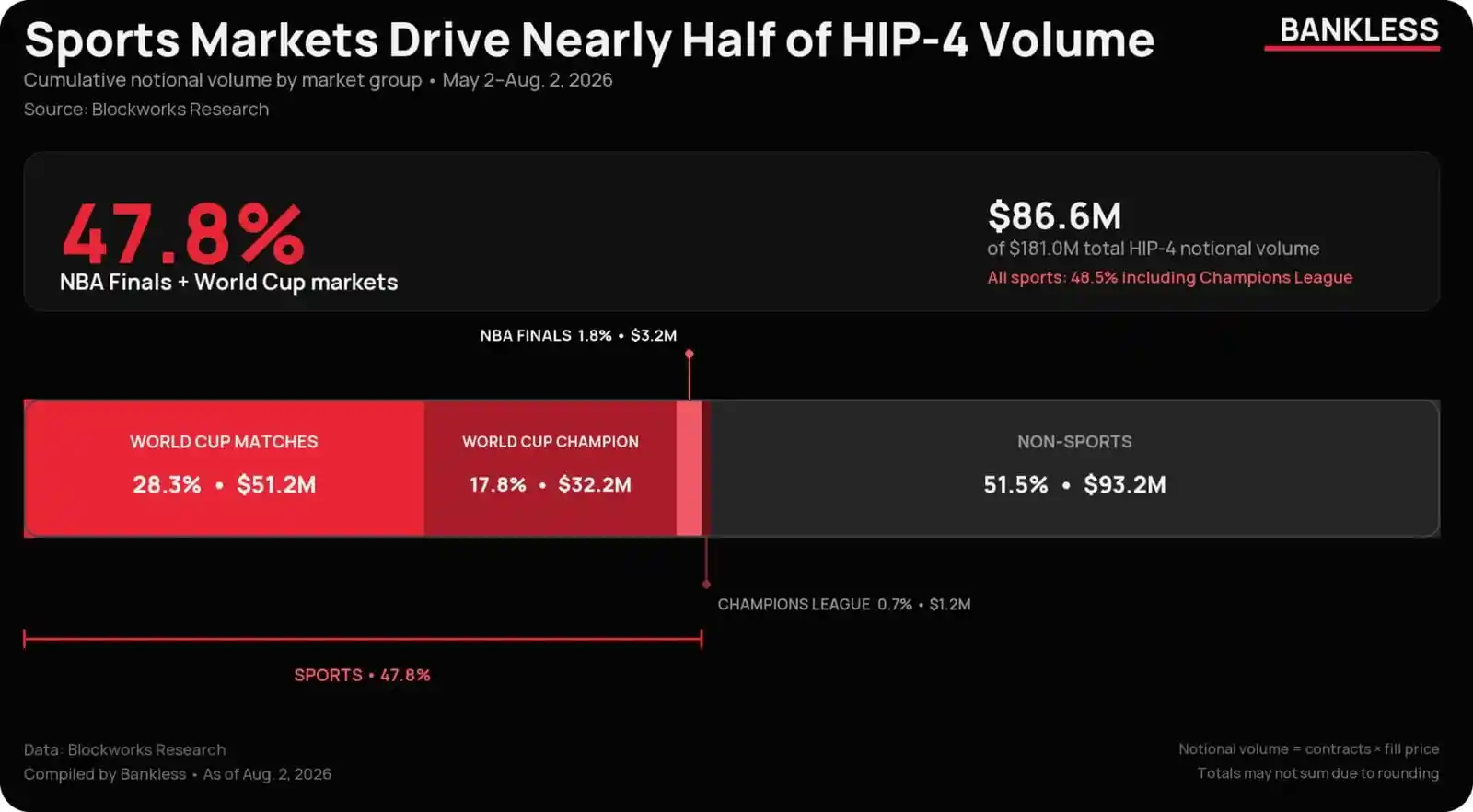
From May–August 2026, 47.8% of HIP-4’s trading volume came from sports markets, with the World Cup contributing the vast majority of sports volume, highlighting the platform’s high dependence on major hot-topic events to attract trading flow.

The Operation Mechanism of HIP-4 in Permissionless Mode

Important note: Permissionless deployment ≠ unrestricted, arbitrary market creation.

According to the initial mainnet proposal: Validators first approve market templates, which are reusable standard frameworks defining market creation rules and settlement methods. Deployers then select an approved template to create a specific trading market, filling in details like the trading topic, possible outcomes, expiry time, and settlement criteria.

One thing is clear: Deployers only need to use a validator-approved template to generate a market; they do not need to apply for separate approval for each individual market.

Consistent with the HIP-3 mechanism, deployers must precisely define market rules and properly execute settlements. In case of significant errors, validators have the right to slash their staked assets.

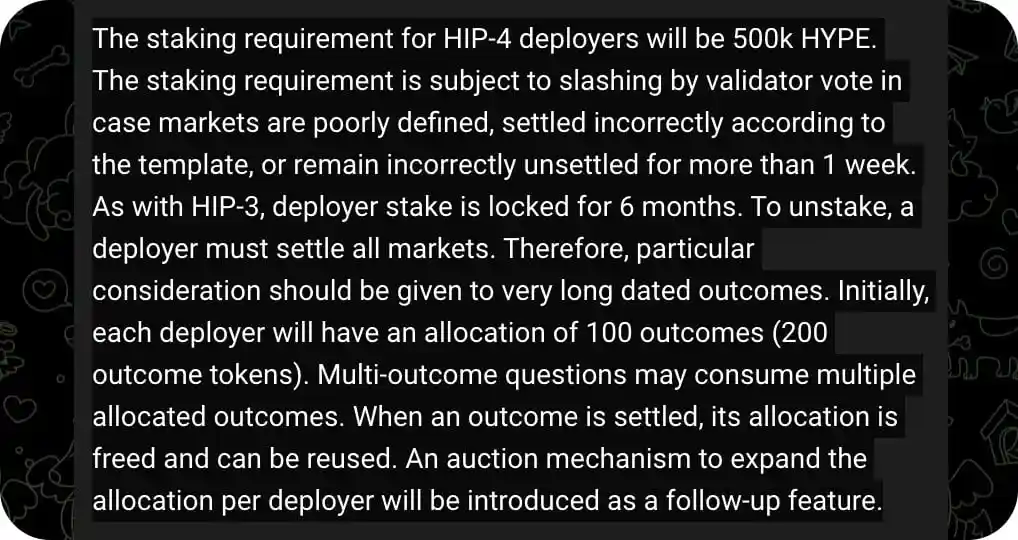
The proposal requires deployers to stake 500,000 HYPE (same standard as HIP-3), with the stake locked for 6 months; a deployer can only withdraw staked assets after all markets under their name have been fully settled. Initially, each deployer has a quota to create a maximum of 100 outcome targets; this quota can be reused after markets are settled. The platform plans to expand additional quotas via auctions later. Deployers can ultimately earn up to 50% of the trading fees generated by their created markets.
After the World Cup Frenzy, Where is the Next Core Opportunity?

The most obvious target: The US midterm elections.

Prediction markets initially gained mainstream visibility through political topics. Kalshi and Polymarket have long-established comprehensive election trading dashboards, covering various markets like control of Congress, individual district races, seat totals, etc., while HIP-4 currently has not listed any related targets.
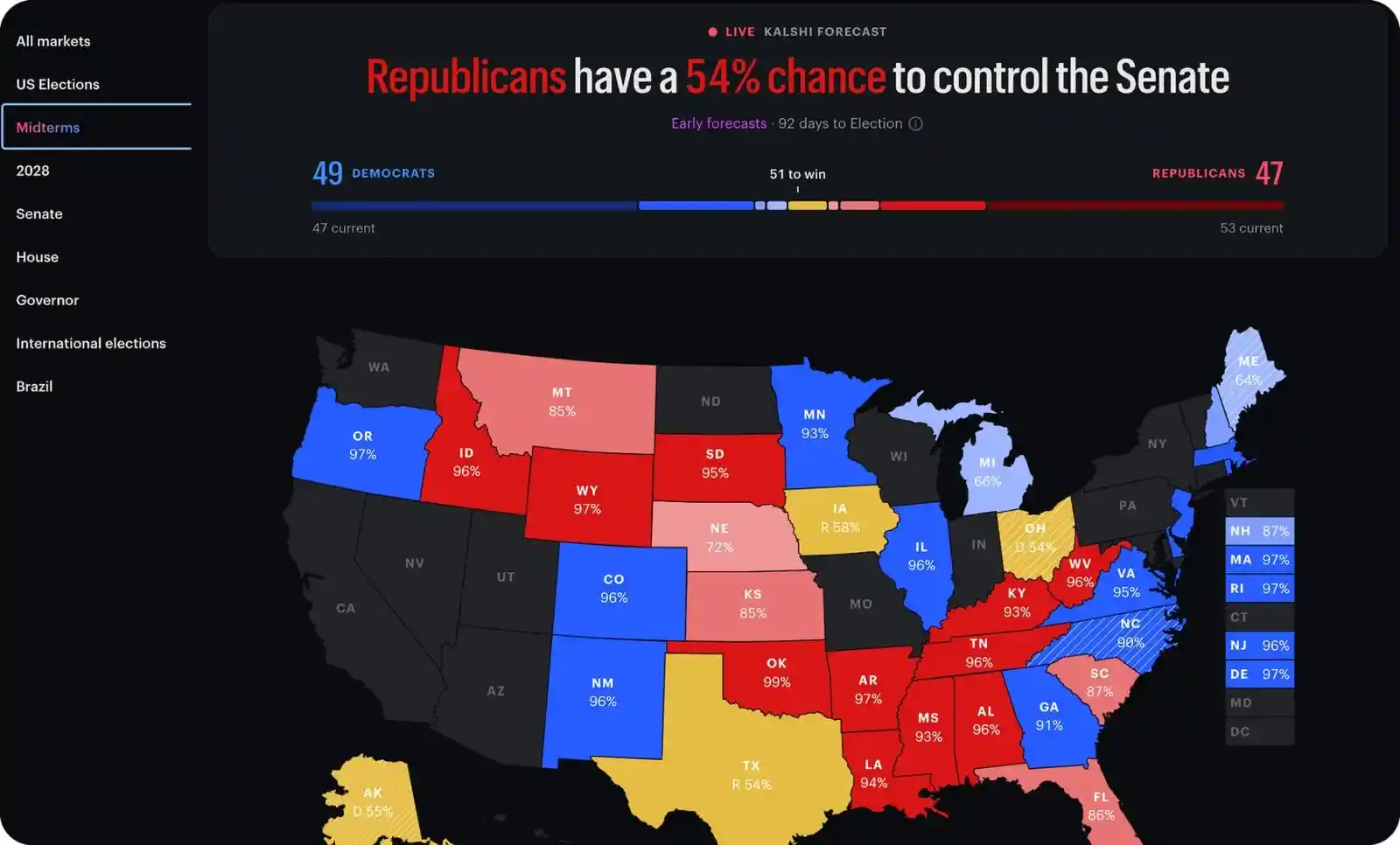
Whether third-party deployers can fill this gap depends on when the permissionless HIP-4 goes live on mainnet. For reference: HIP-3 took 164 days from the launch of the first minimal permissionless testnet version to mainnet launch. However, from releasing the mainnet initial specification and opening the mainnet bug bounty program to the official launch, it was only 18 days.

HIP-4’s current progress lies somewhere between: The mainnet preliminary architecture has been made public, the testnet deployment feature is open, but a mainnet-level bug bounty program has not yet been launched; the overall progress remains in an uncertain phase.

If this system can go live on schedule, deployers could build a comprehensive election trading section around the midterms, rather than sporadically launching individual campaign topic markets—provided validators simultaneously approve trading templates that support election scenarios.

If the permissionless deployment misses the midterm election window, validators can still manually list various midterm election markets. Even so, HIP-4 could still capture trading flow, but it would miss its first major real-world proving opportunity: failing to demonstrate to the market that external third-party deployers can consistently supply the platform with timely, popular trading markets.

The World Cup proved: Hyperliquid users are willing to trade major real-world events. At the same time, the rapid decline in trading volume post-World Cup exposed a pain point: the platform struggles to maintain activity in the absence of blockbuster events.

With high anticipation surrounding this round of midterm elections, it presents an excellent opportunity for HIP-4. The platform can both use this to sustain market heat and advance the launch of permissionless deployment. The coming weeks are crucial to track related progress.


Criptomoedas em alta

Perguntas relacionadas

QWhat was the most successful trading market for Hyperliquid HIP-4, and what event was it associated with?

AThe most successful trading market for Hyperliquid HIP-4 was the one associated with the World Cup, which contributed the vast majority of the sports-related trading volume.

QWhat is the main change introduced to HIP-4 on July 31st, and what is its purpose?

AOn July 31st, a permissionless deployment feature for HIP-4 was launched on the testnet. Its purpose is to allow third-party teams to independently create and operate prediction markets, thereby expanding the platform's market offerings.

QWhat is the next major real-world event mentioned as a key opportunity for HIP-4 to capture trading activity?

AThe next major real-world event mentioned as a key opportunity for HIP-4 is the US midterm elections.

QAccording to the article, what condition must a HIP-4 market creator (deployer) meet before they can withdraw their staked assets?

AA HIP-4 market creator (deployer) can only withdraw their staked assets after all the markets they have created have been fully settled.

QWhat did the drop in trading activity after the World Cup reveal about HIP-4's current limitation?

AThe drop in trading activity after the World Cup revealed that the platform struggles to maintain active trading volume in the absence of major, high-profile events.

Leituras Relacionadas

1.65 Billion Yuan: Sichuan Power Semiconductor Company Sells Itself

Sichuan-based power semiconductor company Jingyi Semiconductor is being acquired by its customer, Jiangsu-listed power semiconductor firm Suzhou Kaiweite Semiconductor Co., Ltd. ("Kaiweite"), for 1.65 billion yuan. Following the transaction, Jingyi Semiconductor will become a wholly-owned subsidiary of Kaiweite. Kaiweite will pay for the acquisition partly with new shares (approximately 901 million yuan worth) and partly in cash (approximately 749 million yuan). The deal is considered a major asset restructuring as Jingyi Semiconductor's assets and revenue in 2025 were 176.34% and 137.38% of Kaiweite's, respectively. Financially, Kaiweite has reported losses for 2024 and 2025. In contrast, Jingyi Semiconductor has remained profitable. The acquisition is expected to significantly improve Kaiweite's profitability. Jingyi Semiconductor's controlling shareholder and chairman, Yi Kun, along with employee持股 platforms, will hold a 13.28% stake in Kaiweite post-transaction. Founded in 2015 and listed on Shanghai's STAR Market in 2023, Kaiweite is a national-level "Little Giant" specializing in intelligent power semiconductor devices and power integrated chips. Established in 2019, Jingyi Semiconductor is a fabless power semiconductor company and a national-level专精特新重点"Little Giant." Its products, including Intelligent Power Modules (IPM), are supplied to major domestic appliance makers like Midea, Xiaomi, Gree, TCL, and Hisense-Hitachi. The company holds a leading 53.5% market share in China's IPM半桥 module segment for white goods. The strategic acquisition aims to repair Kaiweite's profitability and expand its power semiconductor product portfolio through integration in technology, products, and customer channels.

marsbitHá 1h

1.65 Billion Yuan: Sichuan Power Semiconductor Company Sells Itself

marsbitHá 1h

Launch Event Turned into a Make-up Ceremony? Why Hasn't Pools.trade Produced a High-Market-Cap Meme Coin Yet?

The article discusses the launch of Pools.trade, Uniswap's new token launch platform on Robinhood Chain, designed as a Meme coin launchpad. Despite generating high initial trading volumes (over $1.5 billion before the official frontend launch), the platform has yet to produce a high-market-cap Meme coin. The piece highlights two primary reasons for this. First, it outlines Pools.trade's features: it offers Instant and Crowd Launch modes, locks liquidity permanently in Uniswap v4 pools, and charges a low 0.25% transaction fee (compared to 1% on competitors like Pons and Flap), with most fees reinvested into liquidity. Second, it identifies a key problem: a lack of perceived fairness. The two most notable coins on the platform, FRONG (a "frog mascot" coin) and POOLS (a platform namesake), were both minted days before Uniswap's official countdown began. This "pre-minting" or "insider" controversy has dampened community FOMO (Fear Of Missing Out) and trust, causing their market caps to fall from peaks of $18 million and $4 million, respectively. The article argues that fairness is foundational for Meme coin success, and its absence has hindered viral growth. In conclusion, while Pools.trade benefits from Uniswap's existing user base and Robinhood Chain's popularity, its current lack of a fair-launch, high-engagement narrative has prevented a breakout hit. However, the author suggests that with its inherent traffic, such a success might not be far off.

Odaily星球日报Há 2h

Launch Event Turned into a Make-up Ceremony? Why Hasn't Pools.trade Produced a High-Market-Cap Meme Coin Yet?

Odaily星球日报Há 2h

Trading

Spot

Artigos em Destaque

Como comprar 4

Bem-vindo à HTX.com!Tornámos a compra de 4 (4) simples e conveniente.Segue o nosso guia passo a passo para iniciar a tua jornada no mundo das criptos.Passo 1: cria a tua conta HTXUtiliza o teu e-mail ou número de telefone para te inscreveres numa conta gratuita na HTX.Desfruta de um processo de inscrição sem complicações e desbloqueia todas as funcionalidades.Obter a minha contaPasso 2: vai para Comprar Cripto e escolhe o teu método de pagamentoCartão de crédito/débito: usa o teu visa ou mastercard para comprar 4 (4) instantaneamente.Saldo: usa os fundos da tua conta HTX para transacionar sem problemas.Terceiros: adicionamos métodos de pagamento populares, como Google Pay e Apple Pay, para aumentar a conveniência.P2P: transaciona diretamente com outros utilizadores na HTX.Mercado de balcão (OTC): oferecemos serviços personalizados e taxas de câmbio competitivas para os traders.Passo 3: armazena teu 4 (4)Depois de comprar o teu 4 (4), armazena-o na tua conta HTX.Alternativamente, podes enviá-lo para outro lugar através de transferência blockchain ou usá-lo para transacionar outras criptomoedas.Passo 4: transaciona 4 (4)Transaciona facilmente 4 (4) no mercado à vista da HTX.Acede simplesmente à tua conta, seleciona o teu par de trading, executa as tuas transações e monitoriza em tempo real.Oferecemos uma experiência de fácil utilização tanto para principiantes como para traders experientes.

739 Visualizações TotaisPublicado em {updateTime}Atualizado em 2026.06.02

Como comprar 4

Discussões

Bem-vindo à Comunidade HTX. Aqui, pode manter-se informado sobre os mais recentes desenvolvimentos da plataforma e obter acesso a análises profissionais de mercado. As opiniões dos utilizadores sobre o preço de 4 (4) são apresentadas abaixo.

活动图片