Post a Tweet for $5 Million? The Price Tag for a President's Endorsement of a Meme Coin Exposed

比推Publicado em 2026-03-17Última atualização em 2026-03-17

Resumo

Argentine President Javier Milei is accused of accepting a $5 million bribe to promote the meme token LIBRA on his X (formerly Twitter) account, according to a report by local media El Destape. The allegation is based on evidence recovered from the phone of a crypto lobbyist, Mauricio Novelli, who represented KIP Protocol, the entity behind LIBRA. The scandal erupted after Milei posted a tweet on February 15, 2025, endorsing LIBRA as a project aimed at supporting Argentine entrepreneurs. The token's market cap surged to $4.56 billion within 30 minutes, but it collapsed after insiders executed a "rug pull," cashing out over $100 million. Milei later deleted the tweet, claiming he was misled and that the post was intended to support private enterprise. Investigators uncovered a purported agreement between Milei and Hayden Davis, the alleged mastermind behind the scheme. The deal involved a $5 million payment—$1.5 million upfront, another $1.5 million after Milei publicly endorsed Davis as an advisor, and a final $2 million for a blockchain consulting contract. Phone records also showed frequent communication between Novelli and Milei’s office around the time of the tweet. Despite initial investigations by anti-corruption offices and Congress, no conclusive action was taken. The report suggests Milei was aware of the token’s speculative nature but proceeded for financial gain. Davis defended the scheme in an interview, arguing that meme token trading is a “casino” where such ...

Author: Eric, Foresight News

Original Title: How Much Does It Cost for a President to Endorse a Meme Coin? Milei: $5 Million


On March 17, Beijing time, Argentine local media El Destape broke an exclusive bombshell: information recovered from the phone of a cryptocurrency lobbyist in Argentina revealed that Argentine President Milei posted a tweet promoting LIBRA a year ago because he accepted a $5 million bribe, and the mastermind was none other than Hayden Davis, as previously speculated by the outside world.

Opposition lawmakers in Argentina who pushed for the investigation called this an "explosive scandal" and demanded further investigation. However, as of the time of writing, neither Milei nor the presidential office has responded.

Promoting Meme Coin Backfires, Blames "Political Struggle"

On February 15, 2025, Argentine President Milei promoted a Meme token named LIBRA on X, with the caption "Free Argentina is growing!!! This private project will be committed to promoting Argentina's economic growth and providing funding for Argentine small businesses and startup projects. The world wants to invest in Argentina."
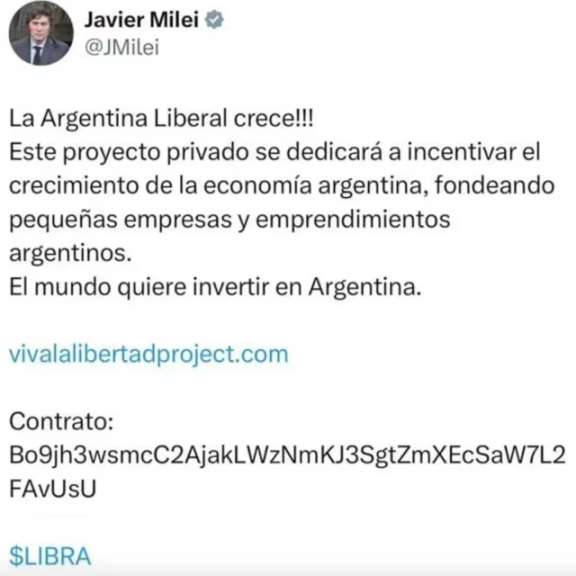
At that time, the hype around the Meme tokens of the US Trump couple had not yet subsided, and the new "presidential concept coin" once again ignited market enthusiasm. The FDV of the LIBRA token soared to a maximum of $4.56 billion within 30 minutes of its launch.

This project, which claimed it would invest token proceeds in Argentine entrepreneurs and education, saw a large number of rat warehouses withdraw liquidity and sell tokens after Milei helped the token price take off, successfully cashing out over $100 million and leaving within an hour or two. At noon Beijing time that day, Milei deleted the tweet and stated that his previous action was merely to support private enterprises and was not related to them, and that after understanding the situation, he decided not to spread the message further.

After the tweet was deleted, the price of LIBRA headed straight to zero without looking back. The entire event started in the early morning Beijing time and was over before the afternoon even arrived.

Even someone as abstract as Trump only dared to issue Meme coins before taking office, but Milei publicly helped promote a Rug project while in office. This kind of "not even pretending" blatant corruption was met with indiscriminate criticism. As the torrent of verbal and written attacks fell, Milei was forced to respond, but these responses seemed more like excuses.

The Argentine presidential office first stated that Milei met with Mauricio Novelli, the representative of KIP Protocol (the entity behind LIBRA) in Argentina, in October 2024. At that time, this representative said that a project named Viva la Libertad would be launched in the future to provide financing support for Argentine private enterprises. Milei's retweet after KIP Protocol launched the LIBRA token was merely to support Argentine entrepreneurs, and he himself was not aware of the details.

In other words, Milei believed LIBRA was a project to help Argentine entrepreneurs, and the retweet was well-intentioned.

Later, Milei himself stated again on a television program that his actions were in good faith, hoping to support any project that could improve the financing situation for technology entrepreneurs, but he was "deceived" because he did not understand the project's situation. Furthermore, Milei shamelessly stated that the vast majority of the deceived investors were Americans and Chinese, and he had not wronged his own citizens.

Finally, Milei even stated that the smear campaign against him was politically motivated and vowed to pursue the matter.

This flimsy explanation was obviously unconvincing: Why would a national president promote a private company without investigation?

Took the Money, But Didn't Fully Deliver

After this national-level scandal occurred, both the Argentine Anti-Corruption Office and Congress launched investigations. The Anti-Corruption Office believed that Milei's action was personal and did not violate public ethics regulations; the congressional investigation committee accused Milei of providing "key cooperation" in the LIBRA incident and recommended that Congress assess whether it constituted misconduct.

However, these investigation results did not reveal details, and the outside world was unclear about what exactly happened.

El Destape's爆料 revealed a key piece of evidence, shedding light on the gray transaction between LIBRA's issuer and the president.

According to the report, investigators recovered an agreement between H (confirmed to be Hayden Davis) and Milei from the phone of Mauricio Novelli, who was referred to by the Argentine presidential office as the "representative of KIP Protocol in Argentina" but was actually a cryptocurrency lobbyist.
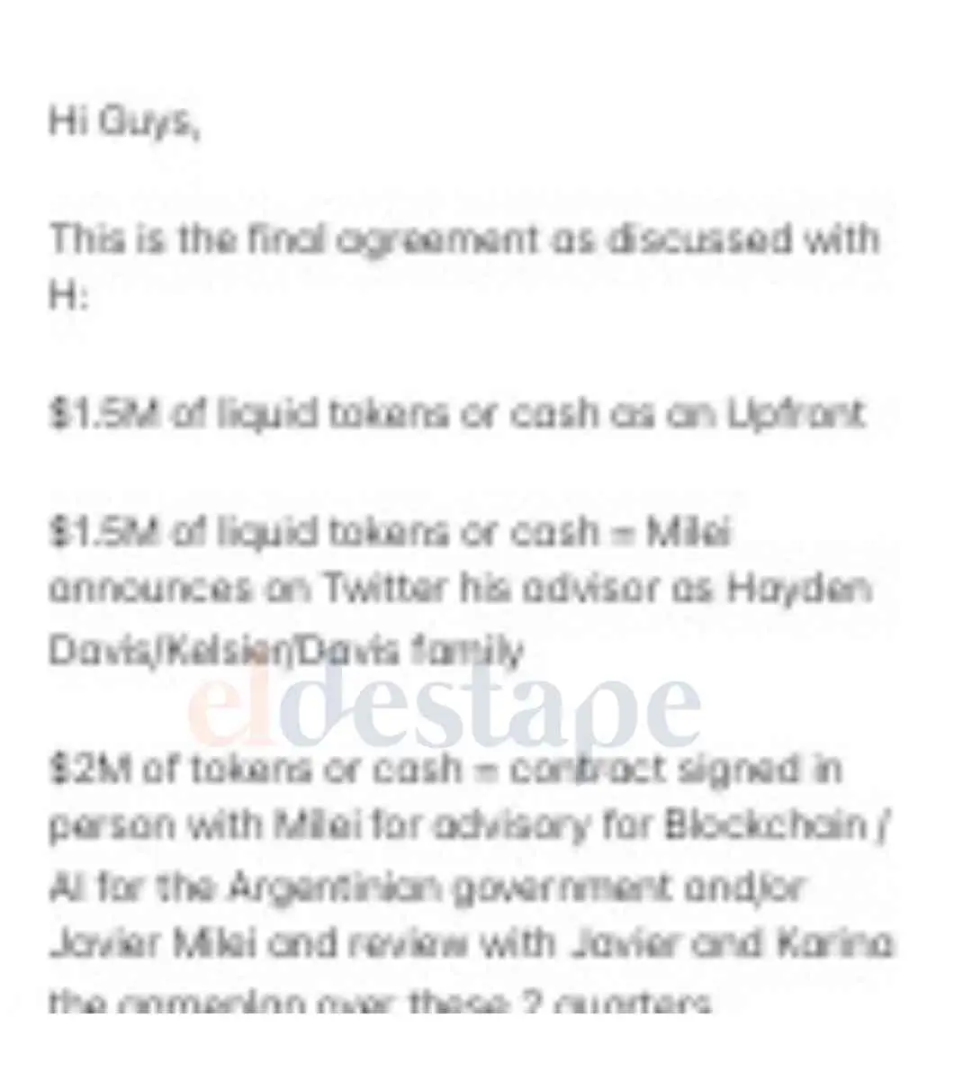
The agreement content shows that Hayden Davis would first pay Milei $1.5 million in liquid tokens or cash as an advance payment. After Milei announced on X that Hayden Davis/Kelsier/Davis family were his advisors, another $1.5 million in liquid tokens or cash would be paid. As for the final $2 million, it required Milei to sign a blockchain/artificial intelligence consulting contract.

The creation date of this file was just three days before Milei posted the promotional LIBRA tweet, and the file came from an expert report by the Argentine General Directorate of Technical Support for Criminal Investigations, but it only appeared in a folder of an attachment.

The secrets found on the phone were far more than just this file; they even included materials related to Milei teaching a cryptocurrency course at a school, which also proved that Milei's claim a year ago that he did not understand cryptocurrency was a pure lie.

In addition, the investigation report also exposed密集的通话记录 (dense call records) between Mauricio Novelli and Milei, as well as Milei's sister (who serves as Secretary General of the Argentine Presidential Office) from a few minutes before to a few hours after Milei promoted the token. Although there was no specific call content, the timing吻合 (coincidence)恰好证明 (just proves) that LIBRA was a premeditated financial scam organized with the involvement of the president.

Judging from Milei's tweet, the cooperation between the two parties may have only reached the first step. Before the tweet announcing that Hayden Davis was his advisor could be sent, the LIBRA incident spiraled out of control, forcing Milei to quickly clarify and distance himself. No wonder Hayden Davis said in an interview with crypto blogger Coffeezilla that Milei was originally supposed to post more interactive tweets, but for some reason the cooperation suddenly stopped.

Bottomless "Open Robbery"

In fact, after the LIBRA incident, some people inferred through on-chain information that Hayden Davis and his Kelsier Ventures were the masterminds behind the incident, and also uncovered that the token MELANIA launched by Trump's wife was also manipulated by him.

El Destape reported that on January 30, 2025, Hayden Davis met with Milei and Milei's sister at the Argentine presidential palace and signed a contract with Milei, making Davis an advisor to the Argentine government in the blockchain field. This contract was also found on Novelli's phone but was concealed by prosecutor Eduardo Taiano and not made known to the relevant parties.

After this agreement was reached, a bank account associated with Davis transferred $1 million to an account with an unconfirmed owner.

So far, we roughly know the whole story:

In October 2024, Mauricio Novelli introduced KIP Protocol (actually controlled by Hayden Davis) to Argentine President Milei, claiming that a project named Viva la Libertad would be launched to provide financing support for Argentine private enterprises, thereby getting closer to Milei.

At the end of January 2025, Hayden Davis, through the introduction of Mauricio Novelli, contacted Argentine President Milei and successfully became the blockchain advisor to the Argentine government. Afterwards, Hayden Davis, through Mauricio Novelli, reached an agreement with Milei: Hayden Davis would pay Milei a total of $5 million in exchange for Milei promoting the Viva la Libertad project and its issued LIBRA token on his personal X account.

Between October 2024 and the end of January 2025, Hayden Davis and Milei may have had more or less contact through Mauricio Novelli and discussed how to promote LIBRA. Milei was probably well aware that this was a pure scam project using cryptocurrency, but the reason he agreed was probably, as Hayden Davis said in an interview, their series of plans would not let this token quickly "rug pull.

But unexpectedly, after Milei posted the tweet, the rat warehouses couldn't wait to cash out over $100 million, quickly triggering a large amount of critical public opinion. Seeing the situation turning bad, Milei chose to cut losses rather than continue the cooperation. As public opinion further发酵 (fermented), the originally win-win situation turned into Milei being left alone in the lurch, while Hayden Davis cashed out and left.

The most terrifying thing about this incident is that Hayden Davis never considered it fraud. In an interview with Coffeezilla, he stated, "In the meme market, this is not illegal. This is what happens in every trade. These are the rules here. People know this, agree to this, and make money from this. If you're going to blame this, I think, for the vast majority of retail traders betting on meme tokens, especially those who get in early, this is the rules of the game in this market. This is not the capital market; this is a casino."

The development process of the industry is never afraid of speculators participating. What it fears is that speculators truly believe the industry is simply a casino for speculation.

This perhaps explains some of the chaos in the Web3 industry in the past two or three years: when schemers don't think they are scheming, they naturally lose all bottom lines. Eventually, projects no longer compare in the simple sense of good or bad, but only in who has the more clever means of "robbing."


Twitter:https://twitter.com/BitpushNewsCN

Bitpush TG Discussion Group:https://t.me/BitPushCommunity

Bitpush TG Subscription: https://t.me/bitpush

Original link:https://www.bitpush.news/articles/7620466

Criptomoedas em alta

Perguntas relacionadas

QWhat was the alleged bribe amount that Argentine President Javier Milei received to promote the LIBRA meme coin on Twitter?

AArgentine President Javier Milei allegedly received a bribe of $5 million to promote the LIBRA meme coin on Twitter.

QWho was identified as the mastermind behind the LIBRA meme coin promotion scandal involving President Milei?

AHayden Davis was identified as the mastermind behind the LIBRA meme coin promotion scandal involving President Milei.

QWhat was the fully diluted valuation (FDV) of the LIBRA token shortly after its promotion by President Milei?

AThe fully diluted valuation (FDV) of the LIBRA token surged to a peak of $4.56 billion within 30 minutes after its promotion by President Milei.

QHow did President Milei respond to the backlash after promoting the LIBRA meme coin?

APresident Milei deleted the promotional tweet, claimed he was deceived and acted in good faith to support Argentine entrepreneurs, and alleged that the criticism was politically motivated.

QWhat evidence was recovered from the phone of cryptocurrency lobbyist Mauricio Novelli that implicated President Milei?

AEvidence recovered from Mauricio Novelli's phone included a agreement detailing a $5 million payment plan to President Milei for promoting the LIBRA token, documents related to Milei's cryptocurrency lectures, and records of密集的通话记录 between Novelli, Milei, and his sister around the time of the promotion.

Leituras Relacionadas

CPU Makes a Comeback to the Table, A $170 Billion "Power Seizure" Drama Begins

A new era is dawning for the server CPU (Central Processing Unit), driven by the shift from AI model training to large-scale reasoning and the rise of Agentic AI. This article explores how the CPU is reclaiming a central role in the AI data center. For years, the focus has been on the GPU (Graphics Processing Unit) for AI training. However, as AI moves to the inference and Agent phase—where tasks involve complex, multi-step reasoning, tool calls, and data management—the workload balance is flipping. Studies show CPUs now handle over 70% of the workload in Agentic AI, up from 10-30% in training. This is because Agent tasks generate massive intermediate data (KV Cache) that exceeds GPU memory, forcing it to be offloaded to the CPU's larger, more scalable memory pools. This increased importance is translating into market changes. Major players are taking note: NVIDIA launched its first standalone CPU line, Vera, based on ARM architecture and optimized for Agent performance. AMD doubled its server CPU market forecast to over $1200 billion by 2030. Analyst reports project the total server CPU market could reach $1700 billion by 2030, with AI-driven demand being a primary driver. Furthermore, the classic ratio of CPUs to GPUs in AI servers is rapidly changing, converging from 1:8 toward 1:1 for Agent deployments. This surge in demand has led to a rare industry-wide price increase of 10-15% for server CPUs from Intel and AMD, breaking a decade-long trend of "more performance for the same price." Demand is bifurcating into high-core-count CPUs for in-rack GPU support and moderate-core CPUs for standalone Agent task orchestration. In China, this global trend presents an opportunity for domestic CPU manufacturers like Hygon (海光信息) and Huawei Kunpeng, who are bolstered by both growing AI infrastructure needs and national policies promoting technological self-reliance ("xin chuang"). The maturity of their software ecosystems is also accelerating, evidenced by faster adaptation to new AI models. In conclusion, the narrative is shifting from a GPU-centric view to one where CPU-GPU synergy is critical. The CPU is no longer a peripheral component but a performance-defining bottleneck and a key growth driver in the AI hardware stack, opening a massive new market estimated in the hundreds of billions of dollars.

marsbitHá 11h

CPU Makes a Comeback to the Table, A $170 Billion "Power Seizure" Drama Begins

marsbitHá 11h

TechFlow Intelligence: AMD AI Director Publicly Criticizes Claude Code for "Becoming Dumber and Lazier", Trump Claims Full Ceasefire in Hormuz But Strait Still Has 80 Unexploded Mines

TechFlow Intelligence Report: This daily digest covers key developments in AI, crypto, hardware, and geopolitics. In AI, SK Telecom faces US export control scrutiny over its partnership with Anthropic, while a Gemini user reports being misled in a scam scenario, sparking safety debates. China's Z.AI launches the GLM-5.2 model, rivaling Claude Opus without NVIDIA chips. In crypto, Bithumb lists ReProtocol, and Upbit delists KernelDAO. On the hardware front, MIT researchers build a custom OS to study chips, ASML denies US claims its advanced lithography machines are in China, and Amazon considers selling its in-house AI chips. Apple's future A21 Pro chip may use TSMC's latest N2P process. Major tech issues include 10,000 GitHub repositories distributing malware and Apple patching a critical eavesdropping flaw in Beats earbuds. US stocks rise, led by semiconductors, with Intel surging 10.6%, while SpaceX falls 3.5%. Geopolitically, despite a US-Iran deal, the Strait of Hormuz remains risky with ~80 uncleared mines, stalling 80M barrels of oil on standby tankers. Iran postpones Switzerland talks, and Trump calls the agreement an "unconditional surrender." The report highlights a contrast: temporary geopolitical calm versus the ongoing, fundamental restructuring of tech supply chains and chip independence.

marsbitHá 11h

TechFlow Intelligence: AMD AI Director Publicly Criticizes Claude Code for "Becoming Dumber and Lazier", Trump Claims Full Ceasefire in Hormuz But Strait Still Has 80 Unexploded Mines

marsbitHá 11h

Trading

Spot
Futuros

Artigos em Destaque

O que é MEME 2.0

Memecoin 2.0: A Ascensão do $MEME 2.0 no Mundo das Criptomoedas Introdução No panorama em constante evolução das criptomoedas, um novo concorrente surgiu. Memecoin 2.0, simbolizado como $MEME 2.0, eleva o conceito de moedas meme a um novo nível emocionante. Como um subproduto do Memecoin original, este projeto capturou a atenção da comunidade crypto ao mudar o foco de incentivos financeiros típicos para uma experiência envolvente e divertida. Operando na blockchain Ethereum, Memecoin 2.0 redefine audaciosamente o envolvimento da comunidade na esfera crypto. O que é Memecoin 2.0, $MEME 2.0? No seu cerne, Memecoin 2.0 é um projeto de criptomoeda que prioriza o espírito comunitário e a diversão associada à cultura meme. Ao contrário das criptomoedas convencionais, que se concentram em casos de uso práticos e benefícios tangíveis, Memecoin 2.0 distingue-se ao abraçar o lado mais leve da moeda digital. O projeto existe sem promessas de utilidade, um roteiro estruturado ou retornos financeiros, focando em vez disso em fomentar uma comunidade vibrante centrada em memes e no prazer partilhado. Ao fazer isso, aproveita a crescente tendência da cultura meme no espaço online, tornando-se num jogador único no mundo dos ativos digitais. Criador do Memecoin 2.0, $MEME 2.0 Apesar de extensa pesquisa sobre as origens do Memecoin 2.0, a identidade explícita do seu criador continua desconhecida. Esta anonimidade não é incomum na comunidade crypto, onde muitos projetos são liderados por indivíduos ou grupos que preferem ficar nos bastidores. A falta de informações publicamente disponíveis sobre o criador pode ser vista como um movimento estratégico, colocando os holofotes no envolvimento da comunidade em vez de na notoriedade individual dentro do espaço. Investidores do Memecoin 2.0, $MEME 2.0 As informações sobre os investidores ou o financiamento do Memecoin 2.0 são escassas. Esta ausência de detalhes pode sugerir que o projeto é autofinanciado ou que o seu foco na comunidade, em vez de estruturas de investimento tradicionais, atraiu um tipo diferente de apoiador. Como o mundo das moedas memes geralmente envolve mais envolvimento de base do que investimento institucional, esta abordagem alinha-se ao ethos de projetos orientados pela comunidade. Como Funciona o Memecoin 2.0, $MEME 2.0? O Memecoin 2.0 opera inteiramente na blockchain Ethereum, aproveitando as suas robustas características de segurança e escalabilidade. Ao aproveitar os pontos fortes da Ethereum, o Memecoin 2.0 pode oferecer um ambiente seguro para interações dos utilizadores enquanto assegura que as transações são eficientes e custo-efetivas. Uma das características únicas do Memecoin 2.0 reside na sua estrutura orientada pela comunidade. O valor e a popularidade do token $MEME 2.0 derivam da participação ativa dos seus utilizadores, em vez de uma utilidade inerente. Este design reforça o foco do projeto no aspecto de entretenimento das criptomoedas, implicando que o riso e o envolvimento da comunidade são as verdadeiras moedas que impulsionam o seu sucesso. Além disso, o projeto insere-se no ecossistema mais amplo das moedas meme, onde o valor de cada moeda meme oscila com base na cultura, nas tendências e no envolvimento da comunidade, em vez de nos princípios económicos tradicionais. Linhas do Tempo do Memecoin 2.0, $MEME 2.0 Para melhor entender a evolução e os marcos do Memecoin 2.0, aqui está uma linha do tempo que destaca eventos significativos na sua história: 2024: O início do Memecoin 2.0 é reconhecido como um desdobramento do Memecoin original, estabelecendo-se dentro do contexto próspero das moedas meme enquanto opera na blockchain Ethereum. 13 de Julho de 2024: O Memecoin 2.0 posiciona-se oficialmente como uma moeda meme centrada na comunidade na rede Ethereum, enfatizando a sua abordagem centrada no entretenimento que convida os utilizadores a participar e envolver-se no seu crescimento. Pontos Chave Sobre o Memecoin 2.0, $MEME 2.0 Várias características críticas definem o Memecoin 2.0: Abordagem Centrada na Comunidade: A missão primária do Memecoin 2.0 é criar uma experiência comunitária divertida e envolvente, capitalizando o prazer coletivo derivado da cultura meme. Construído na Ethereum: Operar na blockchain Ethereum fornece ao projeto uma infraestrutura essencial que garante segurança e escalabilidade. Falta de Utilidade ou Roteiro: Numa notável divergência das criptomoedas tradicionais, o Memecoin 2.0 não promete quaisquer características utilitárias ou retornos financeiros, reafirmando o seu compromisso com o envolvimento da comunidade e a participação social. Foco na Cultura Meme: Ao abraçar os aspectos humorísticos e culturais do fenómeno meme, o Memecoin 2.0 fornece uma plataforma para que os utilizadores se envolvam com a crypto offline e online. Contexto Adicional: A Importância das Moedas Meme As moedas meme emergiram como uma classe distinta de criptomoeda, frequentemente impulsionadas pelo humor e por uma abordagem leve ao comércio. Estas moedas geralmente carecem de utilidade significativa ou roteiros de desenvolvimento, atraindo os utilizadores com a promessa de diversão, interação comunitária e relevância cultural. No panorama do ecossistema crypto mais amplo, as moedas meme revive a importância do envolvimento da comunidade, resistindo contra abordagens exclusivamente orientadas para o lucro. Projetos como o Memecoin 2.0 inauguram uma era em que o entretenimento pode harmonizar-se com aspirações financeiras, transformando a blockchain numa plataforma para criatividade e interação social. Conclusão O Memecoin 2.0, ou $MEME 2.0, representa uma nova onda de criptomoeda que prioriza o envolvimento da comunidade em detrimento de estruturas financeiras rígidas. Com um foco no humor e na interação social, capitaliza a fascinação em torno da cultura meme. Ao operar na blockchain Ethereum, o Memecoin 2.0 aproveita as capacidades da tecnologia, enquanto mantém um compromisso firme com o valor de entretenimento da moeda digital. À medida que o espaço em torno das criptomoedas continua a evoluir, o Memecoin 2.0 serve como um testemunho da ideia de que o futuro dos ativos digitais pode muito bem depender de experiências partilhadas, risadas e conexões comunitárias sólidas. No mundo imprevisível da crypto, talvez a alegria possa ser tão valiosa quanto o ganho financeiro tradicional.

36 Visualizações TotaisPublicado em {updateTime}Atualizado em 2024.12.03

O que é MEME 2.0

Como comprar MEME

Bem-vindo à HTX.com!Tornámos a compra de Memeland (MEME) simples e conveniente.Segue o nosso guia passo a passo para iniciar a tua jornada no mundo das criptos.Passo 1: cria a tua conta HTXUtiliza o teu e-mail ou número de telefone para te inscreveres numa conta gratuita na HTX.Desfruta de um processo de inscrição sem complicações e desbloqueia todas as funcionalidades.Obter a minha contaPasso 2: vai para Comprar Cripto e escolhe o teu método de pagamentoCartão de crédito/débito: usa o teu visa ou mastercard para comprar Memeland (MEME) instantaneamente.Saldo: usa os fundos da tua conta HTX para transacionar sem problemas.Terceiros: adicionamos métodos de pagamento populares, como Google Pay e Apple Pay, para aumentar a conveniência.P2P: transaciona diretamente com outros utilizadores na HTX.Mercado de balcão (OTC): oferecemos serviços personalizados e taxas de câmbio competitivas para os traders.Passo 3: armazena teu Memeland (MEME)Depois de comprar o teu Memeland (MEME), armazena-o na tua conta HTX.Alternativamente, podes enviá-lo para outro lugar através de transferência blockchain ou usá-lo para transacionar outras criptomoedas.Passo 4: transaciona Memeland (MEME)Transaciona facilmente Memeland (MEME) no mercado à vista da HTX.Acede simplesmente à tua conta, seleciona o teu par de trading, executa as tuas transações e monitoriza em tempo real.Oferecemos uma experiência de fácil utilização tanto para principiantes como para traders experientes.

277 Visualizações TotaisPublicado em {updateTime}Atualizado em 2026.06.02

Como comprar MEME

Discussões

Bem-vindo à Comunidade HTX. Aqui, pode manter-se informado sobre os mais recentes desenvolvimentos da plataforma e obter acesso a análises profissionais de mercado. As opiniões dos utilizadores sobre o preço de MEME (MEME) são apresentadas abaixo.

活动图片