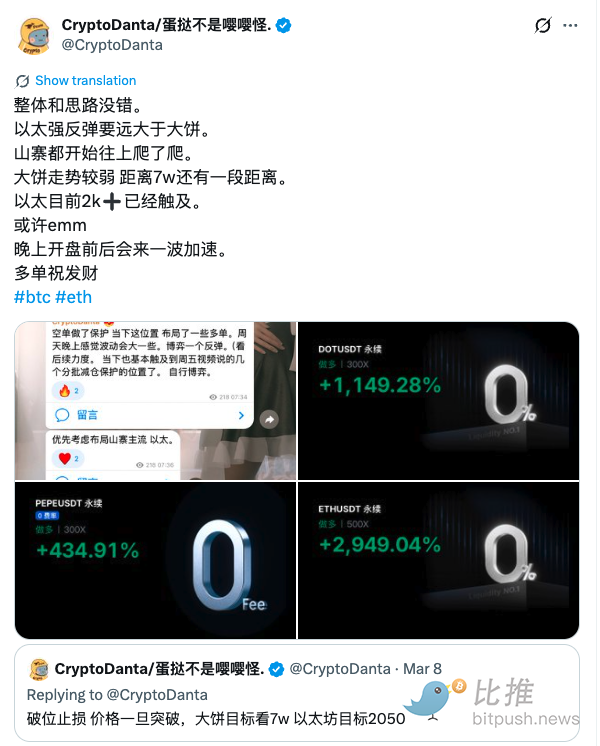
Post-00s Developer Raises 30 Million in 10 Days with Vibe Coding; Cryptocurrency Tycoon Suspected to Be Arrested by Authorities

比推Publicado em 2026-03-09Última atualização em 2026-03-09

Resumo

A 00s-born founder reportedly secured 30 million yuan in funding for "Vibe Coding," a project developed in just 10 days. The GitHub repository and demo links were shared, though some critics dismissed it as a toy project or a resume-building effort. Meanwhile, a major figure in the Chinese crypto circle is rumored to have been arrested, sparking discussions and speculation across social platforms. Additionally, there are talks about Lobster (possibly a crypto or NFT project) opening offline stores in China, surprising even its founders. The article also touches on market sentiment around Bitcoin, with questions about whether it has bottomed out. Replies show mixed opinions—some see patterns while others remain skeptical and cautious about entering the market. The content is compiled from X (Twitter) and presented as personal viewpoints, not investment advice.

Hello dear readers~

What have the KOLs in the crypto circle been talking about in the past 24 hours?

Note: The following content is compiled from the X platform and represents personal opinions. It does not represent the stance of this platform and should not be considered investment advice.

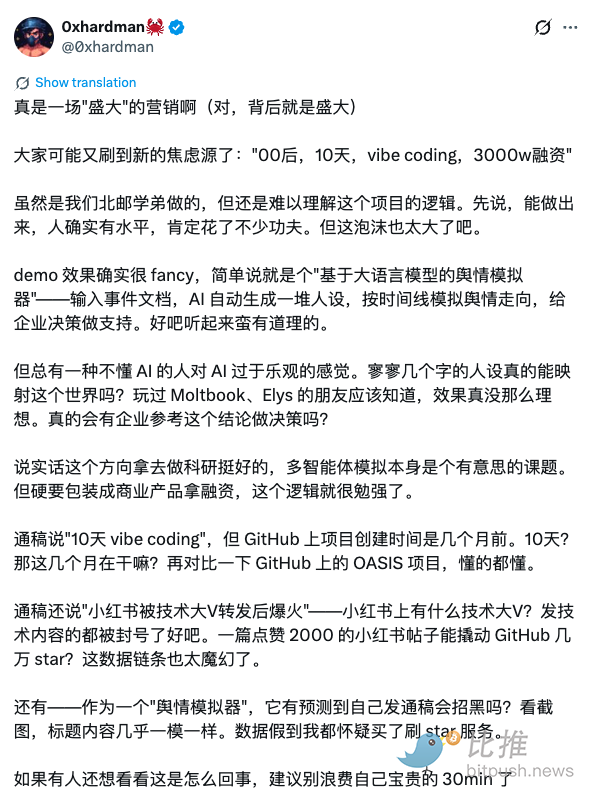
Post-00s, 10 Days of Vibe Coding, 30 Million Funding

Additional details:

Github address: https://github.com/666ghj/MiroFish

Project journey and specific details (written by the founder): https://mp.weixin.qq.com/s/UyYVjlBCvQRJI6B_MmZbsA (Must-read article for super individuals in the AI era)

Product experience:

Official website experience: Wuhan University public opinion prediction: https://666ghj.github.io/mirofish-demo/console

Bilibili watch Dream of the Red Chamber demo (predicting subsequent plot based on the original 80 chapters): https://666ghj.github.io/mirofish-demo/console

极简

Popular replies:

Maybe trying to replicate openclaw and manus from another 'angle'... Recently, I'm sensitive to many big Vs praising some new thing, so I坚决不用... Several have already gone silent... Just like the new movies in the hot comments are unwatchable;

What a thrilling internet legend;

Tried it; currently, it seems like a project with toy attributes. Probably a project for a sophomore to方便 find internships or jobs after graduation;

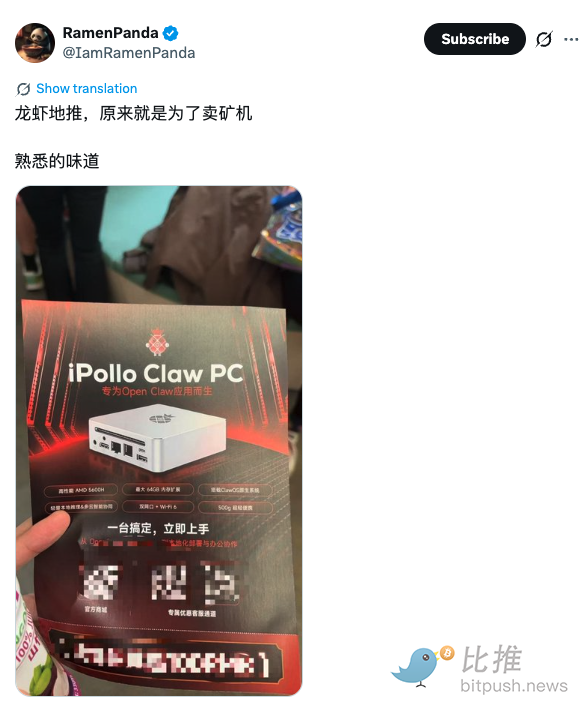
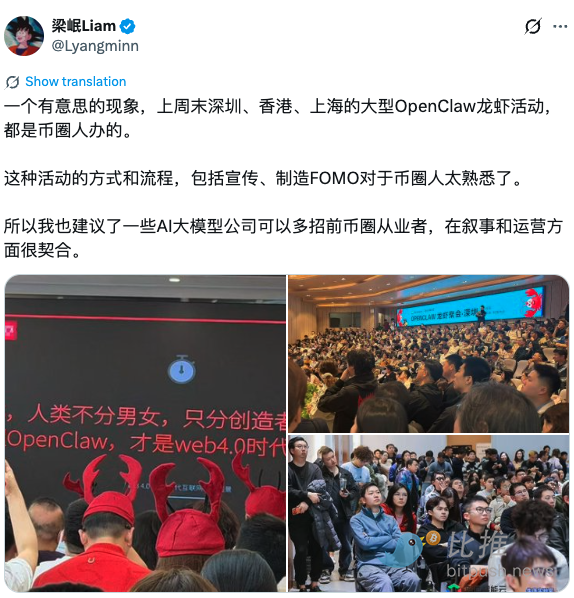
China is Getting a Lobster Offline Store, Even the Founder is Shocked


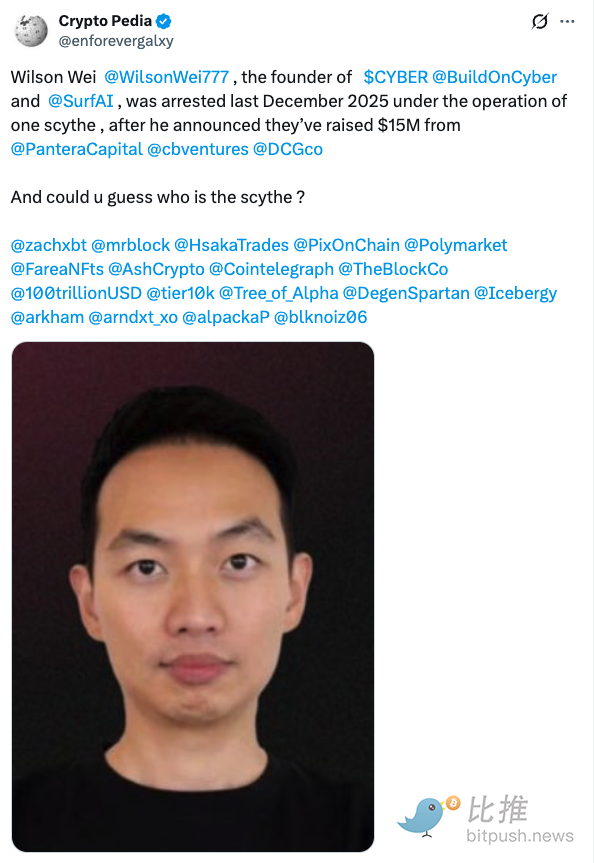
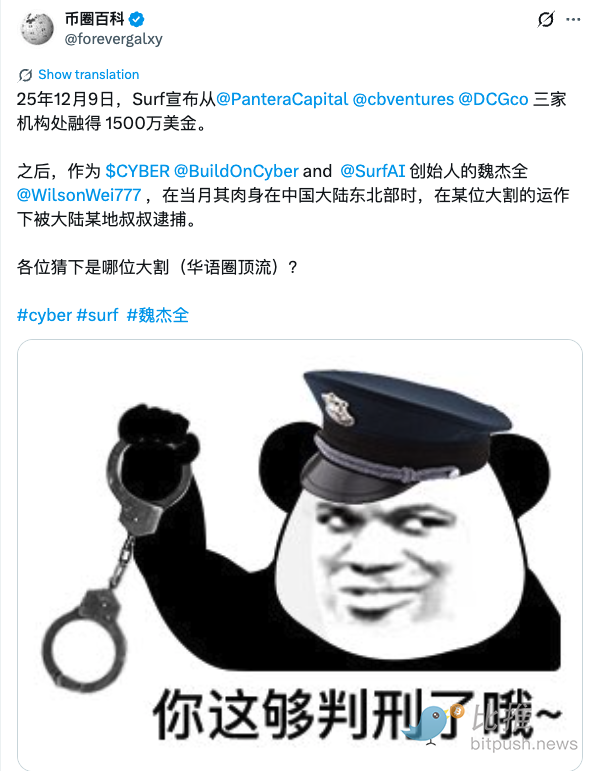
Crypto Gossip: Has a Certain Tycoon 'Flipped' and Been Arrested?!
Has Bitcoin Bottomed Out?
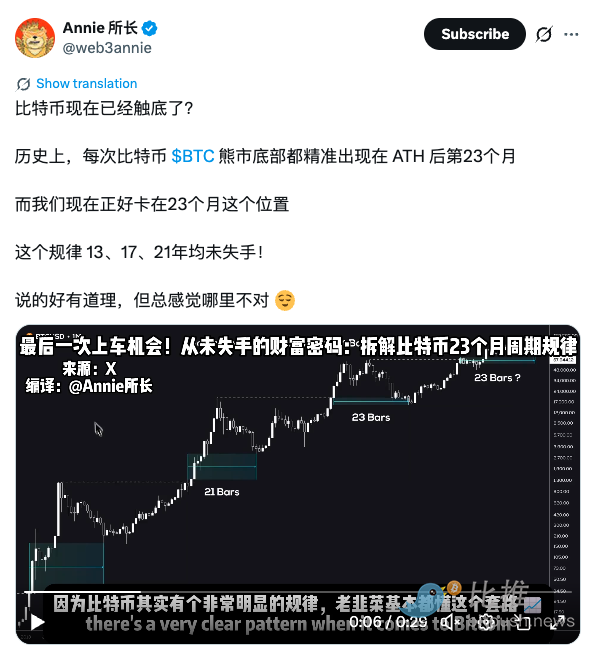
Popular replies:

Patterns are referential, but the market is unpredictable. Don't believe it completely; need to look comprehensively.

Don't忽悠 me to enter the market. Without a 90% drop, whoever goes in will die.


Twitter: https://twitter.com/BitpushNewsCN

Bitpush TG Discussion Group: https://t.me/BitPushCommunity

Bitpush TG Subscription: https://t.me/bitpush

Original link: https://www.bitpush.news/articles/7618195

Perguntas relacionadas

QWhat is the main achievement of the 00s generation project mentioned in the article?

AThe 00s generation project, Vibe Coding, secured 30 million yuan in funding within 10 days.

QWhat is the nature of the cryptocurrency-related incident involving a prominent figure?

AA cryptocurrency influencer is suspected to have been arrested by authorities, as hinted by the article's discussion of 'flipping' or legal trouble.

QWhat product or service is being introduced in China according to the article?

ALobster offline physical stores are being launched in China, which even surprised the founders.

QWhat is the general sentiment about Bitcoin's market condition based on the article?

AThere is speculation on whether Bitcoin has bottomed out, with mixed opinions; some warn against entering the market without a significant drop, while others analyze historical patterns.

QWhat disclaimer does the article provide regarding the opinions shared?

AThe article states that the content is compiled from personal viewpoints on platform X, does not represent the platform's stance, and is not intended as investment advice.

Leituras Relacionadas

Who Funds the Agents?

**Summary: Who Funds AI Agents?** OpenAI recently shut down a feature allowing AI agents to shop for users, highlighting the challenge of creating a secure and regulated environment for agent-driven transactions. While payment infrastructure exists, a crucial governance layer—defining spending limits, fraud detection, tax handling, and return policies—is largely missing. The potential is enormous: AI agents already processed $73M across 176M transactions last year, with McKinsey forecasting this could grow to $3-5T in global consumer commerce by 2030. The core competition isn't just about processing payments, which can be very cheap (especially with crypto-based settlement), but about controlling the rules that govern agent spending. Key players like Stripe and Coinbase are racing to dominate this governance layer. Stripe's acquisition of wallet provider Privy allows it to set spending policies, identity checks, and human-in-the-loop approvals directly at the wallet level. Similarly, Coinbase's stack, including its x402 protocol and AgentKit, embeds governance rules. This vertical integration across settlement, wallet, and governance layers is becoming the dominant strategy. Control over the governance layer is where significant future value lies. If agents handle trillions in transactions, even a small fee for managing compliance, fraud prevention, and policy enforcement could generate billions in annual revenue. The companies that successfully integrate across the payment stack will capture value from idle agent balances, transaction fees, and governance services, positioning themselves as the foundational banks of the AI agent economy.

marsbitHá 24m

Who Funds the Agents?

marsbitHá 24m

A Nation Blocks Chips, a Giant Buys a Nuclear Power Plant: Why It's Time to Seriously Consider DeAI

**Title: Great Powers Blockade Chips, Giants Buy Nuclear Plants: Why It's Time to Seriously Consider DeAI** In May 2026, the US closed loopholes for Chinese firms to acquire advanced NVIDIA chips via overseas subsidiaries. That same month, Kenya halted a $1B geothermal data center project involving Microsoft, fearing its immense energy consumption. Meanwhile, Huawei announced mass production of its Ascend AI chip. These disparate events underscore a new reality: the competition for computing power ("compute") has escalated beyond the tech industry, becoming a geopolitical and infrastructural battleground. A new era of oligopoly is forming, with control over the AI stack—from GPU chips (NVIDIA) and cloud platforms (AWS, Azure, Google Cloud) to foundational models (OpenAI, Anthropic)—concentrating in a few Western "AI Octopus" corporations. This centralization creates systemic risks: pricing power and platform lock-in for users, infrastructure fragility, and a widening "compute divide" that threatens to marginalize nations without independent AI capacity. An "AI Iron Curtain" is deepening through export controls. In response, some nations like Saudi Arabia and the UAE are investing heavily to buy compute power, aiming to transition from oil to AI economies. The EU seeks to triple its compute capacity by 2030 to reduce dependency. However, the spending gap is vast, with four US tech giants alone planning ~$750B in AI capex for 2026. The race is increasingly constrained by energy, with AI tasks consuming up to 1000x more power than web searches, pushing firms to even acquire nuclear plants. This landscape is fueling interest in Decentralized AI (DeAI). It proposes a third way: using open protocols to coordinate a global network of idle GPUs, independent developers, and data centers, creating an AI infrastructure without a single controlling entity. Leveraging blockchain and cryptographic verification, DeAI aims to break market concentration, disperse energy demands, reduce geopolitical dependencies, and enhance transparency. While still nascent in performance and stability, DeAI's core promise is not immediate superiority but providing a crucial alternative architecture to resist monopoly, censorship, and centralized power. As specialized AI hardware costs fall and open-source models flourish, the window to build this foundation is open. The very existence of such competition serves as a vital check against the inevitable abuse of concentrated power.

marsbitHá 1h

A Nation Blocks Chips, a Giant Buys a Nuclear Power Plant: Why It's Time to Seriously Consider DeAI

marsbitHá 1h

Trading

Spot
Futuros
活动图片