Polymarket Faces New Roadblock As Dutch Regulator Bans Prediction Activity — Details

bitcoinistPublicado em 2026-02-22Última atualização em 2026-02-22

Resumo

Polymarket's Dutch operations, under the entity Adventure One, have been ordered to cease all activities by the Netherlands Gambling Authority (Ksa) for offering unlicensed prediction markets, which the regulator classifies as illegal gambling. The platform faces potential fines of up to $840,000 per week for non-compliance. This action is the latest regulatory challenge for Polymarket, creating a conflict between US federal approval and state-level scrutiny. The news coincides with a recent parliamentary proposal in the Netherlands to introduce a controversial 36% tax on unrealized gains from cryptocurrencies and other investments, a move critics warn could drive investors out of the country.

According to recent reports, the Dutch arm of the prediction markets platform Polymarket has been asked to cease its activities in the Netherlands. This order comes as the latest regulatory blow dealt to the prediction market platform in recent weeks.

Dutch Regulator Threatens Polymarket With $840,000 Fine

In a notice dated Tuesday, February 17, the Netherlands Gambling Authority ordered Polymarket’s Dutch arm, Adventure One, to “cease its activities immediately” or risk incurring up to $840,000 in fines per week. According to the Dutch regulator, Adventure One offered illegal bets, including on the local elections, to residents without a license.

While prediction markets do not particularly fall into the traditional gambling category, the Netherlands Gambling Authority has classified them as betting. The regulator revealed that it contacted Polymarket about its activities on the Dutch market, but have seen no corrective action or response from the prediction markets company.

Netherlands Gambling Authority’s director of licensing and supervision, Ella Seijsener, said in the notice:

Prediction markets are on the rise, including in the Netherlands. These types of companies offer bets that are not permitted in our market under any circumstances, not even by license holders. Besides the social risks of these kinds of predictions (for example, the potential influence on elections), we conclude that this constitutes illegal gambling. Anyone without a Ksa license has no business in our market. This also applies to these new gambling platforms.

This restriction in the Netherlands marks the latest stumbling block for Polymarket in terms of regulation over the past few months. Despite receiving approvals from the United States Commodity Futures Trading Commission (CFTC), individual state authorities have placed significant scrutiny on the activities of prediction market platforms.

This has led to an issue of jurisdiction, as the CFTC chair criticized the state-level scrutiny which undermines their federal authority over prediction markets.

Dutch Unrealized Gains Tax On Crypto Rolls On

This crackdown on prediction markets comes just a week after the Dutch House of Representatives advanced a proposal to introduce a 36% capital gains tax on most liquid investments, including cryptocurrencies. This controversial bill, if passed, would see profits made from interest-bearing financial instruments, equity investments, cryptocurrencies, and savings accounts be subject to tax, whether realized or not.

The proposal of this capital gains tax led to interesting reactions, with several crypto analysts noting that the legislation will drive investors out of the Netherlands. “To be honest, the fact that there’s the unrealized gains tax for Bitcoin in the Netherlands is the dumbest thing I’ve seen in a long time. The amount of people willing to flee the country is going to be bananas,” analyst Michaël van de Poppe said on X.
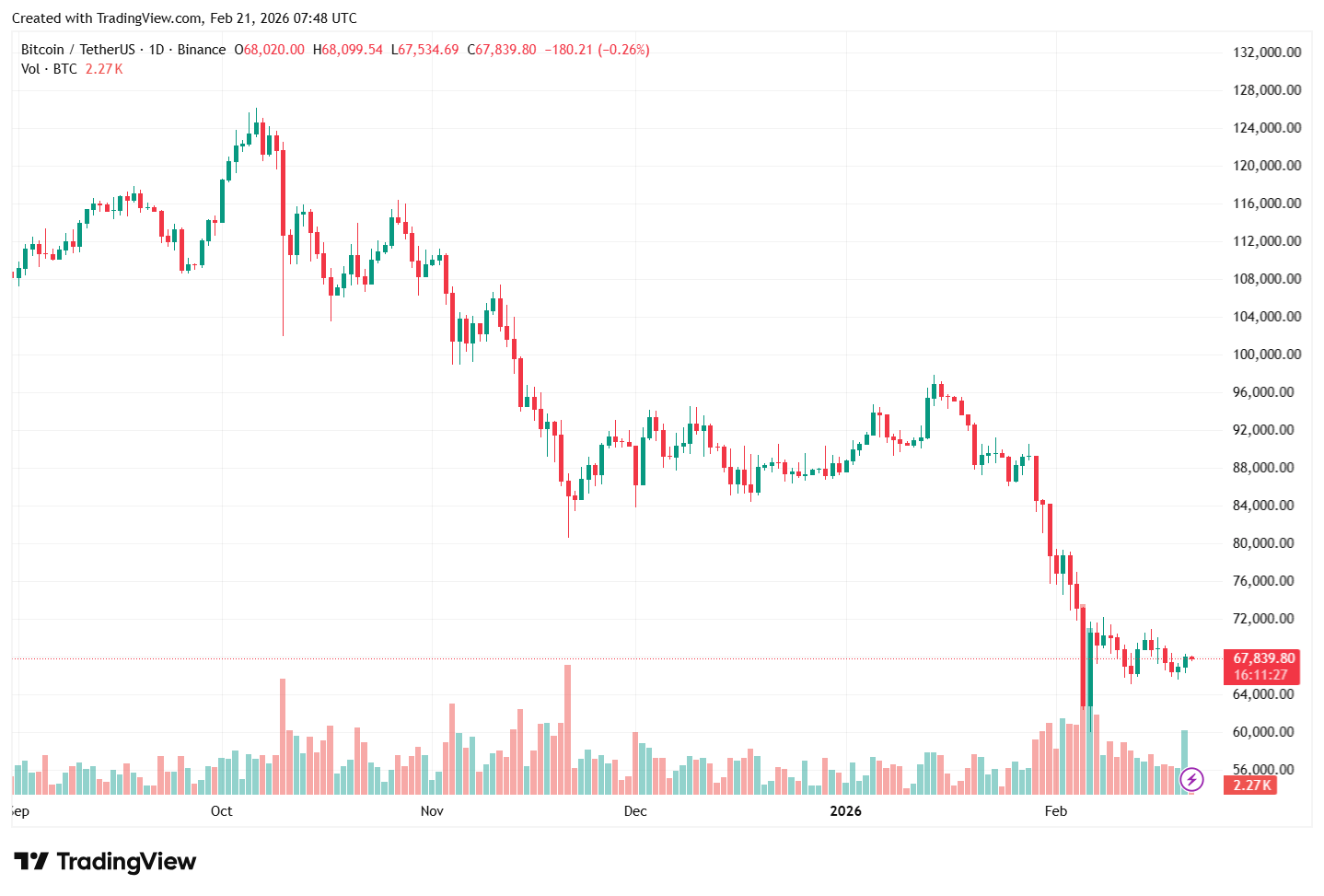
The price of BTC on the daily timeframe | Source: BTCUSDT chart on TradingView


Perguntas relacionadas

QWhat action did the Dutch Gambling Authority take against Polymarket's Dutch arm, Adventure One?

AThe Dutch Gambling Authority ordered Adventure One to cease its activities immediately or face fines of up to $840,000 per week.

QWhat was the primary reason given by the Dutch regulator for banning Polymarket's activities?

AThe regulator classified Polymarket's prediction markets as illegal gambling, stating they offered bets that are not permitted in the Dutch market without a license, including on events like local elections.

QHow did the director of licensing, Ella Seijsener, justify the crackdown on prediction markets?

AElla Seijsener stated that prediction markets offer illegal bets, pose social risks such as potential influence on elections, and constitute illegal gambling that requires a license to operate in the Netherlands.

QWhat recent tax proposal in the Netherlands has also impacted the crypto space?

AThe Dutch House of Representatives advanced a proposal to introduce a 36% capital gains tax on most liquid investments, including cryptocurrencies, taxing both realized and unrealized gains.

QWhat concern did crypto analyst Michaël van de Poppe raise about the proposed Dutch tax on unrealized crypto gains?

AMichaël van de Poppe called the tax 'the dumbest thing I’ve seen in a long time' and predicted that it would cause a significant number of people to flee the country.

Leituras Relacionadas

'Backstabbing' or 'Win-Win'? How Likely Is TradeXYZ to Break Away from Hyperliquid and Go Solo?

The article discusses the growing debate over whether TradeXYZ, which dominates Hyperliquid's HIP-3 market with over 90% of its volume, might break away to build its own independent trading platform. This possibility is fueled by TradeXYZ's immense market influence and the common industry trend of successful projects seeking more control and profit capture. Key arguments for a potential split include TradeXYZ's overwhelming contribution to Hyperliquid's metrics and the financial incentive to retain all transaction fees, as it currently splits them 50/50 with Hyperliquid. The piece draws parallels to other cases, like Anthropic's "Claude Code" competing with its former partner Cursor, suggesting "betrayal" can occur when business leverage shifts. However, strong counterarguments suggest a split is unlikely or would be detrimental. TradeXYZ relies on Hyperliquid's high-performance infrastructure and its platform as a primary user acquisition channel. Building a comparable system would be challenging. Furthermore, the founders of both projects share a history of trust and mutual admiration. The analysis concludes that a separation would likely be a lose-lose scenario: Hyperliquid would lose a major growth narrative and trading volume, while TradeXYZ would face technical hurdles, user migration issues, and reputational damage, potentially allowing competitors to seize market share. The most rational path is seen as continued collaboration, with TradeXYZ potentially negotiating better terms while leveraging Hyperliquid's established strengths.

marsbitHá 4m

'Backstabbing' or 'Win-Win'? How Likely Is TradeXYZ to Break Away from Hyperliquid and Go Solo?

marsbitHá 4m

The Artificial Intelligence Economy Could Accelerate the Establishment of Dominance for Dollar-Pegged Stablecoins

Economists from the ASEAN+3 Macroeconomic Research Office (AMRO) suggest that the winner in the artificial intelligence (AI) race may not be the country developing the most powerful AI model, but the one whose currency underpins these models and their infrastructure. Their thesis outlines a potential cycle where AI-related costs—such as energy for data centers, infrastructure, and usage fees—are denominated in U.S. dollars. As AI grows into a massive industry, this could significantly increase global demand for U.S. dollar liquidity (first channel of dollar dominance). A second channel involves the currency used for payments between AI agents, expected to become widespread in logistics, inventory, and treasury management. Dollar-pegged stablecoins could provide the programmable settlements required for such agent commerce. These two channels may converge, creating a self-reinforcing "dollar loop" where AI computational payments are settled in stablecoins. Stablecoins could gain an early advantage over alternatives like CBDCs due to existing network effects, further entrenching dollar dominance. This would also boost demand for U.S. Treasury bonds used as collateral for stablecoin reserves. The report warns ASEAN+3 nations of over-reliance on this dollar loop and suggests developing regional data centers and tokenized money based on local currencies to participate in the AI economy without reinforcing dollar dependency.

cryptonews.ruHá 7m

The Artificial Intelligence Economy Could Accelerate the Establishment of Dominance for Dollar-Pegged Stablecoins

cryptonews.ruHá 7m

Base Claims Its Distribution Advantage Can Outlast Robinhood Chain's Initial Surge

Base, a layer-2 blockchain, argues that its established distribution network will outlast Robinhood Chain's initial popularity surge. While Robinhood Chain quickly attracted 230,000 daily active users and over $9 billion in DEX volume (primarily from meme coins) shortly after launch, its core feature of tokenized stocks saw minimal use. Base acknowledged shortcomings in focusing on social blockchain products and lagging in areas like perpetual contracts, predictions markets, and on-chain tokenized stocks—a move Robinhood got right. In response, Base highlights its nearly three-year head start in building infrastructure. It emphasizes its x402 payment protocol, which has processed 187.8 million agent payments, its $3.9 billion in stablecoin deposits (mostly USDC), and its integration with partners like Visa, Shopify, and JPMorgan for institutional and merchant settlements. Base contends these capabilities for corporate payments and stablecoin liquidity represent a more durable and defensible ecosystem than Robinhood's retail trading metrics. Coinbase plans to launch its own on-chain, share-backed tokenized stocks on Base, which would directly challenge Robinhood's key differentiating feature. Base's strategy bets that its deep-rooted distribution and institutional partnerships will prove harder to overcome than Robinhood's early, meme-driven volume, which may fade after the initial launch hype.

cryptonews.ruHá 9m

Base Claims Its Distribution Advantage Can Outlast Robinhood Chain's Initial Surge

cryptonews.ruHá 9m

Trading

Spot
活动图片