Polymarket And Kalshi Are Now Under Congressional Investigation — The Evidence That Triggered It Is Hard To Dismiss

bitcoinistPublicado em 2026-05-22Última atualização em 2026-05-22

Resumo

Congress has launched a formal investigation into prediction market platforms Polymarket and Kalshi, led by House Oversight Committee Chairman James Comer. The probe demands explanations on how the platforms prevent insider trading, sparked by suspicious bets tied to classified U.S. military actions. Evidence includes a U.S. soldier's trades before the Venezuela incursion and accounts netting millions from well-timed wagers on U.S.-Iran strikes and a ceasefire announcement. Both companies, which recently updated their rules, face scrutiny over their rapid growth and Washington lobbying. This investigation poses a significant threat that could reshape the prediction market industry.

Representative James Comer, Republican of Kentucky and chairman of the House Oversight and Government Reform Committee, announced a formal investigation into prediction market platforms Polymarket and Kalshi on May 22 — demanding that the CEOs of both companies explain how their platforms detect and prevent insider trading, in a probe triggered by a series of suspicious trades tied to classified US military operations and geopolitical events.

Comer, who announced the investigation on CNBC’s Squawk Box, sent formal letters to the leadership of both platforms seeking information on how they verify user identities, enforce bans on users from restricted jurisdictions, and identify unusual trading patterns that could indicate exploitation of non-public information, per CNBC’s reporting. The inquiry marks a significant escalation of congressional scrutiny that has been building across both parties for months.
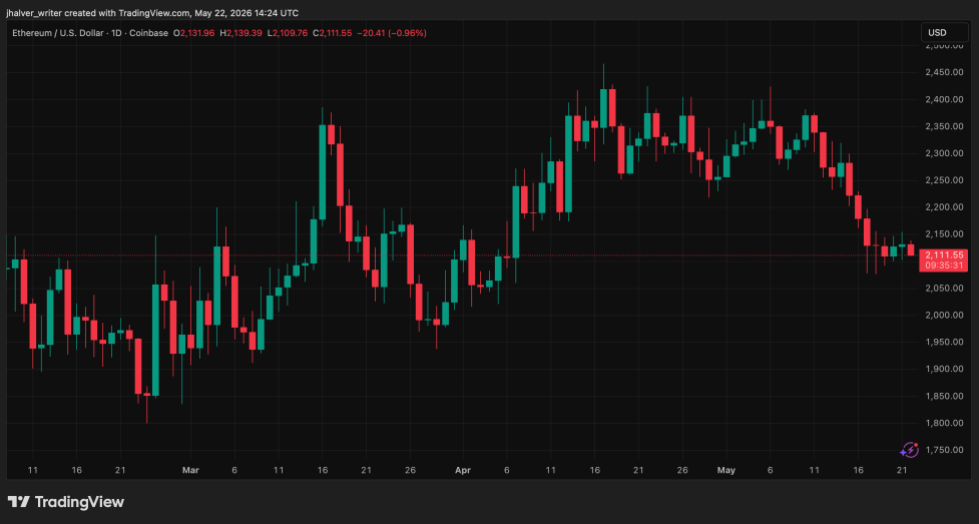
ETH's price trends to the downside on the daily chart. Source: ETHUSD on Tradingview 

The Evidence That Triggered The Probe

The specific trading patterns that prompted the investigation are difficult to dismiss as coincidence. A US special forces soldier was arrested for placing insider trades on Polymarket tied to the US military incursion into Venezuela that resulted in the capture of President Nicolás Maduro — bets placed hours before the operation became public knowledge, per The Hill’s reporting.

A separate trader accumulated nearly $1 million with a 93% success rate on wagers predicting unannounced US and Israeli operations against Iran, placing bets hours before strikes in October 2024, June 2025, and February 2026, according to a CNN report cited by Democratic lawmakers in a letter to Comer.

The February 28 incident is the most striking data point. A group of 38 accounts collectively netted more than $2 million on bets tied to that day’s Iran strikes — with the accounts preloaded with funds the preceding week, per the Democratic lawmakers’ letter. On April 7, at least 50 newly created accounts placed coordinated bets on a US-Iran ceasefire, some opened minutes before the announcement, per the same letter.

Polymarket separately reported suspicious activity across nearly 50 accounts in advance of the US-Iran ceasefire talks, per casino.org’s reporting of the congressional correspondence.

Both Platforms Push Back

Kalshi responded through its head of communications, Elisabeth Diana, who said the company looks forward to engaging with the committee and described its protections against insider trading as comprehensive, per CNBC. Polymarket did not immediately respond to a request for comment at the time of publication.

Both platforms announced updated rules and surveillance tools in March 2026, restricting politicians from trading on their own campaigns and barring athletes from sports-related contracts — moves that preceded but did not prevent the current congressional escalation.

The investigation lands at a moment of peak political sensitivity for prediction markets. Combined trading volumes on Kalshi and Polymarket reached tens of billions of dollars in March 2026 alone, per TipRanks. Both platforms count Donald Trump Jr. as an advisor. And both spent a combined nearly $1 million on federal lobbying in 2025, per CNBC — a Washington presence that may now complicate rather than protect their regulatory standing.

This development marks a pivotal and potentially consequential moment for the nascent prediction market sector. A formal congressional investigation with documented evidence of military-linked insider trading is a categorically different threat than a regulatory inquiry — and the outcome could reshape how these platforms operate, who can participate, and whether the CFTC’s current oversight framework survives intact.

Cover image from Grok, ETHUSD chart from Tradingview

Perguntas relacionadas

QWhat event prompted Representative James Comer to launch a congressional investigation into Polymarket and Kalshi?

AThe investigation was triggered by a series of suspicious trades tied to classified US military operations and geopolitical events, including bets placed by a US special forces soldier and other traders before the operations became public knowledge.

QWhat specific evidence of insider trading is cited in the article regarding the February 2026 Iran strikes?

AOn February 28, a group of 38 accounts collectively netted more than $2 million on bets tied to that day's Iran strikes. These accounts had been preloaded with funds the week before the event.

QWhat information did Representative Comer demand from the CEOs of Polymarket and Kalshi?

AHe demanded that the CEOs explain how their platforms detect and prevent insider trading, including their methods for verifying user identities, enforcing bans on users from restricted jurisdictions, and identifying unusual trading patterns.

QHow did the platforms of Polymarket and Kalshi attempt to address concerns before the investigation was launched?

ABoth platforms announced updated rules and surveillance tools in March 2026, which included restricting politicians from trading on their own campaigns and barring athletes from sports-related contracts.

QWhy is the current moment described as being of 'peak political sensitivity' for prediction markets like Polymarket and Kalshi?

AIt is a sensitive moment due to high trading volumes, the platforms' political connections (such as counting Donald Trump Jr. as an advisor), their significant spending on federal lobbying, and the formal congressional investigation into documented evidence of military-linked insider trading.

Leituras Relacionadas

The Rally That Wasn't

The article analyzes Bitcoin's sharp decline amid a shift in macroeconomic expectations, with strong US job data leading markets to price out Fed rate cuts. Bitcoin fell 13% to around $67,000, triggering significant outflows from US spot ETFs and indicating institutional de-risking. On-chain data confirms a bearish structure. Price has dropped back into the "bear market range," with the Short-Term Holder Cost Basis falling below a key mean level—a pattern last seen in early 2022. The profitability bias has collapsed, with loss realization now dominating, mirroring a panic wave from February. Recent buyers who accumulated near the $82k top are under pressure, and loss realization is accelerating across both short-term and long-term holder cohorts. Off-chain, the rally failed at the aggregate US ETF cost basis near $83k, turning it into resistance. Spot market demand has deteriorated sharply, with sellers dominating order books. While a major long liquidation event cleared over $400M in leverage, spot buyers have not returned to absorb supply. Options markets show sustained demand for downside protection (elevated put premiums) but not panic, with volatility premiums near three-month highs. The conclusion is that the market remains fragile, with overhead supply from trapped ETF investors, weak spot demand, and accelerating losses. Without a return of spot buying and a reclaim of key cost bases, Bitcoin is vulnerable to further downside within the prevailing bear market structure.

insights.glassnodeHá 3h

The Rally That Wasn't

insights.glassnodeHá 3h

Trading

Spot
Futuros

Artigos em Destaque

Como comprar HOUSE

Bem-vindo à HTX.com!Tornámos a compra de Housecoin (HOUSE) simples e conveniente.Segue o nosso guia passo a passo para iniciar a tua jornada no mundo das criptos.Passo 1: cria a tua conta HTXUtiliza o teu e-mail ou número de telefone para te inscreveres numa conta gratuita na HTX.Desfruta de um processo de inscrição sem complicações e desbloqueia todas as funcionalidades.Obter a minha contaPasso 2: vai para Comprar Cripto e escolhe o teu método de pagamentoCartão de crédito/débito: usa o teu visa ou mastercard para comprar Housecoin (HOUSE) instantaneamente.Saldo: usa os fundos da tua conta HTX para transacionar sem problemas.Terceiros: adicionamos métodos de pagamento populares, como Google Pay e Apple Pay, para aumentar a conveniência.P2P: transaciona diretamente com outros utilizadores na HTX.Mercado de balcão (OTC): oferecemos serviços personalizados e taxas de câmbio competitivas para os traders.Passo 3: armazena teu Housecoin (HOUSE)Depois de comprar o teu Housecoin (HOUSE), armazena-o na tua conta HTX.Alternativamente, podes enviá-lo para outro lugar através de transferência blockchain ou usá-lo para transacionar outras criptomoedas.Passo 4: transaciona Housecoin (HOUSE)Transaciona facilmente Housecoin (HOUSE) no mercado à vista da HTX.Acede simplesmente à tua conta, seleciona o teu par de trading, executa as tuas transações e monitoriza em tempo real.Oferecemos uma experiência de fácil utilização tanto para principiantes como para traders experientes.

284 Visualizações TotaisPublicado em {updateTime}Atualizado em 2026.06.02

Como comprar HOUSE

Discussões

Bem-vindo à Comunidade HTX. Aqui, pode manter-se informado sobre os mais recentes desenvolvimentos da plataforma e obter acesso a análises profissionais de mercado. As opiniões dos utilizadores sobre o preço de HOUSE (HOUSE) são apresentadas abaixo.

活动图片













