Polymarket: 84% of Traders Are Losing Money, 0.033% of People Take the Majority of Profits

marsbitPublicado em 2026-04-08Última atualização em 2026-04-08

Resumo

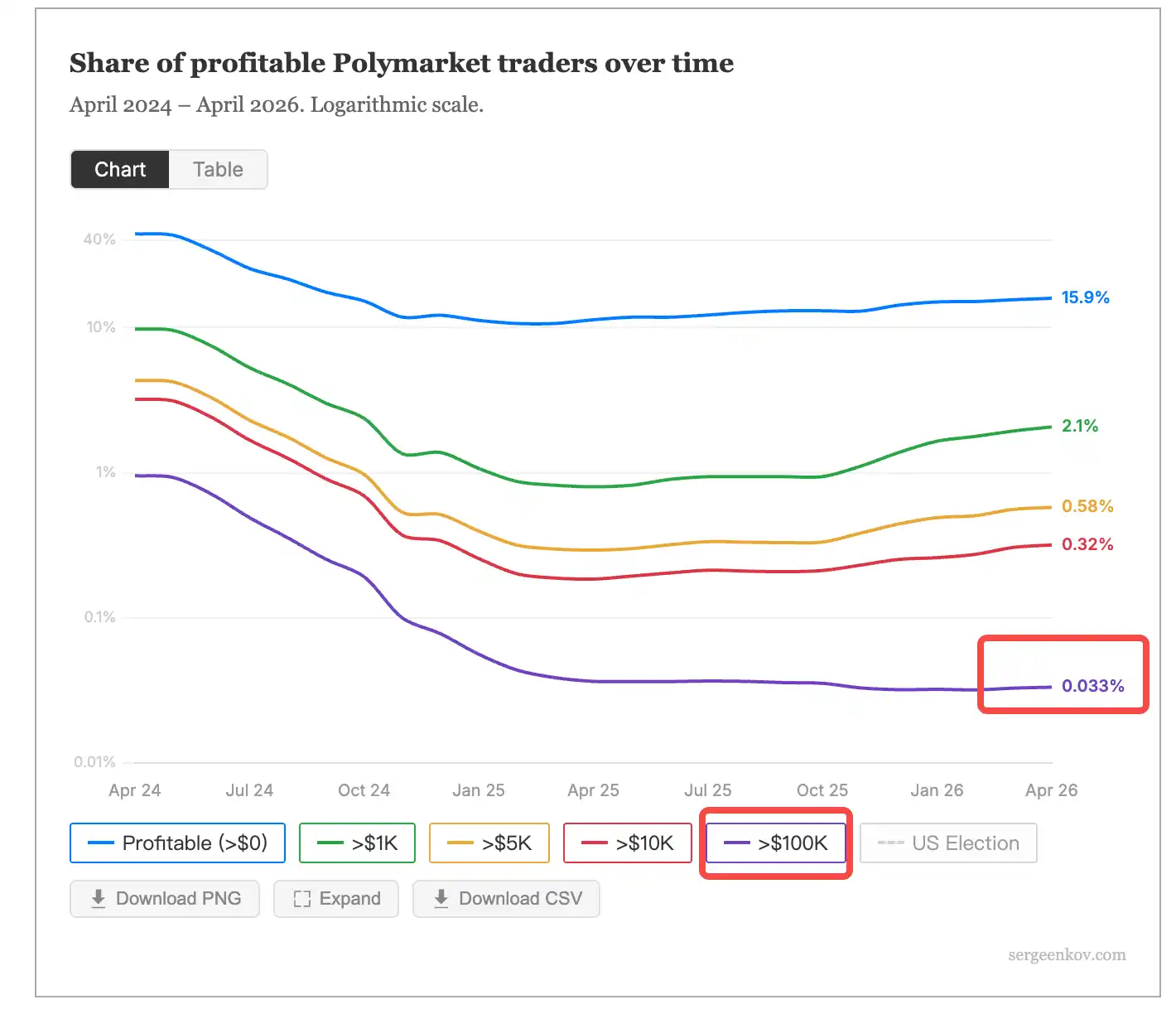
A recent analysis of 2.5 million Polymarket wallet addresses by on-chain researcher Andrey Sergeenkov reveals that 84.1% of traders are losing money, with only 16% achieving any profit. A mere 2% of addresses have accumulated over $1,000 in profits, while just 0.033% (840 addresses) have earned more than $100,000. The study, which improved on prior methodologies by accounting for token splits and mergers, shows a significant increase in unprofitable traders compared to a previous 70% estimate. Profit concentration is extreme: only 1.25% of addresses make over $1,000 monthly, 0.26% earn above $5,000, and just 0.13% surpass $10,000. Most high-earning addresses are short-lived, with 53% of top traders active for only one month. Research indicates that automated strategies—such as arbitrage bots and high-frequency trading systems—dominate profits, exploiting public on-chain data and speed advantages that manual retail traders lack. Despite Polymarket’s accuracy in prediction (94% a month before outcomes), the platform exhibits a stark wealth disparity, raising questions about its function as an information aggregator versus a zero-sum game favoring sophisticated players.

Author: Deep Tide TechFlow

Deep Tide Guide: The latest analysis of 2.5 million wallet addresses on Polymarket by on-chain researcher Andrey Sergeenkov shows that 84.1% of traders are at a loss, with only 2% of addresses accumulating profits exceeding $1,000, and 840 addresses (0.033%) profiting over $100,000. The timing of this report is quite delicate—Polymarket has just secured an exclusive predictive market partnership with MLB for up to $300 million and is pushing hard for retail user growth.

Wealth distribution in on-chain prediction markets is even more brutal than most people imagine.

According to a report by The Defiant on April 6, independent on-chain researcher Andrey Sergeenkov released a profit and loss analysis covering 2.5 million Polymarket wallet addresses, with data as of April 1, 2026. The core conclusion: 84.1% of traders are losing money, and less than 16% of addresses have achieved any level of positive returns.

This is not the first such study. In December 2025, blockchain analyst DeFi Oasis analyzed 1.7 million addresses and 124 million transactions, concluding that 70% of traders were not profitable. Sergeenkov's data sample is larger, and the methodology has been improved (capturing token splits and merges missed in previous research), with the loss ratio jumping from 70% to 84%.

The Top of the Pyramid: Less Than 0.26% Earn Over $5,000 Monthly

Sergeenkov conducted a full analysis of transaction data from two smart contracts, CTF Exchange and NegRisk CTF Exchange, by tracking all USDC fund flows (including buys, sells, redemptions, splits, and merges) on the Polygon chain.

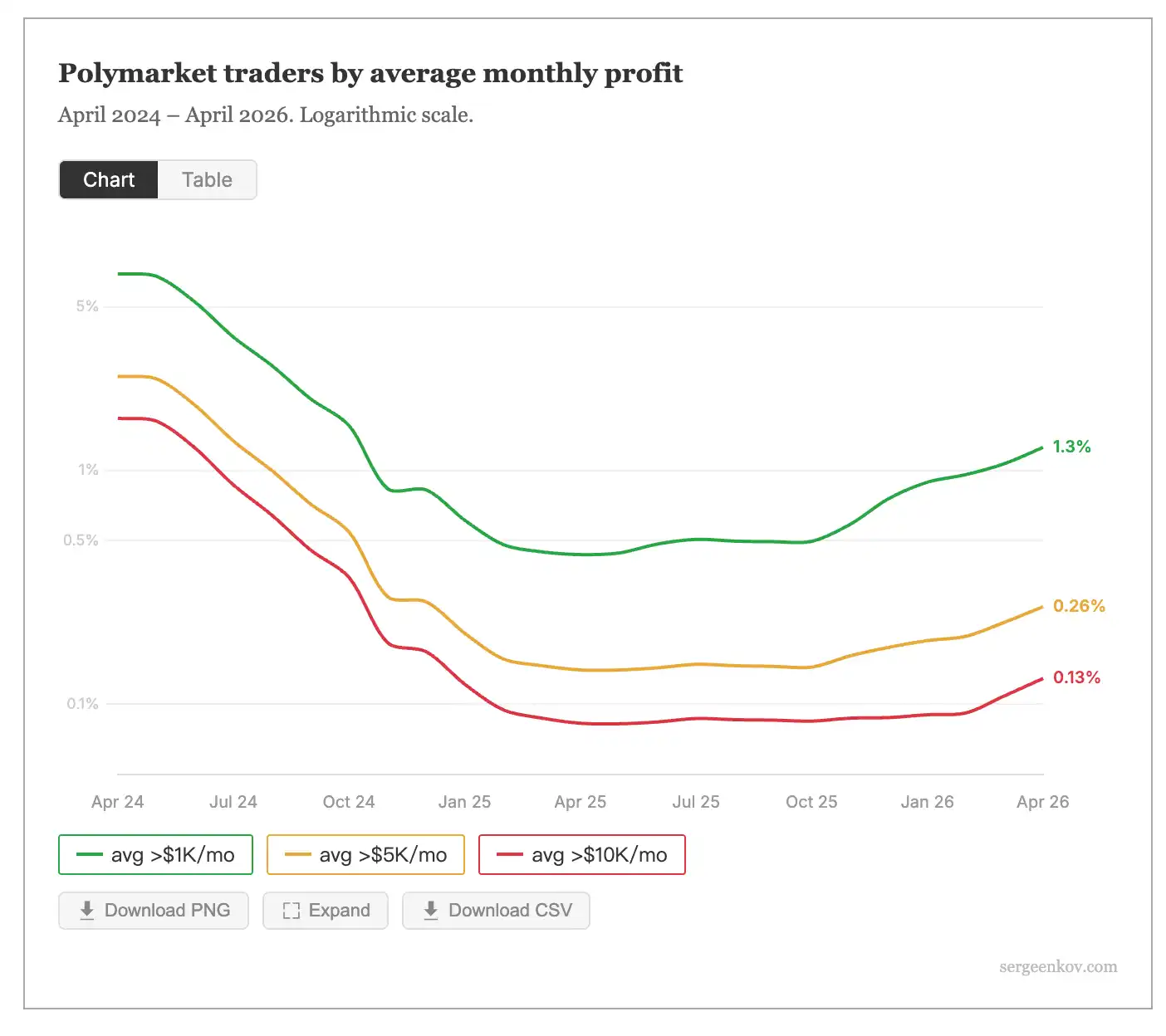
The numbers in the high-profit range are quite stark: addresses with average monthly profits exceeding $1,000 account for 1.25%; those exceeding $5,000 are only 0.26%, about 6,600 addresses; and those exceeding $10,000 drop to 3,250, representing 0.13% of all traders.
More critical is the issue of sustainability. Among those 6,600 addresses with average monthly profits exceeding $5,000, 53% were active for one month and then disappeared, with only 2.6% trading continuously for over a year. Sergeenkov summarized in the report: "Most traders come, trade for a while, and then leave."

In contrast, bottom-feeders consistently harvest profits. An academic paper from Spain's IMDEA Networks Institute analyzed 86 million on-chain transactions between April 2024 and April 2025, finding that arbitrage traders extracted approximately $40 million in profits just from price differences. A single wallet achieved the highest profit of $2 million from 4,049 transactions, averaging $496 per trade.

Retail Manual Trading Can't Beat Bots, Information Advantage Highly Concentrated

The root cause of losses is not complicated. IMDEA's research shows that the largest profits are concentrated in wallets using automated strategies: arbitrage bots, market-making algorithms, and high-frequency trading systems. Manual retail traders typically enter the market only after prices have already adjusted.

This is the fundamental difference between prediction markets and traditional gambling. Polymarket's order book is completely public, and on-chain data is transparent, but this transparency instead makes it easier for professional traders to build systematic advantages. A quantitative wallet equipped with low-latency APIs and probability models is not in the same arena as an ordinary user who opens the app to place a bet after seeing the news.

According to Token Terminal data, Polymarket's nominal trading volume over the past 30 days is approximately $9.8 billion, with about 462,600 monthly active traders. The platform's growth itself is not an issue, but the relationship between user growth and user profitability is inverse—Sergeenkov's data shows that the decline in the proportion of profitable traders is directly related to peaks in user growth, especially the influx after the November 2024 U.S. election.
Information Aggregation Tool or Zero-Sum Game?

This report has reignited an old debate: who exactly do prediction markets serve?

The core argument of supporters is information aggregation. Polymarket's official data claims that its price prediction accuracy exceeds 94% one month before the outcome is determined. In other words, even if 84% of traders are losing money, the market as a whole is still producing valuable probability signals. The losing retail traders are essentially paying for information pricing.

Critics argue that when 84% of a platform's participants are losing money and profits are highly concentrated in the hands of automated traders, the difference between it and a casino is merely a matter of regulatory classification. Especially in the realm of sports contracts, the line between prediction markets and sports betting is being deliberately blurred.

Polymarket's valuation has exceeded $20 billion, and the Intercontinental Exchange (parent company of the NYSE) invested $2 billion in October 2025. Capital markets are clearly betting on the growth story of prediction markets.

But Sergeenkov's report raises a simple question: when the next wave of 2.5 million users floods in, how will their fate differ from the previous wave?


Criptomoedas em alta

Perguntas relacionadas

QAccording to the analysis of 2.5 million Polymarket wallet addresses, what percentage of traders are losing money?

A84.1% of traders are losing money.

QWhat is the estimated number of addresses that have profited more than $100,000 on Polymarket, according to the researcher Andrey Sergeenkov?

A840 addresses (0.033% of the total) have profited more than $100,000.

QWhat does the research from the IMDEA Networks Institute identify as the primary reason for散户 (retail traders) losses on prediction markets like Polymarket?

AThe research found that the largest profits are concentrated in wallets using automated strategies (arbitrage bots, market-making algorithms, and high-frequency trading systems), while manual retail traders typically enter the market after prices have already adjusted.

QWhat key statistic does the article mention about the sustainability of high-earning traders (those making over $5,000 monthly)?

AAmong the 6,600 addresses with monthly profits exceeding $5,000, 53% were only active for one month before disappearing, and only 2.6% traded consistently for over a year.

QDespite most traders losing money, what is the core argument of supporters who defend the value of prediction markets like Polymarket?

ASupporters argue that prediction markets serve as valuable information aggregation tools, with Polymarket's prices achieving over 94% accuracy in predicting outcomes one month in advance, meaning the market as a whole produces valuable probabilistic signals even if most individual traders lose money.

Leituras Relacionadas

Rubin Ultra Makes Major Cuts, Even Nvidia Can't Handle Memory Price Hikes?

NVIDIA's Rubin Ultra, the top-tier variant of the newly announced Rubin AI accelerators, has reportedly seen significant specification downgrades, according to an industry report from SemiAnalysis. Initially designed with four compute dies (4-die), the Rubin Ultra is now said to be reduced to a 2-die design. Key changes highlighted in the report include: * **No increase in peak theoretical compute performance**, remaining at 35 PFLOPs like the standard Rubin. * **Severe reduction in memory capacity** to 192GB using 8-Hi HBM stacks, which is less than the standard Rubin's 288GB using 12-Hi stacks. * **Negligible memory bandwidth improvement** of only 1 TB/s. * **Slightly higher chip-level power consumption**. * The **primary upgrade is a massive increase in scale-up interconnect capacity**, supporting connections for up to 576 GPUs via NVLink, compared to 72 for the standard Rubin. The report suggests the redesign is primarily a cost-optimization move driven by the sharp rise in HBM (High-Bandwidth Memory) prices. By reducing the expensive HBM content and shifting investment towards enhanced system-scale networking, NVIDIA aims to maintain the platform's value for large-scale AI training clusters while managing soaring material costs. The news reportedly triggered a sell-off in South Korean memory stocks, with SK Hynix and Samsung shares falling around 8%, as markets grew concerned that NVIDIA—a major HBM buyer—might be reducing its reliance on high-capacity memory, potentially capping future pricing power for memory makers.

Odaily星球日报Há 21m

Rubin Ultra Makes Major Cuts, Even Nvidia Can't Handle Memory Price Hikes?

Odaily星球日报Há 21m

Can Generative Models Finally Be Trained End-to-End? The Core Is a For Loop

This article introduces a novel training paradigm for generative models called Explorative Modeling (XM), which enables true end-to-end training. Traditionally, powerful generative models like autoregressive and diffusion models are not trained end-to-end. They are trained to predict a single small step but require iterative multi-step sampling for inference. This "exposure bias" leads to error accumulation and limits performance. The core challenge XM addresses is "mode blurring." In generative tasks, a single input (e.g., "generate a dog") corresponds to many valid outputs (multiple modes). Standard training objectives like reconstruction loss force the model to average these modes, producing unrealistic, blurry outputs. To avoid this, existing models break generation into many small, almost deterministic steps, sacrificing end-to-end training. XM tackles this by restructuring the training loop itself. Its key insight is to amplify "generative expressivity." For each training input, instead of generating one sample, the model generates K candidate outputs. Only the candidate closest to the real data is used for computing the loss and updating the model via backpropagation. This simple "best-of-K" mechanism is implemented as a short for-loop. By exploring multiple possibilities, the model learns to distribute its guesses across different modes rather than collapsing to their uninformative average. The paper demonstrates that "exploration" acts as a new, powerful scaling axis. Gains from XM increase with model size, data scale, and compute. Experiments show improvements in FID scores for image generation and significant efficiency gains, sometimes outperforming larger models without exploration. When pushed to the limit, XM enables fully single-step, end-to-end generative models. In robotics tasks, an "Explorative Policy" matched the performance of a 100-step Diffusion Policy with a single forward pass, drastically improving inference speed. While the best-of-K concept is not entirely new, the authors' contribution lies in formally understanding it as a direct method to boost generative expressivity without fragmenting the generation process. This work suggests that as models scale, enhancing exploration during training may become crucial for overcoming fundamental performance bottlenecks.

marsbitHá 1h

Can Generative Models Finally Be Trained End-to-End? The Core Is a For Loop

marsbitHá 1h

Trading

Spot

Artigos em Destaque

Como comprar PEOPLE

Bem-vindo à HTX.com!Tornámos a compra de ConstitutionDAO (PEOPLE) simples e conveniente.Segue o nosso guia passo a passo para iniciar a tua jornada no mundo das criptos.Passo 1: cria a tua conta HTXUtiliza o teu e-mail ou número de telefone para te inscreveres numa conta gratuita na HTX.Desfruta de um processo de inscrição sem complicações e desbloqueia todas as funcionalidades.Obter a minha contaPasso 2: vai para Comprar Cripto e escolhe o teu método de pagamentoCartão de crédito/débito: usa o teu visa ou mastercard para comprar ConstitutionDAO (PEOPLE) instantaneamente.Saldo: usa os fundos da tua conta HTX para transacionar sem problemas.Terceiros: adicionamos métodos de pagamento populares, como Google Pay e Apple Pay, para aumentar a conveniência.P2P: transaciona diretamente com outros utilizadores na HTX.Mercado de balcão (OTC): oferecemos serviços personalizados e taxas de câmbio competitivas para os traders.Passo 3: armazena teu ConstitutionDAO (PEOPLE)Depois de comprar o teu ConstitutionDAO (PEOPLE), armazena-o na tua conta HTX.Alternativamente, podes enviá-lo para outro lugar através de transferência blockchain ou usá-lo para transacionar outras criptomoedas.Passo 4: transaciona ConstitutionDAO (PEOPLE)Transaciona facilmente ConstitutionDAO (PEOPLE) no mercado à vista da HTX.Acede simplesmente à tua conta, seleciona o teu par de trading, executa as tuas transações e monitoriza em tempo real.Oferecemos uma experiência de fácil utilização tanto para principiantes como para traders experientes.

577 Visualizações TotaisPublicado em {updateTime}Atualizado em 2026.06.02

Como comprar PEOPLE

Discussões

Bem-vindo à Comunidade HTX. Aqui, pode manter-se informado sobre os mais recentes desenvolvimentos da plataforma e obter acesso a análises profissionais de mercado. As opiniões dos utilizadores sobre o preço de PEOPLE (PEOPLE) são apresentadas abaixo.

活动图片