Key Takeaways:
- The price of $POL faces bearish pressure towards $0.1.
- The Polygon price forecast for 2026 suggests the $POL price will rise to $0.28.
- By 2032, we expect the maximum $POL price to be $1.19.
Polygon, an Ethereum sidechain and Layer-2 scaling solution, has experienced significant growth in popularity among enterprises and industries over the past year. As a result, many analysts eagerly await the future valuation of its native cryptocurrency, $POL. The question arises: Can the $POL price reach $1?
This Polygon price forecast examines factors such as ecosystem trends, adoption rates, underlying technology, and technical analysis to project the $POL price prediction for the period from 2026 to 2032.
Overview
| Cryptocurrency | Polygon |
| Ticker | $POL |
| Rank | 58 |
| Current Price | $0.1 |
| 24H Price Change | +4% |
| Market Capitalization | $982.8 million |
| Circulating Supply | 10.56 billion $POL |
| 24h Trading Volume | $72.25 million (+26.4%) |
| All-Time High | $1.29, March 14, 2024 |
| All-Time Low | $0.08142, April 13, 2026 |
$POL Price Forecast: Technical Analysis
| Metric | Value |
| Current Price | $0.1051 |
| Price Forecast | $0.09262 (-10.63%) |
| Fear & Greed Index | 69 (Greed) |
| Market Sentiment | Neutral |
| Volatility | 6.92% (High) |
| Green Days | 17/30 (57%) |
| 50-Day SMA | $0.1034 |
| 200-Day SMA | $0.08965 |
| 14-Day RSI | 48.47 (Neutral) |
Polygon Technical Analysis: $POL Price Experiences Bullish Pressure Towards $0.1
- $POL price analysis shows a bullish trend towards $0.1
- Resistance for $POL is observed at $0.11111
- Support for $POL/USD is observed at $0.09574
The $POL price analysis for October 12 confirms increased volatility amid a move towards the $0.1 mark. Buyers are currently aiming for a bullish rally.
$POL Price Analysis on Daily Chart: Polygon Experiences Buyer Pressure Around $0.1
The $POL price shows an uptick thanks to buyer activity pushing the price towards $0.1. $POL is seeking consolidation near immediate resistance levels, preparing to hold above $0.1. The 24-hour trading volume has increased to $10.2 million, indicating heightened trading activity. The $POL price is $0.1, showing a gain of over 4% in the last 24 hours.
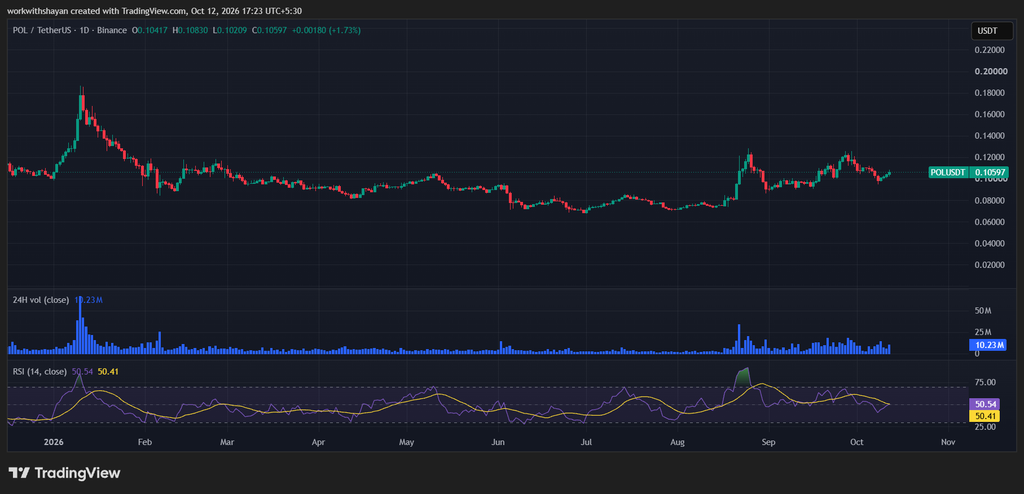
The RSI-14 trend line has risen from its previous level and sits above the midline around the 50 mark, indicating buyers' efforts to control price momentum. The SMA-14 level suggests volatility in the coming hours.
$POL/USD 4-Hour Price Chart: Bulls Aim to Hold Price Above EMA Trend Lines
The 4-hour $POL price chart suggests that $POL continues to experience bearish activity around the EMA lines, creating a negative sentiment on the price chart. As the price continues to face resistance near Fibonacci levels, bulls are preparing for dominance, holding the price above the EMA20 trend line.
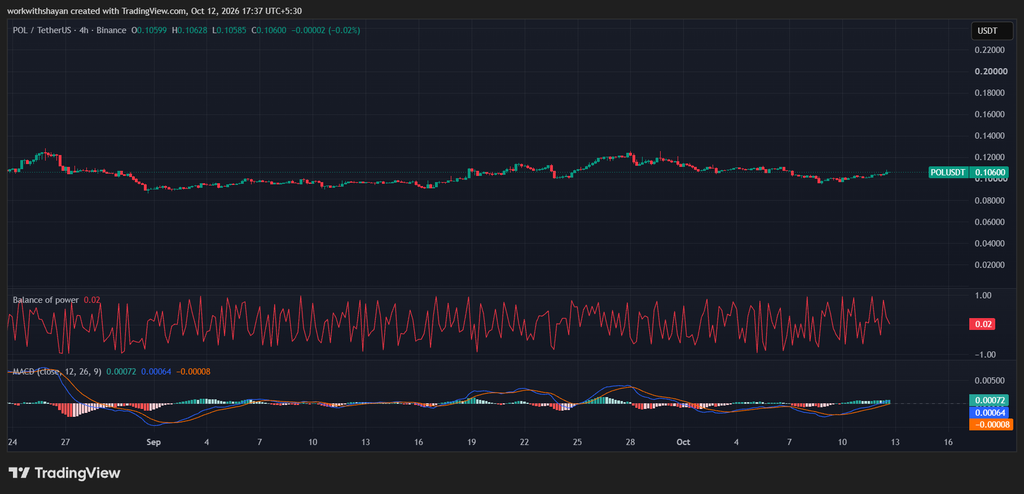
The BoP indicator is trading in positive territory at 0.02, hinting that buyers are attempting to create pressure near resistance levels and enhance the upward correction.
Furthermore, the MACD trend line has formed green candles above the signal line, and the indicator is aiming for a positive dynamic, reinforcing bullish positions.
$POL Technical Indicators: Levels and Actions
Daily Simple Moving Average (SMA)
| Period | Value | Action |
| SMA 3 | $0.1019 | BUY |
| SMA 5 | $0.1012 | BUY |
| SMA 10 | $0.1048 | BUY |
| SMA 21 | $0.1087 | SELL |
| SMA 50 | $0.1034 | BUY |
| SMA 100 | $0.09147 | BUY |
| SMA 200 | $0.08965 | BUY |
Daily Exponential Moving Average (EMA)
| Period | Value | Action |
| EMA 3 | $0.1025 | BUY |
| EMA 5 | $0.1028 | BUY |
| EMA 10 | $0.1045 | BUY |
| EMA 21 | $0.1054 | SELL |
| EMA 50 | $0.1015 | BUY |
| EMA 100 | $0.09637 | BUY |
| EMA 200 | $0.1007 | BUY |
What to Expect from the $POL Price Analysis Next?
The hourly chart confirms that bears are making efforts to prevent an immediate $POL price rise. However, if the $POL price successfully breaks above the $0.11111 level, it could rise further and reach resistance at $0.12605.
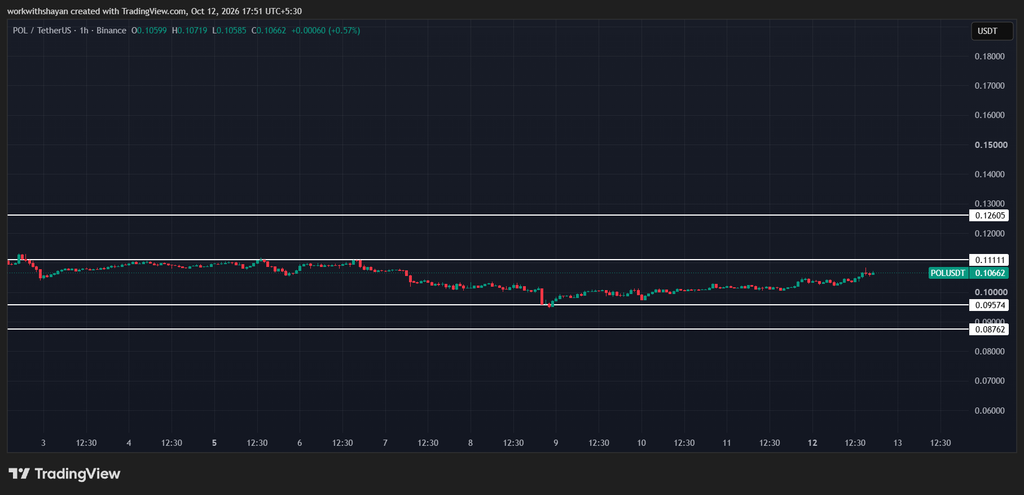
If bulls fail to initiate an uptrend, the $POL price could fall below the nearest support line at $0.09574, leading to a correction to $0.08762.
Is $POL a Good Investment?
The $POL token could be a good long-term investment option as the project develops its roadmap for the Polygon 2.0 version. Polygon is collaborating with various industries to enhance adoption levels, focusing on $NFT solutions and Ethereum scalability. Partnerships include Starbucks for an $NFT loyalty program and collaborations with Adidas, Prada, and Disney for developing $NFT offerings.
Why Is the $POL Price Rising Today?
Following overall market volatility, the $POL price faced intensified buyer pressure around the $0.1 level. Consequently, buyers are holding the price around $0.1.
What Is the $POL Price Prediction for 2026?
The Polygon price forecast for 2026 suggests that the $POL price will reach a maximum level of $0.28.
Will the $POL Price Touch $1?
Yes, the $POL price could reach the $1 mark by the end of 2032. However, this depends on future market sentiment and buyer demand.
Will the $POL Price Reach $10?
If everything goes well and $POL gains regulatory recognition, its price could exceed $10 by 2040.
Is $POL a Good Long-Term Investment?
As Polygon continues to expand its offerings, it holds a significant position in the altcoin market. Consequently, $POL could be a good long-term investment option.
Latest News / Opinions on $POL
Polygon partners with Mastercard to launch Agent Pay, aiming to simplify operations for machines by introducing structure, governance, and trust to this new payment class.
$POL Price Prediction for October 2026
Analysts expect steady growth in the crypto market in October. We forecast that the minimum $POL price will be $0.07, the maximum $0.13, and the average $0.1 in October.
| $POL Price Prediction | Potential Low | Potential Average | Potential High |
| $POL Price Prediction for October 2026 | $0.07 | $0.1 | $0.13 |
$POL Price Prediction for 2026
Ethereum fees surge dramatically during a bull market, making them too expensive for regular crypto users. That's why Polygon gained popularity during the last bull market. But this time, in 2026, Polygon faces tougher competition from Arbitrum, Optimism, and Starknet.
However, Polygon's Proof of Stake (PoS) network can handle up to 65,000 transactions per second (TPS) and is cheaper than networks like Arbitrum and Optimism. Consequently, growing adoption could lead to its price increasing in 2026.
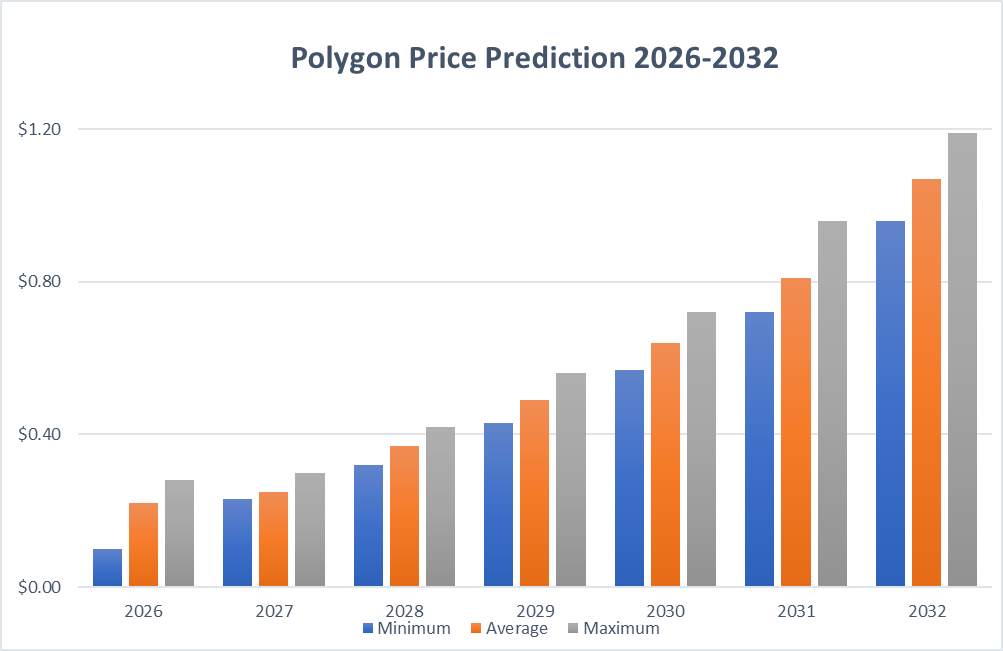
In 2026, the Polygon price is projected to reach a minimum level of $0.07. It is expected to reach a maximum level of $0.28, with an average price of $0.22 throughout the year.
| $POL Price Prediction | Potential Low | Potential Average | Potential High |
| $POL Price Prediction for 2026 | $0.07 | $0.22 | $0.28 |
$POL Price Predictions for 2027-2032
| Year | Minimum Price | Average Price | Maximum Price |
| 2027 | 0.23 | 0.25 | 0.3 |
| 2028 | 0.32 | 0.37 | 0.42 |
| 2029 | 0.43 | 0.49 | 0.56 |
| 2030 | 0.57 | 0.64 | 0.72 |
| 2031 | 0.72 | 0.81 | 0.96 |
| 2032 | 0.96 | 1.07 | 1.19 |
Pol Price Prediction for 2027
Polygon has made Polygon zkEVM available to everyone, becoming one of the first ZK Rollups to do so. This is a major step forward for Polygon and gives it an advantage.
With growing business usage, innovative technology, and past success, Polygon could reach a new all-time high in 2027.
According to forecasts and technical analysis, the Polygon price is expected to reach a low of $0.23 in 2027. The maximum price projection is $0.30, with an average of $0.25.
Polygon ($POL) Price Prediction for 2028
In 2028, the minimum price of one Polygon is expected to be $0.32. The maximum $POL price projection is $0.42, and the average price for the year will be $0.37.
Polygon Price Prediction for 2029
In 2029, the Polygon price is forecast to reach a minimum of $0.43. The maximum price could rise to $0.56, and the average trading price during the year will be $0.49.
Polygon Price Prediction for 2030
In 2030, the minimum Polygon price is expected to be $0.57. The highest possible $POL price level could reach $0.72, and the average forecast price is $0.64.
Polygon ($POL) Price Prediction for 2031
In 2031, the Polygon price is expected to reach a low of $0.72. The maximum projection is $0.96, and the average trading price is $0.81.
Polygon Price Prediction for 2032
In 2032, the Polygon price is forecast to reach a minimum of $0.96. The maximum price could rise to $1.19, and the average trading price during the year will be $1.07.
$POL Price Prediction from Experts
| Company Name | 2026 | 2027 |
| Coincodex | $0.3294 | $0.2629 |
| CoinDCX | $0.42 | $0.5 |
$POL Price Prediction from Cryptopolitan
Cryptopolitan is optimistic about the future market potential of $POL. In 2026, the Polygon price is expected to reach a minimum level of $0.07. The maximum level is expected to be $0.28, with an average price throughout the year of $0.22.
By the end of 2032, the $POL price is expected to rise to a high of $1.19, with an average trading price of $1.07.
$POL Historical Market Sentiment
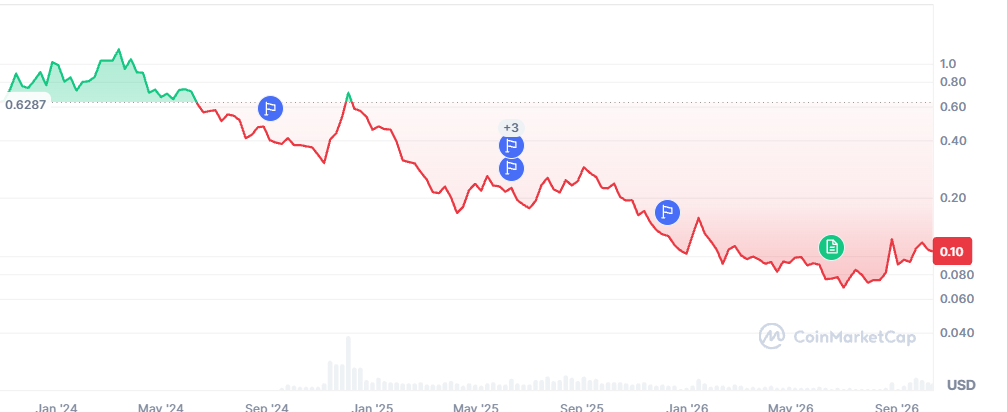
- $POL debuted in 2019, initially priced below a cent.
- For the next two years, the price remained stable around $0.02.
- The rebranding of $POL to Polygon in 2021 fueled growth: the price exceeded $1 in May and reached an all-time high of $2.92 on December 27.
- In 2022, $POL struggled: the price fell below $1 in May, below $0.50 in June, briefly recovered above $1 in August, and ended the year at $0.7585, down 70%.
- The following year, 2023, Polygon showed mixed results: the price exceeded $1 in February but fell to $0.5593 after news from Crypto.com in June. In July, it peaked at $0.8775, declined to $0.4946 in September, and recovered to $0.9789 by November.
- In January, $POL rose from $0.8514 to $1.4 in March but fell below $0.8 by May, reaching a low around $0.4 in June and July. In August and September, the price consolidated in the $0.4–$0.6 range, briefly rising above $0.45.
- In October, the price dropped to $0.39, but in November, following Donald Trump's victory, it surged sharply to $0.63, ending December on bearish ground at $0.477.
- At the beginning of January 2025, $POL opened the market at $0.4511; in February, the price fluctuated in the $0.3068–$0.3455 range.
- However, by the end of February, the $POL price had dropped to around $0.25.
- In March, the $POL price fell sharply, dropping below the crucial $0.2 level.
- In April, the $POL price continued to fluctuate below $0.2. However, as the trade war between the US and China eased, the $POL price broke through resistance levels and reached a high of $0.26 by the end of April.
- In early May, the Polygon price dropped slightly, falling to $0.21. However, later in mid-May, it surged sharply to a high of $0.27.
- In early June, the $POL price dropped sharply to the $0.2 level. By the end of June, the $POL price had fallen to $0.17.
- In July, the $POL price rose to $0.26, but in early August, it dropped sharply to $0.19.
- The $POL price rose to $0.26 in August. However, later in September, it consolidated around the $0.25 level.
- In early October, the Polygon price rose to a high of $0.25. The $POL price ended the month on bearish ground around $0.17.
- By the end of November, the $POL price had fallen to $0.12.
- The $POL price ended 2025 on bearish ground, falling to the $0.1 level.
- In January 2026, the $POL price fell further, reaching a low around $0.08 in February. In early April, the price fluctuated around $0.09. By the end of April, the $POL price had risen to $0.1.
- In May, the $POL price fell to $0.088.
- By the end of June, the Polygon price had fallen to $0.08. In July, the $POL price fluctuated around $0.08.
- In August, the $POL price rose to $0.13. In September, the price fluctuated around $0.12.