Polygon deploys Madhugiri hard fork, aims for 33% throughput boost

cointelegraphPublicado em 2025-12-09Última atualização em 2025-12-09

Resumo

Polygon has deployed the Madhugiri hard fork, targeting a 33% increase in network throughput and reducing block consensus time to one second. The upgrade includes support for three Fusaka Ethereum Improvement Proposals (EIP-7823, EIP-7825, EIP-7883), which improve efficiency and security by limiting gas consumption for heavy mathematical operations. It also introduces a new transaction type for Ethereum-Polygon bridge traffic and adds flexibility for future upgrades. This enhancement aims to better support high-frequency use cases like stablecoins and real-world asset (RWA) tokenization. The hard fork follows the recent Heimdall 2.0 upgrade, which significantly reduced finality times, despite a brief disruption in September due to a bug that was later resolved.

Blockchain network Polygon has rolled out its latest protocol upgrade, known as the Madhugiri hard fork, which aims to achieve a 33% increase in network throughput and reduce block consensus time to one second.

Polygon core developer Krishang Shah said on X that the update includes support for three Fusaka Ethereum Improvement Proposals, specifically EIP-7823, EIP-7825 and EIP-7883. These EIPs make heavy mathematical operations more efficient and secure by limiting the amount of gas they consume.

They also prevent single transactions from consuming excessive computing power, helping the network run more smoothly and predictably.

The upgrade introduces a new transaction type for Ethereum to Polygon bridge traffic and adds a built-in flexibility feature for future upgrades. Polygon previously said that the update makes throughput increases as easy as “flipping a few switches.”

“We are also decreasing the consensus time to 1 second, so blocks can now be announced in 1 second if ready, instead of waiting the full 2 seconds,” Shah wrote.
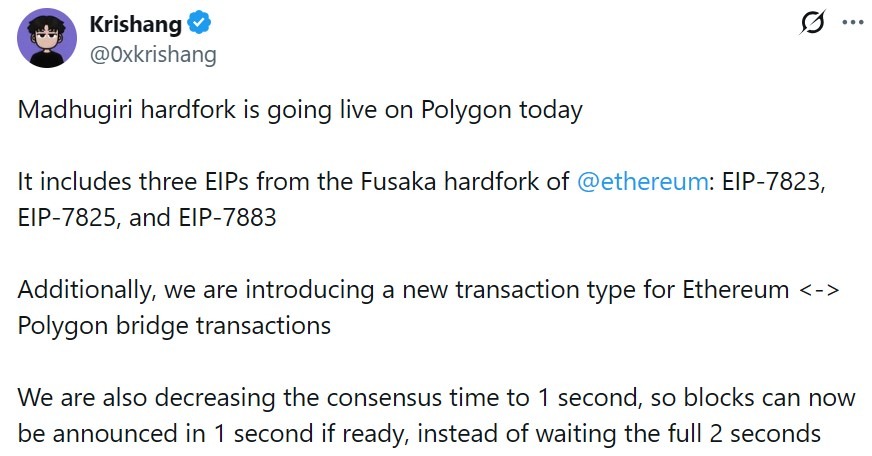
Source: Krishang Shah

New update reinforces Polygon for stablecoins and RWAs

With Madhugiri now live, Polygon aims to reinforce its infrastructure while materially improving its performance. These are prerequisites for high-frequency and high-trust use cases, such as real-world asset (RWA) tokenization and stablecoins.

Aishwary Gupta, the global head of payments and RWAs at Polygon Labs, previously forecasted a “stablecoin supercycle.”

Gupta said there will be a surge of “at least 100,000 stablecoins” in the next five years. However, he said this would not only be about minting tokens and must have a corresponding utility like yield.

Gupta also advocated for more transparency and accountability in the RWA sector. He previously argued that RWA numbers are meaningless if the assets cannot be audited, settled or traded.

“When transparency and accountability are established, RWAs will reach even greater heights, unlocking trillions in institutional capital,” he wrote.

Related: Polygon co-founder mulls resurrecting MATIC a year after POL rebrand

Hard fork follows major Heimdall upgrade

The upgrade comes on the heels of rapid prior improvements. On July 10, Polygon deployed Heimdall 2.0, dubbed by Polygon Foundation CEO Sandeep Nailwal as the network’s “most technically complex” hard fork since its launch.

The update reduced transaction finality times from one to two minutes to roughly five seconds.

However, on Sept. 10, the network experienced a significant disruption when a bug caused finality delays of 10 to 15 minutes, affecting validator sync, remote procedure call services and third-party tooling. Despite this, the team assured the community that blocks were still running.

On Sept. 11, the Polygon Foundation announced that the consensus and finality functions had been restored through a hard fork. With the update, nodes were no longer stuck, while checkpoints and milestones were finalized as expected.

Magazine: Ethereum’s Fusaka fork explained for dummies: What the hell is PeerDAS?

Leituras Relacionadas

Chipsea Turns from A-share to H-share: Riding the Price Surge Trend, or Gambling on the Cycle?

Xintianxia Technology, a Chinese flash memory chipmaker, is making its second attempt to list on the Hong Kong Stock Exchange after withdrawing its application for a mainland China IPO in late 2023. This move coincides with an upcycle in the memory chip sector. Ranked fifth among global fabless code-type flash memory suppliers in 2025, Xintianxia specializes in NOR Flash and SLC NAND chips. However, it holds a small 1.3% global market share in this niche segment. The company is highly dependent on a concentrated group of suppliers, with its top five accounting for over 80% of procurement in Q1 2026. After posting losses in 2023 and 2024, the company's fortunes reversed sharply in Q1 2026. Revenue grew 77.4% year-over-year to RMB 224 million, with net profit reaching RMB 75.89 million. This dramatic turnaround was primarily driven by strategic inventory stockpiling and significant price increases for its core products, leading to a gross margin surge to 55.63%. However, this aggressive strategy carries major risks. Inventory days have risen significantly, and the company's operating cash flow turned negative in Q1 2026 due to high stockpiling costs. The memory industry's cyclical nature means the current price boom may not last. If a downturn arrives, Xintianxia's high-cost inventory could become a financial burden, a scenario that previously derailed its A-share listing ambitions. Further complicating its IPO journey are corporate governance concerns. The company paid substantial dividends during loss-making years, and several major shareholders, including state-backed funds and the founder, cashed out significant stakes shortly before the Hong Kong listing application. Chinese regulators have requested details on past equity transfers, questioning pricing fairness. In essence, Xintianxia's Hong Kong listing bid is a high-stakes gamble on the sustainability of the current chip price cycle. Its future hinges not just on favorable market conditions but on its ability to withstand the inevitable downturn and prove its long-term operational resilience.

marsbitHá 8m

Chipsea Turns from A-share to H-share: Riding the Price Surge Trend, or Gambling on the Cycle?

marsbitHá 8m

BlackRock Launches Stablecoin Reserve Fund BRSRV: Bringing Short-Term US Treasuries to Solana, Ethereum, and Tempo

BlackRock Launches Tokenized Stablecoin Reserve Fund BRSRV, Expands to Solana and Tempo Global asset management giant BlackRock has introduced BRSRV (BlackRock Daily Reinvestment Stablecoin Reserve Vehicle), a tokenized money market fund specifically designed for stablecoin reserves. Concurrently, the firm is issuing tokenized, on-chain shares of its existing BSTBL (BlackRock Select Treasury-Based Liquidity Fund). A key development is the expansion of supported blockchains beyond Ethereum to include Solana and Stripe-affiliated chain Tempo for recording share ownership. The transfer agent Securitize will manage the process through approved, whitelisted wallets requiring verified identity, with a minimum initial investment of $3 million. The fund will invest solely in cash, short-term U.S. Treasuries, and overnight repurchase agreements backed by U.S. government securities, explicitly avoiding any crypto assets. BlackRock states the structure aims to qualify as a compliant reserve asset under the U.S. GENIUS Act for payment stablecoins. This launch builds upon BlackRock's broader tokenization strategy, notably following its BUIDL fund introduced in March 2024, which now holds over $26 billion in assets. The move places BlackRock alongside other major institutions like Morgan Stanley and Fidelity in offering products tailored for the stablecoin reserve market, signaling a deepening institutional push into tokenized real-world assets (RWA) and on-chain finance infrastructure.

marsbitHá 9m

BlackRock Launches Stablecoin Reserve Fund BRSRV: Bringing Short-Term US Treasuries to Solana, Ethereum, and Tempo

marsbitHá 9m

Wall Street Morning Report: AI + Cloud Computing Takes Over the Market Again, Amazon Knocks on the Door of $3 Trillion

Wall Street's August began with a strong rally, driven by easing Middle East tensions as President Trump signaled progress on U.S.-Iran talks, prompting a sharp drop in oil prices. Major indices hit record or near-record highs, with the Dow Jones Industrial Average up 1.32%, the Nasdaq Composite surging 2.13%, and the S&P 500 rising 1.48%. The energy sector was the sole decliner. The AI and cloud computing narrative dominated the tech rally. The "Magnificent Seven" index jumped 3.6%. Amazon's market cap surpassed $3 trillion for the first time following robust AWS results, while Nvidia regained a $5 trillion valuation. Meta, Google, and Microsoft also posted significant gains. Other AI-related stocks like Palantir, CoreWeave, and various semiconductor and infrastructure companies saw strong advances. In other markets, gold held above $4,000, supported by central bank buying. Treasury yields fell as oil prices dropped. The U.S. dollar remained stable despite strong manufacturing data. Japan's substantial currency intervention raised concerns, but U.S. officials reassured markets about the mechanism used. Key events ahead include major industry conferences (Ai4 2026, FMS Summit) and earnings reports from companies like SpaceX, AMD, and Pfizer. The White House is also set to host a meeting with leading AI firms to discuss regulatory frameworks.

marsbitHá 1h

Wall Street Morning Report: AI + Cloud Computing Takes Over the Market Again, Amazon Knocks on the Door of $3 Trillion

marsbitHá 1h

The July Tech Stock Pullback: Which Funds Are Paying the Price for Buying High?

In July, China's technology stocks experienced a sharp correction, causing significant pain for actively managed mutual funds that aggressively increased their holdings in the sector during the second quarter. The sell-off saw major indices like the ChiNext and STAR 50 fall over 25% and 28% for the month, respectively. Funds that piled into tech at its June peak faced steep losses. Notably, several veteran "value investor" fund managers, known for long-term holdings in consumer staples, made dramatic shifts. Star managers like Zhang Kun (E Fund Blue Chip Selected) and Liu Yanchun (Invesco Great Wall Dingyi) drastically reduced positions in liquor stocks like Kweichow Moutai, switching instead to semiconductor and AI hardware companies like SMIC and Ingenic International. Data shows active equity funds' allocation to the electronics sector reached a historical high of 42.64% by end-Q2. Around 67 funds saw their TMT (Technology, Media, Telecom) weighting surge from an average of 6.75% to 54.99%. The consequences were severe in July: these high-TMT funds fell an average of over 20%, with 12 plunging more than 40%. Examples include Jinhua High-Quality Growth and Guoshou Anbao Wenhui, which fell 26.34% and nearly 40% respectively after raising TMT weights above 70%. The article also highlights issues of "style drift," where funds with names like "high-dividend" held high-P/E tech stocks instead, confusing investors. Newly launched funds suffered even more. For instance, Guotai Haitong New Energy RuiXuan Hybrid, launched in mid-June, saw its net asset value plummet to 0.5509 yuan by July 30, a loss of nearly 45%. Analysts note the extreme sector concentration mirrored past bubbles (e.g., 2021 new energy). The intense, crowded trade itself became a major risk. While tech stocks rebounded sharply on July 31, the funds that chased the high face a longer-term market test.

marsbitHá 1h

The July Tech Stock Pullback: Which Funds Are Paying the Price for Buying High?

marsbitHá 1h

Trading

Spot
活动图片