Polish Parliament Slams The Brakes On Crypto Market Act After Controversial Revival

bitcoinistPublicado em 2025-12-20Última atualização em 2025-12-20

Resumo

Polish lawmakers have halted discussions on the controversial Crypto-Asset Market Act until January. The lower house, the Sejm, recently passed a nearly identical version of a bill previously vetoed by President Karol Nawrocki, who expressed concerns about overregulation, threats to innovation, and potential startup exodus. Despite failing to override the veto, the ruling coalition reintroduced the bill with minimal changes, including a reduced fee for crypto intermediaries from 0.4% to 0.1%. The Senate has delayed its decision to carefully review the amendments, with further discussions scheduled for January.

Polish lawmakers have reportedly halted discussions on crypto legislations until January after the parliament’s lower house, the Sejm, voted to pass a nearly identical version of a bill that was vetoed by Poland’s president earlier this month without changes.

Poland’s Sejm Passes Controversial Crypto Bill

On Friday, local news media outlets informed that the Polish Senate hit the brakes on the controversial Crypto-Asset Market Act, following the Sejm’s recent vote to pass “version 2.0” of the legislation.

According to the reports, more than half of the members of the lower chamber voted to pass the revived version of the bill on Thursday, leaving its fate in the hands of the Senate and then the President, who has strongly opposed to the legislation.

As reported by Bitcoinist, Poland’s President Karol Nawrocki vetoed the Crypto-Asset Market Act at the start of the month due to concerns of a potential exodus of startups and overregulating the sector with the “legal mess” proposed by the Polish government.

On December 1, President Nawrocki refused to sign the bill, first introduced in June, which aimed to establish strict rules on the crypto assets market. He argued that the legislation it could pose a real threat to the freedoms of Poles, the stability of the state, and market innovation.

The local crypto community had raised concerns about the bill in September, affirming that it exceeded the European Union (EU)’s minimum regulatory requirements and could drive small businesses and startups abroad.

The parliament attempted to override the President’s veto, but ultimately failed after being unable to secure the required three-fifths majority vote to overturn the presidential decision.

Nonetheless, the part of the ruling coalition in the Sejm reintroduced the bill a week later without allegedly amending any of the controversial policies, raising more concerns among crypto industry players and community members.

Senate Delays Decision Until January

According to the reports, the Senate had initially planned to pass the bill “at an express pace” before the end of the year. However, the Deputy Finance Minister Jurand Drop raised concerns about the intention to pass the legislation with no further revisions.

Deputy Minister Drop pointed out that the Sejm had introduced only one change to the proposal, a lower fee for entities intermediating in crypto trading, despite the government’s disapproval of the current text.

“This amendment, which was introduced during the Sejm vote and which the government disagrees with, concerns the level of fees paid to the Polish Financial Supervision Authority (KNF) by entities in the crypto-asset market. The fee has been reduced from 0.4% to 0.1%,” Drop explained.

“Other market segments have fees of a maximum of 0.5%; for this market, the government has proposed 0.4%. Although the KNF’s projections indicate that these fees will not exceed 0.1%, and in the first year, they will not be collected at all, the question remains what will happen if this market grows and, as a result, the fees are forced to exceed 0.1%,” he added.

On Friday morning, the Senate Budget and Public Finance Committee discussed the recently passed bill and the Ministry of Finance’s concerns. The committee chairman, Senator Kazimierz Kleina, suggested that the committee review this modification calmly.

Therefore, he withdrew the motion to pass the bill without new changes and suspended the discussions on the bill, affirming that the Sejm’s amendments “will have to be carefully considered.” Ultimately, Chairman Kleina scheduled to resume work on the legislation during the January Senate session.
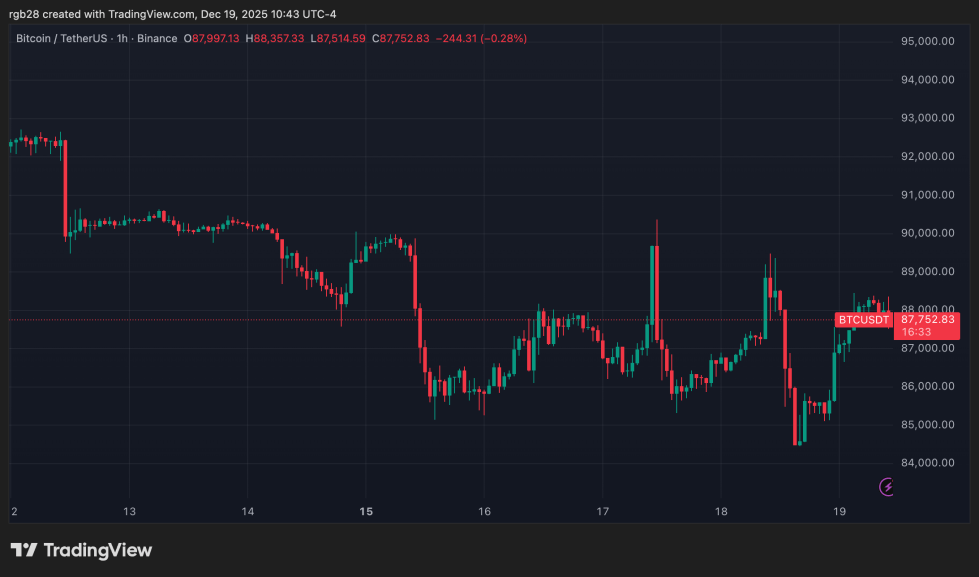
Bitcoin (BTC) trades at $87,752 in the one-week, chart. Source: BTCUSDT on TradingView


Perguntas relacionadas

QWhy did the Polish Sejm halt discussions on crypto legislation until January?

AThe Sejm halted discussions after passing a nearly identical version of a previously vetoed crypto bill, and the Senate decided to delay further review until January to carefully consider the amendments.

QWhat was the main reason President Karol Nawrocki vetoed the Crypto-Asset Market Act initially?

APresident Nawrocki vetoed the bill due to concerns about potential startup exodus, overregulation, and the threat it posed to Poles' freedoms, state stability, and market innovation.

QHow did the Sejm's revived version of the crypto bill change the fee structure?

AThe Sejm reduced the fee paid to the Polish Financial Supervision Authority (KNF) by crypto entities from 0.4% to 0.1%.

QWhat concerns did Deputy Finance Minister Jurand Drop raise about the revised bill?

ADrop expressed concerns about the reduced fee (0.1%) and questioned what would happen if the market grew, potentially requiring fees to exceed that level, as other market segments have fees up to 0.5%.

QWhy did the local crypto community oppose the Crypto-Asset Market Act?

AThe community argued that the bill exceeded the EU's minimum regulatory requirements and could drive small businesses and startups abroad due to overregulation.

Leituras Relacionadas

Qualcomm: AI Hype Subsides, When Will Smartphones Emerge from the Gloom?

Qualcomm reported its Q3 FY2026 results (ending June 2026), with revenue of $9.95B, down 4% YoY but above expectations. Gross margin declined to 53.1%, pressured by rising costs across manufacturing and memory. Key business segments showed mixed performance: Handset revenue fell 19.6% YoY to $5.09B, dragged by an 11% decline in non-Apple Android shipments and weaker high-end mix. Conversely, Automotive revenue surged 61% to $1.59B, and IoT grew 9% to $1.83B. Core operating profit dropped 41% YoY due to margin compression and higher expenses. Management's Q4 FY2026 guidance projects revenue of $9.7B-$10.5B, in line with consensus, but Non-GAAP EPS guidance of $2.05-$2.25 fell short of expectations. Amidst persistent weakness in its core handset market, Qualcomm is pursuing growth in AI, focusing on Edge AI (smartphones, PCs, automotive) and Data Center AI. Its data center strategy includes four pillars: AI accelerators (e.g., AI200), commercial CPUs (Dragonfly C1000), custom silicon, and connectivity solutions. While these initiatives initially boosted its stock, concerns over AI capital expenditure sustainability have since erased those gains. The company targets $5B in data center revenue for FY2027 and $15B for FY2029. The report concludes that with the traditional handset business still under pressure, the data center opportunity is currently viewed as a longer-term option, and a more conservative valuation based on core operations may be warranted until AI contributions materialize.

marsbitHá 3m

Qualcomm: AI Hype Subsides, When Will Smartphones Emerge from the Gloom?

marsbitHá 3m

From TPU to Self-Evolving Agents: How Jeff Dean Predicts the Next Step in AI

At the 2026 YC Startup School, Jeff Dean outlined his vision for AI's next phase, shifting focus from simply scaling models to building intelligent, autonomous systems. He believes AI's progress is no longer just about creating smarter models, but about integrating them into systems capable of long-term, iterative work, automated experimentation, and continuous learning. This evolution moves the competition from "who has the bigger model" to "who can best organize intelligence." Dean suggests AI capabilities are now comparable to a junior engineer, enabling the automation of complex workflows. However, the true challenge and opportunity lie in managing these AI "workers" at scale. He emphasizes the importance of **context engineering**—structuring tools, memory, and feedback loops—over raw model power. For startups, this means building deep expertise in niche domains where general models currently fail (near 0-1% success rates), leveraging proprietary data, specialized tools, and domain-specific evaluators. A recurring theme is re-examining fundamental constraints. Dean's past work, like moving Google's search index to memory or creating the TPU, stemmed from questioning outdated assumptions about hardware and cost. He sees similar inflection points today, particularly in **specialized inference hardware** to drastically reduce latency and energy consumption for real-time Agent operation. Notably, he points out that in modern AI systems, the dominant cost is often not computation but **data movement**. Reliable, long-running Agents require robust system design, borrowing concepts from distributed computing like checkpointing, state management, and parallel exploration to handle failures and maintain progress over days or weeks. As AI automates execution, the scarcest human skills will shift to **defining clear specifications**, **judging what problems are worth solving** (taste), and designing effective feedback loops. Ultimately, Dean's framework prioritizes understanding the problem deeply, identifying the true bottlenecks, and systematically building closed-loop systems where AI can not only perform tasks but also improve AI itself.

marsbitHá 3m

From TPU to Self-Evolving Agents: How Jeff Dean Predicts the Next Step in AI

marsbitHá 3m

Trading

Spot
活动图片




