PhotonPay Upgrades Embedded Wallet API: Building an "Invisible Yet Indispensable" Stablecoin Payment Infrastructure Foundation

链捕手Publicado em 2026-05-27Última atualização em 2026-05-27

Resumo

PhotonPay announces a major upgrade to its Embedded Wallet API, enabling traditional businesses to integrate stablecoin payments rapidly without managing private keys or complex compliance burdens. This "hands-off" infrastructure aims to make blockchain settlement invisible to both enterprises and end-users, offering a structural alternative to costly and slow traditional cross-border payments, which average 6.36% in fees. Key features include rapid developer integration, built-in regulatory compliance (AML/CFT, KYC), high-security key management, and seamless interoperability between fiat and stablecoins. The company argues that in an era of increasing regulatory clarity (e.g., MiCA) and mature institutional infrastructure (Visa, Stripe), "compliance-first" design is a competitive moat. PhotonPay's solution targets platform businesses like B2B marketplaces and SaaS providers, helping them tap into the growing $28 trillion (adjusted) stablecoin transaction volume driven by global demand for efficient settlements.

While media headlines remain fixated on the crypto market's bull and bear cycles, a more profound transformation has been brewing beneath the surface: stablecoins are quietly becoming the default settlement layer for cross-border trade.

According to Chainalysis data, adjusted stablecoin transaction volume in 2025 (after excluding bot activity and wash trading to reflect real economic demand) reached a staggering $28 trillion, with a compound annual growth rate of 133% since 2023.

However, the vast majority of platform-based businesses—from B2B e-commerce platforms and SaaS providers to global cross-border e-commerce hubs—remain shut out from this immense liquidity. This isn't due to a lack of awareness, but because the barriers to entry are dauntingly high: complex asset custody, opaque compliance obligations, and the potential legal risks of touching digital assets without the proper licenses.

PhotonPay is breaking this deadlock. Today, PhotonPay announced a major upgrade to its Embedded Wallet API, enabling non-crypto-native traditional businesses to start integration within minutes and launch officially in as fast as 5 days—all without the heavy burden of managing private keys or navigating regulatory compliance.
Tackling the "Structural Cost" Pain Points of Traditional Payments

The traditional global payments model essentially levies a "structural tax" on global commerce. According to the World Bank's "Remittance Prices Worldwide" database, the current global average cost for international remittances is as high as 6.36%—more than double the United Nations' Sustainable Development Goal target for 2030 (to reduce costs to below 3%). Meanwhile, bank-to-bank wire transfer fees average 13.40%, and in some parts of Sub-Saharan Africa, even exceed 30%.

For the 50 million SMEs reliant on international trade, this payment friction is not merely an "inconvenience"; it is a silent killer of business growth.

"The issue isn't a lack of awareness—CFOs are acutely aware of the value," said Chao, PhotonPay's Product Lead. "The real gap lies in 'safe implementation.' Our API bridges this gap by providing 'natively compliant' infrastructure, allowing businesses to focus on their core operations without having to become experts in the underlying technology."

In contrast, stablecoins offer an extremely attractive structural alternative: 24/7 near-instant settlement, extremely low fees measured in basis points rather than percentage points, and fully programmable liquidity. Stripe noted in its 2025 annual letter that a staggering 60% of its approximately $400 billion in stablecoin payment volume came from B2B transactions. Mastercard's massive $1.8 billion acquisition of BVNK in March 2026 firmly locks onto the immense opportunity in B2B cross-border payments. These signals indicate that this transformation is no longer a conceptual experiment but a structural inevitability.

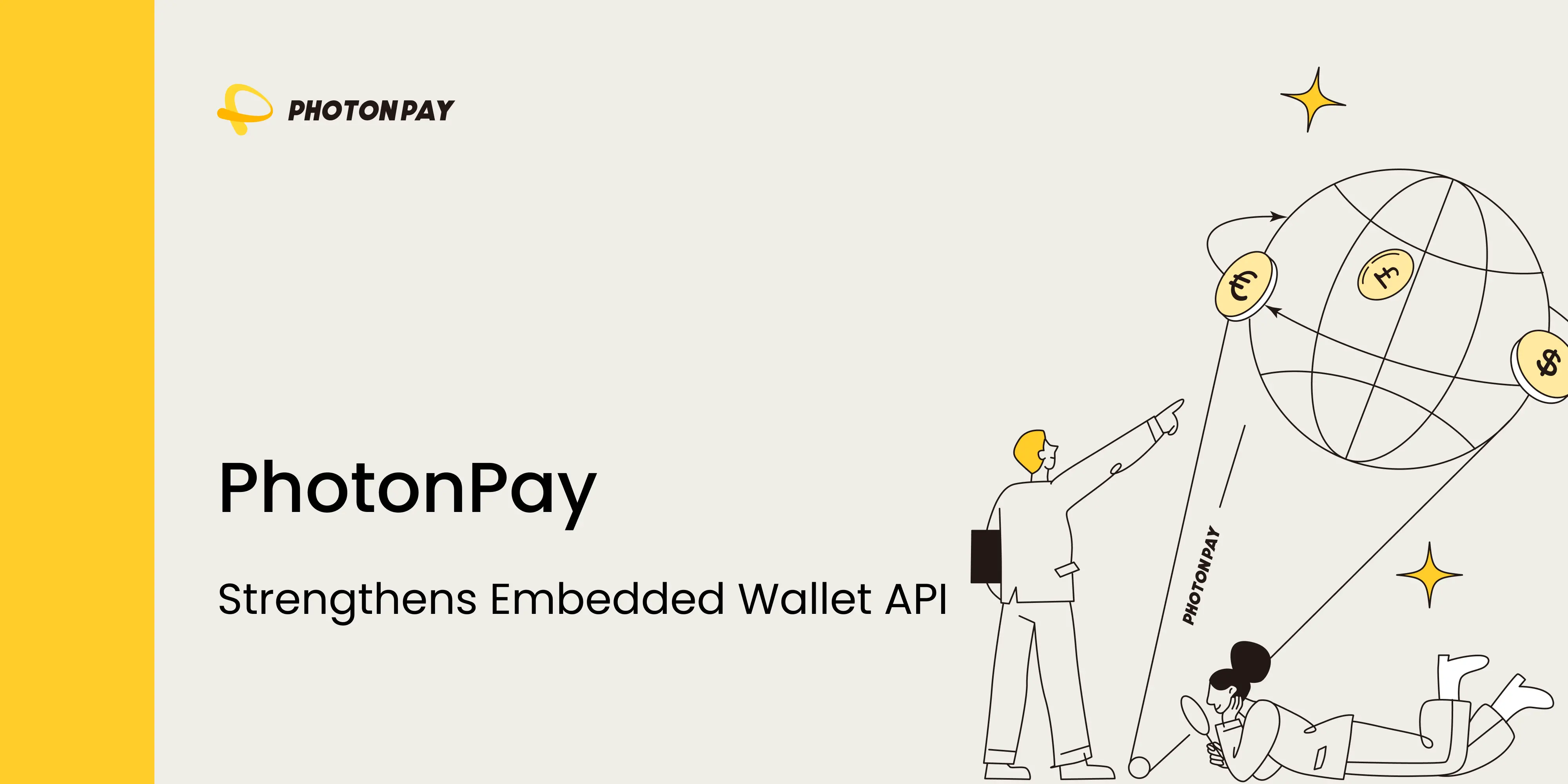
Traditional wire transfers act like a "structural tax" on global commerce, often taking days to settle with fees as high as 7%. For the 50 million SMEs involved in international trade, such severe payment friction is a killer of business growth.

Invisible Infrastructure: The "Hands-Off" Underlying Architecture

This embedded wallet solution is built around PhotonPay's core "Hands-Off" architecture—a design philosophy whose essence is to make blockchain settlement functionally highly "invisible," with neither the business deploying the technology nor the end-user ever needing to sense the underlying blockchain's existence.

When businesses integrate PhotonPay's API, they are not required to custody digital assets, manage private keys, or expend resources operating their own compliance systems. Instead, they gain access to a fully automated orchestration layer that handles the complete lifecycle of a stablecoin transaction in one place—from KYC verification and wallet provisioning to on-chain settlement and fiat payout—while preserving the most familiar, seamless experience for end-users.

This "asset-light" model holds significant strategic value. The architecture draws a clear compliance boundary, allowing businesses to enjoy the efficiency benefits of stablecoins within PhotonPay's well-established regulated framework, completely bypassing the arduous task of applying for high-threshold digital asset licenses themselves.

Chao added, "We provide this 'invisible infrastructure' precisely to allow businesses to return to their core business. Our goal is to build a bridge between complex blockchain protocols and everyday business operations—making the experience of accessing global stablecoin liquidity as straightforward and smooth as integrating standard credit card payments."

Core Features

  • Efficient Deployment & Smooth Integration: A developer-first API suite ensures seamless transition from sandbox testing to production. With comprehensive documentation, pre-built SDKs, and dedicated integration support, technical teams can validate and deploy products within days, eliminating lengthy development cycles.

  • Compliance as Infrastructure: AML/CFT risk controls, sanctions screening, and real-time transaction monitoring are centrally managed within PhotonPay's regulated compliance layer. This not only helps businesses access compliant financial rails at speed but also significantly saves the time and high cost of building equivalent compliance capabilities in-house from scratch.

  • High-Spec Security Eliminating Single Points of Failure: Completely frees businesses from the operational burden and compliance risk of centralized key management. The architecture disperses key control across multiple parties and independent environments, eliminating the most critical single vulnerability in digital asset operations—no single point of failure and no target for concentrated attacks or internal mismanagement.

  • Seamless Synergy Between Global Fiat & Stablecoins: PhotonPay's infrastructure seamlessly bridges traditional fiat environments and on-chain settlement networks, empowering businesses to offer their users flexible options that leverage the advantages of both. As the global financial system gradually moves away from a "fiat vs. crypto" dichotomy towards an era of multi-rail coexistence, this powerful interoperability becomes a core asset.

Why "Compliance-First" Is a Competitive Moat, Not Just a Feature

In the Web3 space, compliance is often labeled a "cost center"—seen as a "necessary evil" that hinders the pace of innovation. However, PhotonPay's core argument completely overturns this traditional view.

As global regulators—from the Financial Action Task Force (FATF), the Monetary Authority of Singapore (MAS), to the UK's Financial Conduct Authority (FCA)—continue to tighten and refine regulatory frameworks for digital assets, possessing "institution-grade compliance capabilities" is rapidly becoming a core prerequisite for enterprise adoption, not an afterthought.

Lewison, Founder and CEO of PhotonPay, stated: "The businesses that will emerge as leaders in the global commercial tide of the next decade are those with the foresight to integrate the best settlement infrastructure today. And what defines superior settlement infrastructure are systems that have compliance embedded in their DNA from the outset."

PhotonPay's compliance tech stack—comprehensively covering KYC/AML, real-time transaction monitoring, and sanctions screening—ensures every transaction through its embedded wallets meets mainstream international standards, paving a clear, safe path for business partners towards global expansion.

Market Momentum: The Tipping Point Has Arrived

Several powerful structural forces are converging, collectively making the present a decisive moment for enterprise adoption of stablecoins:

  1. The Era of Regulatory Clarity Has Formally Begun: The EU's Markets in Crypto-Assets Regulation (MiCA) is fully in effect, the US is accelerating stablecoin legislation, and jurisdictions like Singapore, Hong Kong, and the UAE have all introduced comprehensive digital asset licensing regimes. Businesses can now, for the first time, deploy stablecoin infrastructure within clear, defined legal boundaries.

  2. Institution-Grade Infrastructure Has Matured: Global financial giants including Visa, Stripe, and PayPal have all announced or launched stablecoin settlement products. This sends a strong signal: stablecoins have evolved from a marginal "conceptual experiment" to a mainstream "commercial standard."

  3. Strong Market Demand from the Ground Up: Freelancers in Southeast Asia, suppliers in Sub-Saharan Africa, and service providers across Latin America are increasingly preferring stablecoin settlements over enduring the traditional correspondent banking system. Business platforms that cannot meet this preference risk losing their core supply-side partners in the future.

PhotonPay's Embedded Wallet API is precisely designed to empower businesses to meet this market desire at scale and with efficiency, starting today.

About PhotonPay

PhotonPay is a stablecoin-powered global financial infrastructure operating system. Designed for modern enterprises and platform-based businesses, PhotonPay empowers companies to easily send, receive, convert, and settle funds between traditional fiat and on-chain stablecoin rails through a single, compliance-first system integration. Its service network currently covers over 200 countries and regions worldwide, and it holds relevant regulatory licenses in multiple key international markets. In the digital asset era, PhotonPay is redefining the future of global payroll and cross-border payments.

Disclaimer

This material is for general informational purposes only and does not constitute any legal, regulatory, tax, accounting, or investment advice, nor does it constitute an offer or solicitation for any product or service. The availability, features, and regulatory treatment of PhotonPay's products and services may vary depending on the user's geographic location, business model, and applicable local laws and regulations.


Perguntas relacionadas

QWhat is the core problem that PhotonPay's upgraded Embedded Wallet API aims to solve for traditional platform-based enterprises?

APhotonPay's upgraded Embedded Wallet API aims to solve the problem of high entry barriers that prevent most platform-based enterprises (like B2B e-commerce platforms and SaaS providers) from accessing the global liquidity of stablecoins. These barriers include complex asset custody, opaque compliance obligations, and significant legal risks associated with dealing in digital assets without appropriate licenses. The API allows non-crypto-native businesses to integrate stablecoin payments within minutes, go live in as little as 5 days, and do so without the burdens of managing private keys or navigating regulatory compliance.

QAccording to the article, what are the main structural advantages of stablecoin payments over traditional global payment models?

AThe main structural advantages of stablecoin payments over traditional global payment models are: 1) Near-instant, 24/7 settlement, 2) Extremely low fees measured in basis points rather than percentage points, and 3) Fully programmable liquidity. This is in stark contrast to traditional models like bank wires, which are described as a 'structural tax' on global commerce, often taking days to settle and costing an average of 13.40% (and over 30% in some regions).

QWhat does PhotonPay's 'Hands-Off' architecture mean for its enterprise clients?

APhotonPay's 'Hands-Off' architecture means the blockchain settlement layer is functionally 'invisible' to both the integrating enterprise and its end-users. For the enterprise client, it means they do not need to custody digital assets, manage private keys, or operate their own compliance systems. They gain access to an automated orchestration layer that handles the entire stablecoin transaction lifecycle (KYC, wallet setup, on-chain settlement, fiat off-ramps) within PhotonPay's regulated framework, allowing the business to focus on its core operations.

QWhy does the article argue that 'compliance-first' is a competitive moat, not just a feature?

AThe article argues that 'compliance-first' is a competitive moat because as global regulators (like FATF, MAS, FCA) tighten frameworks for digital assets, possessing 'institutional-grade compliance capabilities' is rapidly becoming a core prerequisite for enterprise adoption, not an afterthought. PhotonPay's compliance tech stack (covering KYC/AML, real-time transaction monitoring, sanctions screening) ensures all transactions meet high international standards, providing partners a secure path for global expansion. This built-in compliance foundation is a strategic advantage that is difficult for competitors to replicate quickly.

QWhat three structural forces, mentioned in the article, indicate a critical inflection point for enterprise adoption of stablecoins?

AThe three structural forces indicating a critical inflection point are: 1) **Regulatory clarity**: With frameworks like the EU's MiCA in effect and legislation advancing in the US, Singapore, Hong Kong, and the UAE, businesses can now deploy stablecoin infrastructure within clear legal boundaries. 2) **Mature institutional infrastructure**: Major financial players like Visa, Stripe, and PayPal have launched stablecoin products, signaling a shift from experimental concept to commercial standard. 3) **Strong end-market demand pull**: Freelancers in Southeast Asia, suppliers in Sub-Saharan Africa, and service providers in Latin America are increasingly preferring stablecoin settlements, forcing platforms to adapt or risk losing partners.

Leituras Relacionadas

Near Returns to the AI Stage: Transformation into a Public Chain Due to 'Payroll Difficulties,' Agent and Privacy Emerge as New Growth Narratives

NEAR Returns to AI Origins: From Payroll Struggles to Blockchain, Now Focusing on AI Agents and Privacy NEAR Protocol's journey began not with grand blockchain ambitions, but from a practical hurdle: its AI startup founders, including Transformer paper co-author Illia Polosukhin, couldn't efficiently pay international developers in 2017. This led them to pivot and build a high-performance, scalable blockchain. After years navigating various crypto narratives like sharding and cross-chain interoperability, NEAR is now leveraging its AI roots to re-enter the AI arena. A key driver is its "NEAR Intents" layer, which abstracts complex cross-chain transactions. Users simply state their goal (e.g., swap BTC for ETH), and a solver network finds the optimal route. This system has processed over $20B in cross-chain volume, generating significant fee revenue. A major growth area is private transactions via "Confidential Intents/Swaps," which hide trade details until settlement to protect against MEV and front-running. Remarkably, private swaps recently accounted for over 40% of NEAR's transaction volume, highlighting strong demand but also potential regulatory scrutiny. With its AI-founder pedigree, NEAR is positioning itself at the intersection of blockchain, AI agents, and privacy, aiming to become infrastructure for the emerging agent economy while navigating the challenges of its rapid adoption.

marsbitHá 1h

Near Returns to the AI Stage: Transformation into a Public Chain Due to 'Payroll Difficulties,' Agent and Privacy Emerge as New Growth Narratives

marsbitHá 1h

From Ethereum to AI's 'CROPS': What Exactly is This Set of 'Slow Variables' That Vitalik Repeatedly Emphasizes?

In recent discussions, Vitalik Buterin has frequently emphasized the concept of "CROPS," a framework defining core values for Ethereum's development. CROPS stands for Censorship Resistance, Capture Resistance, Open Source, Privacy, and Security. Initially outlined in the Ethereum Foundation's "EF Mandate," it represents a commitment to user sovereignty, ensuring that the network resists external control, remains open, protects privacy, and prioritizes security. The relevance of CROPS extends beyond Ethereum's foundational principles, becoming crucial in the context of AI integration. As AI agents begin handling wallet operations and automated transactions, the risk increases that users may cede control over their digital assets, privacy, and intentions to centralized AI service providers. A "CROPS AI" would therefore emphasize local execution where possible, privacy-preserving remote model calls (e.g., using zero-knowledge proofs), and transparent, verifiable processes to maintain user agency. Vitalik highlights a significant convergence between "CROPS Ethereum access layer" and "CROPS AI." Both address the same fundamental challenge: how users can access powerful services—be it blockchain data via RPCs or AI models—without exposing sensitive information or relinquishing ultimate control. This intersection points toward a future digital entry point that is more private, secure, and user-controlled. Ultimately, CROPS is not merely an abstract ideal but a practical guidepost. It steers development—from protocol resilience and wallet design to AI agent safety—towards a future where users retain self-sovereignty even as digital systems grow more complex and powerful. In an era of accelerating AI adoption, these "slow variables" of censorship resistance, openness, privacy, and security may define Ethereum's enduring value.

marsbitHá 1h

From Ethereum to AI's 'CROPS': What Exactly is This Set of 'Slow Variables' That Vitalik Repeatedly Emphasizes?

marsbitHá 1h

Silicon Valley 'Startup Guru' Steve Hoffman: Web3 + AI Could Be a Trap

Silicon Valley investor and "Godfather of Startups" Steve Hoffman warns that combining Web3 with AI is likely a trap, not a promising venture. In an interview, Hoffman argues that while AI is a foundational technology touching all industries, Web3 adds complexity, friction, and regulatory risk without solving mainstream consumer or business needs. He advises founders to focus on deep, specialized applications where startups can out-iterate giants, rather than on generic features easily replicated by large tech companies. Hoffman observes that Silicon Valley will lead foundational AI research, while China excels at rapid, large-scale application and commercialization, particularly in robotics. He stresses that AI-driven autonomous agents capable of collaborative, multi-step tasks are 2-4 years away, which will cause significant job displacement. The solution is not to slow AI but to redesign business models around human-AI collaboration and reform social systems like education and retraining. For startups, Hoffman recommends focusing on vertical, expertise-heavy domains to build defensibility. He sees major opportunities in AI fraud detection and cybersecurity. Key founder mindsets include systemic thinking over feature-focus, relentless customer centricity, building adaptive teams, and deeply understanding AI's capabilities and limits. Hoffman is also leading a non-profit initiative to establish university centers aimed at training future leaders in responsible, human-value-aligned AI innovation.

marsbitHá 3h

Silicon Valley 'Startup Guru' Steve Hoffman: Web3 + AI Could Be a Trap

marsbitHá 3h

Token Inefficient, Economy Tokenless

The article "Tokens Aren't Economical, Economics Aren't Tokenized" analyzes a pivotal shift in the AI industry from a technology-driven narrative to one dominated by capital efficiency. It highlights two concurrent trends: a severe capital shortage due to the exorbitant and recurring costs of compute (e.g., OpenAI's high burn rate) and a wave of corporate spin-offs where major tech companies are separating their AI units (like Kuaishou's Kling and Baidu's Kunlunxin). The core argument is that AI's "anti-internet" business model, where user growth increases costs rather than profits, has created a disconnect between high valuations and actual cash flow. Spin-offs address this by allowing AI assets to be valued independently. Within a parent company, they are seen as cost centers, but as standalone entities, they are priced based on their growth potential and scarcity in the primary market, leading to massive valuation premiums (e.g., Kling's estimated value tripling post-spin-off). The industry is at an inflection point, moving from "model worship" to "value realization." The competition is evolving from a pure compute (GPU) race to a broader focus on systemic efficiency and full-stack engineering (involving CPUs and orchestration) to achieve viable commercialization. The year 2026 is framed as a critical moment where the industry must definitively answer how to economically translate AI capability into tangible business value, reshaping the sector's future power structure.

marsbitHá 3h

Token Inefficient, Economy Tokenless

marsbitHá 3h

Trading

Spot
Futuros
活动图片




