PhotonPay Upgrades Embedded Wallet API: Building an "Invisible Yet Indispensable" Stablecoin Payment Infrastructure Foundation

链捕手Publicado em 2026-05-27Última atualização em 2026-05-27

Resumo

PhotonPay announces a major upgrade to its Embedded Wallet API, enabling traditional businesses to integrate stablecoin payments rapidly without managing private keys or complex compliance burdens. This "hands-off" infrastructure aims to make blockchain settlement invisible to both enterprises and end-users, offering a structural alternative to costly and slow traditional cross-border payments, which average 6.36% in fees. Key features include rapid developer integration, built-in regulatory compliance (AML/CFT, KYC), high-security key management, and seamless interoperability between fiat and stablecoins. The company argues that in an era of increasing regulatory clarity (e.g., MiCA) and mature institutional infrastructure (Visa, Stripe), "compliance-first" design is a competitive moat. PhotonPay's solution targets platform businesses like B2B marketplaces and SaaS providers, helping them tap into the growing $28 trillion (adjusted) stablecoin transaction volume driven by global demand for efficient settlements.

While media headlines remain fixated on the crypto market's bull and bear cycles, a more profound transformation has been brewing beneath the surface: stablecoins are quietly becoming the default settlement layer for cross-border trade.

According to Chainalysis data, adjusted stablecoin transaction volume in 2025 (after excluding bot activity and wash trading to reflect real economic demand) reached a staggering $28 trillion, with a compound annual growth rate of 133% since 2023.

However, the vast majority of platform-based businesses—from B2B e-commerce platforms and SaaS providers to global cross-border e-commerce hubs—remain shut out from this immense liquidity. This isn't due to a lack of awareness, but because the barriers to entry are dauntingly high: complex asset custody, opaque compliance obligations, and the potential legal risks of touching digital assets without the proper licenses.

PhotonPay is breaking this deadlock. Today, PhotonPay announced a major upgrade to its Embedded Wallet API, enabling non-crypto-native traditional businesses to start integration within minutes and launch officially in as fast as 5 days—all without the heavy burden of managing private keys or navigating regulatory compliance.
Tackling the "Structural Cost" Pain Points of Traditional Payments

The traditional global payments model essentially levies a "structural tax" on global commerce. According to the World Bank's "Remittance Prices Worldwide" database, the current global average cost for international remittances is as high as 6.36%—more than double the United Nations' Sustainable Development Goal target for 2030 (to reduce costs to below 3%). Meanwhile, bank-to-bank wire transfer fees average 13.40%, and in some parts of Sub-Saharan Africa, even exceed 30%.

For the 50 million SMEs reliant on international trade, this payment friction is not merely an "inconvenience"; it is a silent killer of business growth.

"The issue isn't a lack of awareness—CFOs are acutely aware of the value," said Chao, PhotonPay's Product Lead. "The real gap lies in 'safe implementation.' Our API bridges this gap by providing 'natively compliant' infrastructure, allowing businesses to focus on their core operations without having to become experts in the underlying technology."

In contrast, stablecoins offer an extremely attractive structural alternative: 24/7 near-instant settlement, extremely low fees measured in basis points rather than percentage points, and fully programmable liquidity. Stripe noted in its 2025 annual letter that a staggering 60% of its approximately $400 billion in stablecoin payment volume came from B2B transactions. Mastercard's massive $1.8 billion acquisition of BVNK in March 2026 firmly locks onto the immense opportunity in B2B cross-border payments. These signals indicate that this transformation is no longer a conceptual experiment but a structural inevitability.

Traditional wire transfers act like a "structural tax" on global commerce, often taking days to settle with fees as high as 7%. For the 50 million SMEs involved in international trade, such severe payment friction is a killer of business growth.

Invisible Infrastructure: The "Hands-Off" Underlying Architecture

This embedded wallet solution is built around PhotonPay's core "Hands-Off" architecture—a design philosophy whose essence is to make blockchain settlement functionally highly "invisible," with neither the business deploying the technology nor the end-user ever needing to sense the underlying blockchain's existence.

When businesses integrate PhotonPay's API, they are not required to custody digital assets, manage private keys, or expend resources operating their own compliance systems. Instead, they gain access to a fully automated orchestration layer that handles the complete lifecycle of a stablecoin transaction in one place—from KYC verification and wallet provisioning to on-chain settlement and fiat payout—while preserving the most familiar, seamless experience for end-users.

This "asset-light" model holds significant strategic value. The architecture draws a clear compliance boundary, allowing businesses to enjoy the efficiency benefits of stablecoins within PhotonPay's well-established regulated framework, completely bypassing the arduous task of applying for high-threshold digital asset licenses themselves.

Chao added, "We provide this 'invisible infrastructure' precisely to allow businesses to return to their core business. Our goal is to build a bridge between complex blockchain protocols and everyday business operations—making the experience of accessing global stablecoin liquidity as straightforward and smooth as integrating standard credit card payments."

Core Features

  • Efficient Deployment & Smooth Integration: A developer-first API suite ensures seamless transition from sandbox testing to production. With comprehensive documentation, pre-built SDKs, and dedicated integration support, technical teams can validate and deploy products within days, eliminating lengthy development cycles.

  • Compliance as Infrastructure: AML/CFT risk controls, sanctions screening, and real-time transaction monitoring are centrally managed within PhotonPay's regulated compliance layer. This not only helps businesses access compliant financial rails at speed but also significantly saves the time and high cost of building equivalent compliance capabilities in-house from scratch.

  • High-Spec Security Eliminating Single Points of Failure: Completely frees businesses from the operational burden and compliance risk of centralized key management. The architecture disperses key control across multiple parties and independent environments, eliminating the most critical single vulnerability in digital asset operations—no single point of failure and no target for concentrated attacks or internal mismanagement.

  • Seamless Synergy Between Global Fiat & Stablecoins: PhotonPay's infrastructure seamlessly bridges traditional fiat environments and on-chain settlement networks, empowering businesses to offer their users flexible options that leverage the advantages of both. As the global financial system gradually moves away from a "fiat vs. crypto" dichotomy towards an era of multi-rail coexistence, this powerful interoperability becomes a core asset.

Why "Compliance-First" Is a Competitive Moat, Not Just a Feature

In the Web3 space, compliance is often labeled a "cost center"—seen as a "necessary evil" that hinders the pace of innovation. However, PhotonPay's core argument completely overturns this traditional view.

As global regulators—from the Financial Action Task Force (FATF), the Monetary Authority of Singapore (MAS), to the UK's Financial Conduct Authority (FCA)—continue to tighten and refine regulatory frameworks for digital assets, possessing "institution-grade compliance capabilities" is rapidly becoming a core prerequisite for enterprise adoption, not an afterthought.

Lewison, Founder and CEO of PhotonPay, stated: "The businesses that will emerge as leaders in the global commercial tide of the next decade are those with the foresight to integrate the best settlement infrastructure today. And what defines superior settlement infrastructure are systems that have compliance embedded in their DNA from the outset."

PhotonPay's compliance tech stack—comprehensively covering KYC/AML, real-time transaction monitoring, and sanctions screening—ensures every transaction through its embedded wallets meets mainstream international standards, paving a clear, safe path for business partners towards global expansion.

Market Momentum: The Tipping Point Has Arrived

Several powerful structural forces are converging, collectively making the present a decisive moment for enterprise adoption of stablecoins:

  1. The Era of Regulatory Clarity Has Formally Begun: The EU's Markets in Crypto-Assets Regulation (MiCA) is fully in effect, the US is accelerating stablecoin legislation, and jurisdictions like Singapore, Hong Kong, and the UAE have all introduced comprehensive digital asset licensing regimes. Businesses can now, for the first time, deploy stablecoin infrastructure within clear, defined legal boundaries.

  2. Institution-Grade Infrastructure Has Matured: Global financial giants including Visa, Stripe, and PayPal have all announced or launched stablecoin settlement products. This sends a strong signal: stablecoins have evolved from a marginal "conceptual experiment" to a mainstream "commercial standard."

  3. Strong Market Demand from the Ground Up: Freelancers in Southeast Asia, suppliers in Sub-Saharan Africa, and service providers across Latin America are increasingly preferring stablecoin settlements over enduring the traditional correspondent banking system. Business platforms that cannot meet this preference risk losing their core supply-side partners in the future.

PhotonPay's Embedded Wallet API is precisely designed to empower businesses to meet this market desire at scale and with efficiency, starting today.

About PhotonPay

PhotonPay is a stablecoin-powered global financial infrastructure operating system. Designed for modern enterprises and platform-based businesses, PhotonPay empowers companies to easily send, receive, convert, and settle funds between traditional fiat and on-chain stablecoin rails through a single, compliance-first system integration. Its service network currently covers over 200 countries and regions worldwide, and it holds relevant regulatory licenses in multiple key international markets. In the digital asset era, PhotonPay is redefining the future of global payroll and cross-border payments.

Disclaimer

This material is for general informational purposes only and does not constitute any legal, regulatory, tax, accounting, or investment advice, nor does it constitute an offer or solicitation for any product or service. The availability, features, and regulatory treatment of PhotonPay's products and services may vary depending on the user's geographic location, business model, and applicable local laws and regulations.


Perguntas relacionadas

QWhat is the core problem that PhotonPay's upgraded Embedded Wallet API aims to solve for traditional platform-based enterprises?

APhotonPay's upgraded Embedded Wallet API aims to solve the problem of high entry barriers that prevent most platform-based enterprises (like B2B e-commerce platforms and SaaS providers) from accessing the global liquidity of stablecoins. These barriers include complex asset custody, opaque compliance obligations, and significant legal risks associated with dealing in digital assets without appropriate licenses. The API allows non-crypto-native businesses to integrate stablecoin payments within minutes, go live in as little as 5 days, and do so without the burdens of managing private keys or navigating regulatory compliance.

QAccording to the article, what are the main structural advantages of stablecoin payments over traditional global payment models?

AThe main structural advantages of stablecoin payments over traditional global payment models are: 1) Near-instant, 24/7 settlement, 2) Extremely low fees measured in basis points rather than percentage points, and 3) Fully programmable liquidity. This is in stark contrast to traditional models like bank wires, which are described as a 'structural tax' on global commerce, often taking days to settle and costing an average of 13.40% (and over 30% in some regions).

QWhat does PhotonPay's 'Hands-Off' architecture mean for its enterprise clients?

APhotonPay's 'Hands-Off' architecture means the blockchain settlement layer is functionally 'invisible' to both the integrating enterprise and its end-users. For the enterprise client, it means they do not need to custody digital assets, manage private keys, or operate their own compliance systems. They gain access to an automated orchestration layer that handles the entire stablecoin transaction lifecycle (KYC, wallet setup, on-chain settlement, fiat off-ramps) within PhotonPay's regulated framework, allowing the business to focus on its core operations.

QWhy does the article argue that 'compliance-first' is a competitive moat, not just a feature?

AThe article argues that 'compliance-first' is a competitive moat because as global regulators (like FATF, MAS, FCA) tighten frameworks for digital assets, possessing 'institutional-grade compliance capabilities' is rapidly becoming a core prerequisite for enterprise adoption, not an afterthought. PhotonPay's compliance tech stack (covering KYC/AML, real-time transaction monitoring, sanctions screening) ensures all transactions meet high international standards, providing partners a secure path for global expansion. This built-in compliance foundation is a strategic advantage that is difficult for competitors to replicate quickly.

QWhat three structural forces, mentioned in the article, indicate a critical inflection point for enterprise adoption of stablecoins?

AThe three structural forces indicating a critical inflection point are: 1) **Regulatory clarity**: With frameworks like the EU's MiCA in effect and legislation advancing in the US, Singapore, Hong Kong, and the UAE, businesses can now deploy stablecoin infrastructure within clear legal boundaries. 2) **Mature institutional infrastructure**: Major financial players like Visa, Stripe, and PayPal have launched stablecoin products, signaling a shift from experimental concept to commercial standard. 3) **Strong end-market demand pull**: Freelancers in Southeast Asia, suppliers in Sub-Saharan Africa, and service providers in Latin America are increasingly preferring stablecoin settlements, forcing platforms to adapt or risk losing partners.

Leituras Relacionadas

Bitcoin Is Ready for "Parabolic Growth". Is Altseason Upon Us?

Amid a general market uptrend, experts are discussing the potential start of an 'altcoin season', where major cryptocurrencies could outpace Bitcoin's growth. This follows Bitcoin surpassing $81,000, predictions of a new bull market, and a capital shift from AI stocks toward Bitcoin and gold. Since August 17th, the crypto market has risen over 22%, primarily driven by Bitcoin (BTC) and Ethereum (ETH), which gained 25% and 30% respectively, reaching highs last seen in May. Analysts suggest the Bitcoin bear cycle has ended, anticipating a historically strong rally, with renewed institutional demand for cryptocurrency ETFs. BitMEX founder Arthur Hayes, in a recent interview, declared the start of a new bull market, predicting Bitcoin could quickly reach "hundreds of thousands" of dollars. Market observers interpret this as an expectation for 'parabolic growth.' Signs of a bull market revival include Bitcoin ETFs re-entering the top 10 most-traded ETFs, displacing some AI-focused funds. Analysts at CryptoQuant note capital is flowing from Bitcoin into riskier altcoins, with their bull market indicators showing the most optimistic signals since October 2025. However, the reality is more nuanced. The current surge is a rebound from yearly lows; Bitcoin's price is still down nearly 40% from its October peak. The Altcoin Season Index has dropped to 39 from 67 in early August, and Bitcoin's dominance remains around 60%, indicating investor focus is still on Bitcoin rather than altcoins. Experts predict the market is entering a phase where project fundamentals and real revenue, rather than speculation, will increasingly determine asset value.

cryptonews.ruHá 46m

Bitcoin Is Ready for "Parabolic Growth". Is Altseason Upon Us?

cryptonews.ruHá 46m

$120 Million Vanishes Overnight! Crypto's 'Steadiest Giant' Stumbles in South America

Summary: Tether's $120 million Bitcoin mining venture in Uruguay, initiated in May 2023, was abruptly shut down in July 2025 when the national power utility UTE cut off electricity. The project, developed in partnership with local firm Microfin in Florida province, was touted as a model for leveraging the country's nearly 98% renewable energy grid. The collapse stemmed from a fundamental contract dispute over electricity supply. Tether interpreted the agreed power volume as a "minimum guaranteed supply," expecting to request more as the mining operation expanded. UTE, however, viewed it as a "strict maximum cap." This disagreement led to frequent power curtailments for the 24/7 mining facility, causing significant revenue loss from lost computing power. Following the 2025 election of left-wing President Yamandú Orsi and a management change at UTE, negotiations broke down. Microfin stopped paying electricity bills in May 2025, formally notified UTE of contract termination in June, and did not attend a final meeting where UTE presented a revised contract. By the July 25 power cut, Microfin's debt approached $5 million. The operation ceased, laying off 30 of its 38 local staff, with all outstanding debts settled by December 2025. The failure highlights key risks for heavy-asset overseas investments: Uruguay's green energy proved not to be cheap energy, especially after the 2024 Bitcoin halving squeezed industry profits. Furthermore, political changes can swiftly alter utility company policies, undermining the long-term regulatory stability critical for such projects. While financially absorbable for Tether, the incident underscores that operational success depends on unambiguous contracts and genuine cost advantages, not just technological scale.

marsbitHá 1h

$120 Million Vanishes Overnight! Crypto's 'Steadiest Giant' Stumbles in South America

marsbitHá 1h

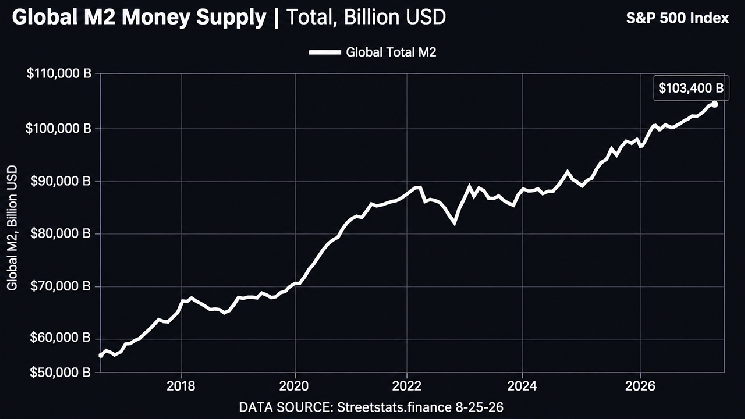
Is Bitcoin Price Lagging? Record Global M2 Money Supply Could Be a Springboard for BTC's Rise

Bitcoin Price Lagging? Record Global Money Supply M2 Could Springboard BTC Growth The global money supply (M2) is expanding rapidly, similar to global debt. The US M2, representing all money circulating in its economy, has reached a record $23.16 trillion. Combined with figures from major economies like the Eurozone, China, and Japan, the global M2 is approximately $103 trillion. Some estimates, however, place it closer to $195 trillion. This surge in liquidity is significant because excess capital often seeks higher returns in assets like precious metals, stocks, and cryptocurrencies. Bitcoin's recent price surge above $81,000 has brought the global M2 metric back into focus. Following a sharp rise in early August after a US Treasury bond buyback announcement, BTC still trades about 37% below its October 2025 all-time high exceeding $126,000. This gap presents a potential "catch-up" trade thesis. Bitcoin's fixed supply of 21 million contrasts with governments' ability to print fiat currency, making scarce assets like BTC attractive if monetary expansion continues. Historically, Bitcoin's bull cycles in 2017-2018 and 2020-2021 coincided with M2 expansion and increased liquidity. Over the past year, the correlation seemed broken as M2 grew while Bitcoin's price fell sharply from its peak. Observers believe fresh dollars may have remained locked in cash-favorable investments. Some, like Ash Crypto, now suggest a long-awaited alignment between Bitcoin and M2 may be starting, especially as a weakening US Dollar Index this month has seen assets like gold and Bitcoin surge. A softer dollar pressures cash havens and prompts holders to act. While record M2 doesn't guarantee higher Bitcoin prices, a sustained influx of liquidity, a weak dollar, and capital flowing into alternative assets could trigger a catch-up rally sooner than expected. However, changes in these conditions could lead to the opposite outcome.

cryptonews.ruHá 1h

Is Bitcoin Price Lagging? Record Global M2 Money Supply Could Be a Springboard for BTC's Rise

cryptonews.ruHá 1h

Trading

Spot
活动图片