Peter Todd Warns Zcash Tech Is Too Risky For Bitcoin Privacy Push

bitcoinistPublicado em 2026-06-05Última atualização em 2026-06-05

Resumo

Bitcoin developer Peter Todd opposes integrating Zcash-style privacy features into Bitcoin's consensus layer, arguing the cryptographic risk is too high. His comments followed a disclosed issue in Zcash's Orchard shielded pool, sparking a debate on privacy, auditability, and Bitcoin's resistance to change (ossification). Todd distinguishes Bitcoin's transparent ledger, where bugs like the 2010 overflow were visible and reversible, from shielded systems where privacy could hide counterfeit coins or supply destruction, making detection and rollbacks difficult. While critics noted Bitcoin's own history of bugs, Todd countered that these didn't pose the same existential risk. He emphasized that with a significant portion of ZEC already shielded, a hidden bug could devastate user holdings without easy recovery. The discussion highlights the trade-off between advanced privacy and systemic risk in a base protocol.

Bitcoin developer Peter Todd has pushed back against calls to bring Zcash-style privacy into Bitcoin’s consensus layer, arguing that the cryptographic risk profile is too high for the network’s base protocol. The debate erupted after ZODL developers disclosed an issue affecting the Orchard shielded pool, briefly turning a technical incident into a broader argument over privacy, auditability, and Bitcoin ossification.

Todd’s initial post was direct: “Why adding Zcash style privacy to Bitcoin at the consensus layer is a bad idea.” He was responding to a post from Zcash Open Development Lab, which said a “coordinated Zcash network upgrade” was underway after an issue affecting the Zcash Orchard pool was identified during routine auditing and security review processes.

Why Peter Todd Sounds Alarm On Zcash-Style Privacy

The exchange quickly widened beyond ZEC itself. One user argued that Bitcoin has its own history of critical bugs, pointing to the 2010 value overflow incident and the 2013 chain split as evidence that “no protocol is exempt from tech issues.” The same post accused Bitcoin maximalists of pushing for “total ossification” while facing future threats such as quantum computing.

Todd answered by drawing a distinction between visible and hidden failures. “Exactly my point. With Bitcoin, rolling back the chain is feasible, as only a small subset of coins were affected, and the exploit was trivial to notice,” he wrote. His argument was not that Bitcoin is bug-free, but that its accounting model makes certain classes of catastrophic bugs easier to detect and unwind.

That point became the core of the disagreement. When another user argued that rejecting consensus-layer privacy on bug-risk grounds would “stop any innovation/development,” Todd responded that not all cryptography carries the same operational risk. “Different types of cryptography have different levels of risk to them. Zcash-style cryptography has a very high level of risk, much more so than Bitcoin’s cryptography. Which is reflected in how Zcash has had much more serious issues than Bitcoin.”

The counterargument was that Bitcoin itself has suffered serious early failures. One participant cited the 2010 value overflow incident and the 2018 bug, CVE-2018-17144, as examples that challenged Todd’s framing. Todd rejected the comparison, saying neither case put the currency at the same kind of existential risk.

“Neither of those exploits had any chance of destroying the currency,” Todd wrote. “Exactly what coins were counterfeit was trivially visible, allowing easy rollbacks. Not so with Zcash.”

The disagreement turns on a specific property of shielded systems: privacy can reduce the visibility that makes supply audits straightforward. In Todd’s view, this changes the risk calculation for Bitcoin. A bug in transparent accounting can be noticed because invalid outputs or counterfeit coins are visible on-chain. In a deeply shielded system, he argued, the damage may be harder to observe, harder to attribute, and harder to reverse.

Zcash defenders pushed back on that framing as well. One user told Todd that he did not understand the “turnstile construct,” arguing that “no such bug can affect the total ZEC supply.” Todd shifted the focus from total supply to shielded user balances, noting that a large share of ZEC already sits inside the shielded pool. “30% of the Zcash supply is shielded. That supply being destroyed would be a disaster, and would completely wipe out the holdings of a high % of all Zcash users. I personally have a little bit of Zcash, all of which is shielded.”

At press time, ZEC traded at $532.
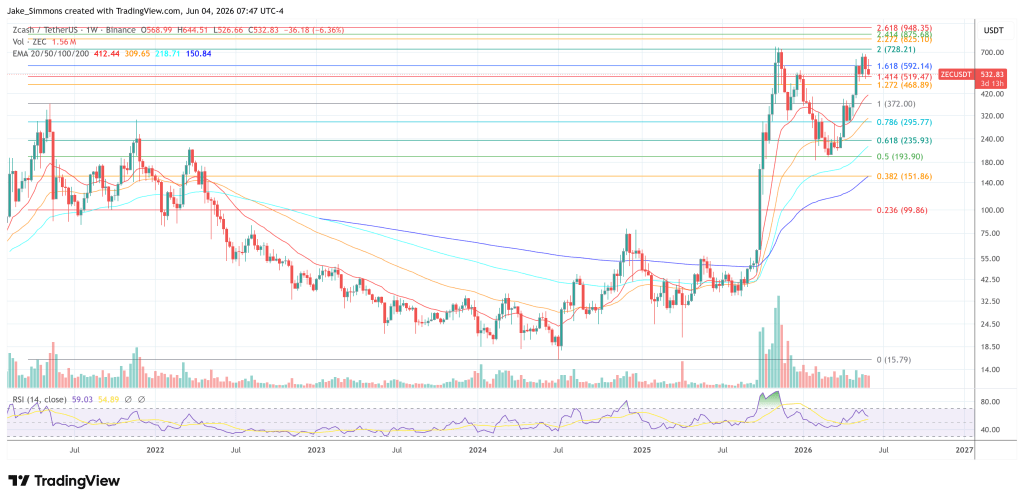
ZEC trades below the 1.618 Fib again, 1-week chart | Source: ZECUSDT on TradingView.com

Perguntas relacionadas

QWhat is Peter Todd's main argument against integrating Zcash-style privacy into Bitcoin at the consensus layer?

APeter Todd argues that the cryptographic risk profile of Zcash-style privacy technology is too high for Bitcoin's base protocol. He believes such shielded systems make catastrophic bugs harder to detect, attribute, and reverse compared to Bitcoin's transparent accounting model.

QAccording to Peter Todd, what key difference exists between handling bugs in Bitcoin's transparent system versus a shielded system like Zcash?

ATodd states that in Bitcoin's transparent system, bugs like counterfeit coin creation are trivially visible on-chain, making coordinated chain rollbacks feasible. In a deeply shielded system, the damage from a bug can be much harder to observe, attribute, and reverse, posing a greater existential risk.

QWhat example did critics use to challenge Todd's view that Bitcoin has a lower risk profile than Zcash?

ACritics pointed to historical Bitcoin incidents like the 2010 value overflow bug and the 2018 CVE-2018-17144 bug as evidence that 'no protocol is exempt from tech issues,' arguing these were also serious failures.

QHow did Peter Todd respond to the claim that a bug cannot affect the total ZEC supply due to its 'turnstile construct'?

ATodd shifted the focus from total supply to user balances, noting that 30% of ZEC supply is shielded. He argued that a bug destroying or compromising that shielded supply would be a disaster, wiping out the holdings of a high percentage of Zcash users.

QWhat event initially sparked the broader debate about privacy and auditability in Bitcoin, as mentioned in the article?

AThe debate was sparked after ZODL (Zcash Open Development Lab) developers disclosed an issue affecting the Zcash Orchard shielded pool during routine auditing, which led to a coordinated network upgrade and broader discussions on privacy technology risks.

Leituras Relacionadas

Silicon Valley 'Startup Guru' Steve Hoffman: Web3 + AI Could Be a Trap

Silicon Valley investor and "Godfather of Startups" Steve Hoffman warns that combining Web3 with AI is likely a trap, not a promising venture. In an interview, Hoffman argues that while AI is a foundational technology touching all industries, Web3 adds complexity, friction, and regulatory risk without solving mainstream consumer or business needs. He advises founders to focus on deep, specialized applications where startups can out-iterate giants, rather than on generic features easily replicated by large tech companies. Hoffman observes that Silicon Valley will lead foundational AI research, while China excels at rapid, large-scale application and commercialization, particularly in robotics. He stresses that AI-driven autonomous agents capable of collaborative, multi-step tasks are 2-4 years away, which will cause significant job displacement. The solution is not to slow AI but to redesign business models around human-AI collaboration and reform social systems like education and retraining. For startups, Hoffman recommends focusing on vertical, expertise-heavy domains to build defensibility. He sees major opportunities in AI fraud detection and cybersecurity. Key founder mindsets include systemic thinking over feature-focus, relentless customer centricity, building adaptive teams, and deeply understanding AI's capabilities and limits. Hoffman is also leading a non-profit initiative to establish university centers aimed at training future leaders in responsible, human-value-aligned AI innovation.

marsbitHá 1h

Silicon Valley 'Startup Guru' Steve Hoffman: Web3 + AI Could Be a Trap

marsbitHá 1h

Token Inefficient, Economy Tokenless

The article "Tokens Aren't Economical, Economics Aren't Tokenized" analyzes a pivotal shift in the AI industry from a technology-driven narrative to one dominated by capital efficiency. It highlights two concurrent trends: a severe capital shortage due to the exorbitant and recurring costs of compute (e.g., OpenAI's high burn rate) and a wave of corporate spin-offs where major tech companies are separating their AI units (like Kuaishou's Kling and Baidu's Kunlunxin). The core argument is that AI's "anti-internet" business model, where user growth increases costs rather than profits, has created a disconnect between high valuations and actual cash flow. Spin-offs address this by allowing AI assets to be valued independently. Within a parent company, they are seen as cost centers, but as standalone entities, they are priced based on their growth potential and scarcity in the primary market, leading to massive valuation premiums (e.g., Kling's estimated value tripling post-spin-off). The industry is at an inflection point, moving from "model worship" to "value realization." The competition is evolving from a pure compute (GPU) race to a broader focus on systemic efficiency and full-stack engineering (involving CPUs and orchestration) to achieve viable commercialization. The year 2026 is framed as a critical moment where the industry must definitively answer how to economically translate AI capability into tangible business value, reshaping the sector's future power structure.

marsbitHá 1h

Token Inefficient, Economy Tokenless

marsbitHá 1h

Crossing the 'Memory Wall': The Wafer-Level Revolution and Computing Power Routes in the AI Inference Era

In 2026, a historic shift occurred in AI as major cloud providers' inference spending surpassed training spending for the first time, signaling a move from "building large models" to "using large models." This shifts the core challenge from computing power to the "memory wall"—the bottleneck of data movement (model weights, activations, KV Cache) between external DRAM and processors, where energy and latency from data transfer far exceed computation itself. Companies like Nvidia face GPU idle time due to bandwidth limits. In contrast, Cerebras Systems adopts a radical "wafer-scale" approach with its Wafer-Scale Engine (WSE). Instead of cutting a silicon wafer into many chips, Cerebras uses almost the entire wafer as one massive chip (WSE-3). This design provides 44GB of on-chip SRAM, delivering memory bandwidth thousands of times higher than traditional HBM (e.g., 21 PB/s vs. Nvidia B200). For LLM inference, weights are streamed layer-by-layer from external MemoryX storage to the chip, avoiding HBM bottlenecks. This results in token generation speeds 1.5–5 times faster than Nvidia's B200 in some models and significant advantages in first-token latency and long-context tasks. Additionally, Cerebras's architecture offers much lower interconnect power consumption (0.15 pJ/bit vs. GPU's ~10 pJ/bit). However, Cerebras faces challenges: SRAM scaling has slowed with advanced nodes, limiting future capacity gains; the chip requires specialized liquid cooling and custom software stacks; and its external I/O bandwidth (150 GB/s) is low compared to NVLink, hindering multi-system scaling for very large models. Competition is intensifying. Major players are pursuing three paths: 1) Developing proprietary inference ASICs (e.g., Google TPU, Microsoft Maia), 2) Leveraging advanced packaging (e.g., TSMC's SoW) to democratize wafer-scale-like integration, potentially eroding Cerebras's process advantage within a few years, and 3) Exploring optical interconnects for ultimate bandwidth. Commercially, Cerebras is transitioning from a hardware vendor to a service provider, facing the immense challenge of building high-power, specialized data centers to meet large contracts (e.g., 250MW/year from 2026–2028). In conclusion, the AI inference era presents a fundamental architectural trade-off. Cerebras opts for extreme physical optimization for low-latency, single-task performance, while Nvidia prioritizes versatility and massive cluster throughput. The path forward remains uncertain, with technology and business models still evolving in the race toward advanced AI.

marsbitHá 1h

Crossing the 'Memory Wall': The Wafer-Level Revolution and Computing Power Routes in the AI Inference Era

marsbitHá 1h

Has Bitcoin's 'Rebound Ended', Officially Entering the Late Bear Market Phase?

**Title: Has Bitcoin's Rebound Ended, Entering the Late Bear Market Phase?** **Summary:** Bitcoin's price has declined by 13% this week, signaling a potential return to late-stage bear market conditions. The price fell to around $67k, positioned between the Realized Price and Realized Cap Weighted Average. For the first time since early 2022, the Short-Term Holder cost basis has dropped below this key average, confirming a hallmark of late-cycle bear markets. Profitability metrics have collapsed sharply. The 7-day average of the Realized Profit/Loss ratio plummeted from a local high of 3.16 to 0.29, mirroring the February panic sell-off. Critically, the 90-day average never breached the threshold of 2, indicating the recent rally to $82k was a bear market bounce, not a structural shift. Realized losses surged to $1.35 billion daily, with $770 million coming from Long-Term Holders selling at a loss. This accelerating redistribution of supply from weak to strong hands is a necessary but ongoing process for a market bottom. The rally stalled almost precisely at the aggregate cost basis (~$83k) of US spot Bitcoin ETF investors, turning that level into strong resistance and leaving the average ETF holder underwater again. Spot market flows have turned decisively negative, showing sellers are dominating order books despite the price drop. While a significant futures long liquidation event cleared over $400 million in leverage, providing a potential reset, sustained spot demand is yet to materialize. Options markets continue to price in higher future volatility (Implied Volatility) than recent price action (Realized Volatility) has shown, with a persistent skew towards put options, indicating ongoing demand for downside protection. In conclusion, multiple metrics point to a fragile market structure. Resistance at the ETF cost basis, accelerating realized losses, dominant spot selling, and cautious options pricing all suggest the bear market trend persists. A sustainable recovery likely requires a resurgence of spot demand, ETF holders returning to profit, and a clear reduction in selling pressure.

marsbitHá 1h

Has Bitcoin's 'Rebound Ended', Officially Entering the Late Bear Market Phase?

marsbitHá 1h

Trading

Spot
Futuros

Artigos em Destaque

Como comprar PUSH

Bem-vindo à HTX.com!Tornámos a compra de Push Protocol (PUSH) simples e conveniente.Segue o nosso guia passo a passo para iniciar a tua jornada no mundo das criptos.Passo 1: cria a tua conta HTXUtiliza o teu e-mail ou número de telefone para te inscreveres numa conta gratuita na HTX.Desfruta de um processo de inscrição sem complicações e desbloqueia todas as funcionalidades.Obter a minha contaPasso 2: vai para Comprar Cripto e escolhe o teu método de pagamentoCartão de crédito/débito: usa o teu visa ou mastercard para comprar Push Protocol (PUSH) instantaneamente.Saldo: usa os fundos da tua conta HTX para transacionar sem problemas.Terceiros: adicionamos métodos de pagamento populares, como Google Pay e Apple Pay, para aumentar a conveniência.P2P: transaciona diretamente com outros utilizadores na HTX.Mercado de balcão (OTC): oferecemos serviços personalizados e taxas de câmbio competitivas para os traders.Passo 3: armazena teu Push Protocol (PUSH)Depois de comprar o teu Push Protocol (PUSH), armazena-o na tua conta HTX.Alternativamente, podes enviá-lo para outro lugar através de transferência blockchain ou usá-lo para transacionar outras criptomoedas.Passo 4: transaciona Push Protocol (PUSH)Transaciona facilmente Push Protocol (PUSH) no mercado à vista da HTX.Acede simplesmente à tua conta, seleciona o teu par de trading, executa as tuas transações e monitoriza em tempo real.Oferecemos uma experiência de fácil utilização tanto para principiantes como para traders experientes.

515 Visualizações TotaisPublicado em {updateTime}Atualizado em 2026.06.02

Como comprar PUSH

Discussões

Bem-vindo à Comunidade HTX. Aqui, pode manter-se informado sobre os mais recentes desenvolvimentos da plataforma e obter acesso a análises profissionais de mercado. As opiniões dos utilizadores sobre o preço de PUSH (PUSH) são apresentadas abaixo.

活动图片