Peter Thiel Dumps Ethereum Treasury Play ETHZilla, Exits Entire Stake

bitcoinistPublicado em 2026-02-19Última atualização em 2026-02-19

Resumo

Peter Thiel and entities linked to Founders Fund have completely exited their position in ETHZilla, a publicly traded company that initially positioned itself as an Ethereum treasury play. A recent SEC filing shows the group held zero common shares as of Dec. 31, 2025, eliminating a stake that previously amounted to 5.6% of the class. This exit coincides with ETHZilla's strategic pivot away from holding ETH and toward tokenized real-world assets, such as aircraft engine leases. The timing raises questions about whether Thiel’s departure preceded the company’s shift in strategy. Commentators on social media have noted Thiel’s history of exiting positions ahead of market downturns. At the time of reporting, Ethereum was trading at $1,984.

Peter Thiel and entities tied to Founders Fund have fully exited ETHZilla, the publicly traded Ethereum treasury play that once marketed itself as a proxy bet on corporate ETH accumulation. A Schedule 13G/A filed Tuesday shows the reporting group finished 2025 with no remaining common shares, wiping out a position that had been closely watched across both crypto and small-cap equity circles.

Thiel Exists Ethereum Treasury Play

The amended filing, dated Feb. 17, 2026, is unusually blunt on the current footprint: “Aggregate amount... 0.00. Percent of class... 0.0%. Ownership of 5 percent or less of a class.” The positions are reported as of Dec. 31, 2025, meaning the exit was completed by year-end.

That zeroed-out line item is a sharp contrast to what Thiel-related vehicles disclosed just a quarter earlier. In a prior Schedule 13G/A reporting holdings as of Sept. 30, 2025, Thiel was listed with 928,389 shares beneficially owned, representing 5.6% of the class at that time, with additional blocks attributed to Founders Fund entities. The same filing noted the company’s 1-for-10 reverse stock split effective Oct. 20, 2025, with reported share counts adjusted accordingly.

ETHZilla’s story arc matters because it tried to translate the Bitcoin treasury template into an ETH-native wrapper at a moment when public-market vehicles were being pitched as liquid, leverable on-ramps to digital asset exposure. Thiel’s initial involvement, widely reported as a 7.5% stake disclosed in August 2025, helped legitimize that pitch, at least briefly.

More recently, ETHZilla has been signaling a pivot away from a pure ETH-treasury identity and toward tokenized real-world assets, including aviation. In an 8-K tied to a Feb. 12 press release, the company said its subsidiary launched “Eurus Aero Token I,” describing it as “a tokenized real-world asset instrument” that gives exposure to aircraft engines on lease “through tradable digital tokens representing contractual revenue rights.”

The sequencing leaves traders with an uncomfortable, unresolved question: did Founders Fund’s exit precede (and implicitly front-run) the strategy shift, or was it simply a portfolio cleanup after the initial “ETH treasury” narrative cooled?

On X, one commentator framed Thiel’s timing as part of a broader pattern, though several of the post’s claims go beyond what’s in the SEC filing. The account @treebook78 called Thiel a “master at sensing crises,” writing that he “dodged this current dip too,” and arguing he’s an “exit master” who gets out early when bubbles or stress build.

“Back in 2022, he posted diamond hands on SNS telling people to hold Bitcoin forever, but then he quietly sold everything and avoided the Luna crash and FTX collapse (as I recall),” @treebook78 wrote.

At press time, Ethereum traded at $1,984.
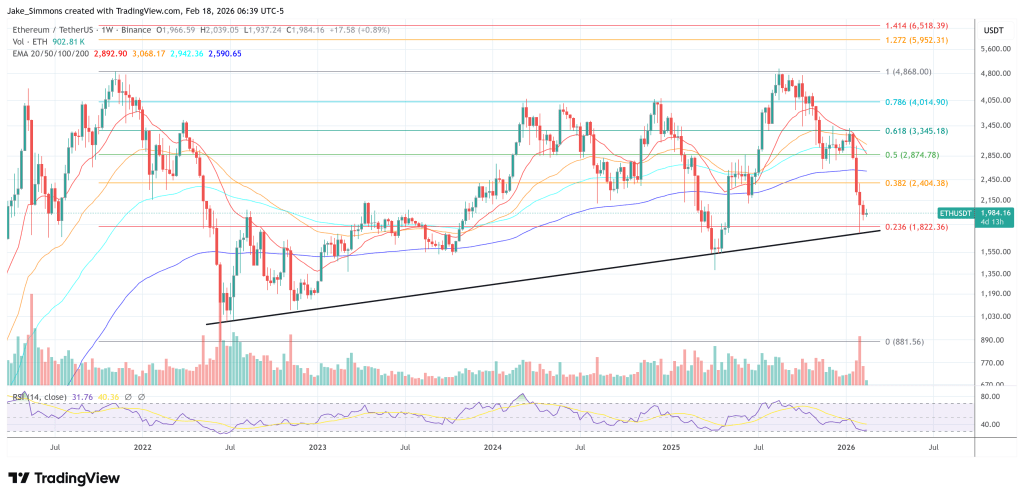
Ethereum remains below the 200-week EMA, 1-week chart | Source: ETHUSDT on TradingView.com

Perguntas relacionadas

QWhat action did Peter Thiel and Founders Fund take regarding their stake in ETHZilla by the end of 2025?

AThey fully exited their entire stake in ETHZilla, reducing their common share holdings to zero.

QWhat was the size of Peter Thiel's stake in ETHZilla as reported in the prior filing for September 30, 2025?

AThe prior filing reported that Peter Thiel beneficially owned 928,389 shares, representing 5.6% of the class.

QWhat new strategic direction has ETHZilla recently signaled it is pursuing?

AETHZilla is pivoting away from being a pure Ethereum treasury play and towards tokenized real-world assets, such as aviation, with the launch of its 'Eurus Aero Token I'.

QAccording to the article, what is one unresolved question that traders are left with regarding the fund's exit?

ATraders are questioning whether Founders Fund's exit preceded and front-ran the company's strategy shift, or if it was simply a portfolio cleanup after the initial 'ETH treasury' narrative cooled.

QHow does the commentator @treebook78 on X characterize Peter Thiel's investment timing?

AThe commentator characterizes Thiel as a 'master at sensing crises' and an 'exit master' who gets out early when bubbles or stress build, citing his past actions during the Luna crash and FTX collapse.

Leituras Relacionadas

In Conversation with Ray Dalio: We Are Currently in an AI Bubble, with 1% of My Portfolio in Bitcoin

Ray Dalio, founder of Bridgewater Associates, warns in an interview that the current AI boom shows classic bubble characteristics, which could lead to significant economic downturns as seen in past cycles like 1929 or 2000. He explains that speculative enthusiasm, fueled by debt and overvaluation, often precedes a crash when rising rates or taxation force asset sales, causing widespread losses and recession. Dalio also outlines his "Big Cycle" theory, describing an approximate 80-year pattern where widening wealth gaps, massive government deficits, and shifting geopolitical power (like China's rise) create internal conflict and global instability. He emphasizes that we are in a late-cycle, transitional phase where traditional powers like the US and UK face decline. For personal wealth protection, Dalio advises diversification beyond cash into assets like stocks, bonds, real estate, and particularly gold, which he prefers over Bitcoin. While he holds about 1% of his portfolio in Bitcoin as a non-printable hard asset, he views gold as more secure from technological or governmental threats. Regarding AI's impact, Dalio believes it will disproportionately benefit capital owners, worsening inequality by replacing both physical and cognitive labor. He suggests that human intuition and emotional intelligence, combined with AI, will be key for future workers. On taxation, Dalio argues that wealth taxes are impractical and risk triggering asset sell-offs, reducing productive investment. He points to the UK as a cautionary example of debt, low productivity, and political strife. Geopolitically, Dalio foresees a more regionalized world, with the US showing weakness in prolonged conflicts like with Iran, akin to past imperial declines. The ideal outcome, he suggests, is coexisting powerful blocs (e.g., Americas, China-Asia Pacific) without major war.

marsbitHá 38m

In Conversation with Ray Dalio: We Are Currently in an AI Bubble, with 1% of My Portfolio in Bitcoin

marsbitHá 38m

Daily 7.2 Trillion KRW: Foreign Capital's Record Net Buying on Friday! Wall Street Says Headwinds for Korean Stock Fund Flows Have Subsided

South Korean stock market sees a dramatic shift in fund flows. On July 31, foreign investors made a record net purchase of approximately KRW 7.2 trillion in KOSPI stocks, marking a fundamental reversal from the persistent large-scale net outflows seen in previous months. This contributed to a significant narrowing of foreign net selling in July to KRW 9.8 trillion, down sharply from KRW 48.4 trillion in June and KRW 44.5 trillion in May. Simultaneously, domestic institutional pressure eased. South Korean pension funds and asset managers turned to a net buying position in July, purchasing KRW 1.0 trillion worth of KOSPI shares, contrasting with net sales in May and June. Market volatility is expected to be dampened by new financial regulations. Effective July 31, the Financial Services Commission tightened access for retail investors to single-stock leveraged ETFs by raising the minimum cash deposit requirement. Trading volumes for these products subsequently dropped to about 50% of their monthly average. Citigroup Research maintains its year-end KOSPI target of 10,000 points. The firm cites several supportive factors: the substantial easing of headwinds from capital outflows, a robust fundamental outlook for the semiconductor sector, historically low market valuations, strong economic fundamentals, and the potential for policy support from financial authorities if needed.

marsbitHá 39m

Daily 7.2 Trillion KRW: Foreign Capital's Record Net Buying on Friday! Wall Street Says Headwinds for Korean Stock Fund Flows Have Subsided

marsbitHá 39m

Thanks to Dice Rolls, Bitcoin Keys Are Stored Offline, But Not Everyone Will Do It

The article discusses using dice rolls to generate secure Bitcoin wallet seeds, providing entropy independent of potentially flawed hardware random number generators. It explains that each fair dice roll offers about 2.585 bits of entropy, with around 50 rolls needed for a standard 12-word seed phrase and 99+ recommended for higher security. This method gained attention after a vulnerability was revealed in some Coldcard hardware wallets, where a faulty firmware RNG (dating back to 2021) compromised generated keys. The analysis notes that while a dice-generated main seed was safe from this specific flaw, other Coldcard functions (like creating paper wallets, backup keys, or passwords) could still be vulnerable if they used the defective RNG. The piece argues that while dice-based entropy is technically robust, the manual process is error-prone, tedious, and unrealistic for most new users, who might make mistakes in recording or inputting rolls. It concludes that while manual entropy generation should remain an option for advanced users, the long-term goal is to develop reliable, user-friendly hardware and software that securely generates randomness without requiring specialized knowledge. Coldcard users are advised to check their firmware version and replace any secondary secrets (like paper wallet keys) created with vulnerable devices, while also considering multi-signature setups with devices from different manufacturers for added security.

cryptonews.ruHá 5h

Thanks to Dice Rolls, Bitcoin Keys Are Stored Offline, But Not Everyone Will Do It

cryptonews.ruHá 5h

Trading

Spot
活动图片





