PEPE Whale Activity Jumps 60%, Among Highest In Market

bitcoinistPublicado em 2026-03-20Última atualização em 2026-03-20

Resumo

According to on-chain data from Santiment, PEPE has experienced a significant increase in whale activity, with its Whale Transaction Count surging 61% week-over-week, ranking it eighth among cryptocurrencies with market caps over $500 million. This metric tracks transfers exceeding $100,000, indicating heightened interest from large investors. Such spikes in whale activity often precede market volatility, as these substantial transactions can impact asset prices. PEPE’s price was around $0.00000334 at the time of writing, down 3% in 24 hours, following a period of recent pullback. Other notable assets on the list include Mantle (MNT), which saw a 600% increase, and stablecoins like USDT and USDC, which also recorded significant jumps in large transactions.

On-chain data shows Pepe is among the cryptocurrencies that have seen the largest week-over-week increases in the Whale Transaction Count.

Pepe Whale Transaction Count Has Witnessed A 61% Jump

In a new post on X, on-chain analytics firm Santiment has shared the top 10 list of digital assets that have seen the largest jumps in the Whale Transaction Count over the past week.

The Whale Transaction Count here refers to an indicator that keeps track of the total number of transfers occurring on a given network that involve a value of more than $100,000. Generally, only the whale entities are capable of making such large moves, so the metric represents the activity of these big-money hands.

When the value of the Whale Transaction Count rises, it means whales are ramping up their activity. Such a trend may be a sign that the large investors have increased their interest in the cryptocurrency.

On the other hand, the indicator going down suggests big-money attention may be moving away from the asset as large entities are lowering their number of transactions.

Now, here is the table shared by Santiment that shows how the assets with a minimum market cap of $500 million compare based on the weekly percentage change in the Whale Transaction Count:
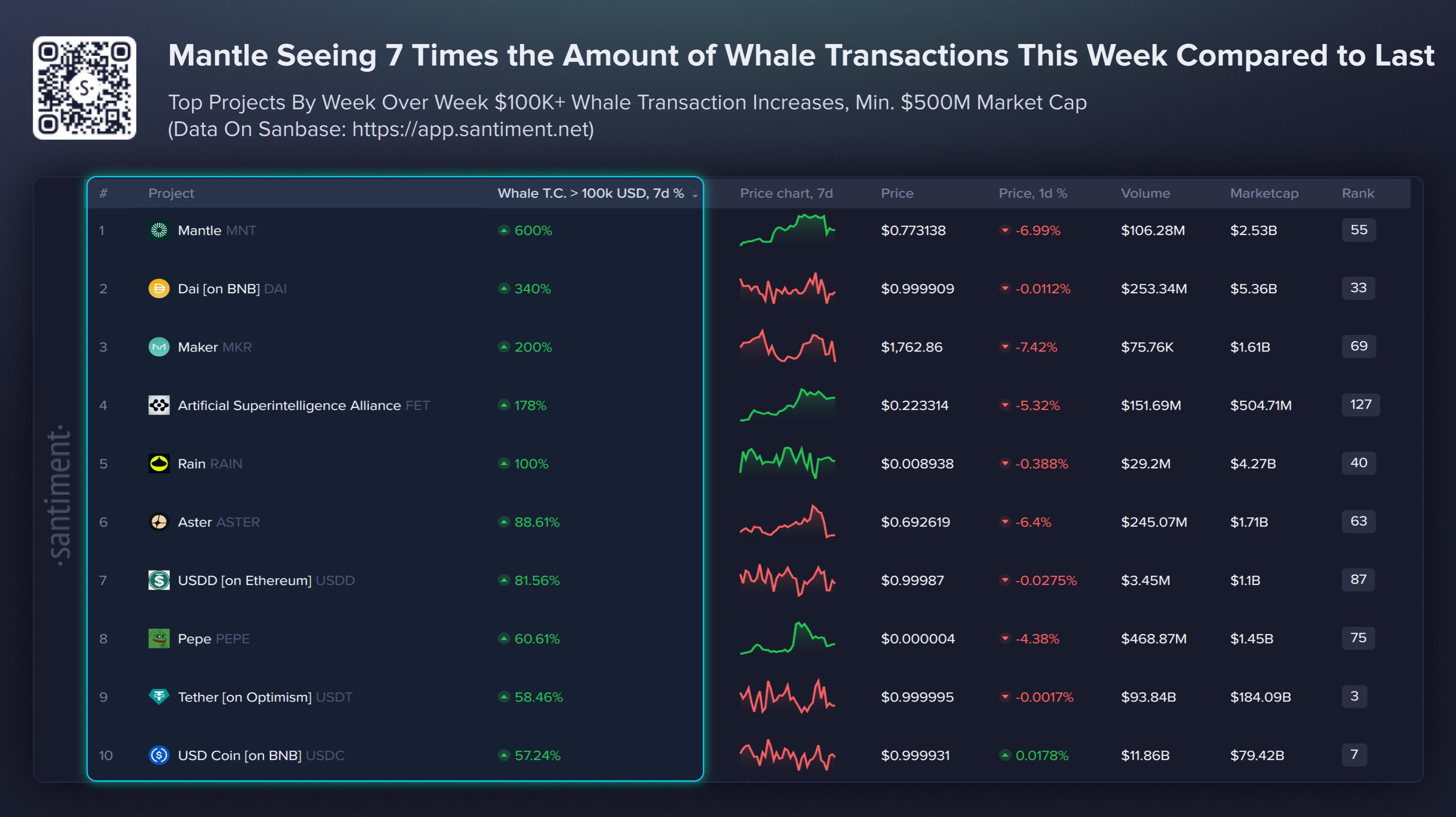
Looks like Mantle topped the list this week | Source: Santiment on X

As displayed above, Mantle (MNT) was the cryptocurrency that saw the strongest jump in the Whale Transaction Count over the last seven days: an increase of 600%. The BNB version of Dai (DAI) ranked second with an indicator rise of 340%, while Maker (MKR) came third with 200%.

Another prominent coin on the list is the memecoin Pepe (PEPE), which ranks eighth with a Whale Transaction Count of more than 60%. Earlier, the asset gained popularity due to the widely-known internet frog meme it’s associated with, but lately, the coin hasn’t been making much rounds in the news. As such, it’s interesting that whale interest in the memecoin has seen a sudden spike.

In the past, whale activity spikes have tended to proceed market volatility, as these humongous entities can create ripples big enough to shake the asset. Pepe and other assets have seen some sharp price action over the past few days, so it’s possible that the elevation in whale activity could be a factor behind it.

The largest assets by market cap on the list are USDT (on Optimism) and USDC (on BNB), garnering Whale Transaction Count jumps of 58% and 57%, respectively. Investors store capital in stablecoins when they want to avoid the volatility associated with the wider market, so these spikes could correspond to big-money hands either preparing capital for deployment into Bitcoin and other volatile assets or stashing it away in safety.

Pepe Price

At the time of writing, Pepe is floating around $0.00000334, down 3% in the last 24 hours.

The price of the memecoin seems to have pulled back over the last few days | Source: PEPEUSDT on TradingView


Perguntas relacionadas

QWhat does the Whale Transaction Count measure in the context of cryptocurrency?

AThe Whale Transaction Count is an indicator that tracks the total number of transfers on a network involving a value of more than $100,000, representing the activity of large investors or 'whales'.

QWhich cryptocurrency saw the largest percentage increase in Whale Transaction Count over the past week, and by how much?

AMantle (MNT) saw the largest increase in Whale Transaction Count over the past week, with a jump of 600%.

QWhat was the percentage increase in Whale Transaction Count for the memecoin Pepe (PEPE)?

AThe memecoin Pepe (PEPE) saw a 61% jump in its Whale Transaction Count over the past week.

QAccording to the article, what has historically tended to follow a spike in whale activity for an asset like Pepe?

AHistorically, spikes in whale activity have tended to precede market volatility, as these large entities can create significant price movements.

QWhat was the price of Pepe (PEPE) at the time the article was written, and how much had it changed in the last 24 hours?

AAt the time of writing, Pepe was trading around $0.00000334, down 3% in the last 24 hours.

Leituras Relacionadas

Lowering Expectations for BTC's Next Bull Market

The author, Alex Xu, explains his decision to significantly reduce his Bitcoin holdings (from full to ~30% of his portfolio) during the current bull cycle, citing a lowered long-term outlook for BTC's price appreciation in the next cycle. He outlines six key reasons for this reduced expectation: 1. **Diminished Growth Drivers:** The narrative of exponential user adoption has largely played out with institutional ETF adoption. The next major growth phase—adoption by sovereign national reserves or central banks—seems unlikely in the near future. 2. **Personal Opportunity Cost:** More attractive investment opportunities have emerged in other assets, such as undervalued companies. 3. **Industry-Wide Contraction:** The broader crypto industry is struggling, with most Web3 business models (SocialFi, GameFi, DePIN) failing. This overall萧条 (depression) reduces the fundamental demand and consensus for Bitcoin. 4. **Strain on Major Buyer:** MicroStrategy, a major corporate buyer of BTC, faces rising financing expenses for its debt, which could slow its purchasing rate and create significant marginal pressure on the market. 5. **Increased Competition from Gold:** The emergence of "tokenized gold" has closed the functional gap (portability, divisibility) between physical gold and Bitcoin, offering a strong competitor in the non-sovereign store-of-value space. 6. **Security Budget Concerns:** The block reward halving continues to exacerbate the long-standing issue of funding Bitcoin's network security, with new fee source explorations like Ordinals and L2s largely failing. The author's decision to hold a significant (though reduced) position reflects a cautious, not bearish, outlook. He remains open to increasing his exposure if the fundamental reasons for his skepticism change or if new positive catalysts emerge.

marsbitHá 25m

Lowering Expectations for BTC's Next Bull Market

marsbitHá 25m

Can Iran 'Control' the Strait of Hormuz?

Iran has announced a comprehensive plan to assert control over the strategic Strait of Hormuz, a critical global oil shipping chokepoint. The proposed measures include requiring all vessels to obtain Iranian permission for passage, imposing fees for security, environmental protection, and navigation management—preferably paid in Iranian rials—and absolutely banning Israeli ships. Vessels from countries deemed hostile by Iran’s top security bodies may also be barred. Analysts suggest Iran’s motives are multifaceted: increasing pressure on the U.S. and Israel by leveraging control over oil transit to influence global prices and inflation; creating a new revenue stream, potentially exceeding $7.7 billion annually, to counter Western sanctions and support postwar reconstruction; and using transit permissions as bargaining chips in future negotiations, notably with the U.S. However, the plan faces significant practical and diplomatic challenges. Enforcing comprehensive interception and fee collection in the busy waterway, patrolled by international military forces, would be difficult. The U.S. has already countering with a blockade of Iranian ports and threats to intercept any ship paying fees, potentially strangling Iran’s oil exports and fee revenue. Broad international opposition, led by European and Gulf states, and legal controversies further complicate implementation. The proposal may ultimately serve more as a negotiating tactic than a feasible policy, with its execution remaining highly uncertain.

marsbitHá 1h

Can Iran 'Control' the Strait of Hormuz?

marsbitHá 1h

Trading

Spot
Futuros
活动图片