Pentagon Pizza Index Soars 1250%: Who Will Be the Next Venezuela?

Odaily星球日报Publicado em 2026-01-08Última atualização em 2026-01-08

Resumo

The Pentagon Pizza Index, an unconventional but historically telling indicator, has surged by 1250% in the past 48 hours, sparking global speculation about imminent U.S. military action. This surge, nearly double the 700% spike observed before the recent operation that captured Venezuelan President Maduro, tracks pizza delivery spikes near the Pentagon—often linked to extended staff hours during crises. Historical precedents include spikes before the 1990 Iraq-Kuwait conflict and 1998 Iraq operations. Current data shows increases ranging from 200% to 1250% at nearby pizzerias. The Trump administration’s “Don-roe Doctrine” suggests potential targets: Greenland (with prediction markets showing a 38% chance of U.S. control), Cuba (20% chance of U.S. strike by year-end), Colombia (15%), and Iran (54% chance of leadership change). Memes and prediction markets are already reacting, with the “Pentagon Pizza Watch” token rising 78% and significant betting activity on platforms like Polymarket. The index underscores how real-time, unconventional data can signal geopolitical shifts before official announcements.

Original | Odaily Planet Daily (@OdailyChina)

Author | jk
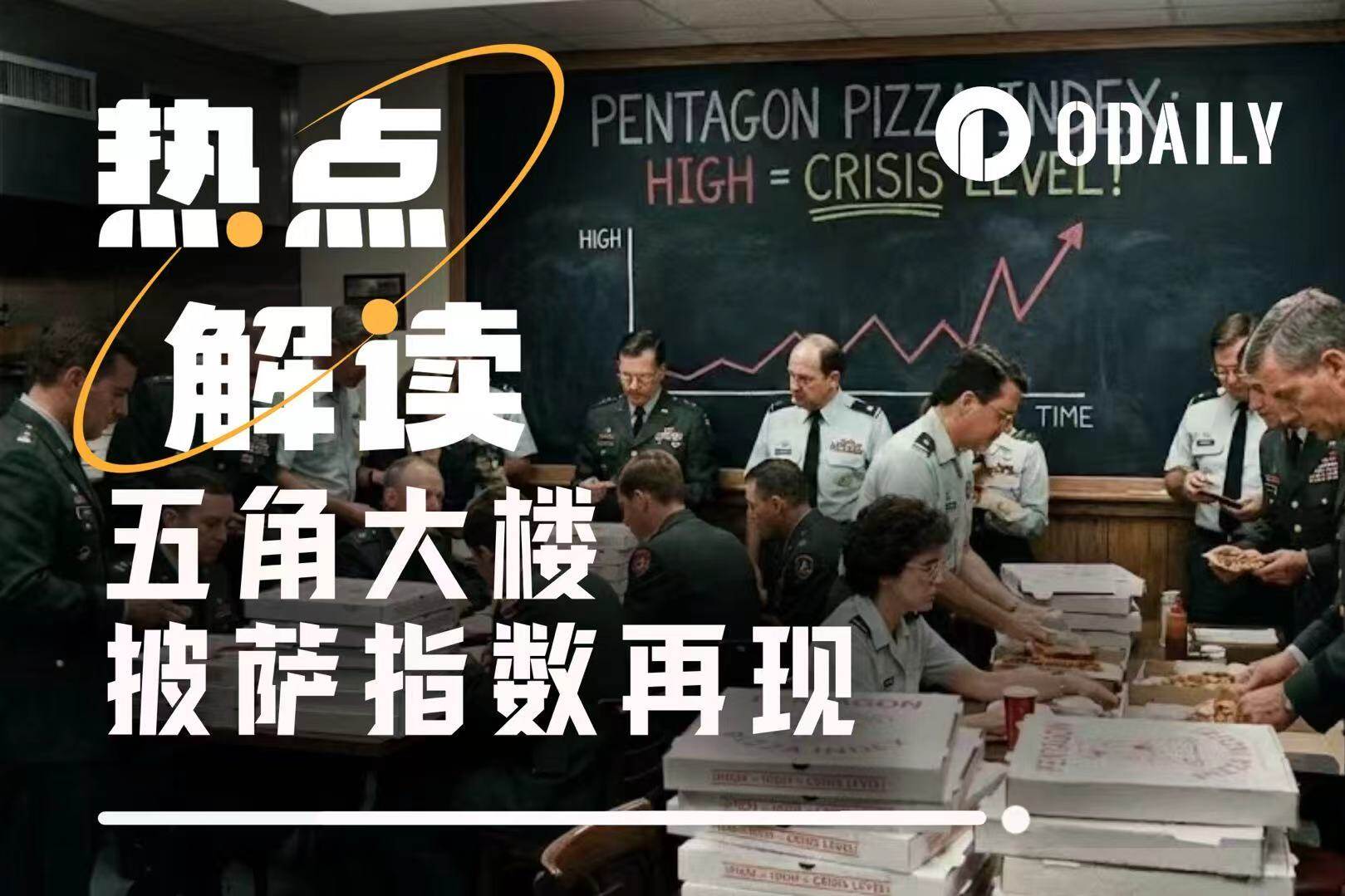
On January 7, 2026, a seemingly absurd but repeatedly effective intelligence indicator has drawn global attention. According to social media monitoring, pizza orders near the Pentagon have surged by 1250% in the past 48 hours, a figure nearly double the 700% increase seen just before the military action in Venezuela. This is the "Pentagon Pizza Index," a remarkable indicator, and its underlying implication is that the United States is brewing new military operations.

Pizza Orders and Military Intelligence?

The concept of the Pentagon Pizza Index dates back to 1990, when Frank Meeks, the owner of a Domino's Pizza in the Washington area, noticed a peculiar phenomenon: on the evening of August 1, 1990, the Central Intelligence Agency ordered a record 21 pizzas, and the next day, Iraq invaded Kuwait.

Moreover, this pattern has repeated:

  • Before the Panama operation in December 1989, orders surged from 30-35 to over 100;
  • During President Clinton's impeachment hearings and the "Desert Fox" operation in Iraq in December 1998, extra cheese pizza orders from the White House increased by 32%.

The logic behind this is very simple: during high-pressure crisis moments, Department of Defense (now the War Department, renamed by Trump) staff often need to work 16-20 hours consecutively, and pizza is cheap, filling, and easy to deliver, making it the go-to choice for overtime work.

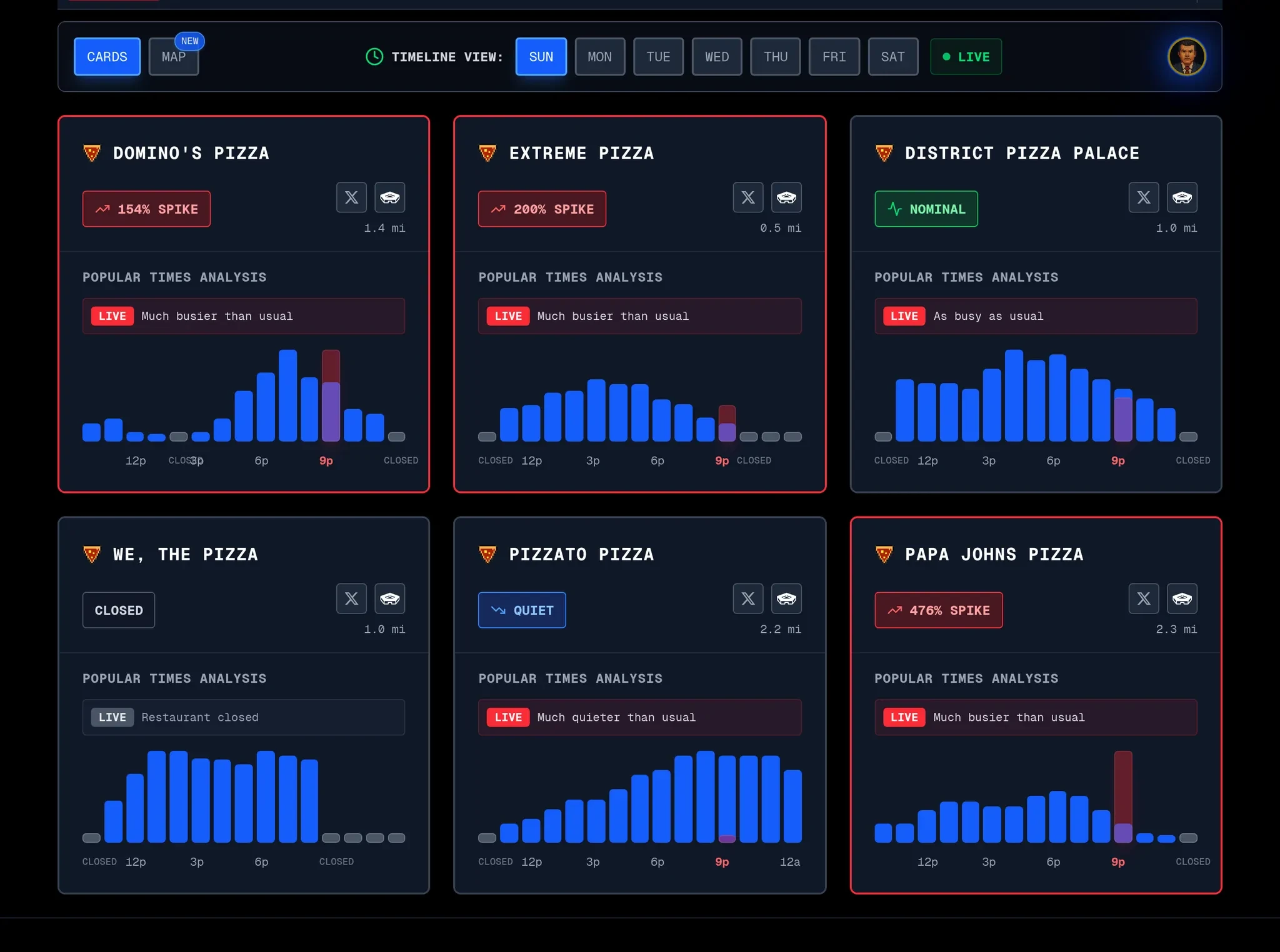
Today, there are dedicated websites monitoring six pizza shops near the Pentagon in real-time, including Papa John's and Domino's. Currently, these websites are all showing crazy multiples, ranging from 150% to 1250%.
What About Before the Venezuela Operation?

In the early hours of January 3, 2026, U.S. forces launched a raid in Caracas, the capital of Venezuela, successfully capturing President Maduro and his wife. Just hours before the operation, the Papa John's pizza shop near the Pentagon was unusually busy.

This was not a sudden military action either; the U.S. began a large-scale military buildup in the Caribbean region in August 2025: August: The USS Iwo Jima amphibious assault ship group arrived; November: The USS Ford aircraft carrier strike group arrived; Totaling about 15,000 U.S. military personnel, the largest military deployment in the region in generations. So, Pentagon staff worked overtime, causing all nearby pizza shops to work overtime as well.

A 1250% Increase: Who Is the Next Target?

Latest data from Sunday evening shows activity at the Papa John's pizza shop 2.3 miles from the Pentagon surged by 476%, while the closer Extreme Pizza saw a 200% increase. The peak increase of 1250% compared to the lowest point set a new historical record.

The Trump administration has stated this is part of its "Don-roe Doctrine." This is a metaphor for a modernized version of the 19th-century Monroe Doctrine, an advanced version of MAGA. Trump declared on Saturday: "American dominance in the Western Hemisphere will never be questioned again."

Based on the latest statements from Trump and his senior officials, the following countries and regions may be the next targets:

  • Greenland: Trump emphasized the U.S. needs Greenland to ensure national security. Prediction markets show the probability of the U.S. "controlling any part of Greenland" has risen from less than 20% last week to 38%. The Danish government is currently in "full crisis mode."
  • Cuba: Secretary of State Rubio warned that the Cuban government "is in big trouble." He pointed out that Maduro's bodyguards were Cuban, and 32 Cuban officers were killed in the Venezuela operation. Trump said: "Cuba looks like it's about to collapse."
  • Colombia: Trump directly threatened: "Colombia is also very sick, run by a sick man who likes to make cocaine and sell it to the United States, and he won't be doing that much longer." When asked if military action was considered, Trump replied: "Sounds good."
  • Iran: After Trump threatened to "hit Iran hard," prediction markets estimate a 54% probability that Iran's Supreme Leader Khamenei will step down before next year.

How Are These Countries Responding?

Colombian President Petro has shown a tough stance. He was reportedly quoted in November 2025 saying: "Brother, if you want to put me in jail, see if you can." Recently, he announced that any commander who prefers the American flag over the Colombian flag will be immediately dismissed from the army.

The Cuban government has held two days of national mourning for the 32 officers killed in the Venezuela operation, clearly remaining highly alert to Rubio's warnings.

Meme and Prediction Markets: Already One Step Ahead

When it comes to such events, meme markets and prediction markets are always the quickest to move.

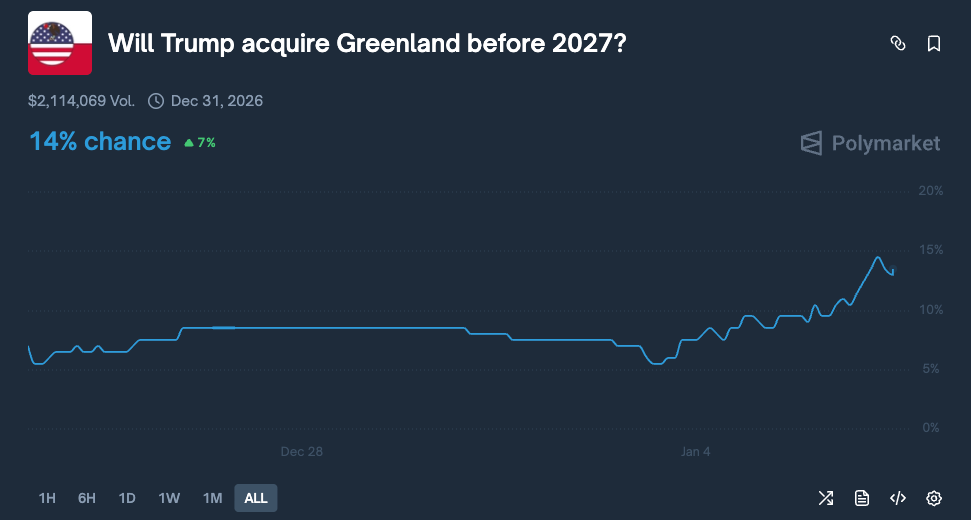
On Polymarket, the market for "Trump 'acquiring' Greenland by 2027" is highly sensitive. The probability in this market rose from about 7% on December 28 to the current 14%, a gain of 7 percentage points, with trading volume exceeding $2.1 million. This rise coincided with the timing of the Venezuela operation.

The "US strikes Cuba by xx date" market shows a阶梯式 probability distribution: only 2% by January 31, 8% by March 31, but jumps to 20% by the end of the year. The loss of 32 Cuban officers in the Venezuela operation could be the trigger for U.S. action.

The "US strikes Colombia by xx date" market shows a more aggressive probability curve: 3% by end of January, 7% by end of March, 15% by year-end.
Simultaneously, related memes have already appeared, such as Pentagon Pizza Watch (PPW); this is a logo featuring a glowing pizza hovering over a green pentagon, adorned with missile elements.
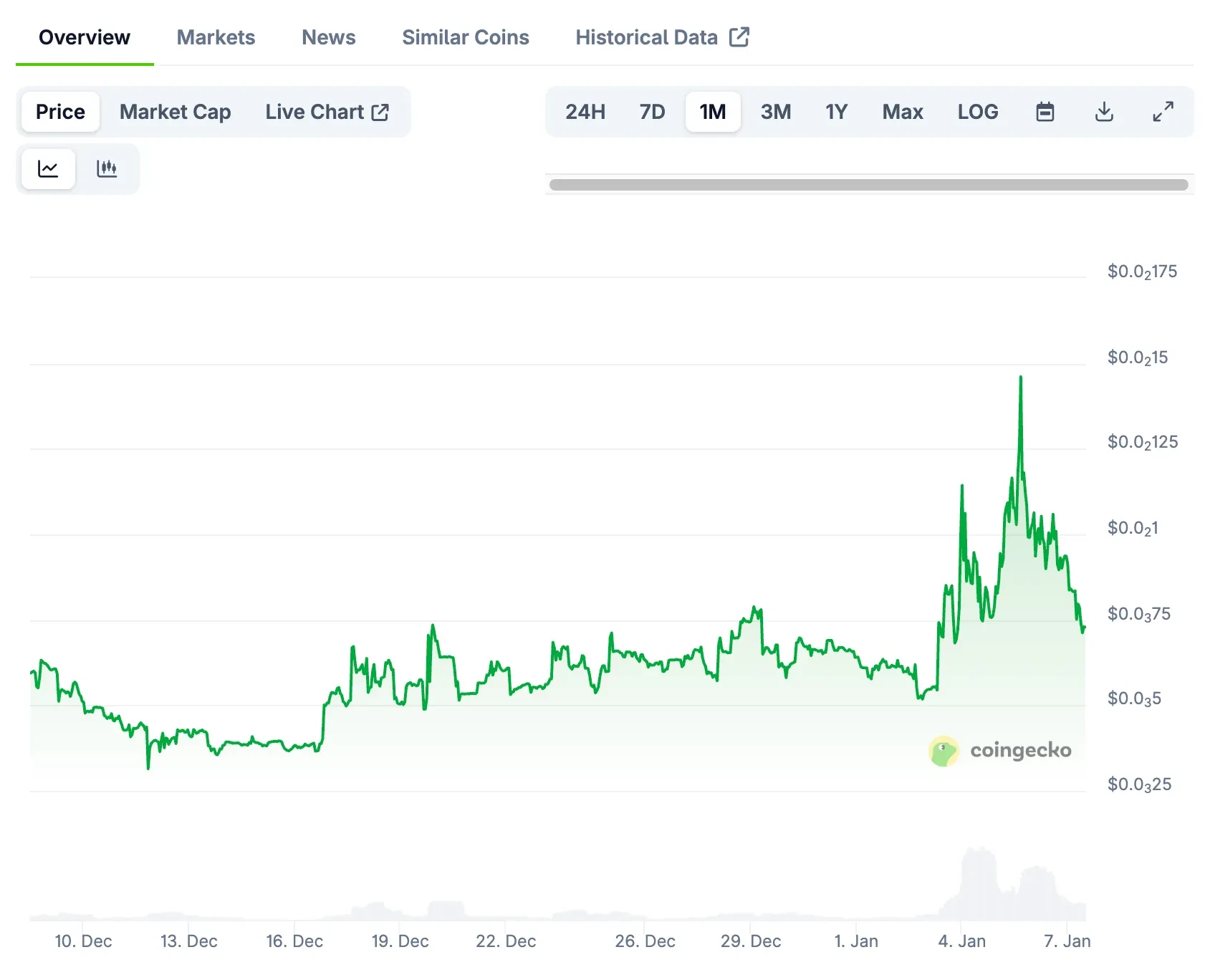
In terms of market performance, PPW saw a 78.20% gain in one week, with a 24-hour trading volume of $114,369, ranking 3689th in market capitalization.

Here, we strongly recommend reading this Odaily article: "When War is Settled Before the News: How Prediction Markets 'Priced' the Maduro Capture 6 Days Early."


Perguntas relacionadas

QWhat is the Pentagon Pizza Index and what does a 1250% surge indicate?

AThe Pentagon Pizza Index is an informal intelligence indicator that tracks pizza delivery orders near the Pentagon. A 1250% surge suggests a significant increase in military staff working long hours, often preceding major U.S. military operations, similar to patterns observed before historical events like the Iraq invasion of Kuwait.

QWhich countries are potential targets according to the article based on recent U.S. government statements?

APotential targets include Greenland, Cuba, Colombia, and Iran, as indicated by statements from Trump and officials, such as threats to 'hit Iran hard' and warnings about Cuba and Colombia's governments.

QHow did prediction markets react to the increased Pentagon Pizza Index and recent military actions?

APrediction markets showed heightened activity, with probabilities for U.S. 'acquisition' of Greenland rising from 7% to 14%, and markets for strikes on Cuba and Colombia seeing increased probabilities by year-end, reflecting speculative responses to military tensions.

QWhat historical events are cited as examples where pizza order spikes preceded military actions?

AHistorical examples include the 1990 Iraq invasion of Kuwait after a spike in CIA pizza orders, the 1989 Panama action with orders jumping from 30-35 to over 100, and the 1998 'Desert Fox' operation in Iraq during Clinton impeachment hearings.

QWhat is the 'Don-roe Doctrine' mentioned in the article and how does it relate to U.S. policy?

AThe 'Don-roe Doctrine' is described as a modernized version of the Monroe Doctrine, reflecting Trump's MAGA agenda, asserting U.S. dominance in the Western Hemisphere and justifying interventions, as seen in the recent Venezuela operation.

Leituras Relacionadas

Must-Watch Events Next Week|CLARITY Act Could Face Senate Vote; SpaceX, Circle to Report Earnings (8.3-8.9)

**Summary: Key Events and Developments to Watch (August 3-9)** The upcoming week is marked by significant financial disclosures, key legislative deadlines, and notable product updates. **Major Financial Events:** Several companies are scheduled to release their Q2 2026 earnings. American Bitcoin (ABTC) will report on August 3, followed by SpaceX and Hut 8 Mining Corp. on August 4, and Circle on August 5. Notably, a significant portion of SpaceX shares (up to 12% of total shares) will be unlocked on August 6 following their earnings release. **Key Legislative Deadline:** The U.S. Senate faces an August 7 deadline to secure 60 votes for the CLARITY Act, a bipartisan bill aiming to establish a federal regulatory framework for cryptocurrencies. The Senate may hold a full vote on the bill during the week. **Economic Data:** The U.S. July Non-Farm Payrolls report will be released on August 7, providing crucial labor market data. **Technology & Product Updates:** * **Shutdowns:** DeFi portfolio tracker Zapper and wallet app Ctrl Wallet will cease operations on August 3. * **Upgrades:** LayerZero will deprecate its v1 relayers on August 3. XRP Ledger's new version 3.3.0, featuring five new functions, is expected next week. * **AI:** Elon Musk announced that the advanced Grok 4.6 AI model is set for release around August 7. * **Bitcoin:** The BIP-110 forced signaling for a potential Bitcoin network change is scheduled to begin around August 8. **Other Notable Events:** Chinese robotics firm Unitree Tech has set its preliminary price inquiry for its IPO for August 5. South Korean exchange Upbit will delist AQT and AERGO tokens on August 3.

marsbitHá 1h

Must-Watch Events Next Week|CLARITY Act Could Face Senate Vote; SpaceX, Circle to Report Earnings (8.3-8.9)

marsbitHá 1h

Stocks Are Plummeting More Sharply Than Cryptocurrencies. Where Has the Money Gone?

Stock Markets Plunge Deeper Than Cryptocurrencies: Where Did the Money Go? In late July, Seoul's Kospi index triggered circuit breakers for two consecutive days, plummeting over 40% from its June high. The collapse was led by heavyweight stocks like SK Hynix, whose record profits still disappointed investors, and devastating leveraged ETFs, with one major product losing over 83% of its value. This signaled a global, forced deleveraging targeting the most crowded trades. Interestingly, while stocks exhibited extreme volatility akin to crypto markets, Bitcoin rose nearly 15% in July after a prior steep drop. Analysis shows the money fleeing equities did not flow into Bitcoin. Instead, Bitcoin had already absorbed its sell-off in May-June, when U.S. spot Bitcoin ETFs saw historic outflows. The true safe-haven beneficiary was gold, whose price rose over 20% year-on-year, highlighting a decoupling between Bitcoin and gold as "digital gold." The sell-off was a targeted unwinding of leveraged positions in tech and semiconductors, accelerated by broker-dealer risk management and shifts in the AI narrative, including new competition from Chinese memory chipmakers. The retreat path was clear: from high-valuation tech stocks to cash and U.S. Treasuries, then to gold. For Bitcoin to attract sustained institutional inflows, conditions like eased global liquidity pressure, a "soft-landing" Fed rate cut, and U.S. regulatory clarity via legislation like the stalled CLARITY Act are needed. Currently, Bitcoin is not a safe haven but an already-cleared asset. Its low correlation with tech stocks, however, makes it a potential diversification play for institutional portfolios once the storm passes. The money isn't here yet, but the positioning is underway.

marsbitHá 1h

Stocks Are Plummeting More Sharply Than Cryptocurrencies. Where Has the Money Gone?

marsbitHá 1h

In Conversation with Ray Dalio: We Are Currently in an AI Bubble, with 1% of My Portfolio in Bitcoin

Ray Dalio, founder of Bridgewater Associates, warns in an interview that the current AI boom shows classic bubble characteristics, which could lead to significant economic downturns as seen in past cycles like 1929 or 2000. He explains that speculative enthusiasm, fueled by debt and overvaluation, often precedes a crash when rising rates or taxation force asset sales, causing widespread losses and recession. Dalio also outlines his "Big Cycle" theory, describing an approximate 80-year pattern where widening wealth gaps, massive government deficits, and shifting geopolitical power (like China's rise) create internal conflict and global instability. He emphasizes that we are in a late-cycle, transitional phase where traditional powers like the US and UK face decline. For personal wealth protection, Dalio advises diversification beyond cash into assets like stocks, bonds, real estate, and particularly gold, which he prefers over Bitcoin. While he holds about 1% of his portfolio in Bitcoin as a non-printable hard asset, he views gold as more secure from technological or governmental threats. Regarding AI's impact, Dalio believes it will disproportionately benefit capital owners, worsening inequality by replacing both physical and cognitive labor. He suggests that human intuition and emotional intelligence, combined with AI, will be key for future workers. On taxation, Dalio argues that wealth taxes are impractical and risk triggering asset sell-offs, reducing productive investment. He points to the UK as a cautionary example of debt, low productivity, and political strife. Geopolitically, Dalio foresees a more regionalized world, with the US showing weakness in prolonged conflicts like with Iran, akin to past imperial declines. The ideal outcome, he suggests, is coexisting powerful blocs (e.g., Americas, China-Asia Pacific) without major war.

marsbitHá 5h

In Conversation with Ray Dalio: We Are Currently in an AI Bubble, with 1% of My Portfolio in Bitcoin

marsbitHá 5h

Trading

Spot
活动图片




