Pentagon Pizza Index Soars 1250%: Who Will Be the Next Venezuela?

marsbitPublicado em 2026-01-07Última atualização em 2026-01-07

Resumo

The Pentagon Pizza Index, an unconventional but historically reliable indicator of US military activity, has surged by 1250% in the past 48 hours, sparking global attention. This spike, nearly double the increase observed before the recent Venezuela operation, suggests the US is planning new military action. The index, which tracks pizza delivery orders near the Pentagon, originated in 1990 when a local pizzeria owner noticed a correlation between large orders and imminent military crises, such as the Iraq invasion of Kuwait. The logic is simple: during high-pressure situations, Pentagon staff work long hours and order cheap, convenient pizza. Following the successful capture of Venezuelan President Maduro on January 3, 2026, which was preceded by a similar pizza order surge, the current unprecedented increase has led to speculation about potential next targets. The Trump administration's "Don-roe Doctrine" signals a reinforced Monroe Doctrine for the MAGA era, with Trump asserting US dominance in the Western Hemisphere. Potential targets identified include Greenland, with prediction markets showing a 38% probability of US control; Cuba, after 32 Cuban officers died in the Venezuela operation; Colombia, directly threatened by Trump; and Iran. Meme and prediction markets are already reacting, with tokens like PPW surging 78.20% and markets pricing in increased probabilities of military action against these nations.

Author|jk

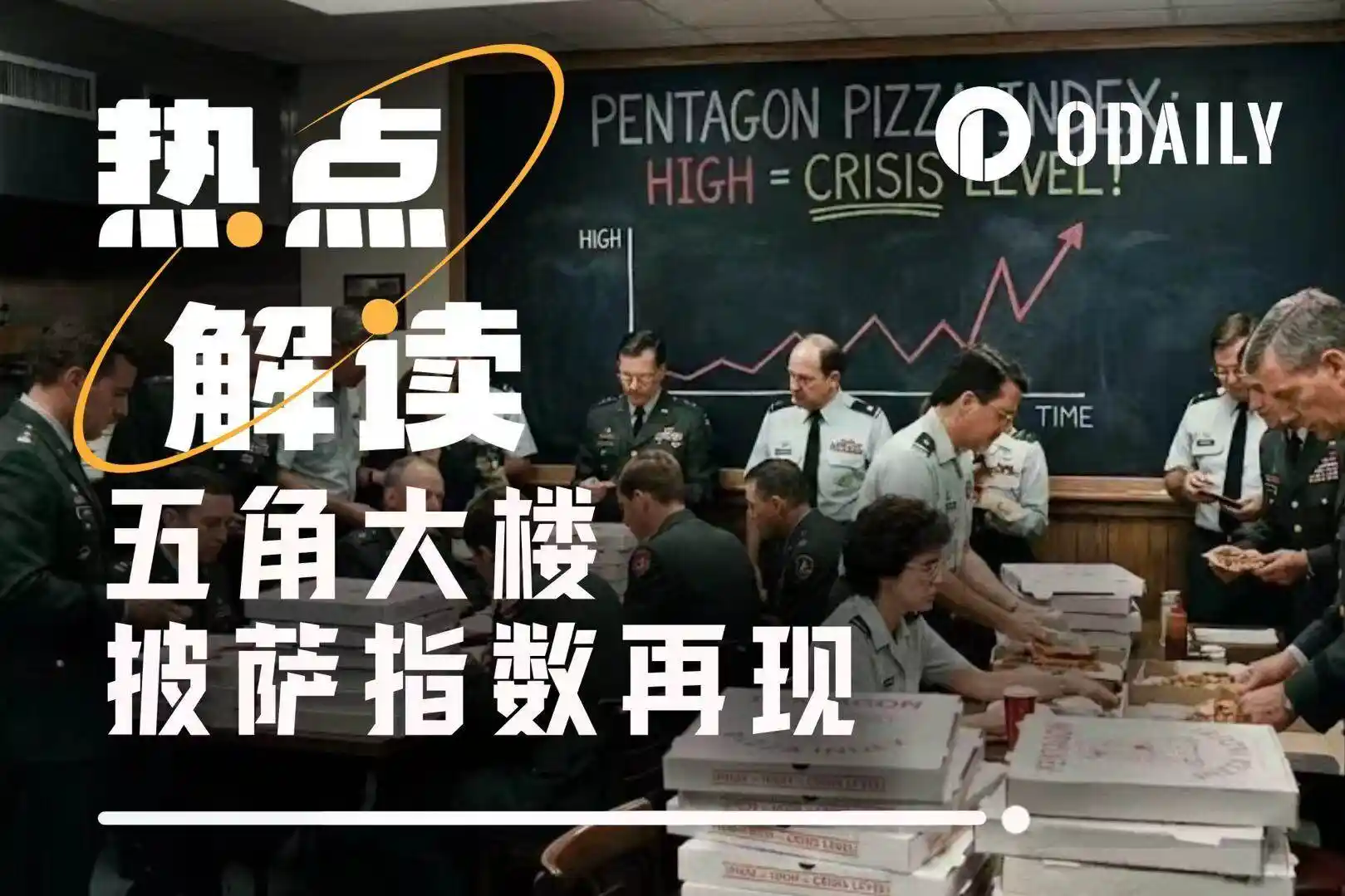
On January 7, 2026, an intelligence indicator that seems absurd but has repeatedly proven effective has drawn global attention. According to social media monitoring, the volume of pizza orders near the Pentagon has surged by 1250% in the past 48 hours, a figure nearly double the 700% increase seen on the eve of the military action in Venezuela. This is the "Pentagon Pizza Index," a remarkable indicator, and its underlying implication is that the United States is brewing new military operations.

Pizza Orders and Military Intelligence?

The concept of the Pentagon Pizza Index dates back to 1990, when Frank Meeks, the owner of a Domino's Pizza franchise in the Washington area, noticed a peculiar phenomenon: on the evening of August 1, 1990, the Central Intelligence Agency ordered a record 21 pizzas, and the next day, Iraq invaded Kuwait.

Moreover, this pattern has recurred repeatedly:

  • Before the Panama action in December 1989, order volume surged from 30-35 to over 100;
  • During President Clinton's impeachment hearings and the Iraqi "Desert Fox" operation in December 1998, extra cheese pizza orders from the White House increased by 32%.

The logic behind this is very simple: during high-pressure crisis moments, Department of Defense (now the Department of War, renamed by Trump) staff often need to work 16-20 hours consecutively, and pizza is cheap, filling, and convenient for delivery, making it the preferred choice for overtime meals.

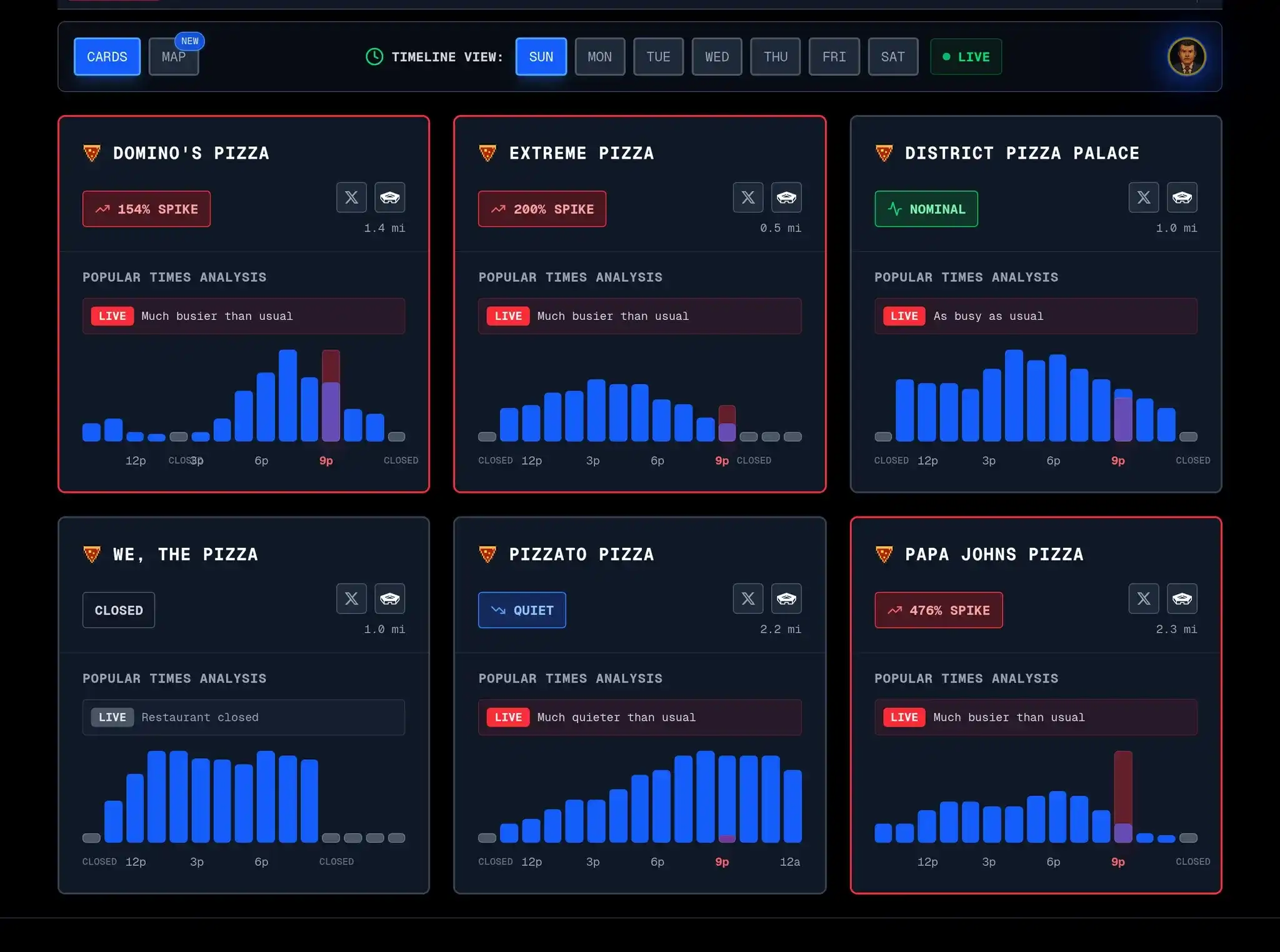
Today, there are dedicated websites online that monitor six pizza shops near the Pentagon in real-time, including Papa John's and Domino's. Currently, this website is showing crazy multiples, ranging from 150% to 1250%.
What About Before the Venezuela Action?

In the early hours of January 3, 2026, U.S. forces launched a raid in Caracas, the capital of Venezuela, successfully capturing President Maduro and his wife. Hours before the operation, the Papa John's pizza shop near the Pentagon was unusually busy.

This was not a sudden military action either; the U.S. had been building up a massive military presence in the Caribbean since August 2025: August: The USS Iwo Jima amphibious assault ship group arrived; November: The USS Ford aircraft carrier strike group arrived; A total of approximately 15,000 U.S. military personnel, marking the largest military deployment in the region in generations. Thus, Pentagon staff worked overtime, causing all nearby pizza shops to work overtime as well.

A 1250% Surge: Who Is the Next Target?

The latest data from Sunday evening shows that activity at the Papa John's pizza shop 2.3 miles from the Pentagon surged by 476%, while the closer Extreme Pizza saw a 200% increase. The peak increase of 1250% compared to the low set a new historical record.

The Trump administration has stated that this is part of its "Don-roe Doctrine." This is a metaphor for a modernized version of the 19th-century Monroe Doctrine, an advanced version of MAGA. Trump declared on Saturday: "American dominance in the Western Hemisphere will never be questioned again."

Based on the latest statements from Trump and his senior officials, the following countries and regions may become the next targets:

  • Greenland: Trump emphasized the U.S. needs Greenland to ensure national security. Prediction markets show the probability of the U.S. "controlling any part of Greenland" has risen from less than 20% last week to 38%. The Danish government is currently in "full crisis mode."
  • Cuba: Secretary of State Rubio warned that the Cuban government "is in big trouble." He noted that Maduro's bodyguards were Cuban, and 32 Cuban officers were killed in the Venezuela operation. Trump stated: "Cuba looks like it's about to collapse."
  • Colombia: Trump directly threatened: "Colombia is also very sick, run by a sick man who likes to make cocaine and sell it to the United States, and he won't be doing that much longer." When asked if military action was being considered, Trump replied: "Sounds good."
  • Iran: After Trump threatened to "hit Iran hard," prediction markets indicate a 54% probability that Iran's Supreme Leader Khamenei will be ousted before next year.

How Are These Countries Responding?

Colombian President Petro has adopted a tough stance. He was said to have stated in November 2025: "Brother, if you want to put me in jail, see if you can." Recently, he announced that any commander who prefers the American flag over the Colombian flag would be immediately dismissed from the army.

The Cuban government has already held two days of national mourning for the 32 officers killed in the Venezuela operation, clearly remaining highly alert to Rubio's warnings.

Meme and Prediction Markets: Already One Step Ahead

When it comes to such events, meme markets and prediction markets are always the quickest to move.

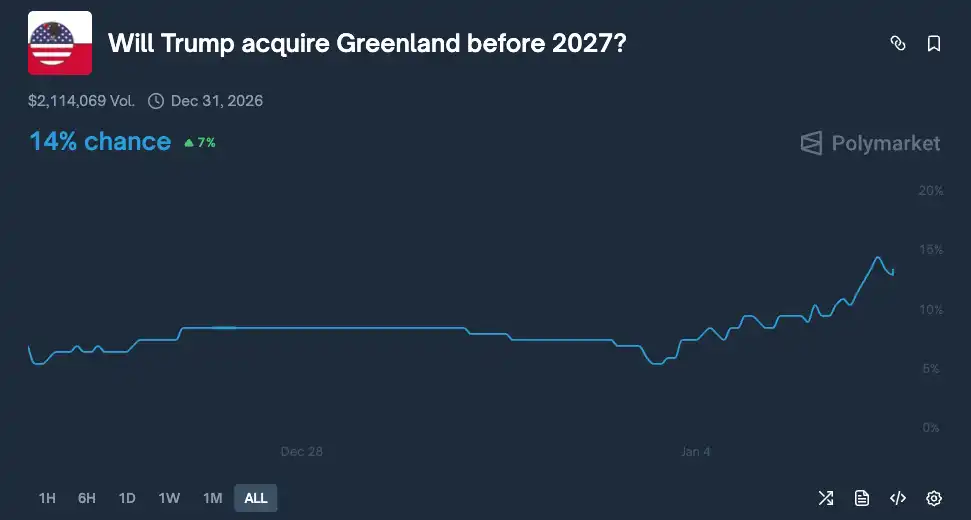
On Polymarket, the market for "Trump 'acquiring' Greenland by 2027" is highly sensitive. The probability in this market rose from about 7% on December 28 to the current 14%, a gain of 7 percentage points, with trading volume exceeding $2.1 million. This increase coincided with the timing of the Venezuela operation.

The "U.S. will strike Cuba by xx date" market shows a tiered probability distribution: only 2% before January 31, 8% before March 31, but jumps to 20% by the end of the year. The loss of 32 Cuban officers in the Venezuela operation could be a trigger for U.S. action.

The "U.S. will strike Colombia by xx date" market exhibits a more aggressive probability curve: 3% by the end of January, 7% by the end of March, 15% by the end of the year.
Simultaneously, related memes have already emerged, such as Pentagon Pizza Watch (PPW); this is a logo featuring a glowing pizza hovering above a green pentagon, adorned with missile elements.
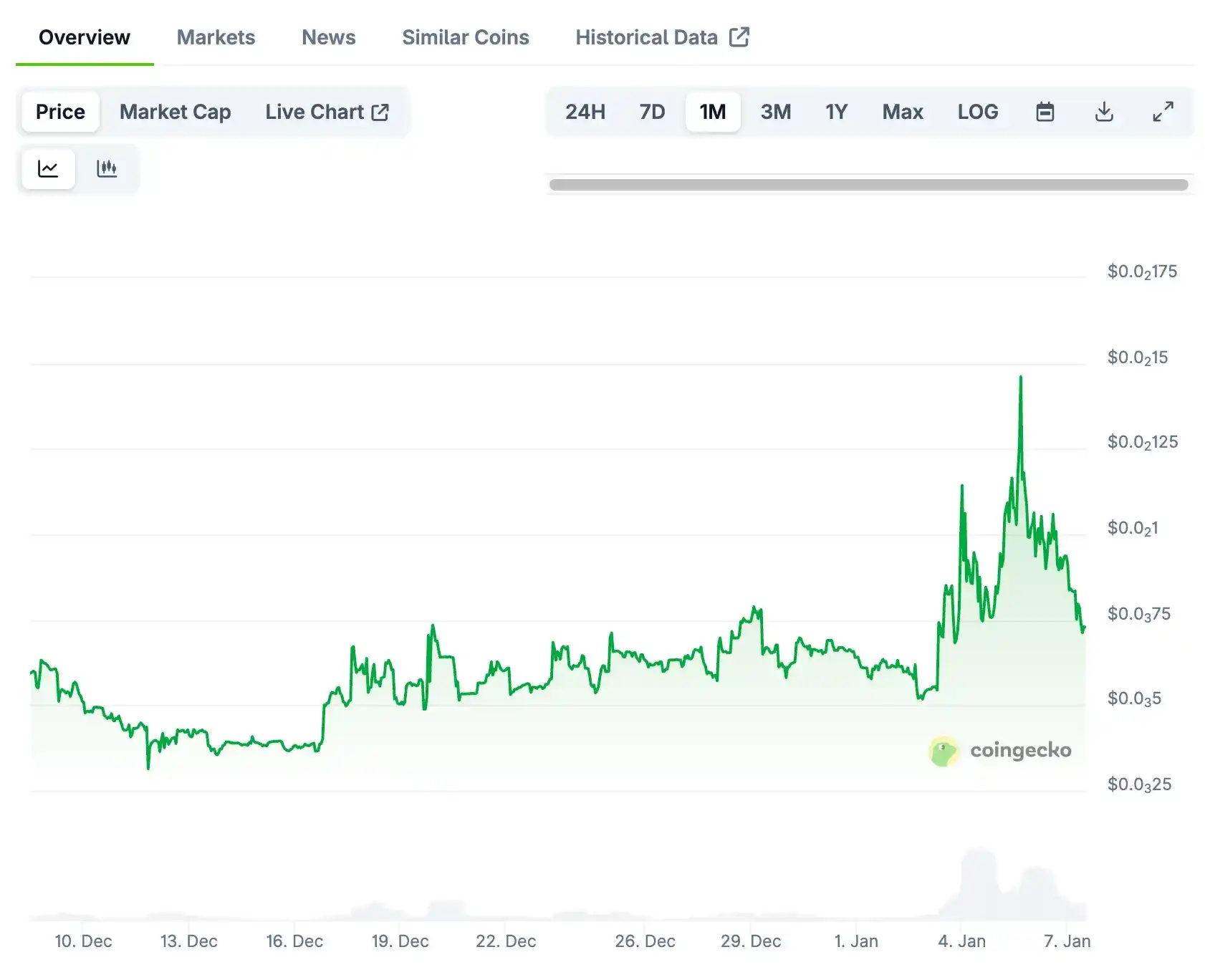
Judging by market performance, PPW saw a 78.20% gain in one week, with a 24-hour trading volume of $114,369, ranking 3689th in market capitalization.

Here, we strongly recommend reading this Odaily article: "When War is Settled Before the News: How Prediction Markets 'Priced' the Maduro Capture Operation 6 Days Early."


Perguntas relacionadas

QWhat is the Pentagon Pizza Index and what does it indicate?

AThe Pentagon Pizza Index is an informal intelligence indicator that tracks the surge in pizza orders near the Pentagon. A significant increase suggests that U.S. military personnel are working extended hours, often indicating imminent military action or a high-stakes crisis.

QWhich countries are mentioned as potential targets for U.S. military action based on the article?

AThe article mentions Greenland, Cuba, Colombia, and Iran as potential targets for U.S. military action, based on statements from Trump and senior officials.

QWhat historical events are cited where the Pentagon Pizza Index proved accurate?

AHistorical events include the 1990 Iraq invasion of Kuwait, the 1989 Panama action, and the 1998 'Desert Fox' operation in Iraq, all preceded by notable spikes in pizza orders near the Pentagon.

QHow did prediction markets react to the increased Pentagon Pizza Index and recent events?

APrediction markets showed increased probabilities for U.S. actions, such as a rise from 7% to 14% for Trump 'acquiring' Greenland by 2027, and significant trading volumes reflecting heightened expectations of military strikes.

QWhat was the significance of the 1250% increase in the Pentagon Pizza Index mentioned in the article?

AThe 1250% increase was a record-high spike, nearly double the surge observed before the Venezuela operation, suggesting the U.S. might be planning a major military action, potentially targeting countries like Greenland, Cuba, Colombia, or Iran.

Leituras Relacionadas

In-Depth Report on the On-Chain Lending Market: When Off-Chain Credit Meets On-Chain Liquidation

The on-chain lending market has evolved from a peripheral DeFi niche into core financial infrastructure. As of early 2026, total value locked (TVL) in on-chain lending protocols has reached $64.3 billion, accounting for 53.54% of total DeFi TVL, making it the largest and most mature vertical within decentralized finance. Aave dominates the sector with approximately $32.9 billion in TVL, commanding nearly half of the market—a leadership position that is unlikely to be challenged in the foreseeable future. However, the path of on-chain lending forward is not without risk. Liquidation cascades, credit defaults, and cross-chain vulnerabilities remain systemic threats hanging over the industry. At the same time, a deeper structural transformation is underway: on-chain lending is shifting from a “leverage tool for crypto-native users” to a “compliant gateway for institutional capital”. The scale of RWA (Real World Asset) lending has surpassed $18.5 billion, with U.S. Treasuries and government securities increasingly serving as core collateral. Institutional capital inflows are reshaping both the user base and risk appetite of the sector. This report systematically analyzes the evolution of on-chain lending definitions, competitive dynamics, core risks, and future trends, providing a comprehensive industry outlook for investors and trade practitioners. Key findings suggest that the “one dominant player with several strong challengers” structure will persist in the short term, while fixed-rate lending, compliant collateral, and institutional credit underwriting will define the next phase of competition. For investors focused on DeFi infrastructure, three key opportunity tracks stand out, namely, the Aave ecosystem (Morpho, Spark), RWA lending protocols (Ondo, Maple) and fixed-rate innovation (Notional, Pendle).

HTX LearnHá 41m

In-Depth Report on the On-Chain Lending Market: When Off-Chain Credit Meets On-Chain Liquidation

HTX LearnHá 41m

Fu Peng's First Public Speech in 2026: What Exactly Are Crypto Assets? Why Did I Join the Crypto Asset Industry?

Fu Peng, a renowned macroeconomist and now Chief Economist at New火 Group, delivered his first public speech of 2026 at the Hong Kong Web3 Festival. He explained his perspective on crypto assets and why he joined the industry, framing it within the context of macroeconomic trends and financial evolution. Fu emphasized that crypto assets are transitioning from an early, belief-driven phase to a mature, institutionally integrated asset class. He drew parallels to the 1970s-80s, when technological advances (like computing) revolutionized traditional finance, leading to the rise of FICC (Fixed Income, Currencies, and Commodities). Similarly, current advancements in AI, data, and blockchain are reshaping finance, with crypto assets becoming part of a new "FICC + C" (C for Crypto) framework. He noted that institutional capital, including traditional hedge funds, avoided early crypto due to its speculative nature but are now engaging as regulatory clarity emerges (e.g., stablecoin laws, CFTC classifying crypto as a commodity). Fu predicted that 2025-2026 marks a turning point where crypto becomes a standardized, financially viable asset for diversified portfolios, akin to commodities or derivatives in traditional finance. Fu defined Bitcoin not as "digital gold" in a simplistic sense but as a value-preserving, financially tradable asset. He highlighted that crypto's future lies in regulated, institutional adoption, moving away from retail-dominated trading. His entry into crypto signals this maturation, where traditional finance integrates crypto into mainstream asset management.

marsbitHá 1h

Fu Peng's First Public Speech in 2026: What Exactly Are Crypto Assets? Why Did I Join the Crypto Asset Industry?

marsbitHá 1h

Justin Sun Sues Trump Family: What $75 Million Bought Was Only a Blacklist

Justin Sun, founder of Tron, has filed a lawsuit in federal court against World Liberty Financial (WLF), alleging he was made the "primary target of a fraudulent scheme" after investing $75 million. Sun claims the investment secured him an advisor title and WLFI tokens, which were later frozen by WLF, causing "hundreds of millions in losses." The dispute began in late 2024 when Sun's investment helped revive WLF's struggling token sale, which ultimately raised $550 million. Shortly after, the SEC dropped its lawsuit against Sun following Donald Trump's inauguration. However, relations soured when Sun refused WLF's demands for additional funding. In August 2025, WLF added a "blacklist" function to its smart contract, allowing it to unilaterally freeze tokens. Sun's holdings, worth approximately $107 million, were frozen, and he was threatened with token destruction. The lawsuit highlights WLF's structure, which directs 75% of token sale profits to the Trump family, who had earned $1 billion by December 2025. WLF's CEO is Zach Witkoff, son of U.S. Middle East envoy Steve Witkoff. The project faces scrutiny for opaque operations, including a controversial loan arrangement on the Dolomite platform, co-founded by a WLF advisor. Despite Sun's history with the SEC, the case underscores centralization risks within DeFi, as WLF controls governance and holds powers to freeze assets arbitrarily. Sun's tokens remain frozen as legal proceedings begin.

marsbitHá 2h

Justin Sun Sues Trump Family: What $75 Million Bought Was Only a Blacklist

marsbitHá 2h

Trading

Spot
Futuros
活动图片




