Payments giant Stripe acquires team from crypto wallet app Valora

cointelegraphPublicado em 2025-12-11Última atualização em 2025-12-11

Resumo

Payments giant Stripe has acquired the team behind crypto wallet app Valora, a day after launching the testnet for its stablecoin-focused blockchain project, Tempo. Valora CEO Jackie Bona stated the team will join Stripe to contribute expertise in web3 and user-first experiences. Valora, which spun out of Celo development group cLabs in 2021, offers a mobile wallet supporting stablecoins across multiple blockchains. The Valora app will continue operating under cLabs. This move accelerates Stripe's growing blockchain initiatives, particularly Tempo network, which has a $5 billion pre-launch valuation and emphasizes easy stablecoin creation.

Payments giant Stripe has acquired the team from crypto wallet firm Valora, just a day after launching its testnet for its stablecoin-focused blockchain project Tempo.

According to Valora CEO Jackie Bona, the acquisition will see the Valora team join Stripe and work on the firm’s blockchain initiatives.

Valora was founded in mid-2021 after spinning out of Celo development group cLabs and raising $20 million in Series A funding in the process.

The Valora app is a mobile wallet that supports stablecoins and other assets across Celo, Ethereum, Base, Optimism and Arbitrum. Apart from the wallet, the team also developed an open protocol launchpad for Web3 apps geared toward a mobile-native experience.

“Stripe shares our conviction that stablecoins and crypto can dramatically expand who gets to participate in the global economy,” said Bona, adding that “by bringing Valora’s team to Stripe, we’ll be able to contribute our expertise in web3 and user-first experiences to a platform with unparalleled reach.”

It is not explicitly stated what the Valora team will work on; however, Stripe will be tapping a team that has had a strong focus on global payments, digital wallets and user-friendly smartphone-based Web3 apps.

“Through this work, we’ve seen firsthand how access to stablecoins and crypto rails can expand economic opportunity. In the past few months, it became clear that we could accelerate this mission by joining Stripe, one of the world’s leading financial infrastructure platforms,” Bona said.
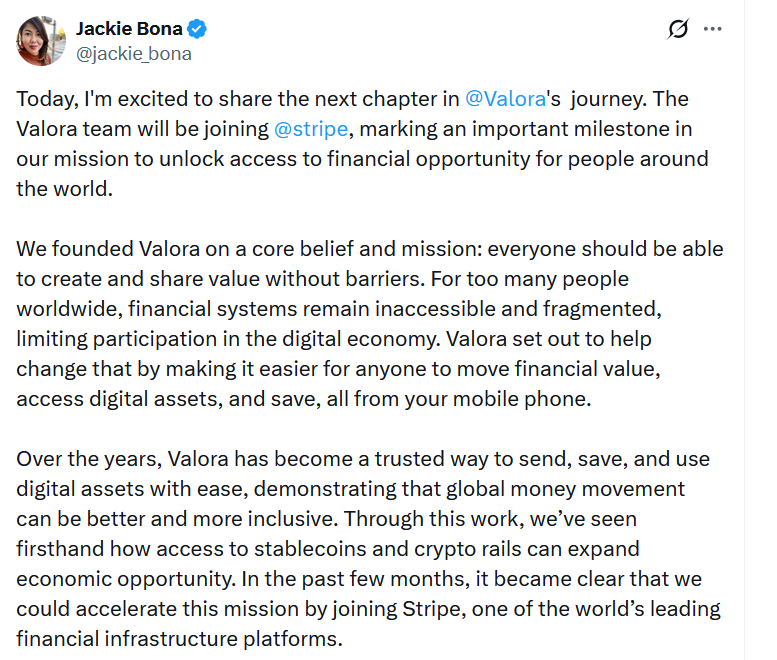
Source: Jackie Bona

Related: The easiest and safest methods for gifting crypto at Christmas in 2025

The Valora app will continue to function, but its operations and future development will be handed over to cLabs.

Momentum building for Stripe and Tempo

After an on-again-off-again relationship with crypto, Stripe has been making strides in the blockchain space over the past couple of years. Momentum has been building particularly since first unveiling Tempo four months ago in partnership with crypto VC firm Paradigm, with the network already having a $5 billion pre-launch.

The latest move from Stripe comes just a day after Stripe and Paradigm’s layer-1 blockchain project Tempo launched its open testnet.

One of the key features highlighted during the testnet launch was the ease and simplicity of creating stablecoins directly in the browser, among other benefits.

Magazine: 11 critical moments in Ethereum’s history that made it the No.2 blockchain
Leituras Relacionadas

Altcoin Hacked, Leading to Sharp Price Drop! Also Listed on Major Exchanges!

The price of the NES token plummeted significantly following suspicious activity and large sell-offs detected on the network. Blockchain observers suggested that one wallet minted approximately $55 million worth of NES tokens and began selling them on decentralized exchanges. This selling pressure caused the price of NES to drop by up to 40%. According to the data, the address in question still holds around $18 million worth of NES, indicating that market sell-off pressure may continue. Prior to the incident, it was reported that about $12.35 million worth (62.9 million NES tokens) were transferred to the Ethereum mainnet in the morning (Turkish time), with claims that liquidity was withdrawn and tokens were sold on the market later that evening. However, data regarding the $55 million token mint and the transfer of 62.9 million NES tokens has not been independently confirmed. The NESA team confirmed in a statement that they detected malicious activity exploiting a vulnerability in their Layer 1 network originating from Cosmos EVM. They stated they are working to contain the impact, responded promptly, and will restore services after implementing a software patch and additional measures to ensure secure network operation. Nesa also notified all cryptocurrency exchanges and stated deposit operations will resume after necessary work is completed. The article includes a chart showing the NES price decline following the exploit and concludes with a standard disclaimer that this is not investment advice.

cryptonews.ruHá 2h

Altcoin Hacked, Leading to Sharp Price Drop! Also Listed on Major Exchanges!

cryptonews.ruHá 2h

PeaqOS and World ID Integrate ZK Proofs into Autonomous Robots

The integration of PeaqOS and World ID now allows autonomous machines to verify they are interacting with real, unique individuals without collecting names, photos, or other personal data. This update, available via robotic.sh, enables connected devices to directly request and verify World ID proofs. The system leverages zero-knowledge technology, letting a person prove they are human while maintaining the privacy of their identity. This addresses a key challenge for operators of delivery robots, shared machines, and autonomous systems: how to authenticate a user as genuine without relying on insecure PINs, pickup codes, or traditional identity checks that require personal data collection. Instead of obtaining identifying information, a device receives a cryptographic proof that the user is a real person. PeaqOS acts as a coordination layer, allowing devices to utilize World ID via decentralized identifiers and a device marketplace. A robot can request verification, receive a zero-knowledge proof, and register an auditable record of the interaction—all without exposing underlying personal data. The system also supports uniqueness verification, enabling machines to enforce rules like "one item per person" without maintaining user identity databases. A demonstrated use case involves autonomous medicine delivery: a patient verifies via the World App when placing an order, a pharmacist verifies before loading the medication, and the patient verifies again upon delivery so the robot can confirm the recipient is linked to the order before unlocking the compartment. Similarly, promotional robots could ensure one item per person, and shared vending machines could grant access to verified individuals without requiring accounts or personal data. This integration for PeaqOS-powered robots and devices minimizes the identity information collected or stored while allowing autonomous systems to confirm they are interacting with real humans.

cryptonews.ruHá 3h

PeaqOS and World ID Integrate ZK Proofs into Autonomous Robots

cryptonews.ruHá 3h

Trading

Spot
活动图片