Patrick Witt Teases ‘Breakthrough’ On US Strategic Bitcoin Reserve

bitcoinistPublicado em 2026-05-18Última atualização em 2026-05-18

Resumo

White House digital-assets official Patrick Witt indicated an upcoming announcement on the U.S. Strategic Bitcoin Reserve, calling recent progress a "breakthrough" in establishing a legally sound and operationally secure framework. He clarified the focus is on implementation, custody, and interagency coordination for Bitcoin already held by the government, not confirming a new open-market purchase program. Witt emphasized the need for robust safeguards, citing past asset thefts, and expressed a desire to codify the reserve into law through pending legislation rather than relying on reversible executive orders. He framed the reserve as part of a broader U.S. strategy to lead in global digital asset financial infrastructure.

White House digital-assets official Patrick Witt said the administration is preparing an announcement on the US Strategic Bitcoin Reserve, describing recent work as a “breakthrough” in making the reserve legally sound and operationally secure. His comments suggest the next step is likely to focus on implementation, custody and agency coordination rather than a confirmed open-market Bitcoin purchase program.

Speaking with Scott Melker in an interview released May 17, Witt confirmed once again that the reserve effort has continued behind the scenes even as broader crypto-market structure legislation has dominated Washington’s digital-asset agenda. The Strategic Bitcoin Reserve, he said, was never dropped; it was simply moving through a slower interagency process triggered by the earlier executive order.

“There’s still progress there. There’s still work going on behind the scenes,” Witt said. “We never stopped working on it.”

US Strategic Bitcoin Reserve Update Nears

Witt credited Harry Jung, his deputy, with leading much of the internal process, including coordination across agencies and White House policy teams responsible for ensuring that executive orders are carried out. The work, he said, has involved the less visible but critical mechanics of government implementation: legal memos, agency authorities, asset safeguards and the question of whether existing powers are sufficient.

“We’ll have an announcement. And I wish I could say more at this time,” Witt said. “It’s a breakthrough as far as getting everything in place, legally sound, properly safeguarding the assets.”

That phrasing matters. The market-sensitive question around the reserve remains whether the US government will eventually move beyond retaining seized Bitcoin and pursue additional accumulation. Witt did not confirm that. Instead, his comments pointed to the architecture of the reserve itself: how Bitcoin already held by the government is identified, secured, transferred, accounted for and separated from the broader US Digital Asset Stockpile.

Witt tied the urgency partly to the government’s existing exposure to digital assets. He referenced the theft of assets from US Marshals Service holdings involving “tier 2 assets,” calling it a proof point that federal digital-asset custody requires a different level of care.

“These assets have to be safeguarded. They are unique,” Witt said. “It’s going to require the government to do this in a bit of a different way and obviously take it very, very seriously because we have more of these assets on the balance sheet.”

The reserve has also become a legislative question. Witt said executive orders are “very reversible,” citing the way incoming administrations often undo prior executive actions. For that reason, he said the administration wants the reserve framework codified into law rather than left dependent on presidential authority alone.

Witt pointed to Senator Cynthia Lummis’ BITCOIN Act and a House effort led by Representative Nick Begich, the American Reserves Modernization Act, or ARMA. According to Witt, the House bill has incorporated stakeholder feedback and could potentially move through a committee markup before seeking a path alongside must-pass legislation.

The broader policy logic is geopolitical as much as domestic. Witt said other jurisdictions are watching Washington’s digital-asset agenda closely, particularly the CLARITY Act and related legislation. In his framing, a US Bitcoin reserve is not isolated from market-structure reform, stablecoin rules or bank-permissible-activity provisions; it is part of a wider attempt to define the financial infrastructure the US wants to lead.

“There’s no more powerful institutional sponsorship than the US government saying we give this a thumbs up and we think that this should be part of the financial architecture,” Witt said. He added that if the US fails to set the rules, “we will be following somebody else’s rule book.”

At press time, BTC traded at $76,825.
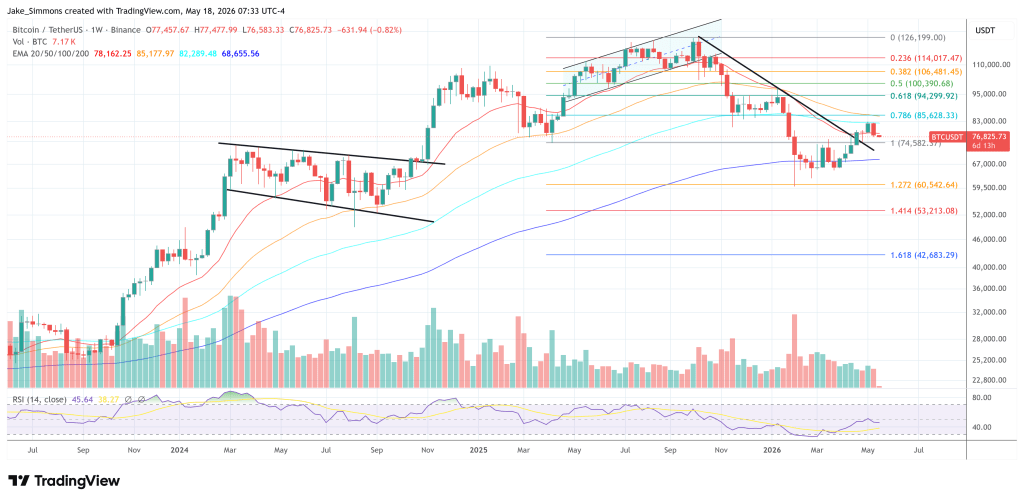
Bitcoin falls below the 20-week EMA again, 1-week chart | Source: BTCUSDT on TradingView.com

Criptomoedas em alta

Perguntas relacionadas

QWhat is the main focus of the upcoming announcement regarding the US Strategic Bitcoin Reserve, according to Patrick Witt?

AThe upcoming announcement will focus on making the reserve legally sound and operationally secure. The next steps are likely to center on implementation, custody, and agency coordination, rather than confirming an open-market Bitcoin purchase program.

QAccording to Witt, why has the Strategic Bitcoin Reserve process been moving slowly?

AThe process has been moving through a slower interagency process that was triggered by an earlier executive order. It was never dropped; work has continued behind the scenes even as broader crypto-market structure legislation has dominated the agenda.

QWhat reason did Patrick Witt give for the urgency in establishing a proper framework for the Bitcoin reserve?

AWitt cited the government's existing exposure to digital assets, referencing a theft from US Marshals Service holdings as proof that federal digital-asset custody requires a different, more serious level of care to properly safeguard these unique assets.

QWhy does the administration want the reserve framework codified into law instead of relying solely on an executive order?

AExecutive orders are "very reversible," as incoming administrations often undo prior executive actions. Codifying the framework into law would make it more permanent and less dependent on presidential authority alone.

QWhat broader geopolitical rationale did Witt provide for establishing a US Bitcoin reserve?

AWitt stated that other jurisdictions are watching Washington's digital-asset agenda closely. A US Bitcoin reserve is part of a wider attempt to define the financial infrastructure the US wants to lead, ensuring the US sets the rules rather than following someone else's rulebook.

Leituras Relacionadas

Pacific 'Fever': How Extreme Weather Becomes Wall Street's Cash Machine?

"Pacific Fever": How Extreme Weather Becomes Wall Street's ATM? The summer of 2026 sees unusually fierce weather across China and globally. The common driver behind this global pattern is a powerful El Niño event, potentially the strongest since 1950, as declared by NOAA. This phenomenon, characterized by warming central/eastern Pacific waters, disrupts global atmospheric circulation, raising risks of floods, droughts, and heatwaves, further intensified by climate change. For financial markets, especially commodities, El Niño is not just weather but a major trading theme. History shows its price impact is profound. In the 1970s, El Niño-driven anchovy collapse in Peru fueled a soybean boom, giving Richard Dennis his first million. Anthony Ward's cocoa empire was built on superior weather intelligence. Most recently in 2024, West African droughts caused cocoa prices to soar over 400%, delivering huge gains for trend-following hedge funds. In 2026, markets are again pricing in future El Niño-induced supply shocks. Despite high current inventories, prices for palm oil, rubber, and sugar have rallied on anticipation of upcoming Southeast Asian droughts and weak Indian monsoons. Analysts identify key indicators to watch: the Niño3.4 index, Indian monsoon rainfall, Malaysian palm oil stocks, and the fundraising scale of specialized weather funds like Moreton Capital. Beyond trading opportunities, a concerning narrative is gaining traction online, linking El Niño with fertilizer shortages and energy supply disruptions to warn of potential global food crises within months. While alarmist, it highlights a deeper truth: the cascading effects of climate-driven weather extremes ultimately translate into higher costs of living for everyone, far beyond the trading floor.

marsbitHá 4m

Pacific 'Fever': How Extreme Weather Becomes Wall Street's Cash Machine?

marsbitHá 4m

Pacific 'Fever': How Extreme Weather Becomes Wall Street's ATM?

"Pacific 'Fever': How Extreme Weather Becomes Wall Street's Piggy Bank" The article examines how the 2026-2027 El Niño, potentially the strongest since 1950, is not only disrupting global weather but also creating major financial opportunities. It links recent extreme events in China and worldwide to this climate phenomenon, which alters atmospheric patterns, increasing risks of floods, droughts, and heatwaves. The core narrative explores how financial markets capitalize on these disruptions. A hedge fund is raising $500 million specifically to bet on El Niño-affected crops like South African corn and Malaysian palm oil. Historically, such strategies have yielded massive profits. Examples include Richard Dennis ("Turtle Trader") making his first fortune in the 1970s soy boom triggered by El Niño's impact on Peruvian anchovies (a key fishmeal source), and Anthony Ward's cocoa empire built on superior weather intelligence. The 2024 cocoa price surge, driven by West African drought, enriched quantitative trend-following funds. Currently, markets are preemptively bidding up palm oil, rubber, and sugar futures based on anticipated future supply shocks, despite high current inventories. The article details El Niño's asymmetric global impacts: causing drought in Southeast Asia (hurting palm oil/rubber) and India (affecting sugar/cotton), but bringing beneficial rains to South American soy and sugarcane. Key metrics to watch include the Niño3.4 index, Indian monsoon data, and Malaysian palm oil stocks. The true price effects often materialize *after* the El Niño peaks, suggesting 2027 may see the real volatility. The conclusion warns that beyond trading gains, the convergence of El Niño, energy shortages, and fertilizer scarcity poses a systemic risk, potentially raising the cost of living for everyone, turning a climate event into a global economic story.

链捕手Há 13m

Pacific 'Fever': How Extreme Weather Becomes Wall Street's ATM?

链捕手Há 13m

Just Now, OpenAI's Chief Futurist Departed, Once Called a Jackass by Musk

Just now, OpenAI's Chief Futurist, Joshua Achiam, announced his departure from the company via X. Having joined as a 25-year-old intern in 2017, he spent nine years at OpenAI, evolving from an AI safety research scientist to leading the Mission Alignment team. Earlier this year, that team was dissolved, and Achiam transitioned to the newly created role of Chief Futurist, positioned at the intersection of AI safety and policy to study AGI's long-term risks and opportunities. In his departure statement, Achiam called his time a "graduation," reflecting on the immense progress from AI that couldn't converse to systems solving scientific problems. He expressed optimism about a future of peace, prosperity, and possibility, closing with "To safe AGI." His tenure was notably marked by a 2018 incident where he publicly challenged Elon Musk—then still with OpenAI—on safety compromises if Musk pursued AGI at Tesla, leading Musk to call him a "jackass." This became an internal legend, with colleagues later giving him a trophy inscribed, "To safety, never stop being that jackass." Achiam's exit follows a pattern of prominent safety and alignment experts leaving OpenAI, including Jan Leike and others who joined rivals like Anthropic or started non-profits. His departure coincides with OpenAI's internal efforts to more tightly integrate its research and policy teams, and the recent hiring of former White House AI advisor Dean Ball. Achiam did not cite a specific reason for leaving but indicated it was a long-considered decision, stating the mission to ensure AGI benefits humanity can now be advanced beyond the "frontier lab's" walls.

marsbitHá 15m

Just Now, OpenAI's Chief Futurist Departed, Once Called a Jackass by Musk

marsbitHá 15m

Anthropic Drops $19 Billion to 'Sponsor' a Bitcoin Miner

On July 6, 2026, Bitcoin mining company TeraWulf (NASDAQ: WULF) saw its stock surge 15% pre-market following the announcement of a landmark 20-year agreement with AI giant Anthropic. The deal grants Anthropic 401 MW of IT load capacity at TeraWulf's "Justified Data" campus in Kentucky and is projected to generate approximately $19 billion in contracted revenue for the miner over its duration. On the same day, TeraWulf also sold its 50.1% stake in a Texas joint venture for about $530 million. This dual move signals a strategic pivot: divesting non-core assets to fund its fully-owned Kentucky project and shifting focus from cryptocurrency mining to becoming a specialized infrastructure provider for AI. The agreement highlights a key advantage for Bitcoin miners transitioning to AI: their pre-existing access to land and critical power grid capacity, which is becoming a major bottleneck for data center expansion. Unlike peers who operate AI clouds, TeraWulf is adopting a "landlord" model, leasing only the physical space and power for clients' own servers. However, a significant gap exists between the deal's announcement and revenue generation, with the first phase of the Kentucky site not operational until late 2027. The $19 billion figure represents a long-term bet on both TeraWulf's execution and Anthropic's financial durability in the capital-intensive AI race. The market's positive reaction reflects the growing value of fundamental infrastructure—secured land and reliable electricity—in the era of AI compute scarcity.

marsbitHá 19m

Anthropic Drops $19 Billion to 'Sponsor' a Bitcoin Miner

marsbitHá 19m

Securitize Drops 40% in First Week of Trading as Tokenization Industry Enters Patent Wars

The article discusses the recent stock performance of Securitize (NYSE: SECZ) and a looming patent war in the tokenization industry. Securitize, a leading tokenization platform and transfer agent for BlackRock's BUIDL fund, debuted on the NYSE via a SPAC merger on July 2. After an initial rise, its stock plummeted nearly 40% within a week, closing at $8.06 on July 7. Analysts attribute the sharp decline largely to typical post-SPAC investor turnover and broader pressure on crypto-related stocks, rather than fundamental business deterioration. Concurrently, Securitize faces significant legal challenges. On June 15, infrastructure rival tZERO accused Securitize of patent infringement concerning its core DS Protocol and Vault Registrar products. Securitize preemptively filed a lawsuit on June 22 seeking a declaratory judgment of non-infringement. tZERO, holding 105 patents, has indicated it has identified at least six other market participants for potential infringement actions, signaling a broader industry-wide patent conflict. A separate lawsuit was also filed by Liquid Rarity Exchange. The article concludes that while Securitize's stock drop may be a temporary SPAC-related correction, the patent disputes initiated by tZERO represent a more profound, long-term risk for the entire tokenization sector, potentially shifting competitive dynamics from business execution to intellectual property litigation.

Foresight NewsHá 48m

Securitize Drops 40% in First Week of Trading as Tokenization Industry Enters Patent Wars

Foresight NewsHá 48m

Trading

Spot

Artigos em Destaque

O que é BITCOIN

Compreender o HarryPotterObamaSonic10Inu (ERC-20) e a Sua Posição no Espaço Cripto Nos últimos anos, o mercado de criptomoedas assistiu a um aumento na popularidade das moedas meme, cativando não apenas os traders, mas também aqueles que procuram envolvimento comunitário e valor de entretenimento. Entre estes tokens únicos está o HarryPotterObamaSonic10Inu (ERC-20), um projeto intrigante que mistura referências culturais no tecido das criptomoedas. Este artigo explora os principais aspetos do HarryPotterObamaSonic10Inu, examinando os seus mecanismos, a sua ética orientada pela comunidade e o seu envolvimento com o vasto panorama cripto. O que é o HarryPotterObamaSonic10Inu (ERC-20)? Como o nome sugere, o HarryPotterObamaSonic10Inu é uma moeda meme construída na blockchain Ethereum, classificada sob o padrão ERC-20. Ao contrário das criptomoedas tradicionais, que podem enfatizar a utilidade prática ou o potencial de investimento, este token prospera no valor de entretenimento e na força da sua comunidade. O projeto visa promover um ambiente onde utilizadores envolvidos possam reunir-se, partilhar ideias e participar em atividades inspiradas por diversos fenómenos culturais. Uma característica notável do HarryPotterObamaSonic10Inu é a zero taxa sobre transações. Este elemento atraente visa encorajar a negociação e o envolvimento da comunidade, isento de encargos adicionais que podem desencorajar os traders de pequena escala. A oferta total da moeda está fixada em mil milhões de tokens, uma cifra que marca a sua intenção de manter uma circulação substancial dentro da comunidade. Criador do HarryPotterObamaSonic10Inu (ERC-20) As origens do HarryPotterObamaSonic10Inu estão um pouco envoltas em mistério; os detalhes sobre o criador permanecem desconhecidos. O desenvolvimento deste token carece de uma equipa identificável ou de um plano explícito, o que não é raro no setor das moedas meme. Em vez disso, o projeto surgiu de forma orgânica, com o seu progresso a depender fortemente do entusiasmo e da participação da sua comunidade. Investidores do HarryPotterObamaSonic10Inu (ERC-20) No que diz respeito a investimentos externos e apoios, o HarryPotterObamaSonic10Inu também permanece ambíguo. O token não lista quaisquer fundações de investimento conhecidas ou apoio organizacional significativo. Em vez disso, o “sangue vital” do projeto é a sua comunidade de base, que informa o seu crescimento e sustentabilidade através da ação coletiva e do envolvimento no espaço cripto. Como Funciona o HarryPotterObamaSonic10Inu (ERC-20)? Como uma moeda meme, o HarryPotterObamaSonic10Inu opera principalmente fora dos quadros tradicionais que muitas vezes governam o valor dos ativos. Existem vários aspetos distintivos que definem como o projeto funciona: Transações Sem Taxas: Sem taxas sobre transações, os utilizadores podem comprar e vender o token livremente, sem a preocupação de custos ocultos. Envolvimento da Comunidade: O projeto prospera na interação da comunidade, aproveitando plataformas de redes sociais para criar entusiasmo e facilitar a participação. Discussões, partilha de conteúdo e envolvimento são elementos cruciais que ajudam a expandir o seu alcance e a fomentar a lealdade entre os apoiantes. Sem Utilidade Prática: Deve ser notado que o HarryPotterObamaSonic10Inu não oferece utilidade concreta dentro do ecossistema financeiro. Em vez disso, é classificado como um token principalmente para entretenimento e atividades comunitárias. Referência Cultural: O token incorpora de forma inteligente elementos da cultura popular para atrair interesse, conectando-se tanto com entusiastas de memes como com seguidores de criptomoedas. HarryPotterObamaSonic10Inu exemplifica como as moedas meme operam de forma diferente de projetos de criptomoedas mais tradicionais, entrando no mercado como construções sociais inovadoras em vez de ativos utilitários. Linha do Tempo do HarryPotterObamaSonic10Inu (ERC-20) A história do HarryPotterObamaSonic10Inu é marcada por vários marcos notáveis: Criação: O token surgiu de um meme viral, capturando a imaginação de muitos entusiastas de criptomoedas. Datas específicas de criação não estão disponíveis, sublinhando a sua ascensão orgânica. Listagem em Exchanges: O HarryPotterObamaSonic10Inu conseguiu entrar em várias exchanges, permitindo um acesso e negociação mais fáceis pela comunidade. Iniciativas de Envolvimento da Comunidade: Atividades contínuas direcionadas a melhorar a interação comunitária, incluindo concursos, campanhas em redes sociais e geração de conteúdo por fãs e defensores. Planos de Expansão Futura: O roteiro do projeto inclui o lançamento de uma coleção de NFTs, mercadorias e um site de eCommerce relacionado aos seus temas culturais, envolvendo ainda mais a comunidade e tentando adicionar mais dimensões ao seu ecossistema. Pontos-Chave sobre o HarryPotterObamaSonic10Inu (ERC-20) Natureza Orientada pela Comunidade: O projeto prioriza a contribuição coletiva e a criatividade, assegurando que o envolvimento dos utilizadores está na vanguarda do seu desenvolvimento. Classificação como Moeda Meme: Representa o epítome da criptomoeda baseada em entretenimento, destacando-se dos veículos de investimento tradicionais. Sem Afiliação Direta com o Bitcoin: Apesar da semelhança no nome do ticker, o HarryPotterObamaSonic10Inu é distinto e não tem qualquer relação com o Bitcoin ou outras criptomoedas estabelecidas. Foco na Colaboração: O HarryPotterObamaSonic10Inu é projetado para criar um espaço de colaboração e partilha de histórias entre os seus detentores, proporcionando uma via para a criatividade e o fortalecimento da comunidade. Perspectivas Futuras: A ambição de expandir além da sua premissa inicial para NFTs e mercadorias delineia um caminho para o projeto potencialmente entrar em avenidas mais mainstream dentro da cultura digital. À medida que as moedas meme continuam a capturar a imaginação da comunidade cripto, HarryPotterObamaSonic10Inu (ERC-20) destaca-se devido aos seus laços culturais e abordagem centrada na comunidade. Embora possa não se encaixar no molde típico de um token orientado para utilidade, a sua essência reside na alegria e camaradagem fomentadas entre os seus apoiantes, destacando a natureza em evolução das criptomoedas em uma era cada vez mais digital. À medida que o projeto continua a desenvolver-se, será importante observar como as dinâmicas comunitárias influenciam a sua trajetória no panorama em constante mudança da tecnologia blockchain.

1.7k Visualizações TotaisPublicado em {updateTime}Atualizado em 2024.12.03

O que é BITCOIN

Como comprar BTC

Bem-vindo à HTX.com!Tornámos a compra de Bitcoin (BTC) simples e conveniente.Segue o nosso guia passo a passo para iniciar a tua jornada no mundo das criptos.Passo 1: cria a tua conta HTXUtiliza o teu e-mail ou número de telefone para te inscreveres numa conta gratuita na HTX.Desfruta de um processo de inscrição sem complicações e desbloqueia todas as funcionalidades.Obter a minha contaPasso 2: vai para Comprar Cripto e escolhe o teu método de pagamentoCartão de crédito/débito: usa o teu visa ou mastercard para comprar Bitcoin (BTC) instantaneamente.Saldo: usa os fundos da tua conta HTX para transacionar sem problemas.Terceiros: adicionamos métodos de pagamento populares, como Google Pay e Apple Pay, para aumentar a conveniência.P2P: transaciona diretamente com outros utilizadores na HTX.Mercado de balcão (OTC): oferecemos serviços personalizados e taxas de câmbio competitivas para os traders.Passo 3: armazena teu Bitcoin (BTC)Depois de comprar o teu Bitcoin (BTC), armazena-o na tua conta HTX.Alternativamente, podes enviá-lo para outro lugar através de transferência blockchain ou usá-lo para transacionar outras criptomoedas.Passo 4: transaciona Bitcoin (BTC)Transaciona facilmente Bitcoin (BTC) no mercado à vista da HTX.Acede simplesmente à tua conta, seleciona o teu par de trading, executa as tuas transações e monitoriza em tempo real.Oferecemos uma experiência de fácil utilização tanto para principiantes como para traders experientes.

4.2k Visualizações TotaisPublicado em {updateTime}Atualizado em 2026.06.02

Como comprar BTC

O que é $BITCOIN

OURO DIGITAL ($BITCOIN): Uma Análise Abrangente Introdução ao OURO DIGITAL ($BITCOIN) OURO DIGITAL ($BITCOIN) é um projeto baseado em blockchain que opera na rede Solana, com o objetivo de combinar as características dos metais preciosos tradicionais com a inovação das tecnologias descentralizadas. Embora partilhe um nome com o Bitcoin, frequentemente referido como “ouro digital” devido à sua percepção como uma reserva de valor, o OURO DIGITAL é um token separado projetado para criar um ecossistema único dentro da paisagem Web3. O seu objetivo é posicionar-se como um ativo digital alternativo viável, embora os detalhes sobre as suas aplicações e funcionalidades ainda estejam em desenvolvimento. O que é o OURO DIGITAL ($BITCOIN)? OURO DIGITAL ($BITCOIN) é um token de criptomoeda explicitamente projetado para uso na blockchain Solana. Em contraste com o Bitcoin, que fornece um papel amplamente reconhecido como armazenamento de valor, este token parece focar em aplicações e características mais amplas. Aspectos notáveis incluem: Infraestrutura Blockchain: O token é construído na blockchain Solana, conhecida pela sua capacidade de lidar com transações de alta velocidade e baixo custo. Dinâmicas de Oferta: O OURO DIGITAL tem um fornecimento máximo limitado a 100 quatrilhões de tokens (100P $BITCOIN), embora os detalhes sobre o seu fornecimento circulante ainda não tenham sido divulgados. Utilidade: Embora as funcionalidades precisas não estejam explicitamente delineadas, existem indicações de que o token poderia ser utilizado para várias aplicações, potencialmente envolvendo aplicações descentralizadas (dApps) ou estratégias de tokenização de ativos. Quem é o Criador do OURO DIGITAL ($BITCOIN)? Neste momento, a identidade dos criadores e da equipa de desenvolvimento por trás do OURO DIGITAL ($BITCOIN) permanece desconhecida. Esta situação é típica entre muitos projetos inovadores no espaço da blockchain, particularmente aqueles alinhados com finanças descentralizadas e fenómenos de moedas meme. Embora tal anonimato possa fomentar uma cultura orientada pela comunidade, intensifica as preocupações sobre governança e responsabilidade. Quem são os Investidores do OURO DIGITAL ($BITCOIN)? As informações disponíveis indicam que o OURO DIGITAL ($BITCOIN) não tem apoiantes institucionais conhecidos ou investimentos proeminentes de capital de risco. O projeto parece operar num modelo peer-to-peer focado no apoio e adoção da comunidade, em vez de rotas de financiamento tradicionais. A sua atividade e liquidez estão principalmente situadas em exchanges descentralizadas (DEXs), como a PumpSwap, em vez de plataformas de negociação centralizadas estabelecidas, destacando ainda mais a sua abordagem de base. Como Funciona o OURO DIGITAL ($BITCOIN) A mecânica operacional do OURO DIGITAL ($BITCOIN) pode ser elaborada com base no seu design de blockchain e nas características da rede: Mecanismo de Consenso: Ao aproveitar o exclusivo proof-of-history (PoH) da Solana combinado com um modelo de proof-of-stake (PoS), o projeto assegura uma validação eficiente das transações, contribuindo para o alto desempenho da rede. Tokenomics: Embora mecanismos deflacionários específicos não tenham sido extensivamente detalhados, o vasto fornecimento máximo de tokens implica que pode atender a microtransações ou casos de uso de nicho que ainda estão por definir. Interoperabilidade: Existe o potencial para integração com o ecossistema mais amplo da Solana, incluindo várias plataformas de finanças descentralizadas (DeFi). No entanto, os detalhes sobre integrações específicas permanecem não especificados. Cronologia de Eventos Chave Aqui está uma cronologia que destaca marcos significativos relacionados ao OURO DIGITAL ($BITCOIN): 2023: O lançamento inicial do token ocorre na blockchain Solana, marcado pelo seu endereço de contrato. 2024: O OURO DIGITAL ganha visibilidade ao tornar-se disponível para negociação em exchanges descentralizadas como a PumpSwap, permitindo que os utilizadores o negociem contra SOL. 2025: O projeto testemunha atividade de negociação esporádica e potencial interesse em envolvimentos liderados pela comunidade, embora não tenham sido documentadas parcerias ou avanços técnicos notáveis até ao momento. Análise Crítica Forças Escalabilidade: A infraestrutura subjacente da Solana suporta altos volumes de transações, o que pode aumentar a utilidade do $BITCOIN em vários cenários de transação. Acessibilidade: O potencial preço de negociação baixo por token pode atrair investidores de retalho, facilitando uma participação mais ampla devido a oportunidades de propriedade fracionada. Riscos Falta de Transparência: A ausência de apoiantes, desenvolvedores ou um processo de auditoria publicamente conhecidos pode gerar ceticismo em relação à sustentabilidade e confiabilidade do projeto. Volatilidade do Mercado: A atividade de negociação depende fortemente do comportamento especulativo, o que pode resultar em volatilidade significativa dos preços e incerteza para os investidores. Conclusão O OURO DIGITAL ($BITCOIN) surge como um projeto intrigante, mas ambíguo, dentro do ecossistema em rápida evolução da Solana. Embora tente aproveitar a narrativa do “ouro digital”, a sua divergência do papel estabelecido do Bitcoin como reserva de valor sublinha a necessidade de uma diferenciação mais clara da sua utilidade pretendida e estrutura de governança. A aceitação e adoção futuras dependerão provavelmente da abordagem da atual opacidade e da definição mais explícita das suas estratégias operacionais e económicas. Nota: Este relatório abrange informações sintetizadas disponíveis até outubro de 2023, e desenvolvimentos podem ter ocorrido além do período de pesquisa.

122 Visualizações TotaisPublicado em {updateTime}Atualizado em 2025.05.13

O que é $BITCOIN

Discussões

Bem-vindo à Comunidade HTX. Aqui, pode manter-se informado sobre os mais recentes desenvolvimentos da plataforma e obter acesso a análises profissionais de mercado. As opiniões dos utilizadores sobre o preço de BTC (BTC) são apresentadas abaixo.

活动图片