Author: Paul Veradittakit
Compiled by: Deep Tide TechFlow
Deep Tide Guide:Pantera Capital released its 2025 annual investment report, completing 31 investments throughout the year, with a lead investment ratio of 85%, setting a record high for deployed capital. Four portfolio companies went public, with a combined market capitalization of approximately $33 billion.
The report details the geographical distribution of investments, sector preferences, and stage allocation, with infrastructure and stablecoins being the heavily weighted directions. As one of the oldest venture capital firms in the crypto industry, Pantera's annual data is an important window to observe the flow of industry capital.
I have been investing in the blockchain space for over a decade, and the best years are often not the smoothest ones.
2025 was a year of diverse elements: regulatory clarity, market volatility, and public market access for investors through exchange-traded funds (ETFs), digital asset trusts (DATs), and initial public offerings (IPOs). At Pantera, we had four portfolio companies successfully go public, with a total market capitalization of approximately $33 billion as of January 2026. Additionally, we completed a strategic exit (Robinhood acquired Bitstamp), and 2025 became the year with the highest capital deployment in Pantera's history—we led 85% of new investments. This year was a rollercoaster of ups and downs, but also full of vitality, exactly what the industry needed to distinguish real value from short-term hype.
The companies that performed well were not chasing hot narratives—they were solving real problems. Stablecoin trading volume reached $46 trillion; infrastructure teams delivered production-grade layered sequencing and parallel execution frameworks; prediction markets entered the mainstream; IBIT (Blackrock's Bitcoin ETF) assets under management (AUM) surpassed $100 billion; and Coinbase even made it into the Fortune 500.
As we move full speed ahead into 2026, let's take a moment to look back at 2025. Through this review, you will understand why we believe 2026 will be an even better year.
Thanks to the Pantera team for their help in preparing this report, including Ping Chen, Jonathan Gieg, Enzo Bachaumard, and Raymond Yu.
Here are some key highlights from 2025:
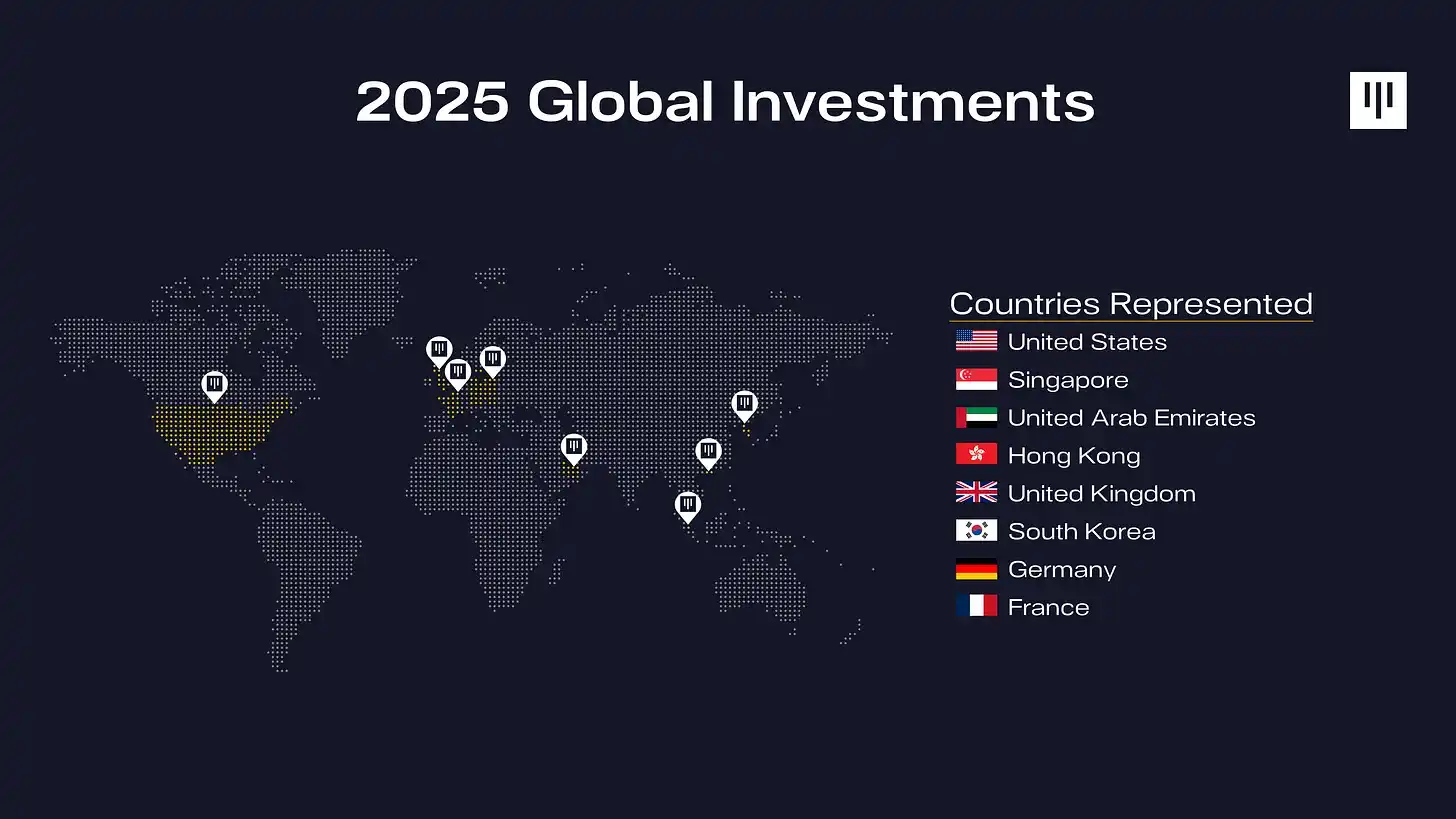
Our investments last year covered eight countries across four regions:
North America (64.52%)
Asia (16.13%)
Europe (9.68%)
Middle East (9.68%)
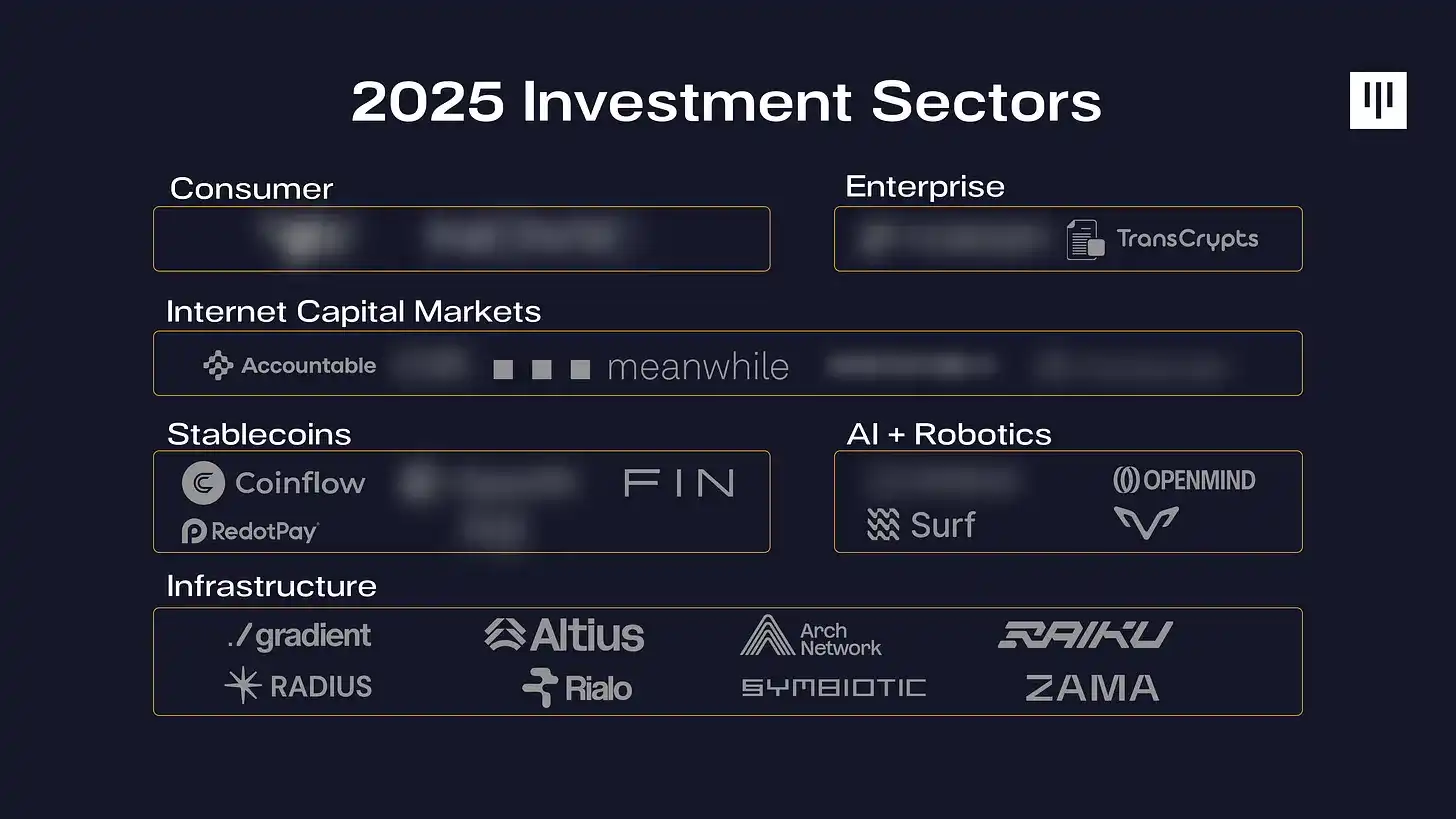
Overview of Investment Sectors Last Year: Distribution of 31 Investments Across Key Industries
Infrastructure (38.71%)
- Altius: A VM-agnostic parallel execution framework for Layer 1 blockchains (L1s), Rollups, and Appchains, designed for high-performance execution and multi-chain atomic composability.
- Arch Network: Bitcoin-native smart contract and settlement infrastructure, enabling developers to build applications directly on Bitcoin without bridging.
- Radius: A decentralized sequencing and block space network adopted by Rollups and L2 teams to monetize block space, improve user experience, and enable shared sequencing infrastructure.
- Raiku: A Solana-native block space market and network scaling framework, providing guarantees and MEV capture for Solana appchains and high-throughput applications.
- Rialo: A modular omnichain programmable network, enabling developers to achieve low-latency cross-chain execution, intelligent workflows, and autonomous interactions.
- Symbiotic: A general-purpose shared security layer providing sovereign security bootstrapping for emerging and existing decentralized networks, while retaining flexibility in governance and token design.
- Zama: Open-source cryptographic infrastructure enabling enterprises, developers, and governments to run private computations, confidential smart contracts, and privacy-preserving AI using fully homomorphic encryption (FHE).
Internet Capital Markets (16.3%)
- Accountable: Privacy-preserving financial data and reporting infrastructure, helping institutional investors, issuers, and exchanges verify the returns, risks, and disclosures of crypto-native financial products.
- [Stealth]: An institutionally-backed crypto exchange serving brokers, market makers, and large asset managers, adapting to the shift in market structure towards multi-venue best execution.
- Meanwhile: A crypto-native life insurance and annuity platform for Bitcoin holders, focusing on regulated downside protection and long-term Bitcoin-denominated financial products.
- [Stealth]: A decentralized exchange and liquidity protocol providing permissionless token trading and on-chain price discovery for traders, developers, and liquidity providers.
- [Stealth]: Token liquidity launch and capital formation infrastructure, helping token issuers and on-chain projects launch assets, build deep liquidity, and capture long-term trading fees through native Uniswap v4 mechanisms.
Stablecoins (12.9%)
- Coinflow: A unified fiat and crypto payment platform offering compliant checkout services, embedded fraud protection, and chargeback insurance for high-risk and high-volume merchants.
- Fin: A payment platform helping individuals, creators, and businesses send and receive stablecoins, NFTs, and cryptocurrencies instantly with minimal friction, designed for payments, peer-to-peer transfers, and embedded payment flows.
- [Stealth]: Decentralized monetary middleware connecting off-chain liquidity from institutions, protocols, and asset issuers to on-chain markets.
- [Stealth]: Real-time cross-border foreign exchange settlement infrastructure, providing instant, transparent high-value payment services for fintech companies, payment firms, and global enterprises.
- RedotPay: A consumer-centric stablecoin payment and card platform serving the underbanked and crypto holders who wish to use stablecoins globally via the Visa network, with strong performance in African and Asian markets.
Consumer Sector (12.9%)
- [Stealth]: A crypto-native casino and sports betting platform offering a compliance-first, brand-driven, and VIP-centric gaming experience for players.
- [Stealth]: A two-way sports prediction exchange providing trading for retail bettors, professional traders, and liquidity providers on money lines, spreads, parlays, and prop bets, offering tighter pricing and a superior mobile-first experience through a CLOB-style market.
AI + Robotics (12.9%)
- OpenMind: An open-source AI and robotics infrastructure platform building software and physical reasoning layers for general-purpose robots, enabling scalable intelligent real-world interactions through a global network of machines.
- Surf AI: A crypto-native AI research and execution platform helping traders, analysts, exchanges, and KOLs generate on-chain-backed intelligence in real-time, faster than general AI tools.
- Vigil: An AI-driven trading and research platform building an autonomous hedge fund enhanced by proprietary inference systems, designed for active traders, hedge funds, and other market participants.
- [Stealth]: Formal reasoning and verification infrastructure for blockchain foundations, enterprises, and government-related organizations to mathematically verify code correctness and eliminate erroneous inferences in critical systems.
Enterprise Solutions (6.45%)
- [Stealth]: An institutional-grade custody and transaction management platform for funds, DAOs, and enterprises to securely manage assets, tokenization, and DeFi workflows.
- TransCrypts: A self-sovereign identity and data verification protocol enabling enterprises to verify revenue, employment, and financial data via zkTLS while protecting user ownership and privacy.
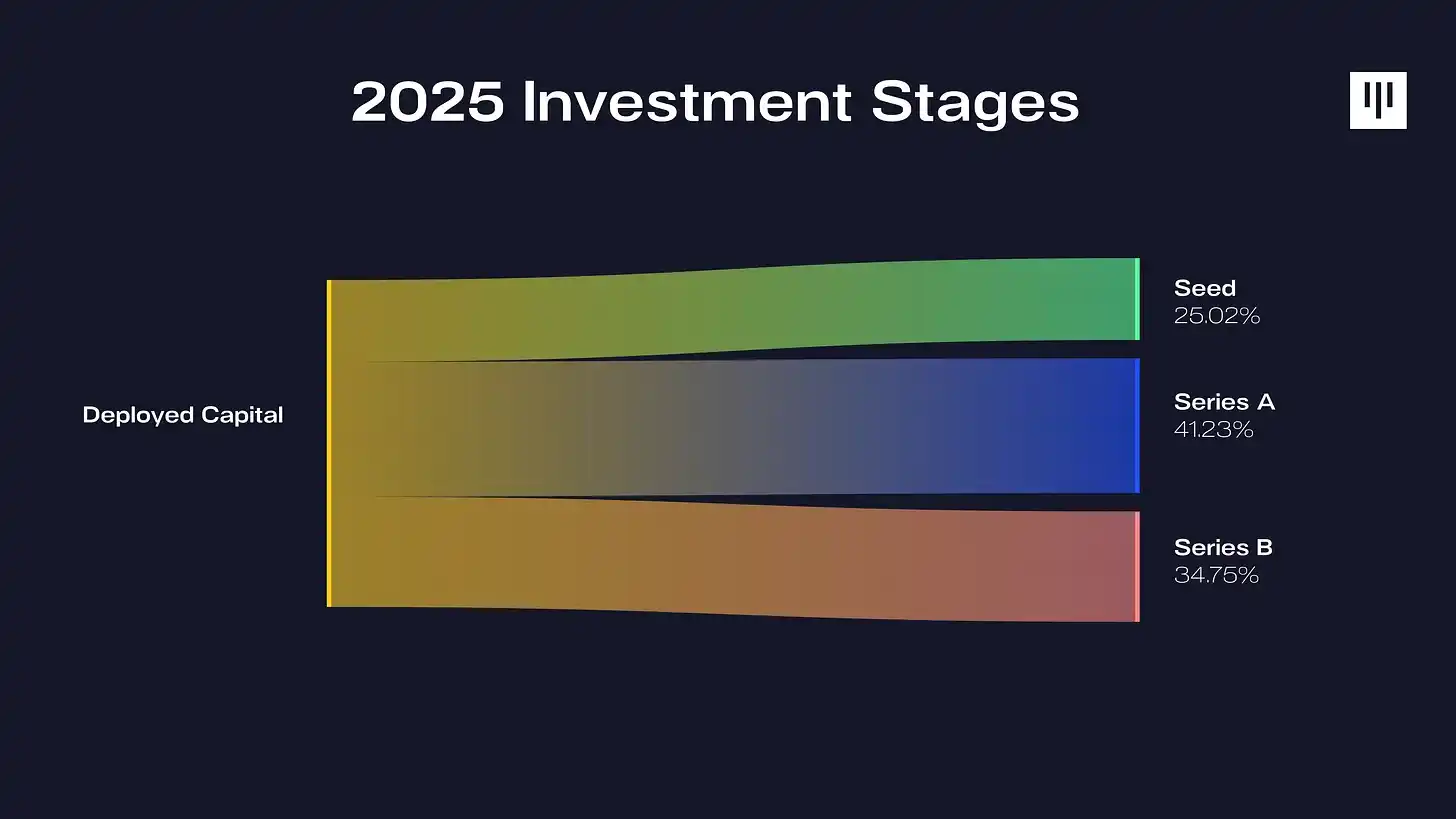
Capital Deployment by Round (31 Investments):
- Series A: 48.4%
- Seed Round: 25.8%
- Series B: 25.8%
Business
- Iran's $780 Million Crypto Ecosystem Growth
Chainalysis reported that Iran's crypto ecosystem grew rapidly, with on-chain activity in Q4 2025 accounting for about half of its crypto ecosystem, indicating its increasingly important role in Iran's economy.
- Avalanche Powers Galaxy Digital's $75 Million Tokenized CLO Debut
Galaxy Digital (Nasdaq: GLXY) completed its first tokenized collateralized loan obligation (CLO), aiming to bring private credit onto the blockchain. The tokens are expected to be listed on INX's ATS platform.
- CoinGecko CEO Responds to $500 Million Sale Rumors
CoinGecko is evaluating "strategic opportunities" and has hired U.S. investment bank Moelis as a sale advisor. Moelis has been involved in transactions totaling over $5 trillion across various industries.
- Miami Crypto-Settled Real Estate Transaction Sets Record with $14 Million USDT Deal
Driven by Propy, Ciprés, and Rilea Group, crypto-backed real estate purchases are becoming a trend as an alternative to wire transfers.
- Algorand Foundation Returns to U.S. Due to Crypto-Friendly Policy Shift
After years of operating in Singapore, the foundation announced its return to the U.S. and appointed new board members. Jito Foundation also moved back to the U.S. from the Cayman Islands, similarly citing its crypto-friendly environment.
Regulation
- U.S. Senate Banking Committee Delays Crypto Vote
The vote originally scheduled for January 15 was postponed. Coinbase expressed concerns about potential impacts that could stifle innovation, subordinate the CFTC to the SEC, and possibly eliminate stablecoin rewards. A new vote date has not been set.
- New Dubai International Financial Centre (DIFC) Crypto Token Regulations to Take Effect
The DIFC updated its rules following a public consultation last year. Financial services companies engaged in crypto businesses will now be directly responsible for judging whether tokens meet national standards.
- Tennessee Bans Kalshi, Polymarket, and Crypto.com from Offering Sports Betting Services
The state sent letters to these companies, accusing them of offering services without a license from the Sports Wagering Committee.
- Russia Pushes for Cryptocurrency to Become "Everyday Finance"
If legislation passes, digital assets will no longer fall under a special regulatory category, allowing ordinary investors to participate in a broader retail market within a limit of approximately $3,800.
New Products & Deals
- CME Group Launches ADA, LINK, and XLM Futures, Expanding Crypto Derivatives
After receiving regulatory approval, CME Group is preparing to launch futures contracts, further driving the institutionalization of altcoin investment in the U.S.
- BitMine Backs MrBeast with $200 Million Investment
BitMine Immersive Technology Company announced an equity investment, continuing to deploy capital beyond traditional blockchain projects.
- London Stock Exchange Launches Digital Settlement Platform, Promoting Blockchain Adoption
The London Stock Exchange launched a digital settlement hub to facilitate fund exchanges between independent payment systems, using underlying technology that supports crypto capabilities, applicable to both blockchain and traditional finance.
- State Street Joins Crypto Craze, Launches Digital Asset Products
The custodian bank will develop products like stablecoins and tokenized deposits, collaborating with asset managers and clients.
Pantera This Week
- New Stateful Episode Discusses Bitcoin vs. Gold: Why 2025 Was Different
Discussion highlights include why Bitcoin's $2 trillion market cap isn't yet ready for national-level capital flows; how gold's $20 trillion market cap absorbs central bank diversification; and why nations are the last, not the first, to adopt Bitcoin.
- Pantera Prepares for 2026 Ondo Summit in New York City
Pantera CEO and founder Dan Morehead will speak at the Ondo Summit on February 3, 2026. The summit brings together the most influential executives, founders, and leaders shaping the intersection of blockchain and finance.
- Join Nexus Chat to Discuss 2026 Crypto Predictions
On the January 15 episode, Pantera's research and investment expert Jay Lu shared his insights with Nexus CEO and co-founder Daniel Martin.
Offline Meetup Schedule
- New York City: January 28 - 30
- Hong Kong: February 10 - 11
- Singapore: February 12
- New York City: February 26