Pantera, Coinbase back Surf’s $15M push to build crypto-native AI models

cointelegraphPublicado em 2025-12-10Última atualização em 2025-12-10

Resumo

Surf, an AI platform for digital-asset analysis, has raised $15 million in a funding round led by Pantera Capital, with participation from Coinbase Ventures and DCG. The funds will support the development of Surf 2.0, which includes more advanced AI models, expanded proprietary data sets, and new agents for multi-step analytical tasks. Since its July launch, Surf has generated over one million research reports and achieved significant annual recurring revenue, serving major exchanges and research firms. Its multi-agent architecture analyzes onchain data, market behavior, and social sentiment through a chat interface, reducing manual workloads. The article also notes the growing convergence of AI and crypto, citing recent funding rounds for AI startups like Nous Research and Catena Labs, as well as Coinbase’s AI tool “Based Agent.” Additionally, a “human vs AI” trading competition hosted by Asterdex is currently underway, with human traders leading in returns as of mid-December.

Surf, an AI platform built for digital-asset analysis, raised $15 million in a round led by Pantera Capital with participation from Coinbase Ventures and DCG, to expand its AI models and enterprise tools.

The company offers a domain-specific model used by exchanges and research companies to analyze onchain activity, market behavior and sentiment. The funding will go toward Surf 2.0, which will introduce more advanced models, broader proprietary data sets and additional agents designed to handle multi-step analytical tasks.

Surf said its platform has seen rapid uptake since its launch in July, generating more than one million research reports and claiming millions in annual recurring revenue, with usage from a large share of major exchanges and research firms.

Surf’s model uses a multi-agent architecture that evaluates onchain data, social sentiment and token activity, delivering its analysis through a chat interface for research and reducing manual workloads for analysts and traders.

Related: How to turn ChatGPT into your personal crypto trading assistant

The continued integration of AI and digital assets

Artificial intelligence and blockchain are increasingly intersecting as more companies develop tools that leverage both technologies.

In April, decentralized AI startup Nous Research closed a $50 million Series A round led by Paradigm. The company is developing open-source AI models powered by decentralized infrastructure and uses the Solana blockchain to coordinate and incentivize global participation in training.

In May, Catena Labs, led by Circle co-founder Sean Neville, announced it had raised $18 million to develop a bank built around native AI infrastructure. The company said the system will be designed for both AI agents and human contributors, with AI handling day-to-day operations under human supervision.

In October, Coinbase introduced “Based Agent,” a tool that lets users create an AI agent with an integrated crypto wallet in just a few minutes to perform onchain actions such as trading, swapping, and staking.

As crypto and AI continue to converge, the role of human traders may also be shifting. The decentralized exchange Aster is running a “human vs AI” trading showdown, funding up to 100 human traders with $10,000 each to compete against top-performing AI agents Dec. 9–23.

Though the competition still has 13 days to go, Team Human was in the lead as of Wednesday, with a return on investment (ROI) of 13.36% compared to Team AI’s ROI of 0.54%.
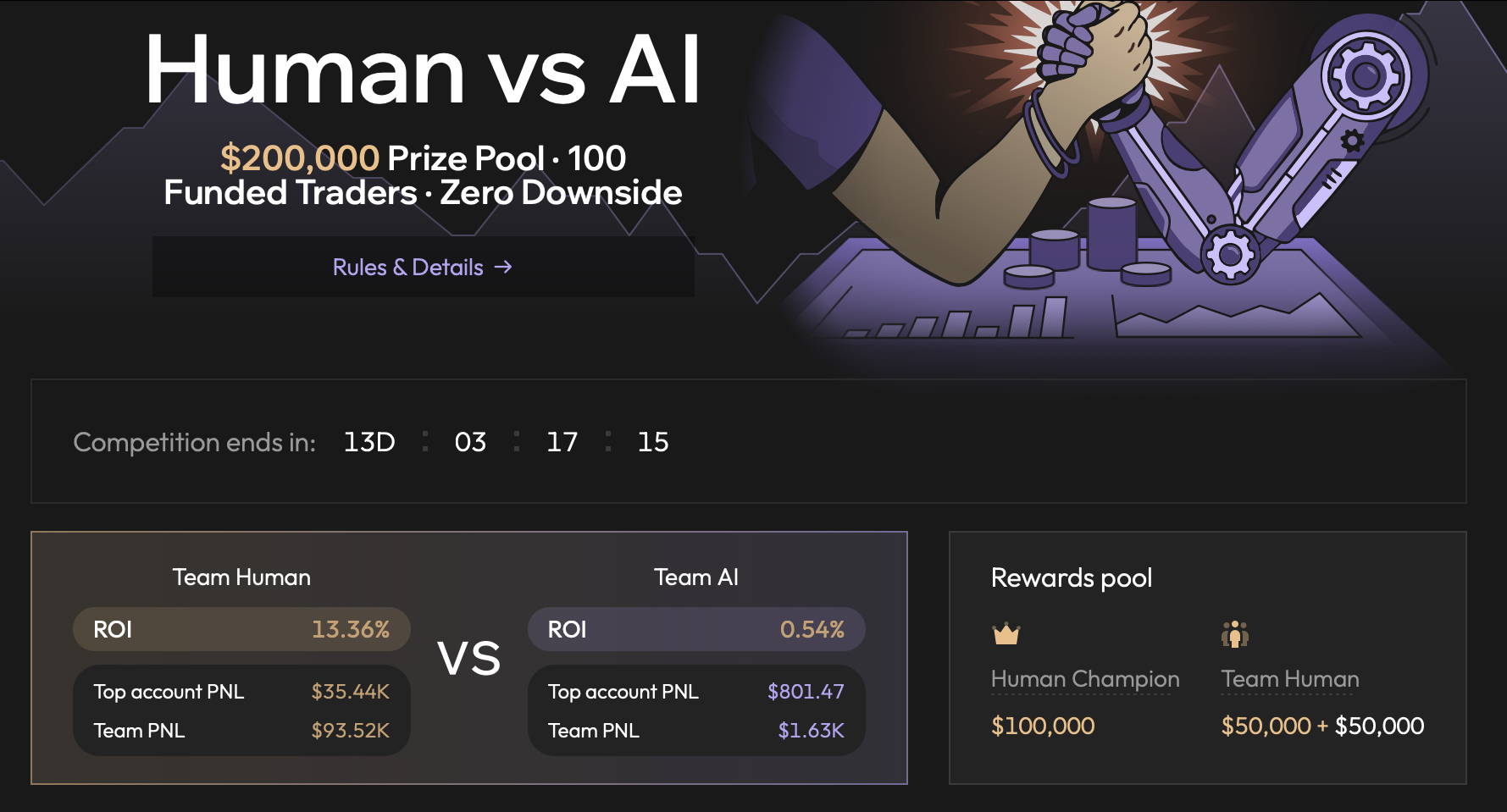
Human vs. AI trading scoreboard. Source: Asterdex.com

Magazine: Quantum attacking Bitcoin would be a waste of time: Kevin O’Leary

Leituras Relacionadas

Public Chain Moat Only 3/10? Alliance DAO Founder's Remarks Ignite Crypto Community Debate

Alliance DAO founder qw (@QwQiao) sparked intense debate in the crypto community by claiming that Layer 1 blockchains have "limited moats," rating them only 3/10 in terms of sustainable competitive advantage. This triggered strong reactions from key industry figures. Dragonfly Capital partner Haseeb strongly disagreed, arguing that Ethereum’s decade-long dominance despite well-funded challengers proves its strong moat. Others, like Multicoin’s Kyle Samani and researchers from Ethereum and Circle, questioned whether liquidity alone constitutes a real moat, with some calling it fleeting and unreliable. In response, qw elaborated on his moat rating framework, giving traditional giants like Microsoft, Apple, and Visa perfect scores (10/10) based on revenue models and infrastructure, while rating top crypto projects around 5/10. He notably rated Bitcoin at 9/10, citing its unique founding story and Lindy effect, but deducted a point due to uncertainties around security and quantum threats. The debate expanded into what truly constitutes a moat in crypto. Critics argued qw’s framework overemphasizes current revenue and undervalues network effects, trust, and technological ethos. Defenders of blockchain moats pointed to elements like developer ecosystems, brand strength, switching costs, and application diversity as core defensive attributes. The article concludes that the crypto industry is still young and small compared to traditional finance and tech giants. Rather than fixating on abstract moat concepts, the priority should be solving real user needs at scale, driving adoption, and expanding overall market reach.

marsbitHá 24m

Public Chain Moat Only 3/10? Alliance DAO Founder's Remarks Ignite Crypto Community Debate

marsbitHá 24m

Trading

Spot
Futuros
活动图片