PANews 2025 Public Chain Data Review: 'Naked Swimming' Moment, Who is Growing Against the Trend?

marsbitPublicado em 2025-12-23Última atualização em 2025-12-23

Resumo

PANews's 2025 public chain data review reveals a year of market correction and divergence. While the total value locked (TVL) across 26 major chains saw minimal growth (5.89%), down sharply from 2024's 119% surge, key metrics highlighted a shift towards fundamentals. The average token price fell by 50%, with new chains like Movement (-95%) and Berachain (-92%) hit hardest. However, underlying on-chain activity surged. Total fees generated grew 60% to $16.75 billion, and aggregate DEX trading volume rose 88%. Solana dethroned Ethereum in DEX volume, processing $1.52 trillion, while BNB Chain grew significantly across most metrics. Hyperliquid emerged as a standout, with a 299% TVL increase and a staggering 9,389% fee growth. BNB Chain and Tron also posted gains. In contrast, Solana's TVL stagnated (+0.8%) and user activity fell, exposing its meme-coindependency. Sui faced significant price pressure from token unlocks. Stablecoin market cap saw a "full bull market," with Solana leading growth at +196%. Funding data showed fewer but larger deals, with Polygon topping total capital raised due to Polymarket's mega-round. The year marked a pivot from "narrative" speculation to a focus on real revenue, user retention, and sustainable ecosystems, setting the stage for a more mature infrastructure landscape in 2026.

Author: Frank, PANews

The year 2025 was a dramatic and watershed year for the public chain sector in the crypto world. If 2024 was a "carnival night" where various new public chains competed for attention with high airdrop expectations and grand narratives, then 2025 was the "moment of awakening" after the carnival.

As the tide receded and liquidity tightened, the real data once concealed by the表象 of prosperity began to surface. We witnessed an "ice and fire dichotomy": on one side, a general halving of secondary market prices and a significant slowdown in TVL growth; on the other, a surge in on-chain fee revenue and DEX trading volume against the trend.

This stark contrast reveals a harsh truth: the market is no longer paying for mere "stories." Capital is concentrating towards leading protocols with revenue-generating capabilities and essential use cases.

The PANews data team comprehensively compiled core 2025 data from 26 mainstream public chains, covering TVL, token price, fee revenue, activity levels, to investment and financing situations. Through these cold numbers, we attempt to还原 the "bubble-squeezing" process the public chain market underwent this year and identify the true winners who managed to build solid moats even in the winter.

(Data Note: Data for TVL, stablecoins, financing, and fee situations are sourced from Defillama; daily active addresses and daily transaction volume data are from Artemis and on-chain information; token price and market cap data use Coingecko as the source. The data period is from January 1, 2025, to December 16, 2025.)

A Spectrum of TVL: Growth Plummets, DeFi Experiences the Pains of "Deleveraging"

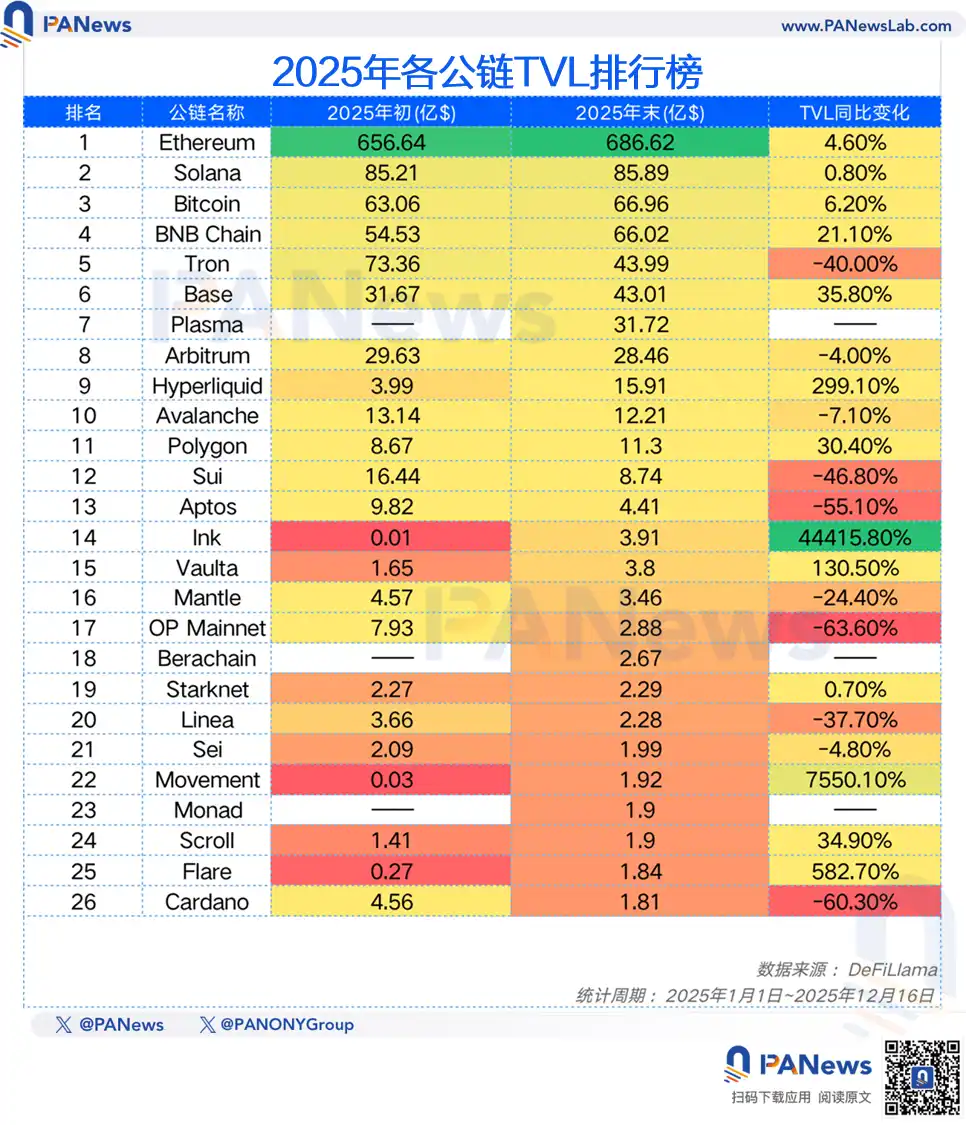
Looking at TVL, the most important indicator for measuring public chain prosperity, the leading chains saw slight overall growth this year, but the growth rate slowed. The total TVL of the 26 major public chains统计 by PANews grew by 5.89% this year, including 5 newly added chains whose initial data was 0. Furthermore, only 11 public chains achieved positive TVL growth, accounting for about 42%. In comparison, the annual TVL growth of the 22 mainstream public chains统计 in 2024 was 119%, with a growth proportion of 78%.

The slowdown in TVL growth also reflects the strong chill in the entire crypto market. But this doesn't mean 2025 was entirely平淡. Looking at the overall industry TVL, the全网 TVL reached a high of $168 billion in October, a 45% increase from $115.7 billion at the beginning of the year. However, after October, due to the暴跌 in market conditions, the entire market's TVL size took a sharp turn for the worse. Partly because the prices of various public chain native tokens fell, and partly because, amidst risk-off sentiment, a significant amount of capital chose to withdraw from the DeFi system.

Among the top ten public chains, Hyperliquid was clearly the winner of 2025. Compared to the single-digit growth of other chains, Hyperliquid's TVL achieved 299% growth this year. Solana, however, became the biggest loser, with growth of only 0.8%. With the cooling of the MEME coin market, this public chain giant seems to be heading towards a crisis. Furthermore, among the 26 public chains统计, Flare's growth rate exceeded 582%, becoming the fastest-growing public chain. OP Mainnet's TVL, on the other hand, dropped by 63.6%, becoming the chain with the most severe decline.
Prices Halved on Average by 50%, Market Stops Paying for New Public Chains

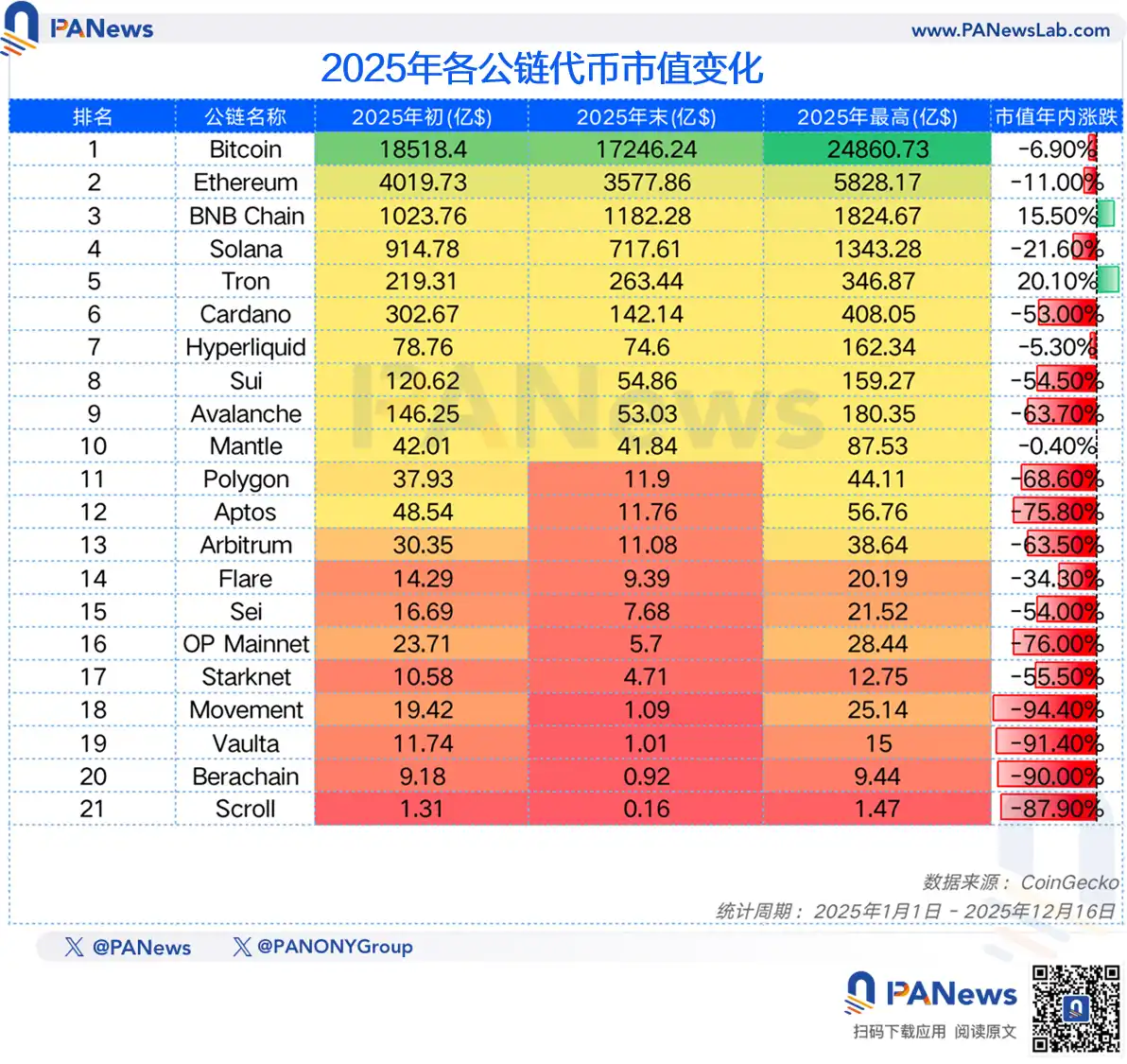
In terms of price, the performance of these mainstream public chains this year was also disappointing. Compared to their prices at the beginning of the year, the tokens of these 26 public chains fell by an average of 50%. Among them, Movement's token price fell by 95%, Berachain's by 92%, and Scroll's by 91%. These new public chains failed to gain market recognition.

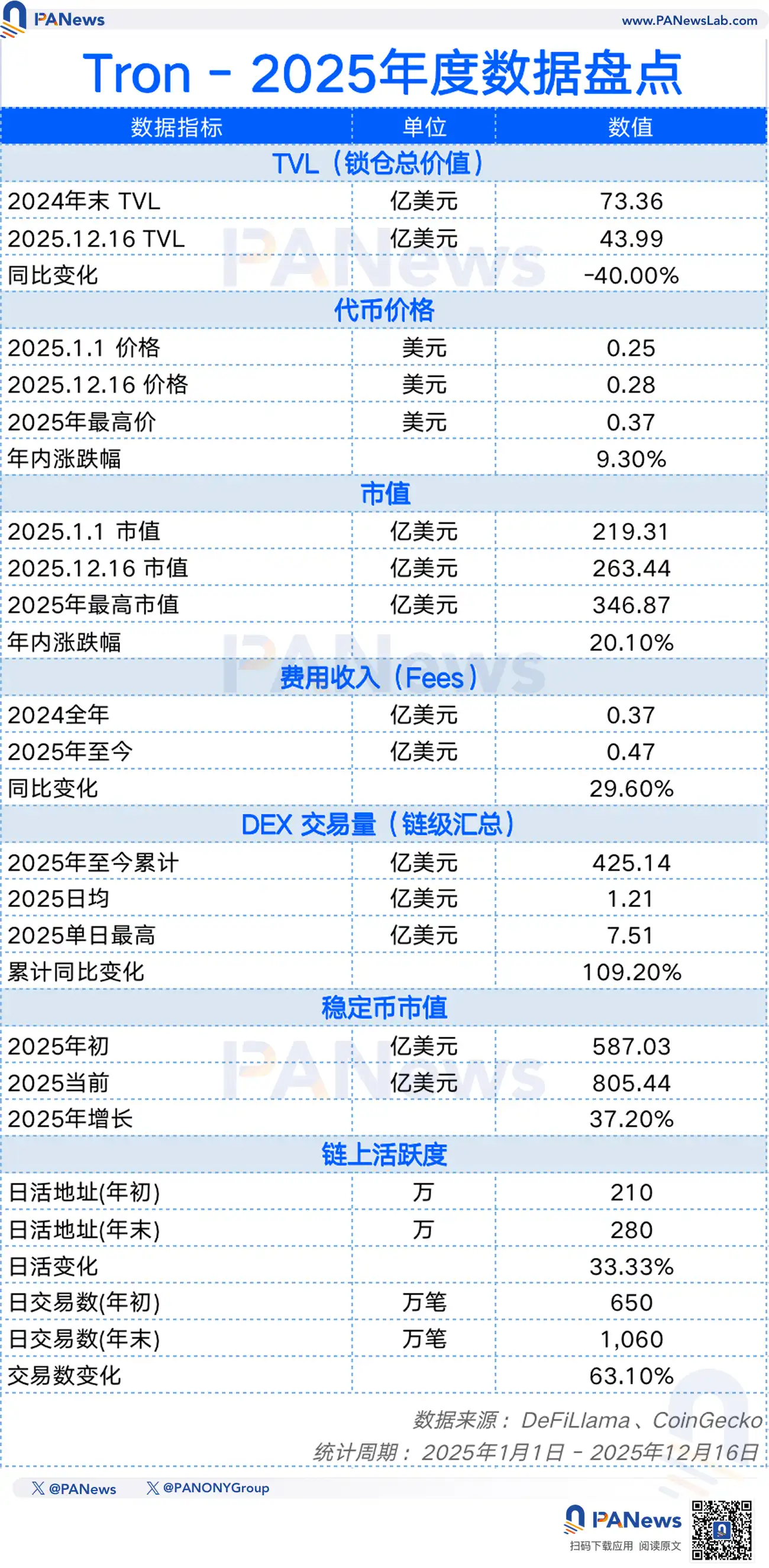
Among the统计 public chains, only BNB Chain (22%), Hyperliquid (14.2%), Tron (9.30%), and Mantle (3%) achieved price increases this year, while the rest declined.
However, the changes behind these two data points, TVL and price, are primarily influenced by changes in crypto market liquidity. Analyzing the ecological development indicators of public chains reveals a different picture.

Protocol Revenue Soars, Public Chains Collectively Enter a New "Revenue Generation" Phase

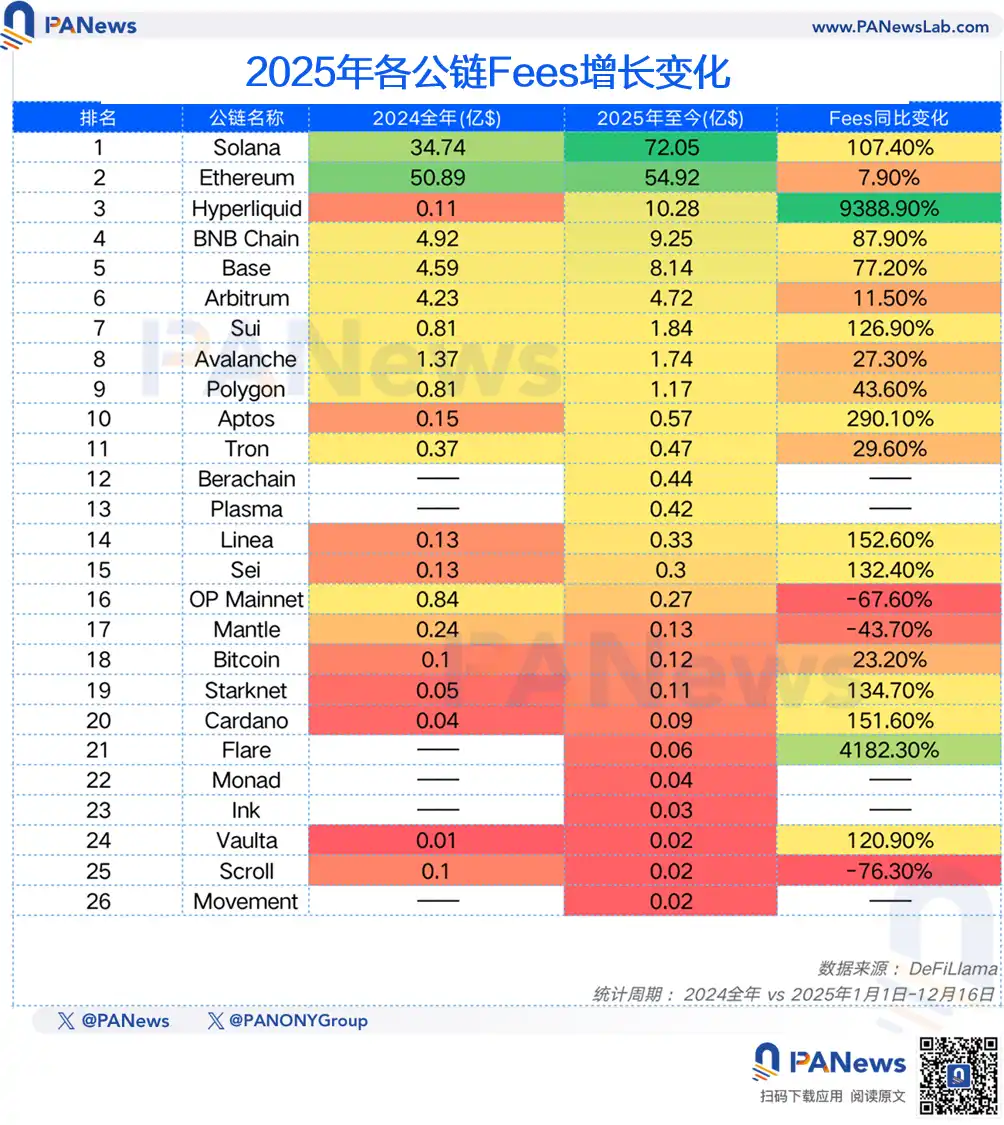
In terms of on-chain fee generation, the统计 public chains generated $10.4 billion in on-chain fees throughout 2024. In 2025, this figure grew to $16.75 billion, an overall increase of 60%. Moreover, except for OP Mainnet, Mantle, and Scroll, which saw declines in fees, all other public chains achieved growth in 2025.

The chain with the largest fee increase was again Hyperliquid (9388.9%), mainly because Hyperliquid had just launched at the end of 2024, so the initial base was small. Additionally, Solana's fees grew by 107%, BNB Chain by 77%, Sui by 126%, and Aptos by 290%. It can be said that the revenue-generating ability of mainstream public chains greatly improved in 2025.
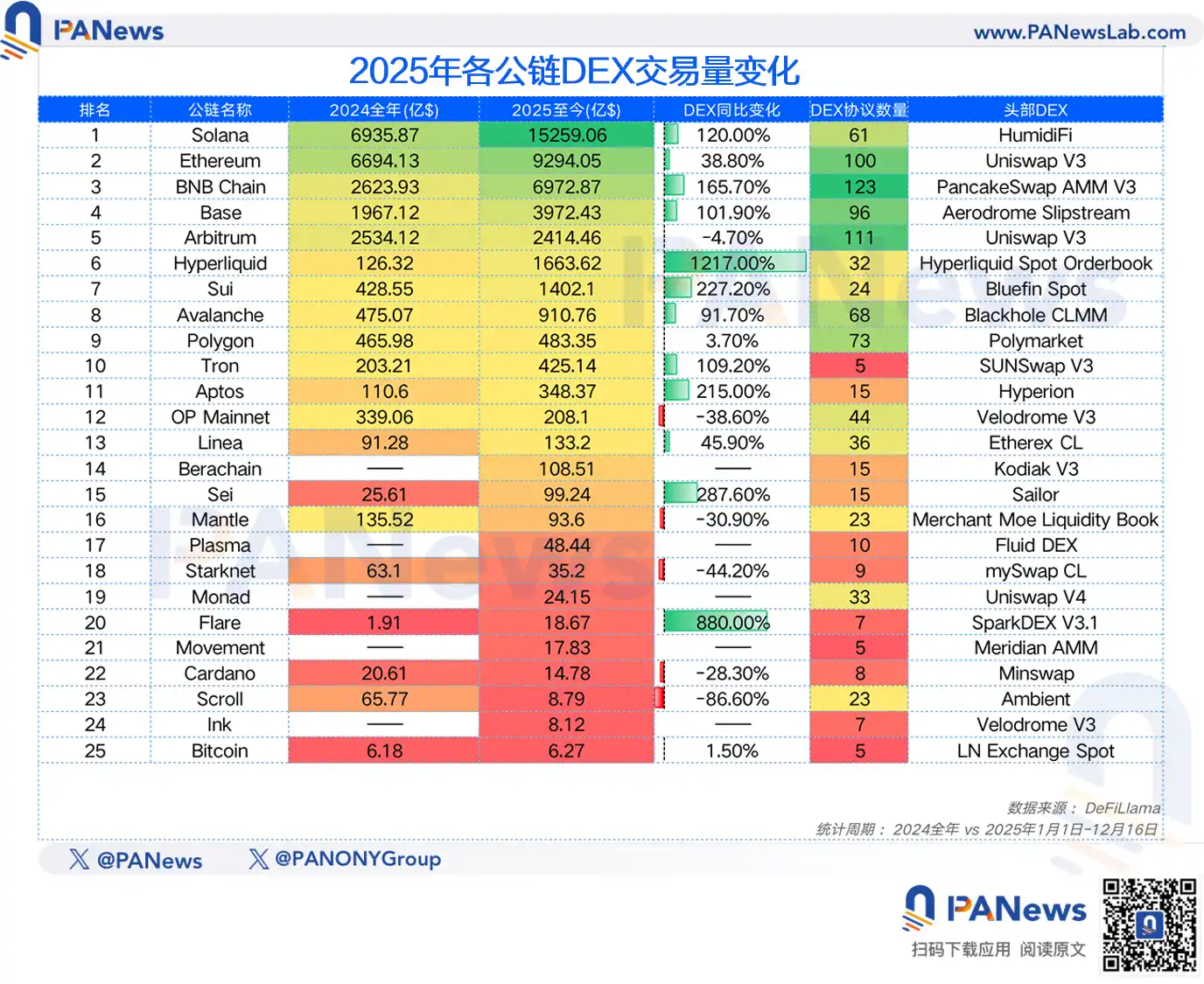
In addition, the trading volume on DEXs across various public chains also achieved an overall growth of 88%, with an average increase of 163%. Among them, Solana even completed its逆袭 against Ethereum, topping the list of chains with the highest trading volume at $1.52 trillion. BNB Chain also closely followed Ethereum with a trading volume of $697.2 billion and is highly likely to overtake Ethereum in 2026 as well.

Hyperliquid remained the fastest growing, with an annual DEX trading volume increase of 1217.00%, and Flare ranked second with an 880% increase.
When the "Airdrop Hunters" Disappear, New Public Chains Struggle with User Retention

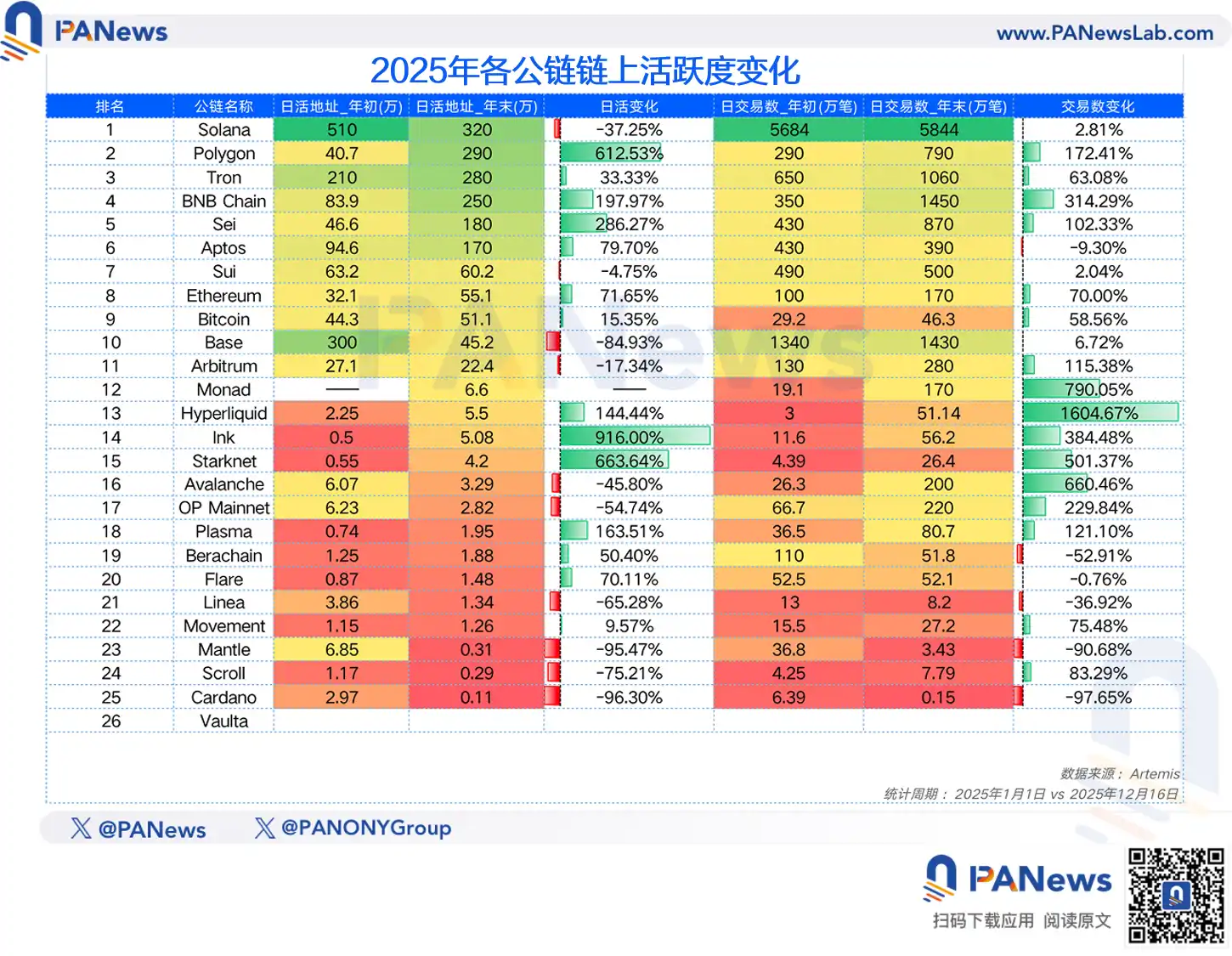
The situation with daily active data is mixed.

Overall, the number of daily active addresses on these public chains grew from 14.86 million to 17.6 million, an overall increase of 18%. Achieving such data performance amidst market低迷 can be considered a relatively positive signal.

On the other hand, chains like Solana, Base, and Sui, which in the past best represented retail investor activity, saw declines to varying degrees. Base's daily active addresses fell by 84.9% compared to the beginning of the year, and Solana's fell by 37%. Recently, however, Polygon's daily active address count saw exponential growth, reaching 2.9 million on December 19th, a 612% increase compared to the beginning of the year. Additionally, the daily active numbers of BNB Chain, Sei, Aptos, and other public chains also achieved significant growth.

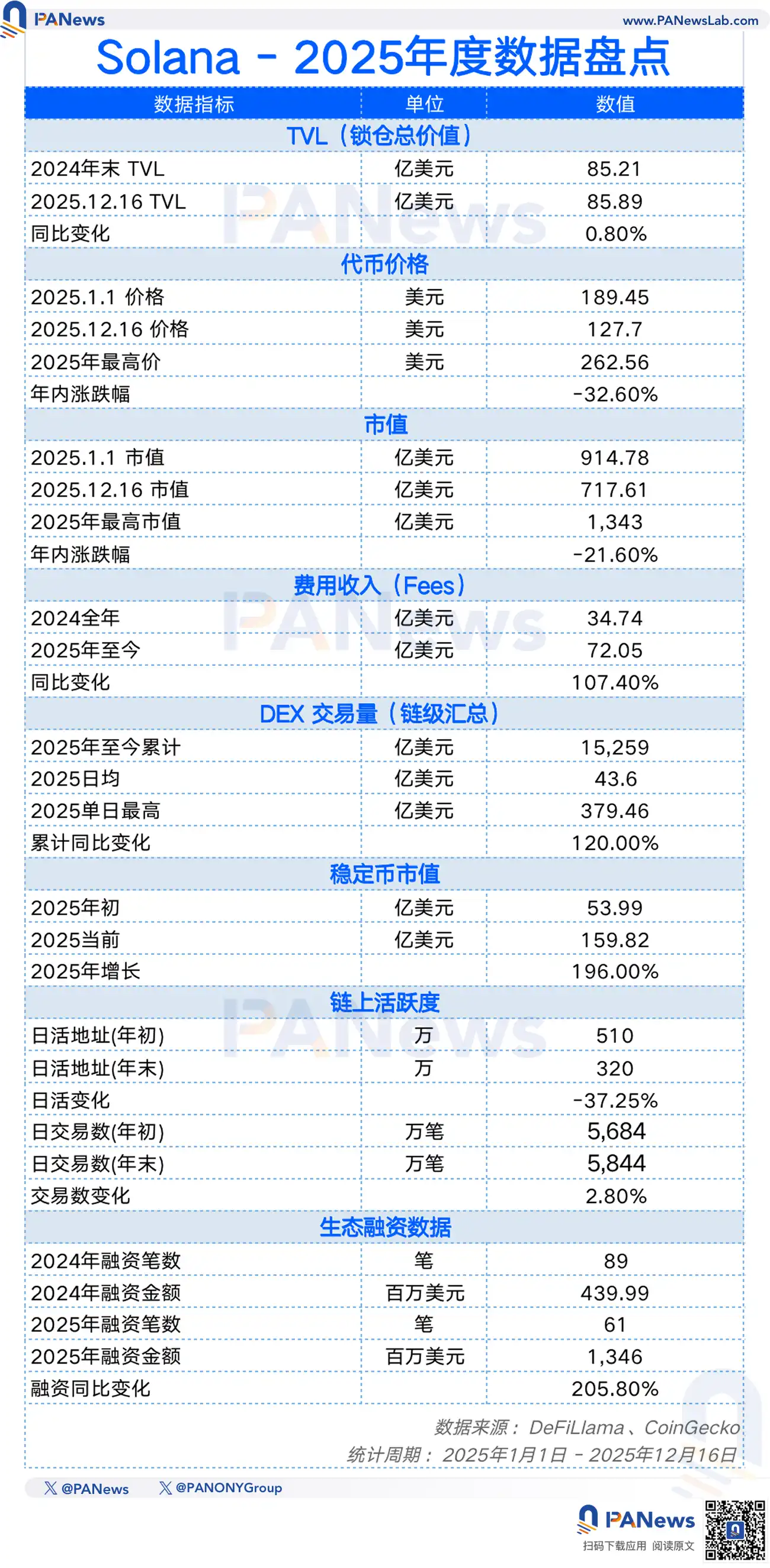
Furthermore, in terms of daily transaction count, the transaction volume of these public chains at the end of the year also achieved an overall growth of 33% compared to the beginning of the year. BNB Chain's data performance here is arguably the most impressive, growing from 3.5 million transactions at the beginning of the year to 14.5 million, outstanding in both scale and growth rate. Although Solana still leads far ahead with 58.44 million transactions, it only achieved a 2.8% growth for the year, showing signs of fatigue.
Stablecoins: The Only "Full Bull Market" of 2025

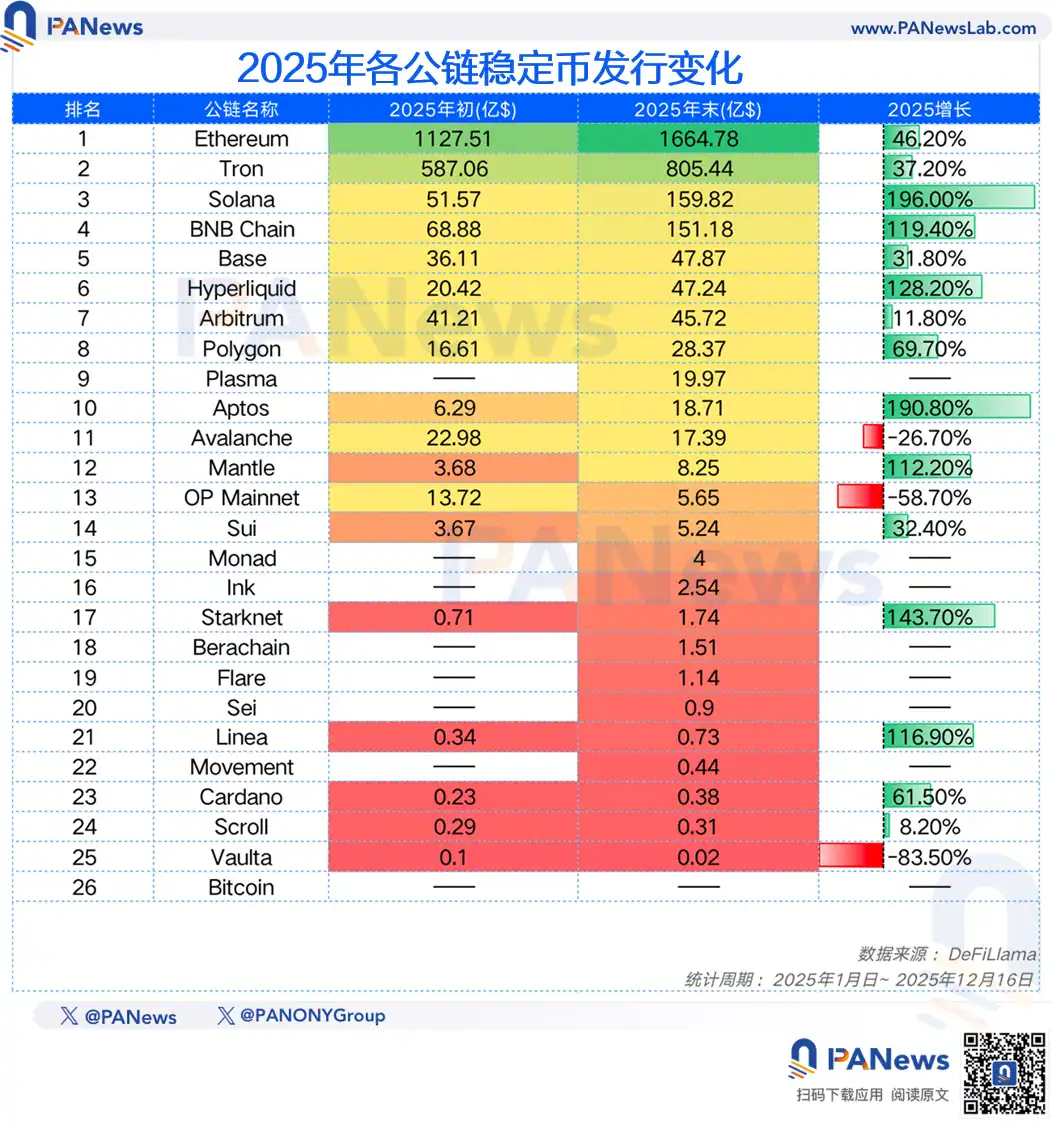
2025 was a year of全面爆发 for the stablecoin market, which is also reflected in public chain data. Compared to 2024, the stablecoin market capitalization on most public chains achieved substantial growth. The most outstanding performer was Solana, whose stablecoin market cap surged by 196% during the year, making it the public chain with the largest stablecoin growth. Ethereum and Tron, as the top two public chains for stablecoins, also maintained year-on-year growth of 46% and 37%, respectively. In addition, some actively performing public chains this year, such as BNB Chain and Hyperliquid, also achieved significant growth in stablecoins.
Ecosystem Financing: Polygon Wins with Star Projects, Ethereum and Solana Remain Hot

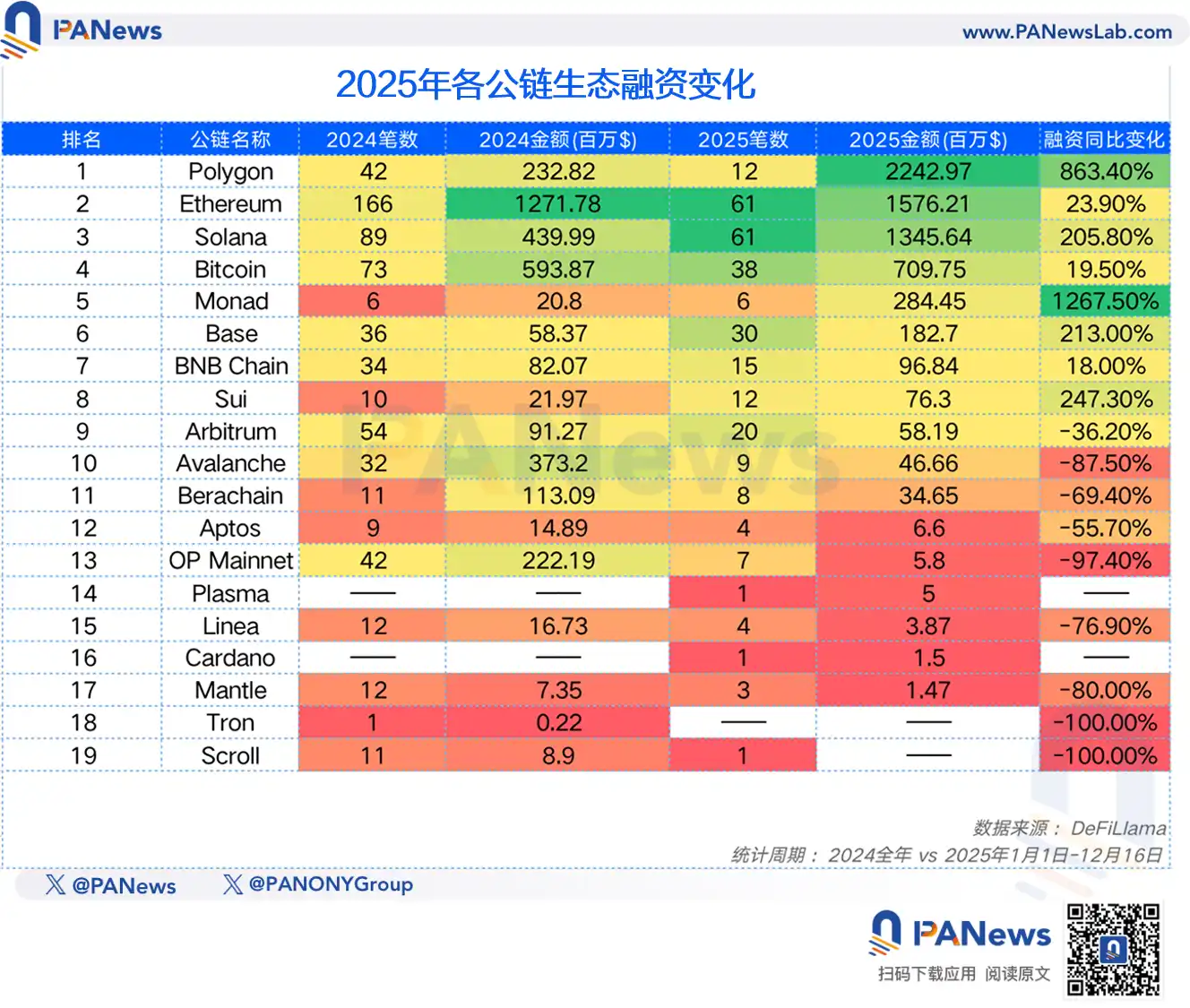
Another data dimension worth attention is financing. The crypto industry set new records in financing in 2025. PANews统计了 6710 financing cases and categorized these financing events according to their affiliated public chains for comparison. The results show that the number of financing deals on these public chains decreased significantly in 2025, from 640 to 293. However, the total amount increased from $350 million to $667 million, and the average financing amount per deal grew from $5.57 million to $22.79 million. This also indicates that it might be more difficult for small and medium-sized startup teams to secure financing in the current market, while capital is more willing to invest larger sums in some star projects.

In terms of public chain classification, Polygon became the financing leader with $2.24 billion, while Ethereum and Solana received $1.57 billion and $1.34 billion, respectively. However, Polygon's lead in financing is mainly due to Polymarket's massive financing of over $2 billion. Looking closely at the number of financing events, the main financing activities still occurred within the Ethereum, Solana, Bitcoin, and Base ecosystems.
Below is an analysis of several public chains of key market focus:

Ethereum: The Light Boat Has Passed Ten Thousand Heavy Mountains - A "Misalignment Period" of Fundamental Recovery and Stagnant Prices

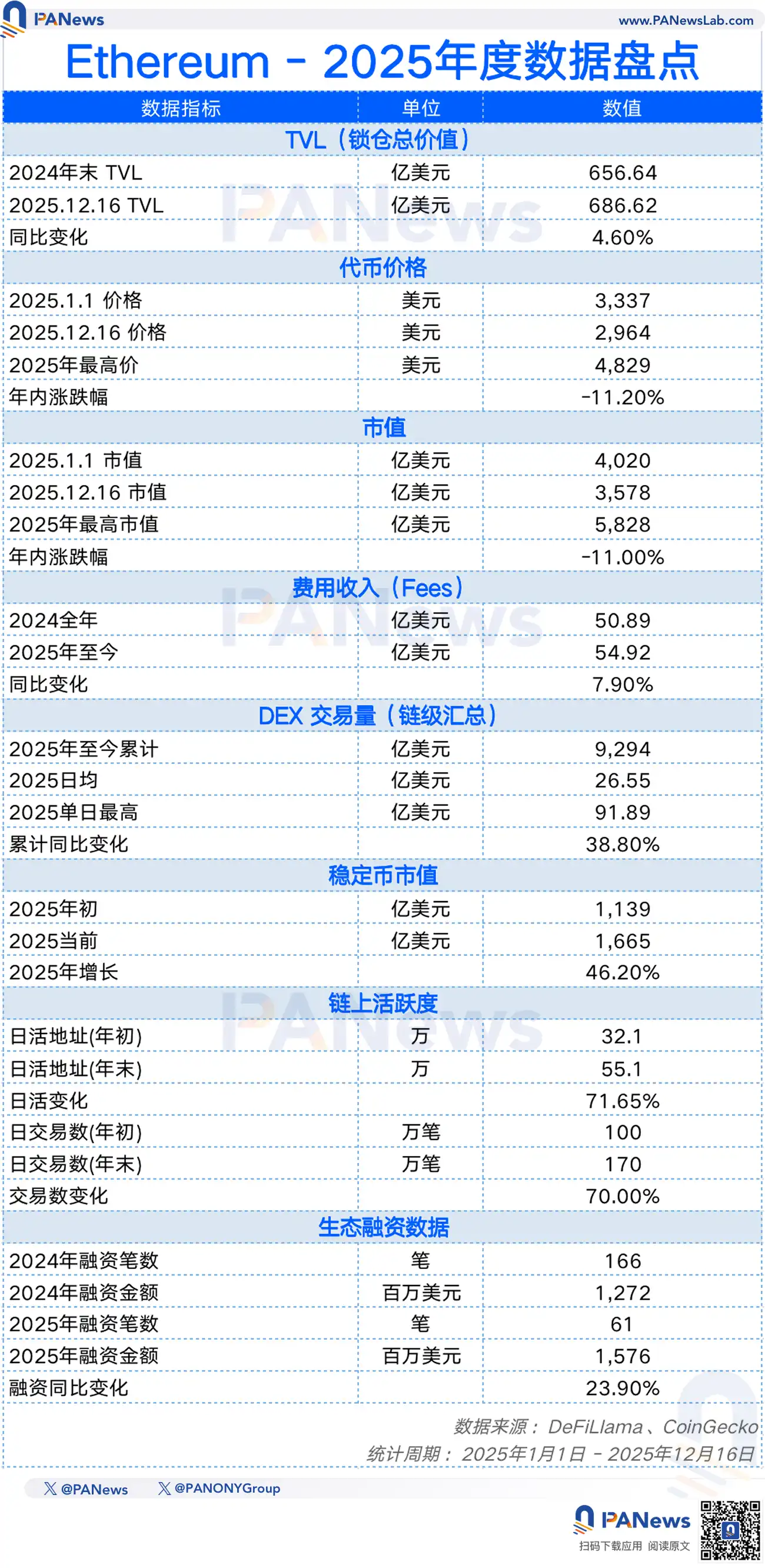
As the leading public chain, Ethereum's development in 2025 can be described as "the light boat has passed ten thousand heavy mountains." After experiencing生态数据停滞 in 2024 due to severe分流 by L2s and徘徊不前的 market prices, Ethereum actually saw good growth in ecological data in 2025, especially in DEX trading volume (38.8% growth), stablecoin market cap (46% growth), on-chain active addresses (71% growth), among others. Additionally, it still leads most public chains in terms of ecological financing events and amounts. From these indicators, the ecological development of the Ethereum mainnet recovered in 2025.

However, in terms of price and TVL data, it remained stagnant due to the impact of the overall market correction. Nevertheless, compared to other public chain tokens, Ethereum's price performance has shown relatively stronger resilience.
Solana: Rise and Fall with MEME, Vulnerability Revealed After the Prosperity Bubble Burst

Compared to 2024, Solana presented a different state in 2025: the ecological fragility exposed after major ups and downs. After the MEME market turned from boom to bust at the beginning of the year, Solana failed to develop more narratives. Instead, various launchpads continued to engage in intense competition within the MEME coin track. Therefore, although it achieved significant growth in fee capture and DEX trading volume during the year, token price, year-end active users, and transaction count saw severe declines. This also indicates that the market is voting with its feet; Solana's prosperity bubble seems to have burst.
BNB Chain: From Defense to All-Out Offense, the "Hexagonal Warrior" with Comprehensive Growth

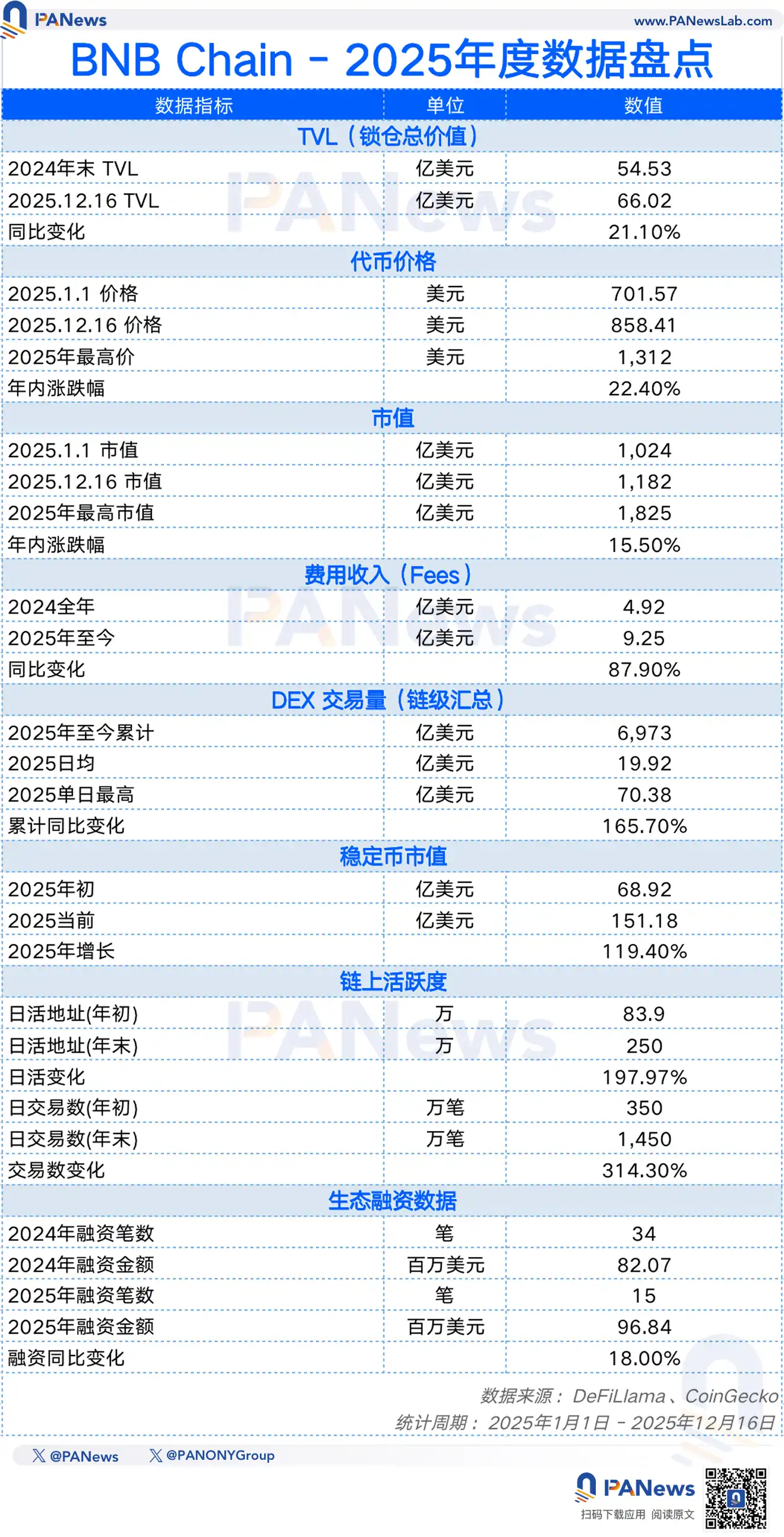
BNB Chain achieved全面爆发 in 2025, achieving positive growth in all统计 data dimensions. Especially in fee revenue, DEX trading volume, stablecoin market cap, and on-chain activity, the growth was almost over 100%. This is rare amidst the低迷 state of the entire public chain market.

Of course, such achievements are inseparable from Binance. From top executives like CZ actively participating in marketing, to launching Binance Alpha which has become a "required course" for many retail users seeking airdrops, to the new derivatives exchange Aster sniping at Hyperliquid. BNB Chain's counterattack from 2024 has turned into an all-out offensive, and this offensive is fierce. For all public chains, BNB Chain may have become an opponent that absolutely cannot be ignored.
Hyperliquid: The Dark Horse of the Year, Giving the Industry a Lesson with "Real Yield"

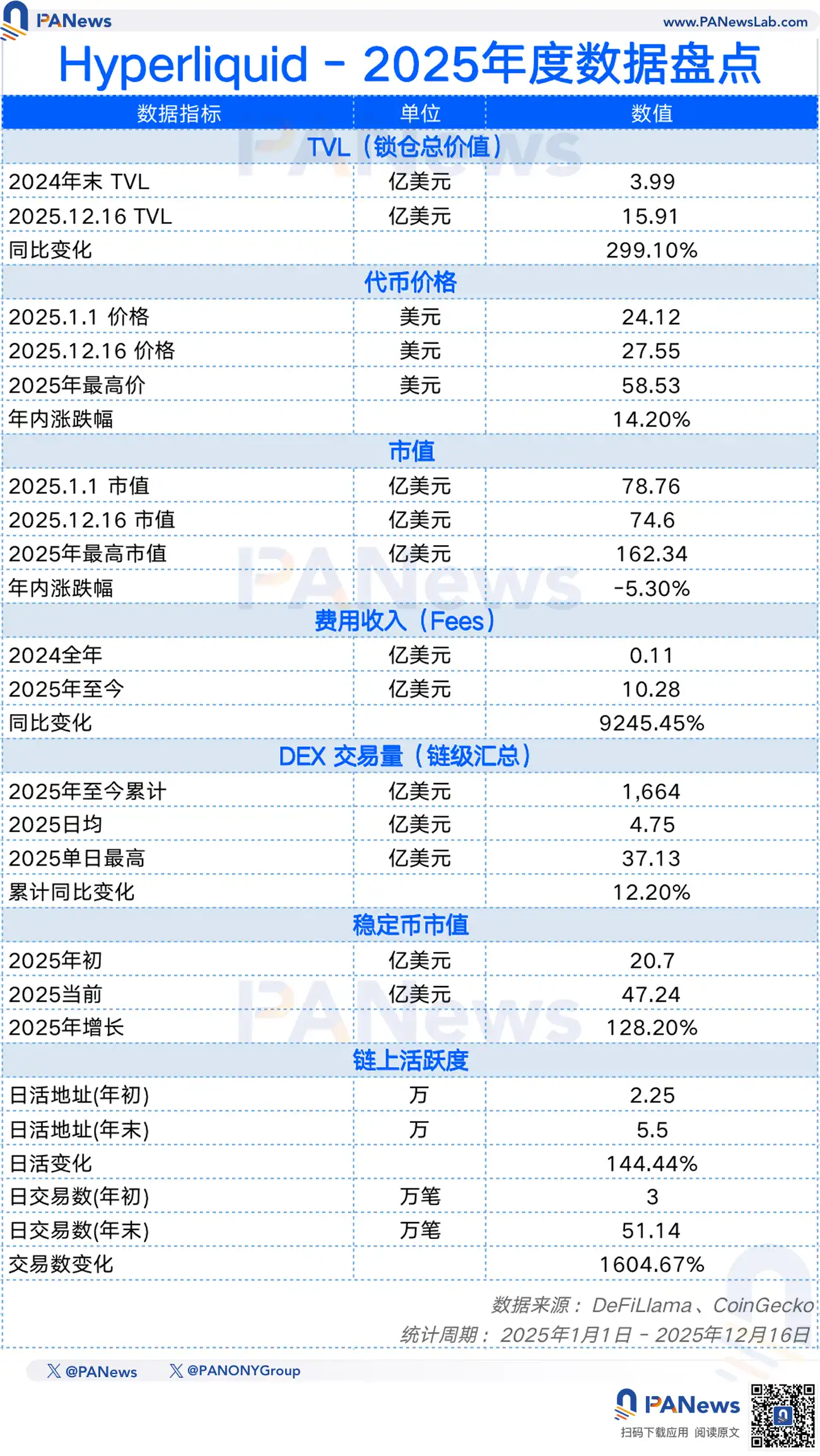
Similar to BNB Chain, Hyperliquid also shone brightly in 2025. Except for a slight decrease in market cap compared to the beginning of the year (-5.3%), all other data showed positive growth, and the increases in multiple data points were the largest among all public chains.

In 2025, Hyperliquid's TVL ranked 9th全网, fee generation amount ranked 3rd, DEX trading volume ranked 6th, and stablecoin market cap ranked 5th. Judging by the rankings of these indicators, Hyperliquid has become a veritable mainstream public chain. As a newcomer to this market, achieving such results is evidently very successful. Moreover, it was one of the very few public chains in 2025 that could sustain its entire ecosystem through real revenue without relying on inflationary incentives.

However, Hyperliquid has recently encountered strong competition from追赶者 like Aster and Lighter, whose trading volumes are already approaching. Unknowingly, Hyperliquid, which was still a challenger the previous year, might find its main theme for 2026 shifting to defending its擂台.
Sui: "Deep Squat" Under Unlock Pressure, Urgently Needs Reshaping After the Bubble Burst

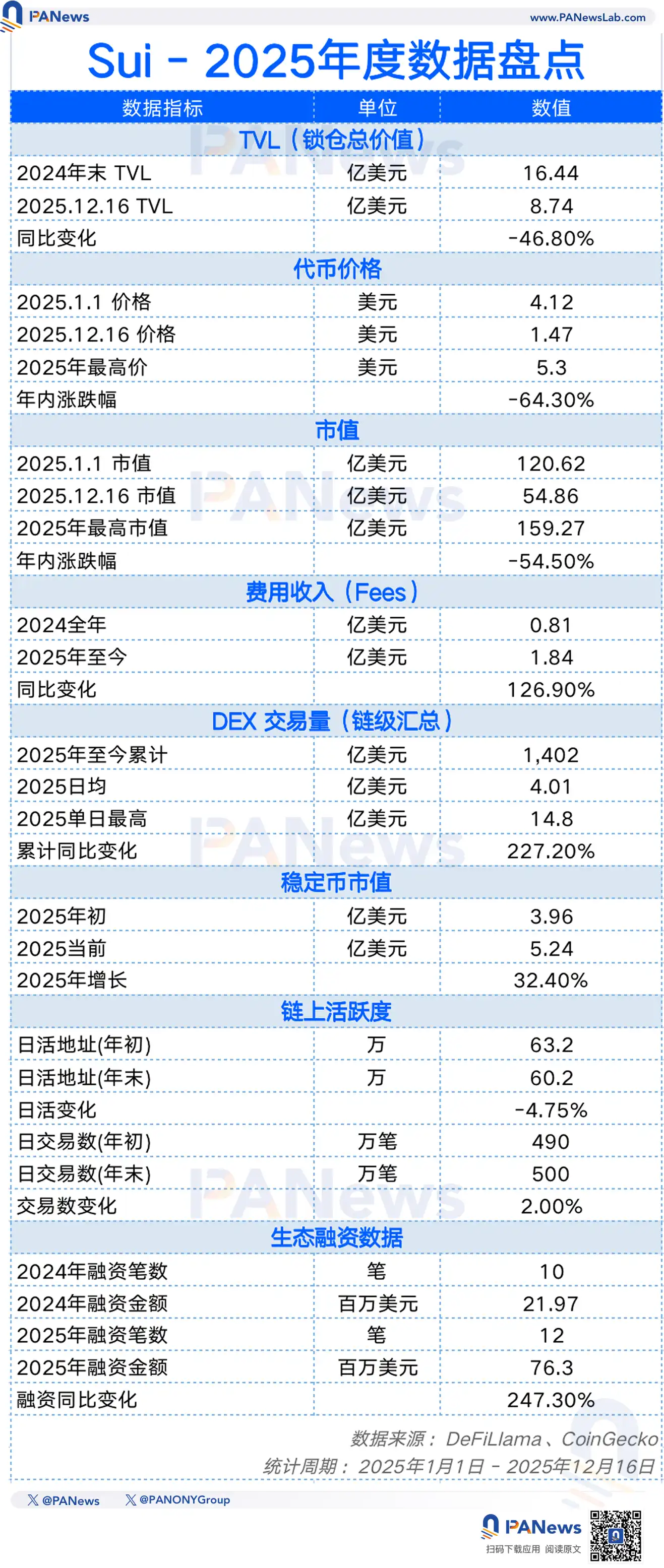
As an emerging public chain that strongly chased Solana and was highly anticipated by the market in 2024, Sui was relatively沉寂 in 2025. Among all mainstream public chains, Sui's token price decline (-64%) and TVL decline (-46.8%)显示出来自市场的压力. This is mainly attributed to Sui entering a "密集解锁期" in 2025. A large number of tokens from early investors and teams entered the market,叠加 the overall market cooling, putting pressure on the price.

At the same time, in terms of ecological activity, daily active data and daily transaction count were almost flat compared to the beginning of the year, also reflecting the root cause of Sui's沉寂 this year: a lack of new narratives, and failure to fully爆发 while following the MEME market. However, judging from the growth in financing amount and DEX trading volume, capital has not completely abandoned Sui in essence. 2026 might be a year of reshaping after the bubble bursts.
Tron: The Ultimate Pragmatist, the "Cash Flow King" Deeply Cultivating the Payment Track

Tron's development trajectory in 2025 established another narrative style for the public chain market: riding the tailwind of stablecoins to持续 "make money quietly." Although TVL and token price saw about half retracement, Tron, relying on the stable performance of the stablecoin market, still generated $184 million in on-chain fees (a 126.9% increase), and DEX trading volume expanded by 224%. For Tron, rather than chasing hot topics for new narratives, it's better to master the基本功 of global stablecoin settlement. This pragmatic attitude has also made it a public chain with stable cash flow and strong user stickiness.
Looking back at the public chain江湖 of 2025, this is not just an annual report card but also a众生相 of public chain development.
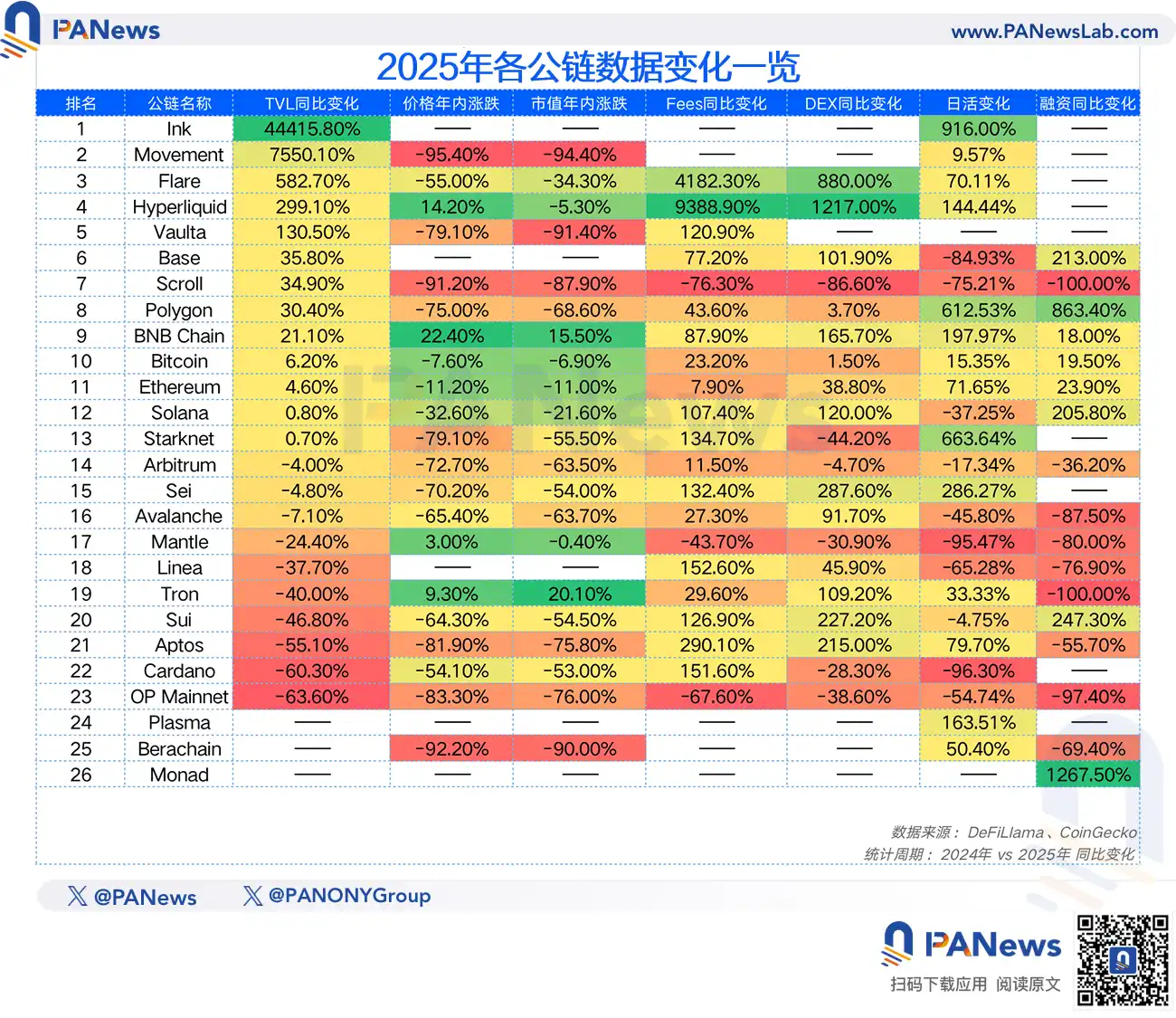
The red and black lists of data clearly tell us: the "thousands of horses galloping" era of the public chain track has ended, replaced by残酷的 "stock game" and "oligopolization" trends. Whether it's Solana's traffic anxiety after the MEME tide receded, Sui's price阵痛 under the pressure of token unlocks, or the惨烈破发 of new public chains like Movement and Scroll in the secondary market, it all proves that the false prosperity maintained by VC blood transfusions and积分 PUA is unsustainable.

However, amidst the full screen of declines, we can better see the evolution of the industry's resilience. BNB Chain's explosive growth across its entire ecosystem, Hyperliquid's reliance on极致 real yield, and Tron's pragmatic深耕 in the payment track collectively point to the survival rule for 2026: survival depends not on storytelling, but on making money; not on刷量, but on real users.

The chill of 2025 might be piercing, but it successfully squeezed out the泡沫 that had been附着 on public chains for years. For the upcoming 2026, we have reason to believe that on this cleaner, more pragmatic foundation, public chains will no longer be merely speculative casinos but will truly become global financial infrastructure承载大规模价值交换.


Criptomoedas em alta

Perguntas relacionadas

QWhich blockchain was the biggest winner in terms of TVL growth in 2025, and what was its growth rate?

AHyperliquid was the biggest winner in terms of TVL growth in 2025, with a growth rate of 299%.

QWhat was the overall trend for the average token price of the 26 major blockchains in 2025?

AThe average token price of the 26 major blockchains fell by 50% in 2025.

QWhich blockchain surpassed Ethereum to become the leader in DEX trading volume in 2025?

ASolana surpassed Ethereum to become the leader in DEX trading volume in 2025, with a total volume of $1.52 trillion.

QDespite a general market downturn, which area of the crypto market experienced a 'full-blown bull market' in 2025?

AThe stablecoin market experienced a 'full-blown bull market' in 2025, with most blockchains seeing significant growth in their stablecoin market capitalization.

QAccording to the article, what is the new survival rule for blockchains in 2026, as demonstrated by the success of BNB Chain, Hyperliquid, and Tron?

AThe new survival rule for blockchains, as demonstrated by BNB Chain, Hyperliquid, and Tron, is to survive not by storytelling but by generating real revenue and attracting genuine users, not by inflating metrics.

Leituras Relacionadas

After Three Consecutive Quarters of Decline, Can the Crypto Market Find a Window for Stabilization in Q3?

The cryptocurrency market has just concluded its worst-performing quarter since 2022, with total capitalization dropping 12.6% to $2.1 trillion. All core metrics indicate capital is leaving the sector, not just rotating within it. Bitcoin fell 14.2% and Ethereum dropped 25.4% in Q2, breaking their previous correlation with US tech stocks. A key driver is the reversal in US spot Bitcoin ETF flows, which saw a net outflow of approximately $4.67 billion in Q2, including a record monthly outflow near $4.5 billion in June. While recent data suggests long-term holders are accumulating again, sustained ETF outflows mean continued selling pressure. Market focus is now singularly on the Federal Reserve. The upcoming July FOMC meeting is seen as the most critical event for Q3. A dovish signal could support Bitcoin reclaiming a $68,000-$84,000 range, while a hawkish stance might establish a new trading band around $50,000-$56,000. Additionally, regulatory uncertainty persists, with the progress of the crucial *CLARITY Act* stalling in the Senate, reducing its perceived 2026 passage probability to 40-45%. Despite the broad downturn, a few sectors showed growth. Prediction markets saw nominal volume surge 48.7% year-over-year to $113.8 billion, and tokenized collectibles transaction volume rose 143% quarterly to $1.4 billion. The Real-World Asset (RWA) tokenization sector also continued steady growth, now representing ~$28.1 billion in on-chain value. The market's foundation for an extreme crash appears limited, with Bitcoin price hovering near its 200-week moving average. However, the trading paradigm has shifted from narrative-driven speculation to decisions based on price action, policy developments, and interest rate expectations, making a broad sentiment-driven rally unlikely in the near term.

marsbitHá 2h

After Three Consecutive Quarters of Decline, Can the Crypto Market Find a Window for Stabilization in Q3?

marsbitHá 2h

BIT Trading Moment: BTC Still Suppressed by Weekly 200 EMA, Rejection May Restart Decline; Storage and Semiconductors that Surged Last Night Begin Falling in Evening Trading

**Crypto & Stock Market Wrap: Bitcoin Tests Resistance, Stocks Retreat After AI Surge** Bitcoin consolidates around $66,000, facing key resistance near $68,000—an area seen as a major psychological and technical hurdle where previous rallies have failed. Analysts note the cryptocurrency is caught between its 200-week moving average (~$63,333) and 200-week EMA (~$68,328). A clear break above $68k is needed to signal a stronger bullish trend, while a rejection could lead to a retest of $63k support. Market sentiment remains cautious, with low futures open interest pointing to a low-liquidity rebound rather than a full bull market. Bitcoin spot ETFs saw another $203 million inflow. US stock futures pointed lower after a strong Tuesday session led by a massive rebound in semiconductors and memory stocks. The rally was fueled by renewed optimism about AI-driven hardware demand, with Micron, SanDisk, and SK Hynix surging. However, those gains reversed in pre-market trading. Super Micro Computer (SMCI) soared over 20% after hours on strong guidance and a record backlog. Other standouts included Rocket Lab and nuclear energy plays Oklo and X-Energy. Rising oil prices (Brent above $91) and climbing Treasury yields (10-year near 4.64%), however, are reigniting inflation concerns and acting as a headwind for equities. In Asia, markets were mixed. South Korea's KOSPI pared early gains to close slightly higher as semiconductor stocks like SK Hynix gave back initial surges. Japan's Nikkei edged lower as the yen hit a fresh 38-year low against the dollar, raising fears of potential market intervention. Key events to watch include the Samsung Galaxy launch, AMD's AI event, and a slew of major tech earnings from Alphabet, Tesla, and IBM after the close on Wednesday, followed by the ECB meeting and Intel's earnings on Thursday.

marsbitHá 2h

BIT Trading Moment: BTC Still Suppressed by Weekly 200 EMA, Rejection May Restart Decline; Storage and Semiconductors that Surged Last Night Begin Falling in Evening Trading

marsbitHá 2h

Former CFTC Chairman, Circle President Tarbert: Preaching Long-Termism While Cashing Out $30 Million Himself

Former CFTC Chairman and Circle President Heath Tarbert has consistently advocated for a long-term vision in public, urging patience from investors as Circle’s stock price has fallen significantly from its peak. However, it has been revealed that since Circle’s IPO, Tarbert has continuously sold his CRCL shares through pre-arranged trading plans, cashing out approximately $30 million, without making any public market purchases. This contrast between his public messaging and personal actions has drawn criticism. Tarbert joined Circle in July 2023 as Chief Legal Officer, leveraging his regulatory experience to help guide the company through its IPO and expansion. Despite promoting stablecoins as long-term infrastructure, he established a 10b5-1 trading plan just before Circle went public, leading to substantial stock sales over the following year. In March 2026, he initiated another plan to sell more shares. His career trajectory highlights a pattern of moving between high-level regulatory roles and influential positions in the financial sector. After resigning as CFTC Chairman in early 2021, he joined Citadel Securities as Chief Legal Officer just 27 days later, during a period of intense regulatory scrutiny for the firm. He later joined Circle, aiding its efforts to navigate regulatory challenges for its public listing. While Tarbert's expertise in policy and compliance is valuable to companies like Circle, his actions—advocating long-term confidence while personally divesting—raise questions about the alignment between his public statements and his private financial decisions, leaving investors who followed his advice to bear the market risks.

marsbitHá 2h

Former CFTC Chairman, Circle President Tarbert: Preaching Long-Termism While Cashing Out $30 Million Himself

marsbitHá 2h

Gate Research Institute: The 'Wall Street-ization' Wave of Crypto Financial Products – Competition or Integration?

The article titled "Gate Research Institute: Are Crypto Financial Products Sparking a 'Wall Street' Wave—Competition or Convergence?" explores the evolving relationship between the crypto ecosystem and traditional finance (TradFi). The piece begins by reflecting on Bitcoin's original 2009 vision of decentralization, disintermediation, and moving away from banks. It then contrasts this with the 2024 landscape, where key crypto assets like Bitcoin are increasingly held through Wall Street products like ETFs issued by giants like BlackRock. The article questions whether this signifies that TradFi is systematically taking over the rights to issue, price, custody, and distribute crypto financial assets. The core argument is that this is not a zero-sum takeover but rather a bidirectional convergence where each side addresses the other's weaknesses. Crypto offers 24/7 global markets, programmable settlement, and open access but lacks compliant channels, institutional-grade custody, deep fiat liquidity, and mainstream distribution. TradFi possesses these but is constrained by legacy systems, limited operating hours, and slow settlement. Two primary convergence paths are highlighted: * **Path A (CEX to TradFi):** Exemplified by Gate, which has progressed from offering tokenized stocks and CFDs to providing direct, real stock trading (US, Hong Kong, South Korea) within its platform, using USDT. * **Path B (TradFi to Crypto):** Exemplified by Robinhood, which has integrated crypto trading, acquired exchanges like Bitstamp, and is moving traditional assets like stocks onto the blockchain via tokenization and its own Layer 2. Both paths are ultimately competing to become the next-generation, unified financial account—a "super account" where users can seamlessly trade cryptocurrencies, stocks, ETFs, RWA (Real World Assets), and tokenized treasury products in one interface. The growth of RWA and tokenized treasuries (e.g., BlackRock's BUIDL) is presented as the asset-layer fusion, providing stable, yield-bearing assets on-chain and acting as a bridge between the two worlds. In conclusion, the "Wall Street-ization" of crypto is framed as a mutual transformation. Decentralized ideals persist in the protocol layer, while at the application layer, a more efficient, global, and accessible unified capital market is emerging from this convergence. The future competition lies not between crypto exchanges and stockbrokers, but between platforms vying to offer the most comprehensive asset coverage, liquidity, and user experience within a single account.

marsbitHá 2h

Gate Research Institute: The 'Wall Street-ization' Wave of Crypto Financial Products – Competition or Integration?

marsbitHá 2h

Trading

Spot

Artigos em Destaque

Como comprar O

Bem-vindo à HTX.com!Tornámos a compra de O1 exchange (O) simples e conveniente.Segue o nosso guia passo a passo para iniciar a tua jornada no mundo das criptos.Passo 1: cria a tua conta HTXUtiliza o teu e-mail ou número de telefone para te inscreveres numa conta gratuita na HTX.Desfruta de um processo de inscrição sem complicações e desbloqueia todas as funcionalidades.Obter a minha contaPasso 2: vai para Comprar Cripto e escolhe o teu método de pagamentoCartão de crédito/débito: usa o teu visa ou mastercard para comprar O1 exchange (O) instantaneamente.Saldo: usa os fundos da tua conta HTX para transacionar sem problemas.Terceiros: adicionamos métodos de pagamento populares, como Google Pay e Apple Pay, para aumentar a conveniência.P2P: transaciona diretamente com outros utilizadores na HTX.Mercado de balcão (OTC): oferecemos serviços personalizados e taxas de câmbio competitivas para os traders.Passo 3: armazena teu O1 exchange (O)Depois de comprar o teu O1 exchange (O), armazena-o na tua conta HTX.Alternativamente, podes enviá-lo para outro lugar através de transferência blockchain ou usá-lo para transacionar outras criptomoedas.Passo 4: transaciona O1 exchange (O)Transaciona facilmente O1 exchange (O) no mercado à vista da HTX.Acede simplesmente à tua conta, seleciona o teu par de trading, executa as tuas transações e monitoriza em tempo real.Oferecemos uma experiência de fácil utilização tanto para principiantes como para traders experientes.

167 Visualizações TotaisPublicado em {updateTime}Atualizado em 2026.06.29

Como comprar O

Como comprar PROS

Bem-vindo à HTX.com!Tornámos a compra de Pharos (PROS) simples e conveniente.Segue o nosso guia passo a passo para iniciar a tua jornada no mundo das criptos.Passo 1: cria a tua conta HTXUtiliza o teu e-mail ou número de telefone para te inscreveres numa conta gratuita na HTX.Desfruta de um processo de inscrição sem complicações e desbloqueia todas as funcionalidades.Obter a minha contaPasso 2: vai para Comprar Cripto e escolhe o teu método de pagamentoCartão de crédito/débito: usa o teu visa ou mastercard para comprar Pharos (PROS) instantaneamente.Saldo: usa os fundos da tua conta HTX para transacionar sem problemas.Terceiros: adicionamos métodos de pagamento populares, como Google Pay e Apple Pay, para aumentar a conveniência.P2P: transaciona diretamente com outros utilizadores na HTX.Mercado de balcão (OTC): oferecemos serviços personalizados e taxas de câmbio competitivas para os traders.Passo 3: armazena teu Pharos (PROS)Depois de comprar o teu Pharos (PROS), armazena-o na tua conta HTX.Alternativamente, podes enviá-lo para outro lugar através de transferência blockchain ou usá-lo para transacionar outras criptomoedas.Passo 4: transaciona Pharos (PROS)Transaciona facilmente Pharos (PROS) no mercado à vista da HTX.Acede simplesmente à tua conta, seleciona o teu par de trading, executa as tuas transações e monitoriza em tempo real.Oferecemos uma experiência de fácil utilização tanto para principiantes como para traders experientes.

160 Visualizações TotaisPublicado em {updateTime}Atualizado em 2026.06.29

Como comprar PROS

O que é VERONA

I. Introdução ao Projeto VERONA é uma blockchain construída para todos, em todo o lado, através da abstração da cadeia. Utilizando a sua camada de Abstração Generalizada, a VERONA distingue-se por integrar funcionalidades complexas de blockchain, como contas, assinaturas e interoperabilidade, diretamente ao nível do protocolo. Esta abordagem permite a interação com aplicações de blockchain sem a necessidade de compreender as tecnologias subjacentes.1) Informação Básica Nome: VERONA (VERONA)III. Links Relacionados Link do site oficial: https://xion.burnt.com/ Whitepaper: https://xion.burnt.com/whitepaper.pdf Exploradores: https://explorer.burnt.com/ Mídias Sociais: https://x.com/burnt_xion Nota: A introdução ao projeto provém dos materiais publicados ou fornecidos pela equipa oficial do projeto, que é apenas para referência e não constitui aconselhamento de investimento. A HTX não se responsabiliza por quaisquer perdas diretas ou indiretas resultantes.

778 Visualizações TotaisPublicado em {updateTime}Atualizado em 2026.06.22

O que é VERONA

Discussões

Bem-vindo à Comunidade HTX. Aqui, pode manter-se informado sobre os mais recentes desenvolvimentos da plataforma e obter acesso a análises profissionais de mercado. As opiniões dos utilizadores sobre o preço de A (A) são apresentadas abaixo.

活动图片













