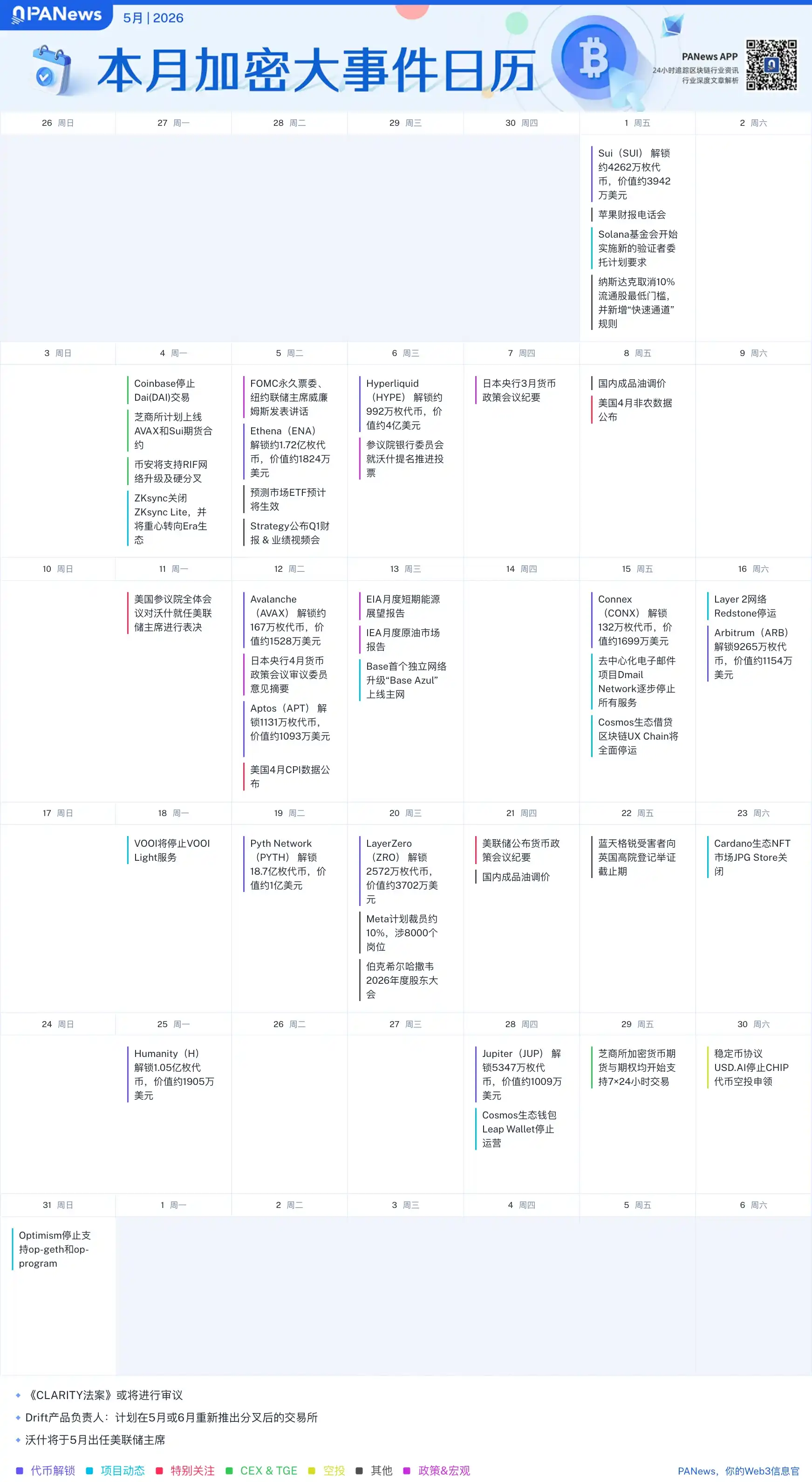
PA图说 | 一图了解2026年5月Web3大事件

marsbitPublicado em 2026-05-01Última atualização em 2026-05-01

覆盖更全、灵活筛选、导出方便,欢迎体验 PANews 新版加密日历👇

点击查看日历

5月的加密市场,宏观政策审议、代币解锁、项目升级等密集交织,核心看点:

📌 美国4月非农、CPI数据公布,美联储货币政策会议纪要发布,宏观预期与市场风险偏好继续博弈

🏛 沃什美联储主席任命进程进入关键阶段;《CLARITY法案》或将进入审议

🪙 SUI、ENA、HYPE等多个代币迎来密集解锁,已披露规模合计约超6.7亿美元

🚀 项目方面,芝商所计划上线AVAX和Sui期货合约;预测市场ETF预计将生效

🔧 基础设施与生态持续调整,Solana、ZKsync、Base等迎来验证者机制、网络升级及服务支持变化

⚠️ 多个项目关停:Dmail Network、UX Chain、Leap Wallet等服务将陆续停运

政策、宏观、解锁与项目出清同步推进,5月市场或继续在流动性预期、监管进展与生态轮动中寻找新方向。

全球焦点事件汇聚,锁定2026年5月Web3核心脉络,就看这一张!

Leituras Relacionadas

The Value Distribution of Stablecoins

**Summary: The Value Distribution of Stablecoins** The article argues that stablecoins are evolving from mere trading tools into broader channels for dollar access. It divides the stablecoin ecosystem into four layers to analyze how value is distributed: 1. **Issuance Layer:** Mints stablecoins, holds reserve assets, and captures the spread between reserve yield and user costs (e.g., Tether, Circle). This layer currently earns the largest profit margin. 2. **Infrastructure Layer:** Connects stablecoins to the traditional financial system, handling fiat on/off-ramps, banking integration, compliance (KYC/AML), and asset management (e.g., Bridge, BVNK). This is the "unglamorous" but critical work, building the essential bridges between crypto and real-world finance. 3. **Acquiring/Distribution Layer:** Integrates stablecoins into merchant systems, manages payment flows, and provides enterprise financial software (e.g., Stripe, Coinbase). They act as the access point for businesses. 4. **Application Layer:** The end-users and businesses that ultimately use stablecoins for payments, settlements, or as a store of value. They benefit from convenience but have little pricing power. The core thesis is that while the issuance layer currently dominates profits, the often-overlooked **infrastructure layer holds significant long-term potential**. The real challenge and barrier to mass adoption is not the on-chain transfer of stablecoins (which is simple), but the complex "last mile" integration into existing business workflows, banking systems, and regulatory frameworks across different countries. Companies in this layer are currently in a "land grab" phase, investing heavily to build networks, secure bank partnerships, and establish compliance pathways. While their position is currently pressured by the profitable issuers above and distribution platforms below, the article suggests that if stablecoins become a default financial rail for businesses, the infrastructure providers who have done the hard work of integration will ultimately gain strong pricing power and become entrenched, essential players.

marsbitHá 5h

The Value Distribution of Stablecoins

marsbitHá 5h

The Value Distribution of Stablecoins

The Value Distribution of Stablecoins The article argues that stablecoins are evolving from a mere trading tool into a broad "dollar channel." It analyzes the industry's value chain through four layers: 1. **Issuance Layer (e.g., Tether, Circle):** The top layer that mints stablecoins, holds reserve assets, and captures the thickest interest rate spread. 2. **Infrastructure Layer (e.g., Bridge, BVNK):** Connects stablecoins to the traditional financial system, handling critical but complex "dirty work" like fiat on/off-ramps, banking integration, compliance (KYC/AML), and cross-border settlement. 3. **Acquiring/Distribution Layer (e.g., Stripe, Coinbase):** Embeds stablecoins into merchant systems, manages payment flows, and integrates with enterprise software. 4. **Application Layer:** End-users and businesses that ultimately use stablecoins for payments, settlement, or storing value. The author posits that while the issuance layer currently captures the most profit, the most overlooked and potentially critical layer is infrastructure. The core challenge for stablecoin adoption isn't the on-chain transfer (which is simple), but bridging the gap between blockchain and the real-world financial system. This involves solving practical problems for businesses: fiat conversion, reconciliation, tax handling, and user onboarding. Infrastructure companies are currently in a difficult "land-grab" phase—building networks, securing banking relationships, and achieving compliance country-by-country. They face pressure from both the profitable issuance layer above and distribution platforms below. However, the author suggests this layer is building a crucial moat. Once stablecoins become a default business rail, the infrastructure players who have done the hard work of integration may gain significant, durable value and pricing power.

链捕手Há 5h

The Value Distribution of Stablecoins

链捕手Há 5h

Trading

Spot
Futuros
活动图片