Overseas Funds Accelerate Withdrawal, U.S. Bonds Face Largest Selling Pressure in Six Years

marsbitPublicado em 2026-03-25Última atualização em 2026-03-25

Resumo

Overseas official investors are accelerating their withdrawal from U.S. Treasuries, with foreign official accounts at the New York Fed shedding $75 billion over the past four weeks—the largest monthly decline since the COVID-19 pandemic hit in March 2020. According to Deutsche Bank research, this implies net sales of approximately $60 billion, marking the most significant sell-off since the pandemic began. The sell-off is particularly concentrated in the mid-term segment of the yield curve, contributing to recent rapid yield rises. Unlike in March 2023, the drawdown was not offset by increased use of the Fed’s FIMA repo facility, indicating outright sales or non-reinvestment of maturing securities. The drop in custody holdings aligns with observed FX intervention by Asian central banks and a broader slowdown in foreign purchases of dollar assets. Historical correlation suggests custody data explains about 50% of the variation in official net flows reported in TIC data. Deutsche Bank warns that sustained foreign selling could erode the “convenience yield” advantage enjoyed by U.S. debt due to its reserve currency status. Estimates suggest the 10-year yield may be suppressed by 90–100 basis points due to dollar dominance. A continued retreat of foreign demand could push long-term yields significantly higher, increasing refinancing costs and affecting global financial conditions.

Author: Bu Shuqing

Source: Wall Street Insights

The U.S. bond market is facing potential selling pressure from overseas official investors, a development that has raised high alert in the market.

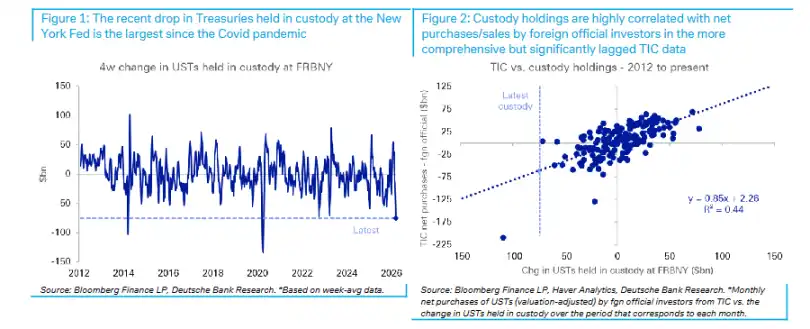
According to the Trading Desk, a research report released by Deutsche Bank on March 23 shows that the U.S. bond holdings of foreign official accounts custodied at the New York Fed plummeted by $75 billion over the past four weeks, marking the largest monthly decline since the impact of the COVID-19 pandemic in 2020. Based on historical data models, this change implies that foreign official investors actually net sold approximately $60 billion in U.S. bonds, also the largest since the pandemic.

This data aligns with the recent sharp rise in U.S. bond yields, particularly the abnormal upward movement in mid-term (belly) yields—a segment where foreign official investors' holdings are concentrated. Deutsche Bank warns that if overseas demand continues to shrink, the "convenience yield" advantage of U.S. bonds will be eroded, posing a substantive upside risk to long-term yields.
Custody Data Reveals Selling Signals

The most authoritative data source for tracking the movements of foreign official investors in U.S. bonds is the U.S. Treasury's TIC (International Capital Flows) report, but this data has significant lag—the March data will not be available until mid-May at the earliest.

As an alternative indicator, the New York Fed's weekly H.4.1 report includes a memorandum entry recording the face value of securities custodied for foreign official and international accounts, with a lag of only one day. Deutsche Bank strategists Matthew Raskin, Steven Zeng, and Andrew Fu noted in the report that the latest H.4.1 data shows, based on weekly averages, that the U.S. bond holdings of foreign official custodied accounts fell by $75 billion over the past four weeks, not only the largest decline since March 2020 but also the second-largest single-week drop in the past decade.

Notably, unlike a similar situation in March 2023, the scale of FIMA repo operations did not rise simultaneously this time, indicating that this round of reduction was due to direct sales or non-renewal at maturity, rather than liquidity financing through repo operations with the Fed. Foreign reverse repos, foreign official deposits, and FIMA securities lending also showed little change over the past month.

High Correlation Between Custody Data and TIC Data

To what extent can custody holding data represent the overall changes in U.S. bond holdings by foreign official investors? Deutsche Bank conducted a systematic verification.

The report shows that over the past 15 years, the correlation between changes in custody holdings and the net purchases by foreign officials in TIC data has been significant, with the former explaining about 50% of the latter's changes. Even when shortening the sample to post-2019 to eliminate potential interference from changes in reserve management models, this relationship remains robust.

Based on this historical relationship, a $75 billion decline in custody holdings corresponds to a net sale of approximately $60 billion by foreign official investors. Deutsche Bank pointed out that this would be the largest net sale by foreign official accounts since the COVID-19 pandemic; to find a comparable case, one would need to go back to December 2018.

Shift in Capital Flows Amid Foreign Exchange Intervention

The decline in U.S. bond custody holdings is highly consistent with recent market dynamics observed by Deutsche Bank's foreign exchange strategy team.

According to a previous report by Deutsche Bank's foreign exchange strategy team, despite the outbreak of the Iran war and soaring oil prices, the U.S. dollar failed to strengthen as expected, partly due to large-scale foreign exchange interventions by several Asian central banks. Meanwhile, the team's high-frequency ETF monitoring data also showed a significant slowdown in foreign investors' purchases of U.S. dollar assets.

The combination of these two clues leads to a conclusion: foreign official investors are reducing their allocation to U.S. dollar assets, and the sale of U.S. bonds is a direct manifestation of this trend.

Sustained Selling Could Push Long-Term Yields Up by Over 100 Basis Points

Deutsche Bank's analysis reveals a structural concern: U.S. bond yields have long benefited from the "convenience yield" brought by the U.S. dollar's reserve currency status, and this advantage is now being tested.

The report cites previous Deutsche Bank research, indicating that the current 10-year U.S. bond yield is more than 100 basis points lower than the reasonable level implied by the U.S. net international investment position (NIIP). Another recent academic working paper estimated that the U.S. dollar's reserve currency status keeps long-term U.S. interest rates about 90 basis points lower than "normal levels."

Deutsche Bank warns that if foreign demand continues to decline, this convenience yield will face regression pressure, and the term premium and overall yield of U.S. bonds will have substantive upside space, posing a direct impact on investors holding U.S. bonds.


Perguntas relacionadas

QWhat does the sharp decline in foreign official holdings of U.S. Treasuries at the New York Fed indicate, according to Deutsche Bank's report?

AIt indicates that foreign official investors have been net selling approximately $60 billion in U.S. Treasuries over the past four weeks, marking the largest net selling since the COVID-19 pandemic began.

QHow does the recent movement in U.S. Treasury yields, particularly in the belly of the curve, relate to the actions of foreign official investors?

AThe abnormal rise in mid-term (belly) Treasury yields is corroborated by the sell-off, as foreign official investors' holdings are concentrated in that specific maturity segment.

QWhy is the H.4.1 report from the New York Fed used as a proxy for tracking foreign official investor activity, and what is its key advantage?

AThe H.4.1 report is used because the official TIC (Treasury International Capital) data has a significant publication lag. The key advantage of the H.4.1 data is that it is updated weekly with only a one-day lag.

QWhat two key market dynamics observed by Deutsche Bank's FX strategy team point towards foreign official investors reducing their dollar asset allocations?

AThe two dynamics are: 1) Large-scale FX interventions by several Asian central banks, which prevented the dollar from strengthening as expected, and 2) A noticeable slowdown in foreign investors' purchases of U.S. dollar assets, as shown by high-frequency ETF flow data.

QWhat is the 'convenience yield' of U.S. Treasuries, and what is the potential impact if foreign demand continues to decline?

AThe 'convenience yield' is the advantage U.S. Treasuries enjoy due to the dollar's reserve currency status, which has been estimated to suppress long-term yields by over 100 basis points. If foreign demand declines persistently, this premium could erode, leading to a substantial rise in term premiums and overall yields.

Leituras Relacionadas

Not Speculation but a Necessity: The 4 Unique Values of Prediction Markets

Polymarket's recent $4 billion funding round and soaring valuation of $15 billion highlight the explosive growth of prediction markets, with trading volume reaching $25.7 billion in March 2026—a 10.6% monthly increase. This analysis argues that prediction markets serve critical non-speculative functions, positioning them as essential tools rather than mere gambling platforms. Prediction markets offer four unique values: entertainment consumption, insurance-like protection, risk hedging, and truth discovery. Firstly, they stimulate economic activity by engaging users in event-based betting, similar to the broader sports industry. Secondly, they act as a form of decentralized insurance, allowing users to hedge against specific, well-defined risks (e.g., weather events) transparently and without traditional overhead costs. Thirdly, institutions and individuals use these markets to hedge against geopolitical and commodity price risks, as demonstrated during the U.S.-Iran conflict and the launch of 24/7 commodity markets on platforms like Kalshi. Finally, prediction markets counter media bias by aggregating crowd-sourced information, often achieving 30% higher accuracy than surveys due to users' vested interests. Experts like Bitwise’s Jeff Park and SIG’s Jeff Yass emphasize the markets' role in risk transfer and financial innovation. As these platforms evolve, they are poised to become trillion-dollar markets, offering more reliable, decentralized mechanisms for information pricing and risk management.

marsbitHá 2h

Not Speculation but a Necessity: The 4 Unique Values of Prediction Markets

marsbitHá 2h

Trading

Spot
Futuros
活动图片